Skip to content

Tag: Writing

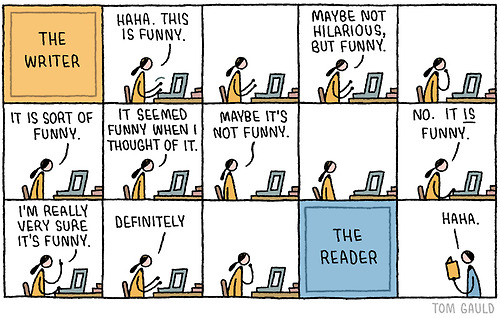
It Seemed Funny When I Thought of It

Haha This is Funny
Haha.

Tom Gauld.

Comments closed

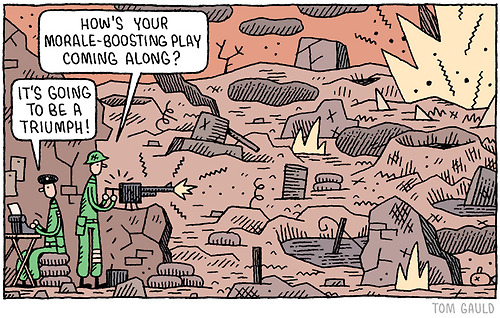
Morale

morale
In light of my previous post about how awful being a writer is, Tom Gauld‘s latest cartoon for The Guardian seems strangely appropriate…

Comments closed

Writing and the Cost of Living

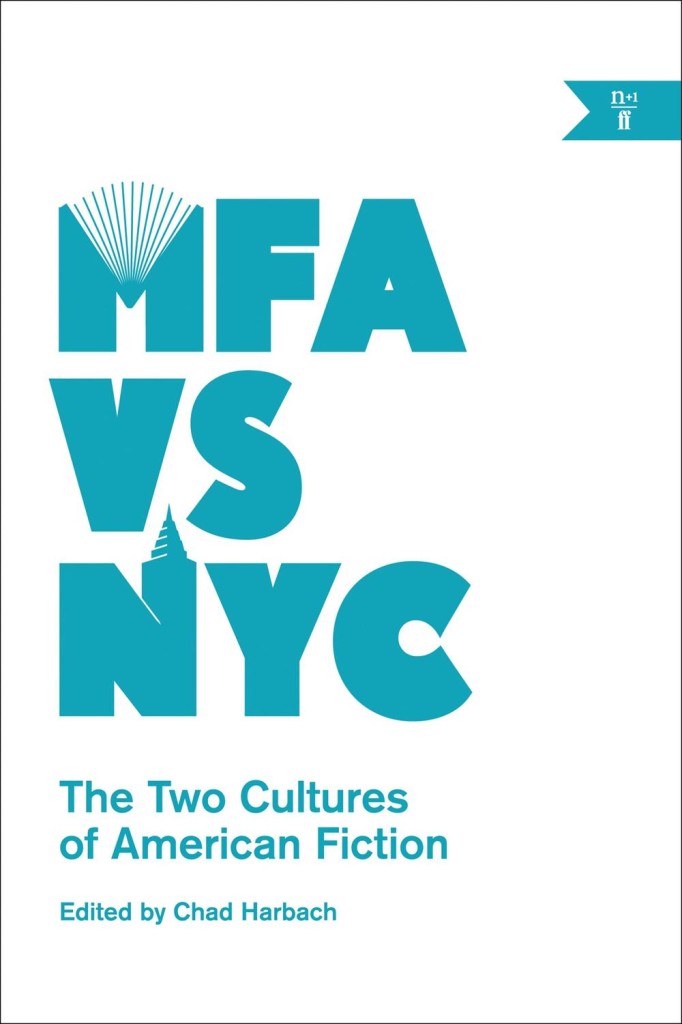
mfc_vs-nyc

I finally just got around to reading Emily Gould‘s spiralling essay on writing and debt ‘How much my novel cost me‘ over the weekend. It’s an excerpt from the new n+1 book MFA vs NYC edited by Chad Harbach (author of The Art of Fielding), which seems like it could be essential reading for idealistic folks wishing to pursue writing as a career:

IT’S HARD TO WRITE ABOUT BEING BROKE because brokeness is so relative; “broke” people run the gamut from the trust-funded jerk whose drinks you buy because she’s “so broke right now” to the people who sleep outside the bar where she’s whining. But by summer 2012 I was broke, and in debt, and it was no one’s fault but mine. Besides a couple of freelance writing assignments, my only source of income for more than a year had come from teaching yoga, for which I got paid $40 a class. In 2011 I made $7,000.

During that $7,000 year I also routinely read from my work in front of crowds of people, spoke on panels and at colleges, and got hit up for advice by young people who were interested in emulating my career path, whose coffee I usually ended up buying after they made a halfhearted feint toward their tote bag–purses. I felt some weird obligation to them and to anyone else who might be paying attention to pretend that I wasn’t poor. Keeping up appearances, of course, only made me poorer. I’m not sure what the point of admitting all this might be, because I know that anyone who experiences a career peak in his mid-twenties will likely make the same mistakes I did, and it’s not even clear to me that they were all mistakes, unless writing a book is always a mistake, which in some sense it must be.

Interestingly, Robert McCrum touches on the financial difficulties of older authors in an article for this weekend’s The Observer

To writers of my generation, who grew up in the age of Penguin books, vinyl records and the BBC, it’s as if a cultural ecology has been wiped out. For as long as most of us can remember, every would-be writer knew the landscape of the printed word. This Georgian square was home to publishing grandees (now retired). On that high street were the booksellers (now out of business). In those twisting back streets, you could expect to find literary agents working the margins with the injured innocence of pickpockets at a synod. It was a mutually dependent ecosystem.

Publishers were toffs, booksellers trade and printers the artisan champions of liberty. Like the class system, we thought, nothing would change. The most urgent deadline was lunch. How wrong we were. The years 2007-2010 are pivotal: first… came the credit crunch. And it occurred at the very moment that the IT revolution was wrecking the livelihoods of those creative classes – film-makers, musicians and writers of all sorts – who had previously lived on their copyrights.

Gould is self-recriminating. McCrum — a former editor-in-chief at Faber and Faber — is nostalgic for a time I don’t remember (things were always better in the ‘old days’ in publishing circles). For Gould the internet is a double-edged sword — a platform and a distraction — for McCrum it has brought nothing but woe. Both seem to agree, however, that nobody is making any money, “marketing types” are awful (aren’t they though?), and being a writer is not all it’s cracked up to be…
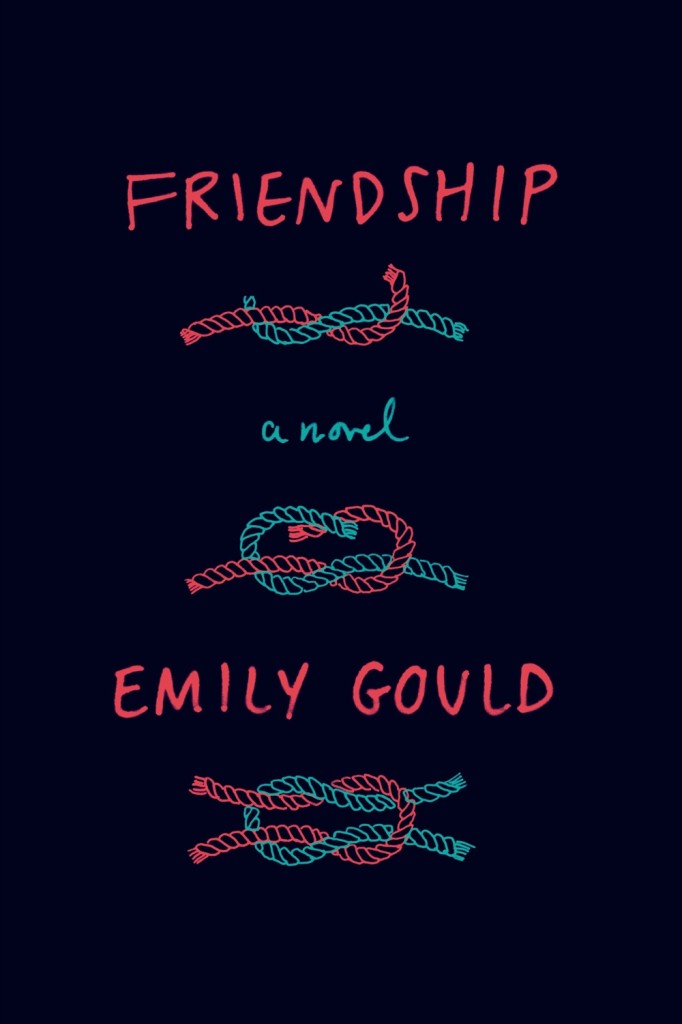
friendship_gould

Coincidently, Emily Gould’s new novel Friendship will be published in the US and Canada by Farrar, Straus & Giroux on July 1 (and a couple of days later in the UK by Virago). I’m not sure who designed the cover, but it is rather nice.

(NB: FSG, and n+1 / Faber & Faber are distributed in Canada by my employer Raincoast Books)

UPDATE: Leslie Jamison, author of the forthcoming essay collection The Empathy Exams (published by Graywolf Press, also distributed in Canada by Raincoast — sorry), reviews MFA vs NYC  for The New Republic:

Writers throughout these essays face the shame of privilege and the specter of poverty: They join magazine mastheads to keep from going broke, or they teach to keep from going broke, or else they actually do go broke—they’re broke in Brooklyn and broke in Los Angeles. Eli Evans evokes his years living in a “warehouse on Pico and Fourth” in one perfect image, one of the most remarkable moments in the entire collection: “I once found a baby rattlesnake strangled with electrical wire and tied to a signpost.” This baby rattlesnake, apparently, is what dreams become…
1 Comment

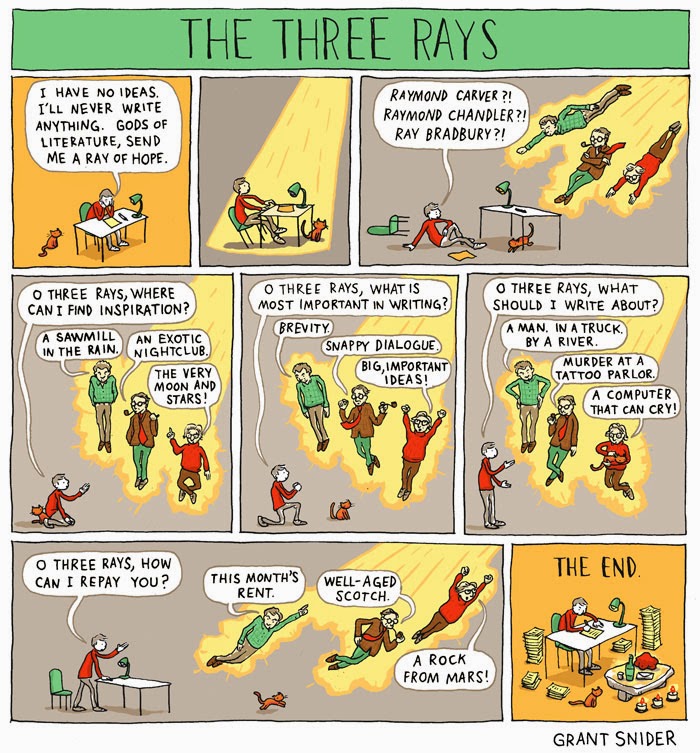
The Three Rays by Grant Snider

threerays-blog

Grant Snider’s latest comic for the New York Times Book Review.

Comments closed

Eve Babitz: Muse and Writer

Lili Anolik on the stranger-than-fiction life of Eve Babitz, “an irresistible hybrid of boho intellectual and L.A. party girl”, for Vanity Fair:

Eve Babitz’s claims to fame rest, in large measure, on her claims on the famous. She’s the goddaughter, of course, of one of the most influential composers of the 20th century. Then there’s that photograph of the chess match with Marcel Duchamp, Eve contemplating her next move without so much as a fig leaf for cover. And what about the series of Adams, better known than the original, some of them, to whom she offered her forbidden fruit? Jim Morrison, Steve Martin, Ed Ruscha, J. D. Souther, Stephen Stills, Glenn Frey, Harrison Ford, Warren Zevon, Ahmet Ertegun all took a bite at one time or another.

If that were her whole story, however, Eve wouldn’t be a whole story. She’d be a footnote. A minor figure of glamour in America’s cultural history. A groupie with a provocative pedigree. She’d be Edie Sedgwick, basically: so relentless a companion to celebrity that she became a bit of one herself, the spotlight just naturally spilling over onto her, making her luminous, too. But she’s not. Eve is Edie cut with Gertrude Stein and a little Louise Brooks thrown in.

Why?… Eve could write.

(pictured above: Eve Babitz, chessboard, and Marcel Duchamp, photograph by Julian Wasser, 1963)

Comments closed

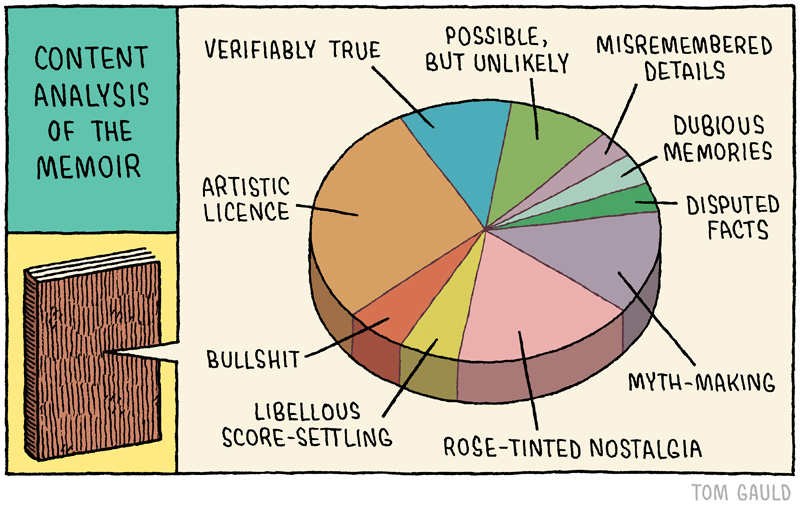
Content Analysis of the Memoir by Tom Gauld

memoir-tom-gauld
Tom Gauld

(My memoir will be largely myth-making, dubious memories, and bullshit. Maybe some artistic license too… )

Comments closed

Rachel Kushner on Images

Author Rachel Kushner discusses her novel The Flamethrowers (now out in paperback), and the importance of images to her work, with The Quietus:

I’m inspired by visual art and film… Whether or not I’m writing about those mediums directly, as I sometimes do in Flamethrowers, I’m always thinking about images… I always wanted to have images in a book, and with [The Flamethrowers], after I got to have my choice of the image on the North American cover, I got a little bold, and asked about putting images inside. My editor said yes, so I quickly put together a short list of ideal visual passages. I didn’t want anything that would illustrate the narrative. I wanted, instead, images as kind of pauses, or counterpoints, but that would complicate, function in a relation, but not an obvious one. There’s a Richard Prince image, and he’s a shadow presence over the course of the book (one of the characters is also the name of Prince’s alter-ego, John Dogg). There’s a photograph by Aldo Bonasia, of a riot and police tear-gassing the rioters, in Italy. There’s a still from the movie Wanda, which figures in the book…

Funnily enough, I have feeling that Scribner have actually stuck closer to the hardcover for the front of the US paperback edition and slapped needless award stickers all over it, but I prefer the restraint of the version above left. The cover on the right is the UK paperback — a vast improvement on that mystifying hardcover).

Comments closed

Miriam Markowitz: ‘Here Comes Everybody’

I am very late to this, but Miriam Markowitz’s article for The NationHere Comes Everybody‘, on women and book publishing in 2013, is well worth reading:

More nuanced fiction that isn’t of an obvious commercial genre—much of which is written by women—often brushes up against the literary. Publishers have various terms for the books that straddle this line. One of the ugliest and yet most useful is “upmarket.” The writers who may be lumped in this category are diverse in their output and their ambitions.

One commercial editor told me that many of her writers once cherished literary aspirations, but that they’re comfortable in the “upmarket” category, in part because it’s more lucrative. “If you cash in on the monetary market, you won’t get prestige. A lot of writers are OK with that.” Few writers have control over their covers, let alone the way their books are marketed, but if an agent or publisher says that this lacy dress or that whispery veil might entice more readers, who are they to object? Readers of literary fiction, especially women, will buy commercial titles as well. But the phenomenal popularity of Fifty Shades of Grey or the Twilight series or Nora Roberts among women who do not specifically identify as “readers” suggests that the reverse is less true. It’s hard to blame women writers for trying their hand at the commercial market when the literary one is so inhospitable.

For writers of work that is unambiguously ambitious, this choice is more difficult in that it may not be an option at all.

Comments closed

Homo Sapiens Solitarius by Tom Gauld


Tom Gauld.

Comments closed

Triumph of the English Major

Book editor Gerald Howard had lovely op-ed in this weekend’s New York Times called ‘Triumph of the English Major’:

Almost any cultural transaction involving a sum of money represents, as Samuel Johnson famously said of second marriages, the triumph of hope over experience. We live in a time when college enrollment in the humanities is declining precipitously, in good part because majoring in such subjects seems unlikely to result in gainful employment in a strapped economy and thus would be a waste of hard-earned (or usuriously borrowed) tuition dollars.

Somehow our culture has persuaded itself that the naked quest for financial gain, often through the devising and trading, on monstrous amounts of (very low interest) borrowed money, of what Warren Buffett has called instruments of mass destruction, is a more urgent and honorable calling than the passionate pursuit of truth and beauty.

I’ve tried to suggest that at least a portion of that pursuit can have gratifying economic results. (Plus it will not plunge us into an endless recession!) But that’s not really the point. The point is truth and beauty, without which our lives will lack grace and meaning and our civilization will be spiritually hollowed out and the historical bottom line will be that future epochs will remember us as a coarse and philistine people who squandered our bottomlessly rich cultural inheritance for short-term and meaningless financial advantage.

Read it. It’s a wonderful thing (and I’m not even an English Major).

Comments closed

Tom Gauld: Four Obstacles to Writing


Nothing in the bank. Yep.

Comments closed

Rachel Kushner and the Radical Gesture


Boris Kachka (Hothouse) profiles Rachel Kushner, author of The Flamethrowers, for New York magazine:

It’s tempting to ask just how transgressive a novel, especially a best-selling novel, can be—and whether taking a stand against mainstream values makes you subversive or just modern. In other words: Is Kushner the flamethrower for real?

The answer is, basically, yes, in both senses of the phrase: She knows what she writes about, and she’s dead serious about her ideals. There’s plenty of room in The Flamethrowers for the dark side of that idealism—murdered businessmen, casually discarded girlfriends, movements warped by violence. In many ways it’s the subject of the book. But if something ardent and glamorizing blazes through, like the flashy World War I brigade of the title, that’s because Kushner herself is a believer, a genuine and unself-conscious exponent of what she might call the radical gesture—even if those gestures are more common now among academics and art stars than any genuine underclass. In a forthcoming interview with Tin House, she calls her shimmering mosaic of a second novel a “paean, maybe, to things that have long interested me. Nothing is in the book that I had to learn about. Instead, it is filled with things I already knew … drawn from my taste, my life, my sensibility.”

The paperback edition of The Flamethrowers is out in February 2014.

Comments closed