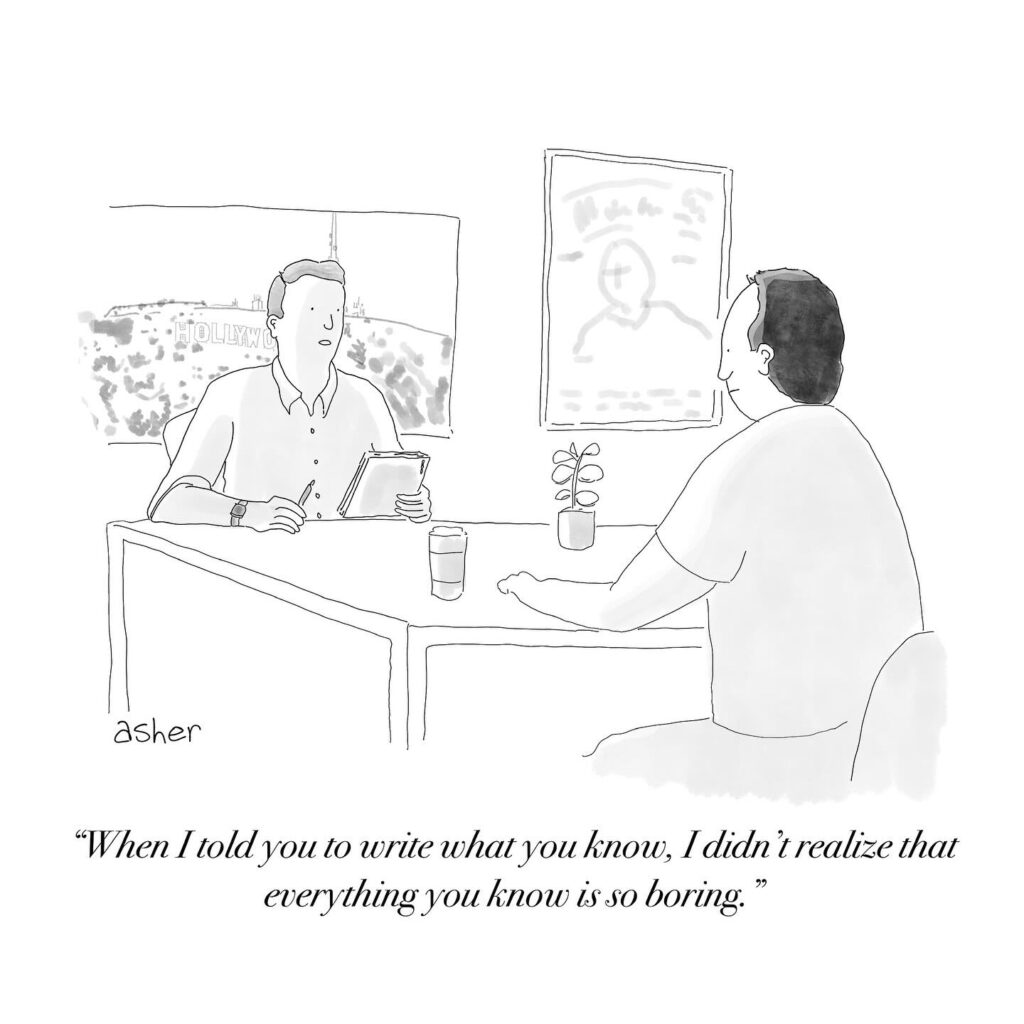
This is pretty much why I don’t write anything I don’t have to.
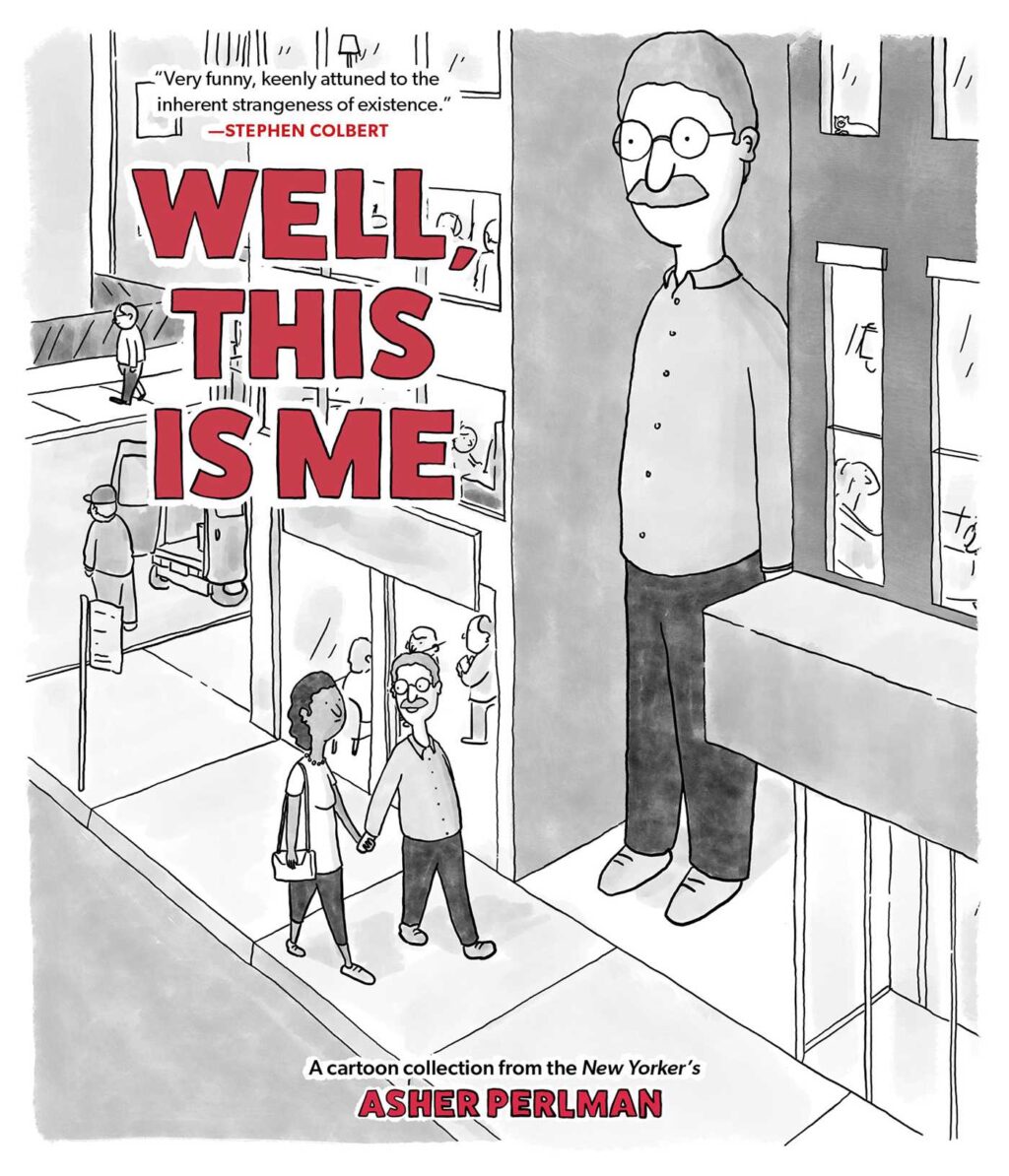
Asher Perlman’s book of cartoons, Well, This is Me, is available now.
Comments closedBooks, Design and Culture
This is pretty much why I don’t write anything I don’t have to.
Asher Perlman’s book of cartoons, Well, This is Me, is available now.
Comments closed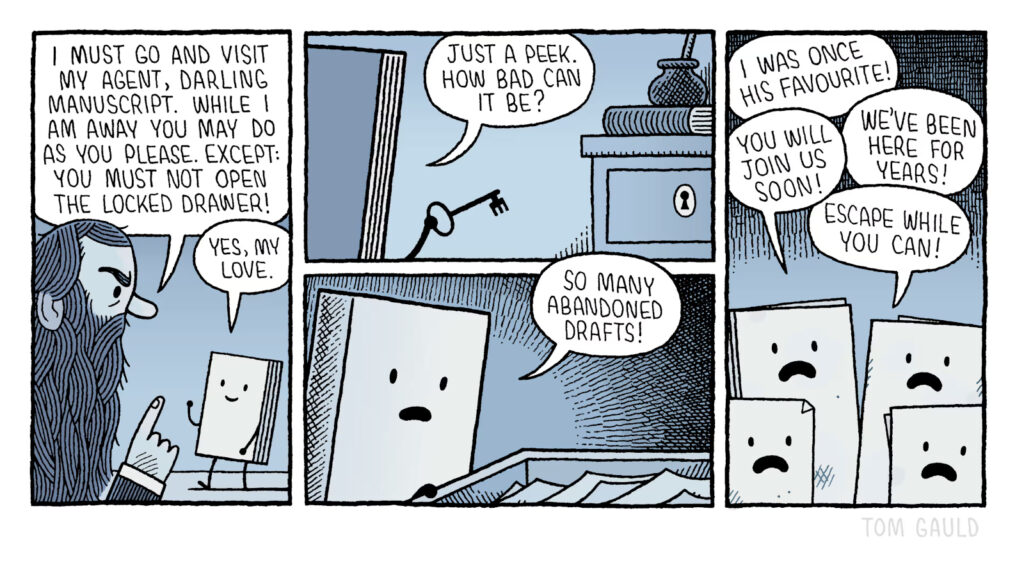
This, but for my personal art and design projects, and my actual proper job.
(Tom Gauld for The Guardian, obviously. Tom is currently selling some original drawings in his shop if you would like to own one of his masterpieces)
Comments closed
Cartoon by Graham Annabelle.
And just a reminder, Graham AKA Grickle has a new graphic novel for kids called Eerie Tales from the School of Screams coming out this summer.
Comments closed
Designer David Pearson and friends have launched a new website for 500-word (or thereabouts) reviews of book covers from the past and present.
There are a lot names you will be familiar with among the reviewers. I particularly enjoyed John Gall‘s review of the cover for The Franchiser by Stanley Elkin designed by relative unknown Lawrence Ratzkin for Farrrar, Straus & Giroux in 1976:
“Cover design in the US went from being house-styled, design driven and idiosyncratic (think Grove Press or New Directions or whatever Push Pin was up to) to the ‘big book look’ of the 1970s defined by designers like Paul Bacon. Make the type as large as possible, centre it, and combine with some non-specific imagery. That look still defines what we see on the bestseller list to this day. It established a generic way for covers to look and a familiar shorthand for sales teams and booksellers to understand – ‘aah, this must be a … big book!’. It ignored design principles of layout, composition and conceptual thinking that had been codified over the previous 50 years in favour of a commercial literal-ness. It also took away a lot of the fun.”
Jamie Keenan’s review of Joe Orton and Kenneth Halliwell’s naughty cover for The Secret of Chimneys by Agatha Christie is also a good time.
2 Comments
Tom Gauld has drawn a new cartoon for the New York Times Books section.
This is probably my favourite panel…


With the release of an annotated edition of The Big Sleep this month, author Megan Abbott reflects on noir and the work of Raymond Chandler:
What fascinates and compels me most about Chandler in this #MeToo moment are the ways his novels speak to our current climate. Because if you want to understand toxic white masculinity, you could learn a lot by looking at noir.
Loosely defined, noir describes the flood of dark, fatalistic books and films that emerged before, during, and especially after World War II. As scholars like Janey Place have pointed out, this was an era when many white American men felt embattled. Their livelihoods had been taken away—first by the Depression, then by the war, and then by the women who replaced them while they were off fighting. Into this climate noir flowered: Tales of white, straight men—the detective, the cop, the sap—who feel toppled from their rightful seat of power and who feel deeply threatened by women, so threatened that they render them all-powerful and blame them for all the bad things these straight white men do. Kill a guy, rob a bank—the femme fatale made me do it. These novels simmer with resentment over perceived encroachment and a desire to contain female power.
In an earlier essay for the LA Times, Abbott looks at why women are interested in true crime stories:
[In] the last few years, and especially in recent months as the Harvey Weinstein and associated scandals have dominated headlines, I’ve come to think of true crime books as performing much the same function as crime novels (also dominated by female readers): serving as the place women can go to read about the dark, messy stuff of their lives that they’re not supposed to talk about — domestic abuse, serial predation, sexual assault, troubled family lives, conflicted feelings about motherhood, the weight of trauma, partner violence and the myriad ways the justice system can fail, and silence, women.
While these weighty issues aren’t generally resolved in true crime… these books provide a common site to work through crises, to exorcise demons. I’ve come to believe that what draws women to true crime tales is an instinctual understanding that this is the world they live in.
And at Vulture Abbot talks to Ruth Franklin about her new novel, Give Me Your Hand:
The seductive female criminal, a.k.a. femme fatale, has always been a noir staple: Mary Astor in ‘The Maltese Falcon’, Ava Gardner in ‘The Killers’. But Abbott argues that these characters aren’t psychologically authentic. They’re “a projection of male anxiety,” she says, vampy caricatures whose primary purpose is to use their irresistible charms to lure the detective-hero into a setup. As Abbott sees it, classic noir “always comes back to the idea of femininity as a kind of dark continent.” Male writers “really don’t want to look in there,” she says. They want to believe female violence “is always an aberration … What if those stories had been told from the femme fatale’s point of view? Think how different they would look.”
On a semi-related note, film critic David Thomson recently wrote a long piece for the London Review of Books on Alfred Hitchcock’s film noir Vertigo in light of the revelations about Harvey Weinstein. It’s interesting as a dissection of a classic movie, but it is not, ultimately, the take I wanted. Thomson’s claim that a medium that has historically been dominated by the male gaze is somehow essentially so, is surely something that only a male critic would say. Women need to be given the space to address these issues, and, frankly it is a female critic’s reassessment of Hitchcock that I want to read.
Both the Abbott and Thompson pieces on noir reminded of Claire Dederer’s 2017 essay, ‘What Do We Do with the Art of Monstrous Men?‘, on Woody Allen and whether genius and monstrosity go hand in hand. It’s worth reading if you haven’t already. In the essay, Dederer talks briefly about Roman Polanski. I would love to read a contemporary reassessment of Chinatown. 1
Comments closed