Skip to content

Tag: Writing

Learning to Love the House Style

In a long and charming essay for The New Yorker, the magazine’s query proofreader Mary Norris muses on her career, and the history and uses of the comma:

Then I was allowed to work on the copydesk. It changed the way I read prose—I was paid to find mistakes, and it was a long time before I could once again read for pleasure. I spontaneously copy-edited everything I laid eyes on. I had a paperback edition of Faulkner’s “The Hamlet” that was so riddled with typos that it almost ruined Flem Snopes for me. But, as I relaxed on the copydesk, I was sometimes even able to enjoy myself. There were writers who weren’t very good and yet were impossible to improve, like figure skaters who hit all the technical marks but have a limited artistic appeal and sport unflattering costumes. There were competent writers on interesting subjects who were just careless enough in their spelling and punctuation to keep a girl occupied. And there were writers whose prose came in so highly polished that I couldn’t believe I was getting paid to read them: John Updike, Pauline Kael, Mark Singer, Ian Frazier! In a way, these were the hardest, because the prose lulled me into complacency. They transcended the office of the copy editor. It was hard to stay alert for opportunities to meddle in an immaculate manuscript, yet if you missed something you couldn’t use that as an excuse.

Norris’s book, Between You & Me: Confessions of a Comma Queen, will be published by W. W. Norton in April.

Comments closed
Jesse and the Typewriter Shop

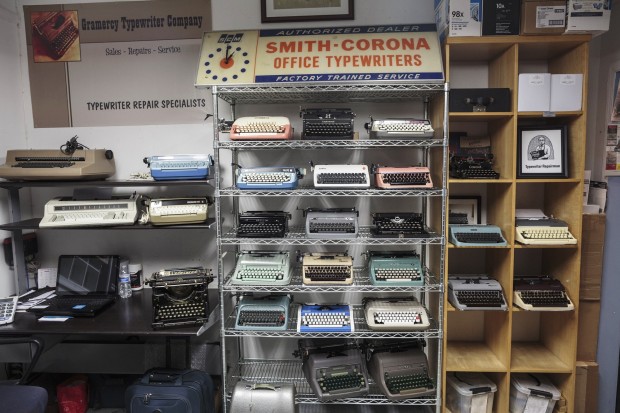
Related to yesterday’s post on Gramercy Typewriter Co. in New York, here’s a short film about U.S. Office Machines, one of the last remaining typewriter repair shops in Los Angeles:

https://vimeo.com/43212146

(Thanks Sam!)

1 Comment

The Last of the Typewriter Men

last-typewriter

At Medium, Mary Pilon profiles Paul Schweitzer of Gramercy Typewriter Co. — a father-and-son business in the Flatiron District of New York that will still repair your typewriter:

“Computers are being updated all the time,” he said, rolling his eyes at a PC laptop his son keeps in the corner. “Your computer becomes obsolete in a very short amount of time. It’s slow. It doesn’t have enough memory. A new model comes out. A printer won’t work with it anymore. That Underwood over there” — he points at a gleaming, black machine fit for James Joyce — “it’s 100 years old. What computer is going to last 100 years?”

Schweitzer was also the subject of this 2012 documentary short by Prospect Productions:

And if you can’t get enough of this stuff, I was reminded of this 2010 Wired article about the last generation of typewriter repairmen in California.

3 Comments

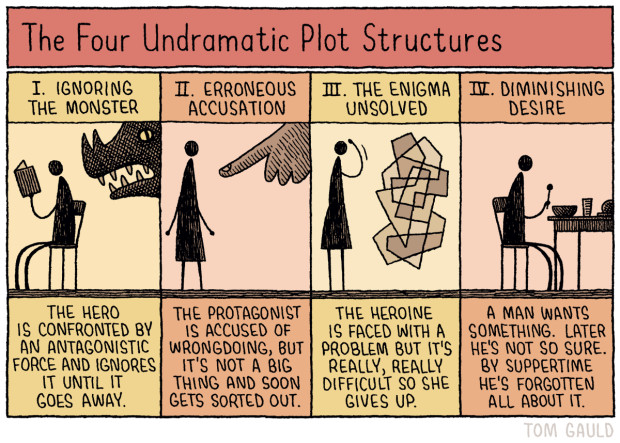
The Four Undramatic Plot Structures by Tom Gauld

gauld-four-undramatic-plot-structures-1200

Tom Gauld for The New Yorker.

Comments closed

Hilary Mantel: Speaking with the Dead

I’m finally, finally reading Wolf Hall (I know, I know…). It is excellent of course, and I’m looking forward to reading Hilary Mantel’s new collection of stories The Assassination of Margaret Thatcher just as soon as I’ve finished it (and Bring Up the Bodies). Mantel was recently profiled by Olivia Laing, author of A Trip to Echo Spring (one of my favourite books of the year), for the November issue of Elle magazine:

there’s an unmistakably eerie element to what Mantel does: a summoning of and speaking with the dead. Although she insists that she has “a very constrained imagination” and is happiest working within a scaffolding of fact, she is nonetheless adept at the act of mediumship that fiction requires. More than any other historical novelist I can think of, she also has a knack for conveying the slipperiness of time, the way it sloshes backward and forward, changing even as you watch. “History and memory is the theme,” she agrees, “how experience is transmuted into history, and how memory goes to work and works it over. It’s the impurity, the flawed nature of history, its transience—that’s really what fascinates me.”

Comments closed

Mac Barnett: Why a good book is a secret door

I’m all about the charming videos today… In this recent TED Talk, Mac Barnett, award-winning author of Billy Twitters and His Blue Whale ProblemExtra Yarn, Telephone and the forthcoming Sam and Dave Dig a Hole, talks about childhood and making stories come alive:

Comments closed

It Kills Everything It Touches

sheer-rage

At the LA Review of Books, Daniel Mark Janes discusses last month’s curious conference at Birkbeck College (University of London) about the author Geoff Dyer:

Anyone who has written about Geoff Dyer will have been tempted to emulate his style, particularly his tendency to digress: “I planned to write about Geoff Dyer but instead I got distracted/stoned/fell asleep.” (Of those who resist this urge, most feel obliged to describe this temptation.) However, the point of works like ‘Out of Sheer Rage’ and ‘Zona’ is not just that Dyer chronicles his experiences; it is that, for all of the tangents, we still at the end find ourselves closer to Lawrence, closer to Tarkovsky. Personal reminiscence alone did not necessarily make us closer to Dyer — but it was still welcome in shaping the tone. Amid the ’ism’s and ’otic’s of traditional academic papers, humanity can often be lacking — yet Dyer’s work is all flesh and bone, united by a persona that is profoundly, playfully human.

And on a related note, Philip Maughan also spoke to Dyer about the conference for the New Statesman:

“I’m one of the people who seem to have licensed the ‘I’m meant to write about this book but I’m just going to write how I got stoned instead’ essay – but it only works for certain subjects. It has to lead you into a deeper appreciation of the subject than could have been attained in a more direct way. It’s like those legal highs,” he said. “Some of them can get you pretty messed up. Really they ought to be proscribed.”

Comments closed

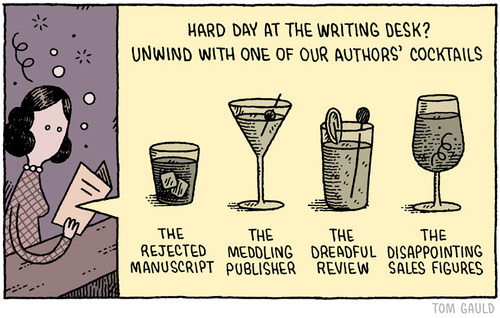
Authors’ Cocktails

hard-day

I didn’t see this weekend’s Guardian, but I assume Tom‘s cartoon is in reference to Olivia Laing’s article about 20th century female writers who drank, a follow-up to her excellent book The Trip to Echo Spring, which examines the link between creativity and alcohol through the lives F. Scott Fitzgerald, Ernest Hemingway, Tennessee Williams, John Berryman, John Cheever, and Raymond Carver:

Female writers haven’t been immune to the lure of the bottle, nor to getting into the kinds of trouble – the fights and arrests, the humiliating escapades, the slow poisoning of friendships and familial relations – that have dogged their male colleagues. Jean Rhys was briefly in Holloway prison for assault; Elizabeth Bishop more than once drank eau de cologne, having exhausted the possibilities of the liquor cabinet. But are their reasons for drinking different? And how about society’s responses, particularly in the lubricated, tipsy 20th century; the golden age, if one can call it that, of alcohol and the writer?

Comments closed

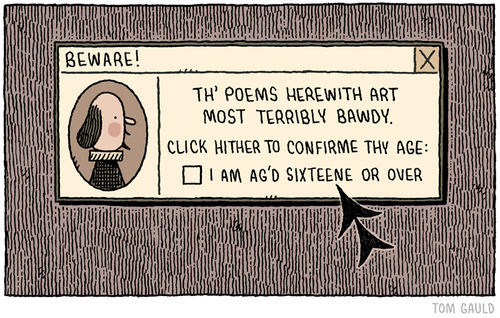
Beware!

beware

Tom Gauld

Comments closed

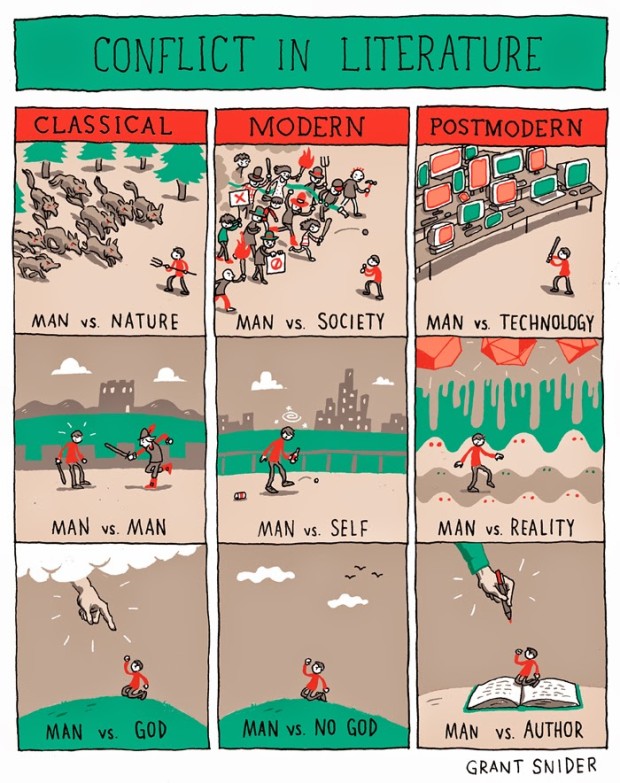
Conflict in Literature

conflict-blog

Grant Snider.

Comments closed

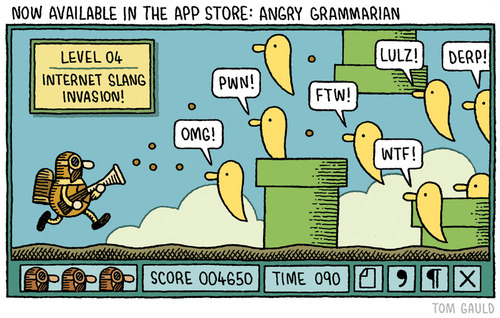
Angry Grammarian

One for the editors…
angry-grammarian
Tom Gauld.

Comments closed

Procrastination for Writers…


…a 10-Week Course.

Tom Gauld.

1 Comment