Skip to content

Tag: Writing

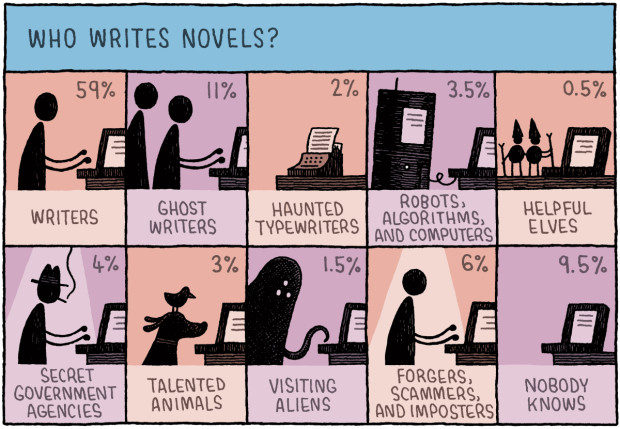
Who Writes Novels?

Gauld-Who-Writes-Novels-526-1200

Tom Gauld for The New Yorker.

Comments closed

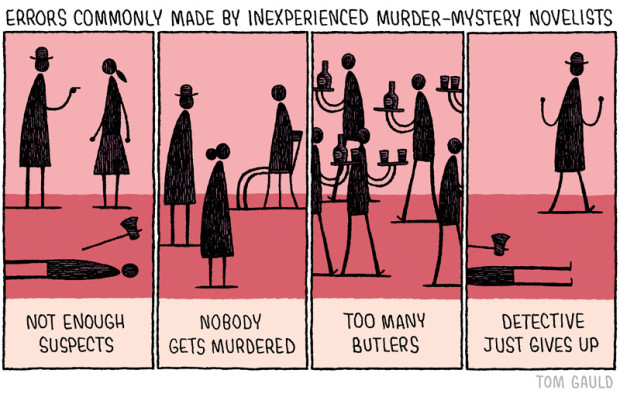
Errors Commonly Made by Inexperienced Murder-Mystery Novelists

errors-commonly-made

Tom Gauld.

Comments closed

Tim Parks on Where I’m Reading From

Where I'm Reading From (1)

At BOMB Magazine, writer Tim Park discusses his new book Where I’m Reading From, a collection of his essays from the NYRB Blog, with Scott Esposito (co-author of The End of Oulipo):

In a way, this book is an autobiography of someone brought up with a very particular relation to books, in a religious family, in an English literary tradition, who on becoming an adult, for private personal reasons, set himself literary goals that were gradually revealed as spurious. Also, it’s about a person from the literary center—English, London— who has spent more than thirty years in another country, Italy, that is out of the literary mainstream. And a writer who also, by chance, became a translator and went on to teach translation. My life has been a long process of awakening to the reality, the changing reality, of the contemporary book world, which is a million miles from the naïve vision I had when I started writing books at twenty-two. Since it is in the publishers’ interests, and indeed the University’s, to sustain a false picture of what the book world is like and what the contemporary experience of books amounts to, my articles were a response to this, and an attempt to get my own head straight about what I’m really doing and the environment I move in. One is seeking at last to be unblinkered about it all.

And, if you missed it, Park reviewed What We See When Read by designer Peter Mendelsund on the NYRB Blog earlier this month:

One of the pleasures of his book is his honesty and perplexity at the discovery that every account he offers of the process of visualization very quickly falls apart under pressure. We do not really “see” characters such as Anna Karenina or Captain Ahab, he concludes, or indeed the places described in novels, and insofar as we do perhaps see or glimpse them, what we are seeing is something we have imagined, not what the author saw. Even when there are illustrations, as in many nineteenth-century novels, they only impose their view of the characters very briefly. A couple of pages later they have become as fluid and vague as so much of visual memory. At one point Mendelsund posits the idea that perhaps we read in order not to be oppressed by the visual, in order not to see.

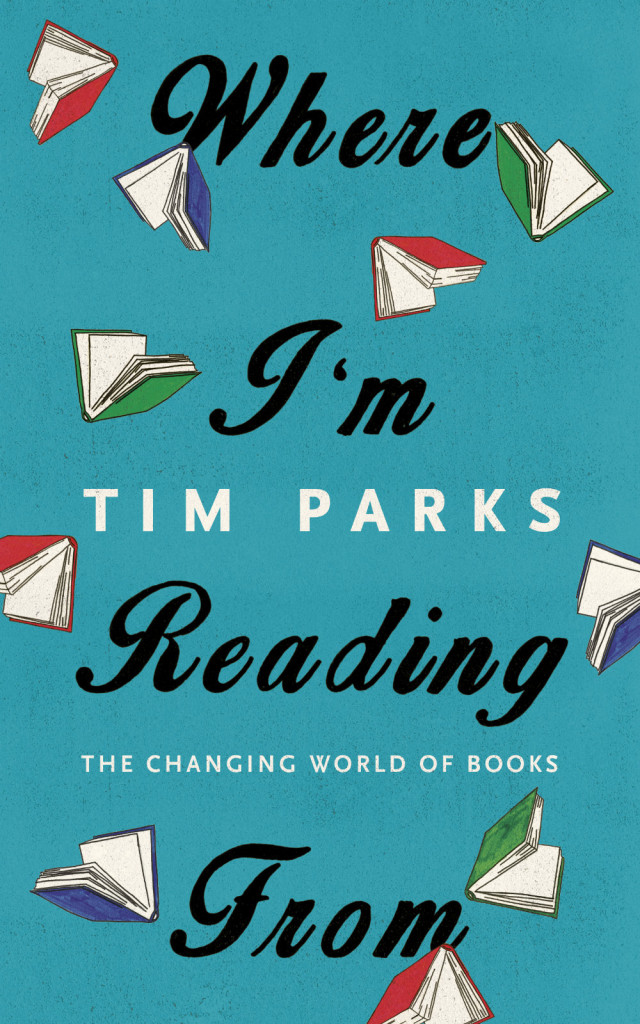
(Pictured above is the cover of the UK edition, published by Harvill Secker in December last year, of Where I’m Reading From designed by James Paul Jones. The US edition, which has a more utilitarian cover, was just published by New York Review of Books)
Comments closed

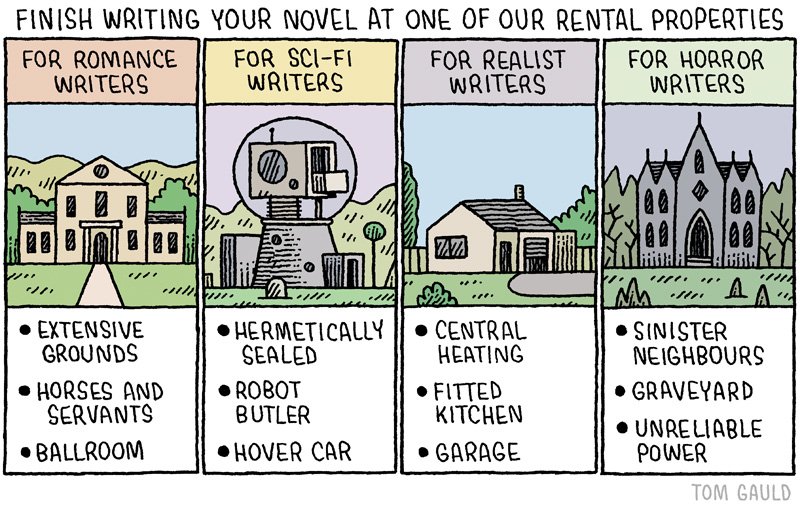
Finish Writing Your Novel…

finish writing tom gauld

Tom Gauld.

Comments closed

Too Many Books

At the NYRB Blog, Tim Parks wonders if there are just too many books:

Is there a relationship between the quantity of books available to us, the ease with which they can be written and published, and our reading experience?

At present, for example, it’s hard not to feel that we are in an era of massive overproduction. Just when we were already overwhelmed with paper books, often setting them aside after only a few pages in anxious search of something more satisfying, along came the Internet and the e-book so that, wonderfully, we now have access to hundreds of thousands of contemporary novels and poems from this very space into which I am writing.

Inevitably, this tends to diminish the seriousness with which I approach any particular book. Certainly the notion that these works could ever be arranged in any satisfactory order, or that any credible canon will ever emerge, is gone forever.

1 Comment

Chris Ware: Beyond the Cover

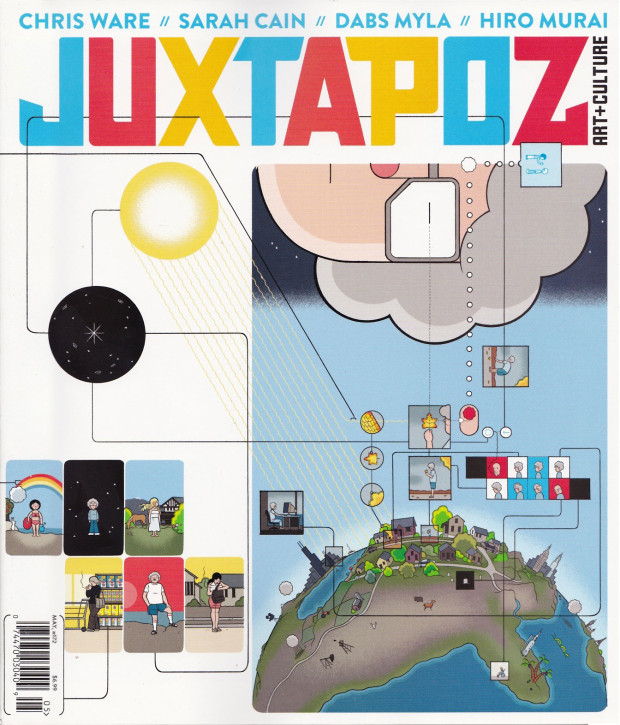
juxtapoz-may-2015

Juxtapoz contributing editor Kristin Farr talks to Chris Ware, the magazine’s May 2015 cover artist, for their Beyond the Cover site:

Beyond setting a very specific mood, tone or feeling of a time of day or era, color in my stuff sometimes acts as a separate, countervailing story, connecting elements and images in ways that I sometimes hadn’t even predicted when I was simply drawing the page, reflecting more the way we see the world than how we define it. At the same time, the page compositions are also an attempt to get a glimpse at the way we edit, remember, and clean up our own experiences into “stories”…

…Comics best approximate how I remember and think about the world and how I also think many other people do; I believe even Nabokov at some point expressed frustration at not being able to induce a non-verbal image-based sort of page-memory (but he still did it better than anyone, except Joyce). I find myself thinking about my stories at odd times during the day, almost as if they’re an alternate reality; I can’t liken the experience to anything other than the psychosis of false or self-induced memories. Then again, any memories are always going to have some falseness, all of which add up to a fairly unreliable sense of one’s life and experience.

Comments closed

The Eeriness of the English Countryside

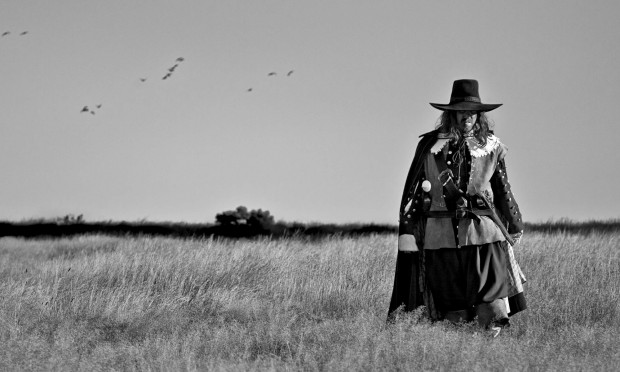
A-Field-in-England-009
A Field In England

Robert Macfarlane, whose new book Landmarks was published in the UK last month, has a fascinating essay in The Guardian on the writer M. R. James, and the eerie horror of the English countryside:

We do not seem able to leave MR James (1862–1936) behind. His stories, like the restless dead that haunt them, keep returning to us: re-adapted, reread, freshly frightening for each new era. One reason for this is his mastery of the eerie: that form of fear that is felt first as unease, then as dread, and which is incited by glimpses and tremors rather than outright attack. Horror specialises in confrontation and aggression; the eerie in intimation and aggregation. Its physical consequences tend to be gradual and compound: swarming in the stomach’s pit, the tell-tale prickle of the skin… James stays with us is his understanding of landscape – and especially the English landscape – as constituted by uncanny forces, part-buried sufferings and contested ownerships. Landscape, in James, is never a smooth surface or simple stage-set, there to offer picturesque consolations. Rather it is a realm that snags, bites and troubles. He repeatedly invokes the pastoral – that green dream of natural tranquillity and social order – only to traumatise it.

James’s influence, or his example, has rarely been more strongly with us than now. For there is presently apparent, across what might broadly be called landscape culture, a fascination with these Jamesian ideas of unsettlement and displacement. In music, literature, art, film and photography, as well as in new and hybrid forms and media, the English eerie is on the rise. A loose but substantial body of work is emerging that explores the English landscape in terms of its anomalies rather than its continuities, that is sceptical of comfortable notions of “dwelling” and “belonging”, and of the packagings of the past as “heritage”, and that locates itself within a spectred rather than a sceptred isle.

I think the eerie is also a theme that runs through English comics, although Macfarlane doesn’t mention it, and I’m hard pressed to think of specific examples. Gothic psychogeography is very much Alan Moore territory, and it feels like it should be in Warren Ellis’s wheelhouse too, but have either of them written anything explicitly about the horror of the English countryside?

(via Theo Inglis)

3 Comments

Comma Queen: Possessed

In the second episode of The New Yorker‘s Comma Queen video series, copy editor Mary Norris tackles using an apostrophe to form the possessive:


I am one of those people who annoy Norris by dropping the ‘s’ after the apostrophe when a name ends in ‘s’. I’m sure she is right — I’m certainly not going to argue with her! — but the exceptions seem completely infuriatingly arbitrary to me!

UPDATE: Mary Norris, whose memoir Between You & Me is out next week, is profiled in today’s New York Times:

Ms. Norris says she tries not to bring her work home with her. But she often has to restrain herself. Bad punctuation leaps out at her. Sloppy diction and grammatical errors in conversation register as minor assaults on her ear, as if her headphones had suddenly erupted into high-pitched feedback.

Her pet peeves include poorly punctuated signs; people who call the serial comma the Oxford comma; the wrong sort of pencil; the misuse of “who” and “whom” and other crimes against the accusative; book introductions by writers other than the author; incorrectly deployed apostrophes; people she meets on vacation who harass her about The New Yorker’s style; and grammatical errors in popular songs. She is particularly irked, she said, by the line “Till the stars fall from the sky for you and I” from “Touch Me” by the Doors.

Me, I’m just irked by The Doors.


Comments closed

Mad Men: The Shock of the Pretty

mad-men-season-7

Another overdue link from my ‘longreads’ bookmarks, The Hollywood Reporter talks to the cast and crew of Mad Men about the early days of the show now that it is about to come an end:

Christina Wayne (former senior vp scripted programming, AMC) Years earlier, I’d wanted to option Revolutionary Road [Richard Yates’ novel about suburbia in the 1960s]. But I was a nobody screenwriter, and [Yates’ estate] held out for bigger fish, which they got with Sam Mendes. So when I read [the Mad Men script], it resonated with me. This was a way to do Revolutionary Road, week in, week out. When we had lunch with Matt for the first time, I gave him the book. He called me after and said, “Thank God I’d never read this because I never would have written Mad Men.”

Perhaps more interesting, however, is James Meek’s lengthy article for the London Review of Books on the show’s superficiality, and its curious relationship with advertising:

Sterling Cooper, the fictional advertising agency around which Mad Men is built, is a caricature of the commercial TV system that produced the series: a pool of creative people in bitter thrall to the accountants and deal-makers they rely on for money. Although we learn in parenthesis that the agency gets most of its income from commission on the ads it places, for dramatic purposes the agency is divided into two departments: Creative, which comes up with campaign slogans, artwork and copy for ads, and Accounts, which persuades, charms, fawns, bribes and pimps its way to getting and keeping corporate clients. Mad Men is a show about writers dependent on advertising, written by writers dependent on advertising, the difference being that the fictional writers of Creative write the ads on which they depend.

Comments closed

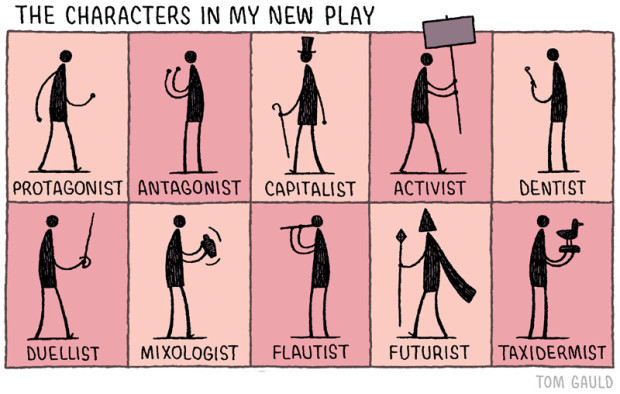
The Characters In My New Play

characters-in-my-new-play

Tom Gauld.

Comments closed

Comma Queen

The New Yorker has launched a new video series “devoted to language in all its facets” called Comma Queen. In the first episode, copy editor Mary Norris talks about commas, the “little squiggle” with “a history rich in controversy”:


On a related note, Julia Holmes reviews Mary Norris’ book, Between You & Me: Confessions of a Comma Queen, for the New Republic:

copy-editing can also be a soul-crushing enterprise. Not the work itself, which is perfectly pleasant and definitely necessary, but the surprising and strictly enforced class system that almost always accompanies it. Magazines are rigidly hierarchical places, no matter how outwardly easygoing and free-spirited and ad hoc they may endeavor to look on a visit to the office. A funny thing about publishing is that it’s populated almost exclusively by frustrated writers. It’s a kind of slow-burn Stanford Prison Experiment, in which former English majors are randomly assigned the roles of language guard and word prisoner, affirming once more how quickly and insanely people will adapt to new, relative states of power and powerlessness.

Mary Norris’s very funny, lucid, and lively new book, Between You & Me: Confessions of a Comma Queen, illuminates this shadow world at last. It’s part memoir, part language guide, and part personal account of life at The New Yorker (where Norris has worked as a copy editor since 1978). “One of the things I like about my job,” she writes, “is that it draws on the entire person: not just your knowledge of grammar and punctuation and usage and foreign languages and literature but also your experience of travel, gardening, shipping, singing, plumbing, Catholicism, midwesternism, mozzarella, the A train, New Jersey.”

Norris exemplifies what David Foster Wallace observed in “Authority and American Usage”: “We tend to like and trust experts whose expertise is born of a real love for their specialty instead of just a desire to be expert at something.”

Comments closed

Wear and Tear

Somewhat related to Timothy Young’s list of the 10 good reasons the book is important, Oliver Farry writes on the comfort of well-worn books for the New Statesman:

This is one of the attractions of wear and tear. Objects that feel lived in give us a comforting feeling of having come a long way, of having been through the years (or months, as it might be). There is also the sense of having done some work. Even reading a book can be denoted by the physical mark you leave on it – the cracking of a spine, its progressive warping as you work your way to the end. Occasionally when reading a secondhand paperback, a bookmark or a dog-eared page shows you where the last owner gave up – you feel momentarily like Amundsen discovering Scott’s encampment.

Comments closed