Skip to content

Tag: Writing

Something for the Weekend

The Technological Sublime — Rick Poyner on the science fiction artist Chris Foss and Hardwarea new book collecting his work, at Design Observer:

These visionary images have a stillness, a control of atmosphere and a mood of mystery and wonder, even when something huge, alien, imponderable and beyond our terrestrial grasp is taking place. Foss loves the paintings of J.M.W. Turner and his finest pictures, often from the 1970s, seem as much concerned with ambience and painterly effect — they are cosmic cousins of Turner’s Rain, Steam and Speed, at least in spirit — as with the engineering of the vast structures they depict. They are also early visual encapsulations of what came to be known in the 1990s as the technological sublime. The vertiginous sense of awe, wonder, poetry and terror that people experienced in nature, when opening their senses to the sky, mountains, forests, rivers or oceans, could now be felt when contemplating the frightening immensity of a machine’s harnessed power, the magical effectiveness of electricity, or the boundless matrix of digital connection.

(Pictured above: Chris Foss, The Bloodstar Conspiracy by Stephen Goldin and E. E. “Doc” Smith, Panther, 1978)

Those Who Can… — Eric Olsen, journalist, editor and co-author of We Wanted To Be Writers, discusses writing and picks 5 books on the subject:

There are always ways that you can help a writer along. You’re not going to take a mediocre writer and turn him or her into a great writer, and there are also some things that can’t be taught, like the basic desire to be a writer. That seems to be a given. You’re not going to make someone want to be a writer. Sometimes what goes on in a writing workshop is that you convince the writer that he doesn’t want to be a writer. That is a kind of teaching too…

 The Source Code of Our Being — Tom McCarthy, author of Remainder and C, on the influence of Freud:

As a writer, I’m in love with Freud. I can’t imagine any serious writer not being. Freud, ultimately, concerned himself not with the mind, nor with the individual, but with the question of meaning’s emergence in the world, and of the mechanisms through which this emergence takes place. What, according to him, are these mechanisms? Why, they’re substitution and elision, condensation and displacement, metaphor, metonymy — in short, the very mechanisms at work in a poem or a novel. For Freud, if you want to understand mental and social life you don’t take a biopsy of a murderer’s brain or observe groups of people in a room: you study Antigone and Hamlet. That’s why his case-histories read like Gothic novels. It’s why his best patients are fictional characters like Jensen’s Norbert and Goethe’s Werther. And it’s why his preferred model for memory is a mystic writing pad.

And finally…

A short film homage to author Jorge Luis Borges by Ian Ruschel:

Comments closed

Midweek Miscellany

Lumps of Language — John Sutherland reviews The Words of Others: From Quotations to Culture by Gary Saul Morson for Literary Review:

We think of our use of language as ‘fluency’. There are, however, congealed lumps floating in it and, if we look beneath the surface, often more lumps than liquidity. Put another way, most language is pre-owned. The previous owners are, as Gary Morson instructs us, often worth knowing about.

Hard — Cartoonist James Sturm finds out just how hard it is to get a cartoon in The New Yorker:

I don’t normally draw gag cartoons; I’m what’s now called a “graphic novelist.” I’m not really considering a career change, but I was dealing with the mid-career blahs and wanted to try something new. It takes me several years to write and draw a book. The book’s subject determines and limits what I can and can’t draw. I enjoy the process, but it’s a slog. I wanted more spontaneity in my creative life. So in March I decided to fill a sketchbook, 90 pages, with New Yorker-style cartoons—one cartoon a day for three months. No excuses.

Much linked to elsewhere: A sad (and slightly bonkers) interview with Grant Morrison about his book Supergods in Rolling Stone.

Dan Nadel at The Comics Journal responds.

And finally… While were on the subject of comics…

Here’s an neat primer on comics journalism, in the form of comics journalism, by Dan Archer (via The Ephemerist).

Comments closed

Midweek Miscellany

Comic Unease — Cartoonist Emily Carroll talks about comics, fairy tales, dreams, and her story His Face All Red with The Comics Journal:

I think a lot of fairy tales have that sort of unease built into them, just because they introduce so many elements that they never explain, and use fairy tale logic—the kind that isn’t really logic at all, but has that matter-of-fact feel to it anyway—and the reader just has to roll with it.

Dark Matter — Author Lev Grossman on fan fiction for Time Magazine:

Fan fiction is what literature might look like if it were reinvented from scratch after a nuclear apocalypse by a band of brilliant pop-culture junkies trapped in a sealed bunker. They don’t do it for money. That’s not what it’s about. The writers write it and put it up online just for the satisfaction. They’re fans, but they’re not silent, couchbound consumers of media. The culture talks to them, and they talk back to the culture in its own language. Right now fan fiction is still the cultural equivalent of dark matter: it’s largely invisible to the mainstream, but at the same time, it’s unbelievably massive.

Grossman’s new novel The Magician King (the sequel to his 2009 novel The Magicians) is published next month.

Dysfunctional Spies — Author John Le Carré reflects on his time in MI6:

The creation of George Smiley, the retired spy recalled to hunt for… a high-ranking mole in Tinker, Tailor, was extremely personal. I borrowed elements of people I admired and invested them in this mythical character. I’m such a fluent, specious person now, but I was an extremely awkward fellow in those days. I also gave Smiley my social ineptitude, my lack of self-respect and my fumblings in love.

Because I came from a dysfunctional background, I made home the most dangerous place for Smiley. Home is where he lets himself in cautiously. Home is where he sees the shadow of his adulterous wife in the window and wonders who she’s with.

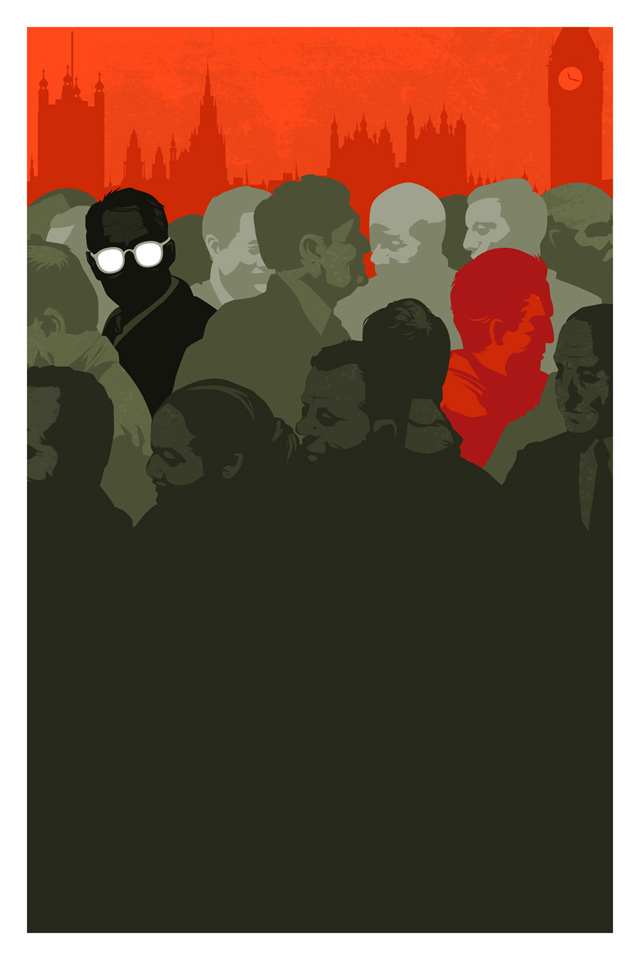
Pictured above is Matt Taylor’s incredible illustration for a new Penguin US edition of Le Carré’s novel Tinker, Tailor, Soldier, Spy — more of that wonderful stuff to come — and a new film adaptation of the book, starring Gary Oldman as Smiley, is being released later this year:

Comments closed

David Lodge | Writers & Company

In another great archive interview for Writers & Company, author David Lodge talks to Eleanor Wachtel about artificial intelligence, consciousness and his 2002 novel Thinks:

CBC RADIO WRITERS & COMPANY: David Lodge, Think

Comments closed

Something for the Weekend

Simplicity with Sophistication — Typographer Gerard Unger talks about his work and the influence of Wim Crouwel with MyFonts:

What seemed amazing when I joined [Crouwel’s] company Total Design in 1967 was how simple it all seemed. When Wim explained how to design and do typography, you got the impression it had always been done like that and that it couldn’t be done any other way — maximum clarity. Later, I realized that this approach also had its limitations. When graphic designers had to select a typeface, they automatically specified Helvetica and stopped thinking. Wim’s own work was different: it seemed clear and simple, but was full of refinement, which comes naturally to him. That is probably why it is so attractive to younger generations: simplicity with sophistication. Yet I personally wouldn’t welcome a revival of Swiss typography — it was too formulaic. Also, I think design should be more of a social thing than that. For too long, graphic design has been about individualism and about fulfilling personal ambitions.

The Doctrine of Immaculate Rejection— A wonderful with E. B. White from the Paris Review 1969. It’s a great read, but it’s hard not to get the feeling it comes from a more genteel era that has long since disappeared (via Longform):

I revise a great deal. I know when something is right because bells begin ringing and lights flash. I’m not at all sure what the “necessary equipment” is for a writer—it seems to vary greatly with the individual. Some writers are equipped with extrasensory perception. Some have a good ear, like O’Hara. Some are equipped with humor—although not nearly as many as think they are. Some are equipped with a massive intellect, like Wilson. Some are prodigious. I do think the ability to evaluate one’s own stuff with reasonable accuracy is a helpful piece of equipment. I’ve known good writers who’ve had it, and I’ve known good writers who’ve not. I’ve known writers who were utterly convinced that anything at all, if it came from their pen, was the work of genius and as close to being right as anything can be.

And finally…

Type and Still Imagery — Writer-director Mike Mills, who began his career as a graphic designer, talks about his semi-autobiographical movie Beginners with AIGA:

Before I was a filmmaker I loved Godard as a graphic designer. He does the best design, to me. And a lot of my graphics being very, almost sort of didactic or presentational, or sort of centered and clean, to me really comes from how Godard uses type and still imagery in his films, in Tout va bien or One Plus One or Pierrot le Fou, so Godard’s been influencing me for a very long time. And the graffiti in the film is much more sort of May 1968, sort of Situationist graffiti rather than being like hip-hop graffiti.

There is also a book, Drawings From the Film Beginners, that accompanies the movie (thx @Henry)

Comments closed

Jarvis Cocker on Writing

Jarvis Cocker talks to Faber Publishing Director Lee Brackstone about songwriting and the publication of Mother, Brother, Lover, his first collection of lyrics:

Mother, Brother, Lover will be published by Faber in October.

(via Largehearted Boy)

Comments closed

Midweek Miscellany

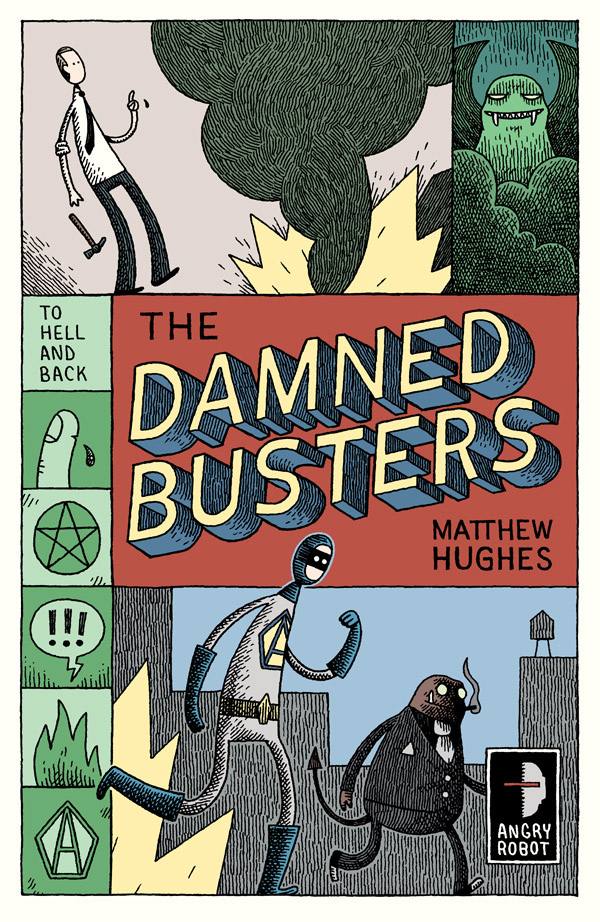
Cartoonist and illustrator Tom Gauld chats with the Angry Robot blog:

I find [robots] almost endlessly interesting. There is tragedy in their place between sentient beings and disposable products. And … they are much easier to draw than real people.

I’m hoping to interview Tom here as well sometime soon (just as soon as I think of something smart to ask him).

Hard Scenes — Actor, writer and director John Turturro talks about his work and one of my all time favourite films Miller’s Crossing at the A.V. Club (via Biblioklept):

Sometimes you think about movies, and you say, “Well, I want to try to do something that’s not exactly in a movie.” If you’ve ever been in a very dangerous situation, you know that people will do all kinds of things to keep themselves alive. It was very well-written, but you want to imagine what it’s really like to be in that kind of situation. It depends on what you’re willing to do, and in real life you would do a lot of different things. I tried to capture a little bit of that… to do something that was almost a little difficult to watch, because people aren’t trying to be heroic at those moments.

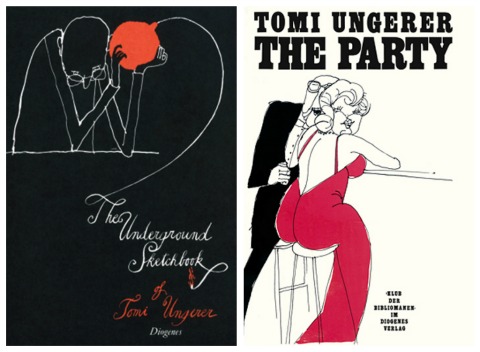
Curiosity and Collecting — Writer and illustrator Tom Ungerer in conversation with Julie Lasky at Design Observer:

One of the most important things for one’s own development is curiosity. Once you have curiosity, you just accumulate. My interests go from botany to mineralogy, geology, anatomy, history. Sometimes I’ve been bitten like bug. I buy one object and I’m so fascinated that I start collecting. And then when I finish collecting, and the collection doesn’t inspire, I give it away, like my toy collection of 6,000 pieces that I donated to my hometown museum for children.

Learning to Write — An interview with author Zadie Smith at The Literateur:

[O]ne of the things I look for in other people’s writing is the ability to confer freedom. That’s what I want to be able to do myself. I like a writer who doesn’t have to be in total control of how their readers react. More mystery, less explanation. All I can say is I’m working on it. But it’s so hard! I really feel I’m just at the base of a huge mountain called ‘learning how to write’. I’m still only 35. Learning to write is a task that takes up your whole life.

And finally…

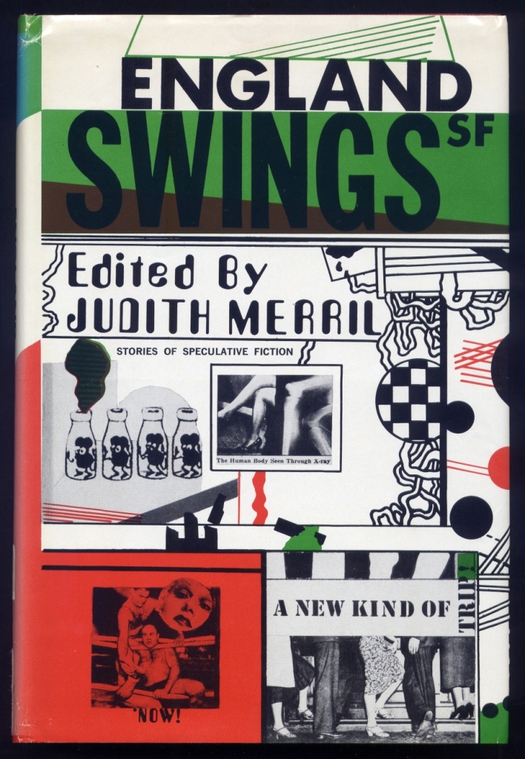
Rick Poynor on the unusual cover design for England Swings SF, published in 1968, also at Design Observer.

Comments closed

J.J. Abrams | Fresh Air

One last miscellaneous post before the weekend…

Filmmaker J.J. Abrams  talks about his new movie Super 8 and, perhaps most interestingly, his storytelling process with Terry Gross for NPR’s Fresh Air:

In a movie like “The Graduate,” Ben and Elaine had their first real date and they’re, you know, sitting at a restaurant eating in his convertible car and people are being very loud and they put the top up. And they’re having this conversation and you can’t hear it, but you’re watching it. So you get to sort of, you know, fill in the blanks and I think there is a sort of – almost a reflexive reaction that we have to fill the blanks in when there’s something of some substance and pieces are missing. You sort of fill it in.

I think there’s something about the unseen and the unknown that has real value in moments. But I do think that, you know, you can’t apply a magic box approach to everything. And if you go to see a movie or if you watch a show, you better have something of substance that you’re building to. The whole thing in itself can’t be a magic box.

NPR FRESH AIR: J.J. Abrams: The ‘Super’ Career Of A Movie-Crazed Kid

The full transcript is here.

(via The Cultural Gutter)

1 Comment

Something for the Weekend

Canadian book designer Bill Douglas annotates one of his favourite covers for the newly launched Toronto weekly The Grid.

Tools of the TradeJonathon Green, author of the three volume Green’s Dictionary of Slang and the somewhat more compact and affordable Chambers Slang Dictionary, on the life of a lexicographer:

What I do is to sit alone in a room with a screen in front of me, a book more than likely to my left, held open by the weight of a discarded piece of chain, and within reach walls full of more books which are not just books but also tools and at the same time both extensions of and bastions for my existence. Some of them I have even made myself. With this screen and books and book-shaped tools I chase down words. And by placing these words in alphabetical order and by naming and defining and providing a word-based background for their existence and more words that illustrate examples of their use I create yet another book which is designated more than any other type to be a tool in its turn.

A Nostalgic Baseline — Harvard English Professor Leah Price, author of The Anthology and the Rise of the Novel and the forthcoming Unpacking My Library: Writers and Their Books, on books as objects:

“In thinking about new media, we measure what we do now against a nostalgic baseline. We compare the way we really do use digital media to the way we imagine we once used printed media, so that we take the reading of printed books to stand for all sorts of values we think we used to have, like sustained attention, linear thinking, noninstrumental appreciation,” Price said. “But if you just count how many pages came off of the printing press at any moment, never in any historical period have books, let alone literary works, been the majority of printed production.”

What Are You? — A wonderful essay by Alexander Chee, author of the novel Edinburgh, on comics, identity and American culture at The Morning News:

At the supermarket when people asked my white mom, “Whose little boy is this?” sometimes I would defiantly insist I was hers, sometimes say nothing, but I’d glare each time as if I had eyebeams that could vaporize them… No one else was like me, except my sister and brother… In the bathroom I sometimes imagined myself as I would have been with either a white face or an Asian one, looking into the hazel part of my eye and seeing the green extend across all the way, or watch it shrink back, covered by brown. The freckles would blanch away or extend until they met and my face turned darker.

It would have been easier to be a mutant, I decided. I sometimes told myself I was one, that it was the only explanation for the reason so many people asked me “What are you?”

The Ludovico Treatment — Steve Rose on Stanley Kubrick’s film adaptation of A Clockwork Orange, released 40 years ago, for The Guardian:

Beyond the UK, the movie has never been out of currency, particularly in the US, and particularly among the young. Its sci-fi stylings have aged remarkably well, and its almost abstract portrayal of out-of-control youth and paternalistic society have made it something of a teenage rite of passage, the movie equivalent of The Catcher in the Rye. Remarkably, it has been a style guide for pretty much every subsequent musical genre… On the big screen, meanwhile, every time you see a gang walking along in slow-motion, a speeded-up party scene, a slow pan out from a closeup of a face, a torture scene set to cheerful music, the chances are it was plundered from Kubrick’s original.

There Are Enough Chairs — A short interview with designer Dieter Rams in the New York Times:

Most of the things are done already — you can’t make it better. Look at chairs: there are enough chairs. There are bad chairs, some good ones, mostly bad ones. But there are, even with a chair, possibilities to make it more comfortable or, from the economic point, you can make it cheaper, save some material or you can try new materials.

And finally…

Because it’s Friday, and because I can, The Velvet Underground Oh! Sweet Nuthin’:

You can thank me later.

Comments closed

Edward St Aubyn | Open Book

Author Edward St. Aubyn talks to Mariella Frostrup about his brilliant, funny, and very, very harrowing semi-autobiographical novels for BBC Radio’s Open Book:

BBC RADIO OPEN BOOK: Edward St. Aubyn

At Last, Edward St. Aubyn’s new novel, and the conclusion of the Melrose series, is being published next month.

Comments closed

Something for the Weekend

Holly MacDonald is Assistant Art Director at Bloomsbury in London. She has some of her own lovely cover designs on her blog.

Losing the Knack — Stephen King talks about his creative process and the current state of short fiction at The Atlantic:

I’ve got a perspective of being a short-story reader going back to when I was 8 or 9 years old. At that time there were magazines all over the place. There were so many magazines publishing short fiction that nobody could keep up with it. They were just this open mouth going “Feed me! Feed me!” The pulps alone, the 15- and 20-cent pulps, published like 400 stories a month, and that’s not even counting the so-called “slicks” — Cosmopolitan, American Mercury. All those magazine published short fiction. And it started to dry up. And now you can number literally on two hands the number of magazines that are not little presses that publish short fiction… You don’t see people on airplanes with their magazines folded open to Part 7 of the new Norman Mailer. He’s dead of course, but you know what I mean. And all of these e-books and this computer stuff, it kind of muddies the water and obscures the fact that people just don’t read short fiction. And when you fall out of the habit of doing it, you lose the knack, you lose the ability to sit down for 45 minutes like you can with this story and get a little bit of entertainment.

Also at The Atlantic: Peter Osnos, founder of Public Affairs Books, on how publishing has changed since 1984.

No Comment — Khoi Vinh, former-Design Director for NYTimes.com, writing on his own blog Subtraction about how comments and blogging are changing:

[B]logging in the style that I cherish — the Blogger/MovableType/WordPress.org style, you might say, where each blog is a kind of an independent publication — now feels somewhat like a niche activity practiced by relatively few, where it once seemed like a revolutionary democratization of publishing. What seems more lively, more immediate and more relevant right now is what I might call ‘network blogging’ — content publishing that’s truly integrated into a host network like Tumblr or Twitter, that’s not just on the network, it’s of the network too. It’s simpler, faster, more democratic than what came before. It’s not my preferred style of blogging, but it’s hard to acknowledge that it’s not incredibly exciting in very different ways.

Part of this change, I think, is a decline in commenting… [T]here are much more absorbing content experiences than independent blogs out there right now: not just Tumblr, but Twitter and Facebook and all sorts of social media, too, obviously, and they’re drawing the attention that the ‘old’ blogs once commanded. Moreover, these social networks allow people to talk directly to one another rather than in the more random method that commenting on a blog post allows; why wouldn’t you prefer to carry on a one-on-one conversation with a friend rather than hoping someone reads a comment you’ve added to a blog post…?

Comments closed

Something for the Weekend

It Looks Pretty Cool” — Chip Kidd on his design for Haruki Murakami’s new novel 1Q84:

logistically the title is a book designer’s dream, because its unique four characters so easily adapt it to a very strong, iconic treatment.

F**ked — Author Dale Peck on founding  Mischief + Mayhem, a new publishing collective, in The Financial Times:

“The whole point of writing literature was that in exchange for not getting paid a lot of money, you could say whatever you wanted; now, you don’t get a lot of money and you don’t get to say what you want. All of which segues to why writing is f***ed.”

The Last of the Old-Style Hollywood Actresses — A Ballardian Primer to Elizabeth Taylor:

What did Taylor represent to Ballard? Less a sex symbol and more an emblem of the parallel landscape that celebrity culture in the 1960s and 70s inhabited, a virtual reality colonising the private lives of ‘ordinary’ people exposed, through mass communications and on a hitherto unprecedented scale, to a world as strange as an alien planet yet paradoxically erotic and near – a synthetic substitute for reality itself.

(images: cropped photograph of Elizabeth Taylor by Bert Stern via Dan Shepelavy (top). Cover of Crash by J.G. Ballard designed by David Wardle).

Too Much InformationThe New York Times of the meaning and the use of the word “information”:

The use of the word “information” itself… seems to have exploded since its earliest recorded appearance in 1387. (“Fyve bookes com doun from heven for informacioun of mankynde.”) As Michael Proffitt, the managing editor of the Oxford English Dictionary, notes in an essay written for the recent relaunch of the O.E.D.’s digital edition, “information” is the 486th most frequently occurring word in Project Gutenberg’s searchable corpus of mostly pre-1900 literature. A 1967 survey of contemporary American English ranked it 346th. And the rise of digital technology seems only to have speeded its ascent. One recent survey of online usage lists “information” as the 22nd most common word.

And finally… It seems unlikely that you haven’t seen these already, but still…

New Vintage paperback designs for James M. Cain “conceived by Megan Wilson, executed by Evan Gaffney.” Stunning stuff.

Comments closed