Skip to content

Tag: Writing

Alex Ross | School of Life

In this short interview, Alex Ross, music critic of The New Yorker and author of The Rest is Noise and Listen to This, discusses music and music criticism:

Thanks to the chaps at We Made This for directing me to The School Life of video series.

Comments closed

Rousseau Deep, Montaigne High

Anthony Gottlieb writes on the renewed interest in 16th Century French essayist Michel de Montaigne for The New York Times:

Like Socrates, Montaigne claims that what he knows best is the fact that he does not know anything much. To undermine common beliefs and attitudes, Montaigne draws on tales of other times and places, on his own observations and on a barrage of arguments in the ancient Pyrrhonian skeptical tradition, which encouraged the suspension of judgment as a middle way between dogmatic assertion and equally dogmatic denial. Montaigne does often state his considered view, but rarely without suggesting, explicitly or otherwise, that maybe he is wrong. In this regard, his writing is far removed from that of the most popular bloggers and columnists, who are usually sure that they are right.

And, funnily enough, Sarah Bakewell author of How To Live: Or, A Life of Montaigne in One Question and Twenty Attempts at an Answer — one of the books mentioned by Gottlieb — recently spoke to Eleanor Wachtel about Montaigne for CBC  Radio’s Writers & Company:

CBC RADIO WRITERS & Co. WITH SARAH BAKEWELL

The cover of the US edition of How To Live, published by Other Press, is by Mr. John Gall (pictured above). But you knew that already of course….

Comments closed

Learning to Love the (Shallow, Divisive, Unreliable) New Media

James Fallows, veteran journalist and author of Breaking the News, has a lengthy article in The Atlantic on Gawker and the effect of digital media on journalism:

One by one, the buffers between what people want and what the media can afford to deliver have been stripped away. Broadcast TV was deregulated, and cable and satellite TV arose in a wholly post-regulation era. As newspapers fell during the rise of the Internet, and fell faster because of the 2008 recession, the regional papers fell hardest. The survivors, from The New York Times to the National Enquirer, will be what British newspapers have long been: nationwide in distribution, and differentiated by politics and class. The destruction of the “bundled” business model for newspapers, which allowed ads in the Auto section to underwrite a bureau in Baghdad; the rise of increasingly targeted and niche-ified information sources and advertising vehicles; and the consequent pressure on almost any mass offering except for sports—all of these are steps toward a perfected market for information of all sorts, including news. With each passing month, people can get more of what they want and less of what someone else thinks they should have.

Every news organization recognizes this shift… The Atlantic is now profitable in part because traffic on our Web site is so strong. Everyone involved in the site understands the tricks and trade-offs that can increase clicks and raise the chances of a breakout “viral” Web success. Kittens, slide shows, videos, Sarah Palin—these are a few. For us and for other publications, they are complications. For Gawker, they’re all that is.

According to Fallows, however, the disruption is also creating new, positive opportunities:

Economic history is working against “legacy” news organizations like the BBC, The New York Times, NPR, and most magazines you could name. But historical forces don’t play out on a set schedule, and can be delayed for a very long time. Economic history is also working against museums, small private colleges, and the farm-dappled French countryside, but none of them has to disappear next week. Even as it necessarily evolves, our news system will be better the longer it includes institutions whose culture and ambitions reach back to the pre-Gawker era, and it would be harder and costlier to try to re-create them after they have failed than to keep them on life support until their owners find a way to fit their values and standards into the imperatives of the new systems.

But the new culture also creates positive opportunities—as, it’s worth saying again, every previous disruption has… At no stage in the evolution of our press could anyone be sure which approaches would support life, and which would flicker out. Through my own career I have seen enough publications and programs start—and succeed, and fail—to know how hard it is to foresee their course in advance. Therefore I am biased in favor of almost any new project, since it might prove to be the next New York Review of Books, Rolling Stone, NPR, or Wired that helps us understand our world.

If you are interested in journalism and news media, the whole article is definitely worth your time.

Comments closed

Something for the Weekend

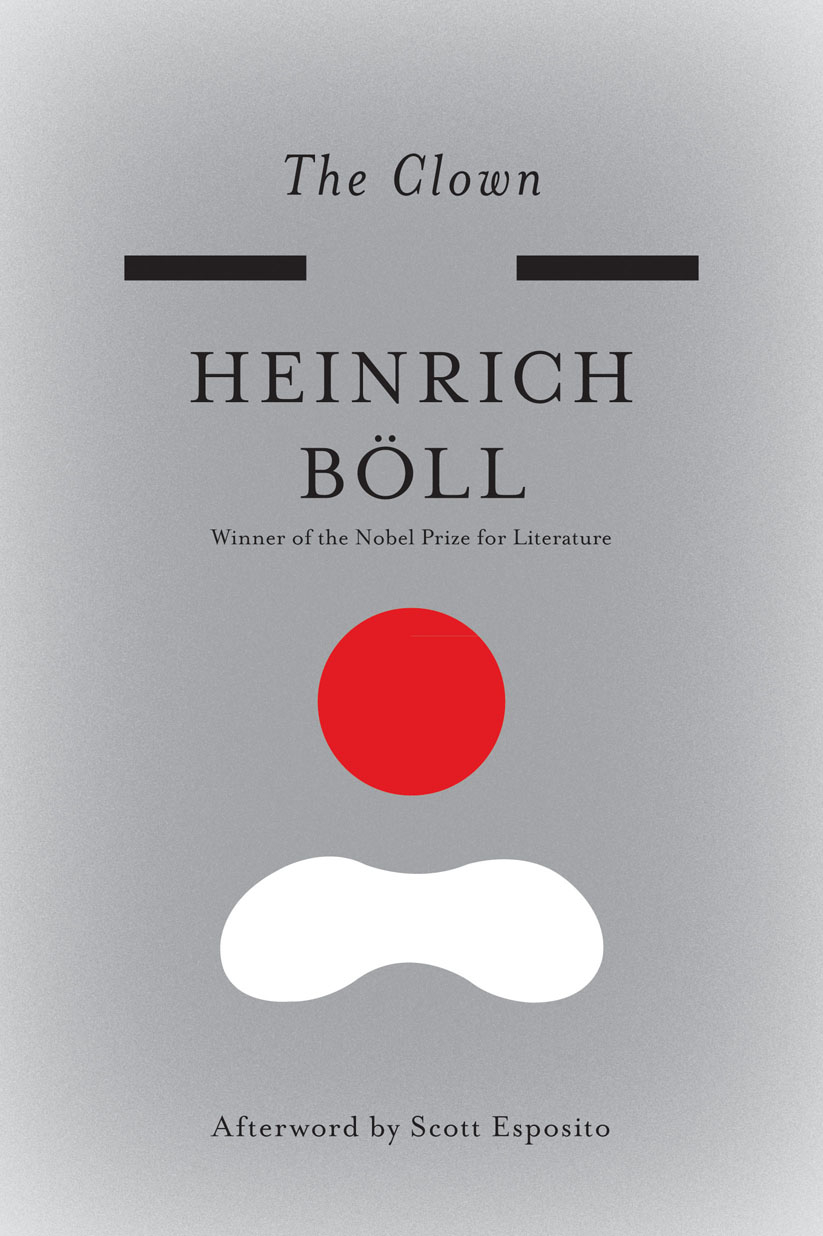
The Book Bench interviews designer Kelly Blair about her work and her Heinrich Böll redesigns for Melville House:

There are so many amazing and striking book covers out there, yet I am most often drawn to the simplest thing on the shelf. Perhaps it’s because I am so immersed in book design day-to-day, but sometimes going into the bookstore can feel visually overwhelming, like the cereal aisle at the grocery store. To that end, David Knopka’s series design for the Melville House novellas still stands as one of my favorites. For the same reason, walking into the Persephone book shop in London feels like a breath of fresh air.

And on the subject of book covers, I’ve been loving designer Andrew Henderson‘s Lovely Book Covers Tumblr.

You can find The Casual Optimist Tumblr here.

Cabaret — Author Hanif Kureishi on the art of writing for The Independent:

There’s no connection between being able to write and being able to explain your work in a rain-swept tent to an audience staring at you like hungry animals contemplating a suspect steak. Listening and reading are different experiences. Reading, writing for a reader, and being read, are intimate acts, and there’s something about trying to articulate what you’ve done that can flatten and reduce it, horrifyingly so.

Some writers choose the written word because they find it difficult to speak directly; many writers are in love with solitude. Whichever it is, good writing should resist interpretation, summary and the need for applause.

The Information — Michael Dirda reviews Too Much To Know: Managing Scholarly Information Before the Modern Age by Ann M. Blair for The Washington Post:

Just how to present information for easy use was a constant vexation. In late antiquity, one might simply find a list of authorities cited. Gradually, though, compilers began to employ categorical headings or to arrange entries alphabetically or according to elaborate branching diagrams of knowledge. “One historian has counted nineteen different systematic orders present in early modern encyclopedic works, including the order of creation, of the Decalogue, of the biblical narrative,” and various “chronological and geographical orders,” as well as others that follow “the chain of being.”

While people during the Middle Ages and later drew much of their learning from dictionaries and digests, the more ambitious also took extensive notes from whatever classics came their way. By the Renaissance one could even purchase the equivalent of “Reading for Dummies”: Francesco Sacchini’s 1614 “De ratione libros cum profectu legendi libellus,” i.e.,”A Little Book on How to Read With Profit.”

The Science of Making Decisions — Sharon Begley on how too much information impairs our ability to make decisions:

The problem has been creeping up on us for a long time. In the 17th century Leibniz bemoaned the “horrible mass of books which keeps on growing,” and in 1729 Alexander Pope warned of “a deluge of authors cover[ing] the land,” as James Gleick describes in his new book, The Information. But the consequences were thought to be emotional and psychological, chiefly anxiety about being unable to absorb even a small fraction of what’s out there. Indeed, the Oxford English Dictionary added “information fatigue” in 2009. But as information finds more ways to reach us, more often, more insistently than ever before, another consequence is becoming alarmingly clear: trying to drink from a firehose of information has harmful cognitive effects. And nowhere are those effects clearer, and more worrying, than in our ability to make smart, creative, successful decisions.

And related… Jonah Lehrer, contributing editor at Wired and the author of How We Decide and Proust Was a Neuroscientist, on why easy decisions seem so hard:

The problem, of course, is that the modern marketplace is a conspiracy to confuse, to trick the mind into believing that our most banal choices are actually extremely significant. Companies spend a fortune trying to convince us that only their toothpaste will clean our teeth, or that only their detergent will remove the stains from our clothes, or that every other cereal tastes like cardboard. And then there is the surreal abundance of the store shelf… While all these products are designed to cater to particular consumer niches, they end up duping the brain into believing that picking a floss is a high-stakes game, since it’s so damn hard. And so we get mired in decision-making quicksand.

Comments closed

Q & A with John Williams, The Second Pass

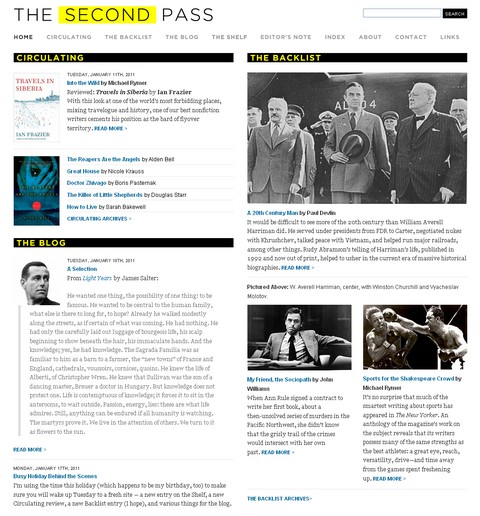
I feel a special admiration for The Second Pass. Launched almost two years ago — shortly after first tentative posts at The Casual Optimist — and with a list of whip-smart contributors, it seemed to signify a second wave online literary journals that built on the success of groundbreaking sites like  Bookslut and ReadySteadyBlog. Well-designed and appropriately eclectic, it had wider horizons than ailing newspaper review pages, and yet Brooklyn-based founder John Williams — who previously worked in publishing — seemed less prone to the snark so commonplace among some of the more established online literary set.

I was, needless to say, surprised when I first received an email from John. The idea that he had even heard of the less-than whip-smart The Casual Optimist seemed so… unlikely. And yet, John and I have remained in touch on and off for the past year and half, and I have even contributed to The Second Pass, so I thought it was high time I talked to him about the site and its recent book party in Brooklyn.

We corresponded by email…

For those people unfamiliar with the site, could you describe The Second Pass?

The site is an online magazine devoted to books new and old. It features reviews of new books, essays about older and more obscure books, and a blog about books of all stripes. That’s the basics. It’s a place where serious readers of all kinds can enjoy themselves and, from time to time, maybe learn about a book or author they might not otherwise learn about.

What makes The Second Pass unique?

Unique is a strong word. There are other sites and publications that pay attention to obscure books, but I think the site’s regular devotion to it — including out-of-print books — is rare, if not entirely unique. I also like to think the writing is generally at a level that separates it from many other online-only enterprises.

What lessons have you learned in the first 20 months of editing the site?

Plan ahead. And have contingency plans. I’ve learned those lessons, though I’m still learning to act on them.

Appearance and readability often seem to be an afterthought for websites about books, but that doesn’t seem to be the case with The Second Pass. Did a lot of planning go into the design of the site?

Yes, my friend Strath Shepard spent time coming up with several visual ideas for the site, and I chose from among them — any one of which I would have been thrilled with. I wanted to make sure the site looked good, because I think design is as important online as anywhere else. It should be strong and inviting without being an obstruction or a distraction, in my opinion.

Is it easier or more difficult for independent online literary journals to find an audience today?

Easier than it was in the past online? I’m not sure about that. My unscientific sense is that many more people are spending time online, but that the idea of a big audience for niche blogs or journals is more or less a dead dream. Reaching a certain core number of readers is easy enough online, if you’re patient and steady in your production, but I think the audience for serious books coverage is inherently limited in a way that can be hard to admit. I would rather try to reach the maximum of that particular audience (and I have no idea what that number would be; my site’s traffic is surely a tiny sliver of it) than start throwing too many things at the wall to try to reach a more general audience. I think the pressing need for lots of traffic is reflected at a place like The Huffington Post, where the books coverage is a hodgepodge of too-frequently-published pieces that don’t feel unified in any satisfying way. But those people who work for places where increasing traffic is paramount — to paraphrase David Letterman, I wouldn’t give their troubles to a monkey on a rock. I’m happy there’s no one above me worrying about traffic.

What other book sites do you read regularly?

Maud Newton, The Book Bench, Paris Review Daily, Bookslut, The Millions, John Self, Levi Stahl’s I’ve Been Reading Lately, the Barnes & Noble Review, Mark Athitakis, Novel Readings, and yours. Those might be the ones I check most regularly, off the top of my head, but I drop in on many more, most or all of them on the links page at The Second Pass.

Where does the name of your blog, A Special Way of Being Afraid, come from?

It comes from a Philip Larkin poem called “Aubade,” which is a terrifying and beautiful confrontation of the fear of death. It begins: “I work all day, and get half-drunk at night. / Waking at four to soundless dark, I stare.” And a bit later: “This is a special way of being afraid / No trick dispels. Religion used to try…” It’s always been one of my favorite poems, and I thought that phrase would make a good blog name, back in 2005, when I started it. I still like the name.

How has the experience as founder and editor of The Second Pass been different from blogging?

I started the older blog while working for a big publishing house, partly as a way to maintain the habit of writing and to develop my own voice while in a job that made it difficult to find time for those things. Especially in the beginning, I felt it was important to keep the blog regularly updated, for the exercise of it and for building readership, however modest. I feel that pressure more keenly with The Second Pass, since I have more ambitions for it. Ideally, I would update it far more often than I do. I also work with other people on The Second Pass. I wear all the hats, but I rely on reviews and essays from other writers, a social part of the experience that I really enjoy but that makes it different from the more dictatorial nature of the blog.

The blog is also more wide-ranging. I’m probably a reader first and foremost, but I’m also a longtime fan of music, movies, and sports, among other things. Not to mention the more personal things I might ruminate about over there. I still consider the blog a useful outlet for those things, though I’ve been terribly neglecting it for the past several months, if not longer.

The Second Pass held its first event in November. What made you decide to throw a party?

I had been meaning to have a party ever since last March, when the site celebrated its one-year anniversary, but was stymied by various obstacles that wouldn’t have stymied someone with more resolve. I thought it would be fun to have a party, and figured it couldn’t hurt the site’s visibility. Plus, I wanted to showcase some of the fantastic people who have written for the site.

Who read at the event?

Carlene Bauer, Will Blythe, and Maud Newton read from works of fiction in progress. Jason Zinoman read from his book about horror movies in the 1960s and ’70s, which is being published here next summer. And Lauren Kaminsky read an excerpt from a terrifically weird book called Listen, Little Man by Wilhelm Reich, a screed written by an Austrian psychoanalyst who worked with Freud and later seemed to have cracked up pretty good. I’m hoping Lauren will write about the book (and him) for the site at some point.

Do you think the evening was a success? And will you be organizing more events in future?

I thought it was a big success. I’m biased, of course, but the readers couldn’t have done a better job, there was plenty of wine and food, and everyone seemed to have a good time. Melville House, an independent publisher and bookstore in Brooklyn, was a gracious host. And yes, I’m certainly hoping to do it again, perhaps in Manhattan next time, when the site turns two (which happens March 10) or soon after.

Do you think interest in live book events will see the same kind of revival that live music events have in recent years?

I think live book events, at least in New York, have been thriving in recent years. My dirty little secret is that I find many traditional readings dull. Not all, but many. Lots of good writers just aren’t good readers, which is no knock on them. It’s not their job, and they’re very different skills. Only a few lucky people have both. I think it’s also asking a lot of a text to keep people interested for a long stretch of time while it’s read aloud. (I’m not a big fan of audio books for that reason, though this is probably saying much more about my aural attention span than about the worth of audio books.)

Who are some of your other favourite authors?

William Trevor, Richard Russo (especially pre-Pulitzer), Marilynne Robinson, David James Duncan, Dostoevsky, Lorrie Moore, Wilfrid Sheed, Nabokov, William James, Martin Amis (back when), Iris Murdoch, Richard Ford (the Bascombe books, particularly), to name a few.

What were your favourite books of 2010?

I recently finished The Killer of Little Shepherds by Douglas Starr, a nonfiction story set in late-19th-century France, which tells the parallel stories of a serial killer on the loose and a criminologist who was doing a lot to introduce the set of forensic techniques that we now, thanks to TV, simply refer to as “CSI.” It’s a gripping story, smartly told. I also enjoyed Brady Udall’s The Lonely Polygamist. He’s an old-fashioned storyteller, sweeping and just the right amount of sentimental, and this novel is about a Mormon with four wives and 28 children.

What books are you looking forward to reading in 2011?

I’m glad you asked this, because it reminded me that I’m behind in figuring out what the site will cover this year. I’m a fan of Jonathan Coe’s work, and his new novel, The Terrible Privacy of Maxwell Sim, is coming in March. Just today, I received a galley of House of Exile by Evelyn Juers, a biography of Heinrich Mann, his wife Nelly, and their circle of famous friends. I’ve been looking forward to its U.S. publication since I read a terrific review in the TLS. And of course, there’s David Foster Wallace’s novel in April. Though I’m skeptical of posthumous releases, including this one, I’m as curious as every other fan of his.

Thanks John!

Photo credit: Justin Lane

credit Justin LaneJ
Comments closed

Bring the Noise: Alex Ross Talks to Paul Morley

Paul Morley interviews fellow music critic Alex Ross, author of The Rest is Noise and Listen to This,  for The Guardian:

Morley’s post about critics, and meeting Alex Ross, is also worth reading:

I’ve always liked a critic who doesn’t think like anyone else. Someone who takes me so much by surprise with their opinions, approach and rigour that they themselves become a kind of artist. I like a critic who demonstrates that they deserve to evaluate and document the work and art of others by writing in such a way that the work makes more sense, sometimes only makes sense, because of what they write and why they write it. I loved critics, whether it was Kenneth Tynan, Susan Sontag, Tom Wolfe, Richard Meltzer, John Updike, Roland Barthes, Pauline Kael, Angela Carter or Lester Bangs, for the way they made it clear, with such evangelical poise, precision and purpose, that without the great critic, the world, and the worlds of those that made up the world, was never properly finished off.

Comments closed

Something for the Weekend

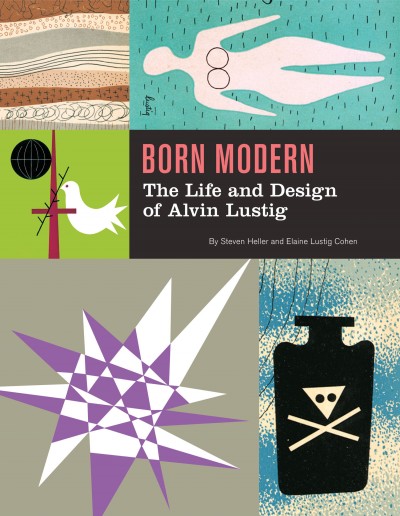
Past and Present — An excerpt from Born Modern: The Life and Design of Alvin Lustig by Steve Heller and Elaine Lustig Cohen at Design Observer*:

Lustig’s designs fluidly shift from past to present. For his early “experimental” work he built upon an armature of old technologies… and techniques…, which evolved through new technologies… into unprecedented styles… Toward the end of his life, his typography turned into a playful amalgam of vintage letters composed in contemporary layouts with vibrant colors. In “Personal Notes,” he wrote, “As we become more mature we will learn to master the interplay between past and present and not be so self-conscious of our rejection or acceptance of tradition. We will not make the mistake that both rigid modernists and conservatives make, of confusing the quality of form with the specific forms themselves.”

The AuthenticChuck Klosterman, author most recently of Eating the Dinosaur, profiles Jonathan F., author of Freedom, for GQ Magazine:

It’s a present-day problem: There’s just no escaping the larger, omnipresent puzzle of “reality.” Even when people read fiction, they want to know what’s real. But this, it seems, is not Franzen’s concern. He disintegrates the issue with one sentence.

“Here’s the thing about inauthentic people,” he says on the train, speaking in the abstract. “Inauthentic people are obsessed with authenticity.”

Telling Stories — Nicholas Carr, author of The Shallows, on interactive storytelling:

The ability to write communally and interactively with computers is nothing new… Digital tools for collaborative writing date back twenty or thirty years. And yet interactive storytelling has never taken off. The hypertext novel in particular turned out to be a total flop. When we read stories, we still read ones written by authors. The reason for the failure of interactive storytelling has nothing to do with technology and everything to do with stories.

Footnotes — Part one of a long interview with journalist and cartoonist Joe Sacco, author most recently of the remarkable Footnotes in Gaza, at Art Threat (via Drawn):

[T]he biggest influence on me journalistically speaking has been George Orwell. I don’t know if you’re familiar with the book Road to Wigan Pier, but Orwell spent time in the industrial areas of Britain during the depression and took a room with a miner, lived with miners. He went down into the mine shaft with the miners. His ability to go to these places and really look at things from a ground level, that was impressive to me. And for other reasons too: because he was so dedicated to his work, and he felt that his work was sort of bigger than himself as a human being. I appreciated that dedication.

Part two will run on Monday apparently…

And finally… Superhero WikiLeaks:

(Thanks Shawn)

*Born Modern is published by Chronicle Books and is distributed in Canada by my employer Raincoast Books.

Comments closed

Midweek Miscellany

I’m something of skeptic when it comes to Nick Hornby (to put it politely) but the “Ministry of Stories” is, despite its Orwellian moniker, clearly a well intentioned venture, and the design of its Hoxton Street Monster Supplies storefront by We Made This is pretty stellar.

There is more on the Ministry of Stories, which is based on David Eggers 826 project, at The Guardian.

Elsewhere…

Largehearted Boy is doing everyone a favour by aggregating every online “Best of 2010” book list he can find.

AND Design Observer’s contributing writers recommend books for the holidays. While The Bygone Bureau asks some stellar bloggers for their Best BLOGS of 2010.

The Daily Cross Hatch has a four-part interview with Love & Rockets cartoonist Jaime Hernandez:

There are teachers and there are doers—I’m a doer. I don’t know how this stuff happens, it just spills out of me, it’s that kind of thing.

After a while, I’ll think about it and say, “oh, that’s how I do it.” But I couldn’t stand in front of a class and tell them how to do it.

[part one] [part two] [part three] and [part four]

And finally…

A fantastic animated Batman short by Spanish illustrator Javier Olivares:

(via The Ephemerist)

Comments closed

PKD Documentary

After mentioning Philip K. Dick earlier this week, it only seems appropriate to post A Day In The Afterlife, a 1994 BBC documentary about the author:

(via Largehearted Boy | Open Culture)

2 Comments

What Is There In Life If You Do Not Work?

A winsome post by William Zinsser, author of On Writing Well, on work and writing for The American Scholar:

I’ve never defined myself as a writer, or, God forbid, an author. I’m a person–someone who goes to work every morning, like the plumber or the television repairman, and who goes home at the end of the day to think about other things. I can’t imagine not going to work as long as I can…

…It may seem perverse that I compare my writing to plumbing, an occupation not regarded as high-end. But to me all work is equally honorable, all crafts an astonishment when they are performed with skill and self-respect. Just as I go to work every day with my tools, which are words, the plumber arrives with his kit of wrenches and washers, and afterward the pipes have been so adroitly fitted together that they don’t leak. I don’t want any of my sentences to leak. The fact that someone can make water come out of a faucet on the 10th floor strikes me as a feat no less remarkable than the construction of a clear declarative sentence.

(via  Coudal)

2 Comments

Midweek Miscellany

Vintage Dostoevsky, design by Michael Salu

Precisely and Concisely — The Caustic Cover Critic interviews designer and Artistic Director of Granta magazine Michael Salu:

Bizarrely, designers looking for employment are often judged by what software they’re able to use. Intellect, cultural awareness and often creativity don’t seem to be values worthy of a resume. There is no substitute for good ideas, the rest are just supportive tools. I have always been quite a craft-led designer, but I am of the generation that studied with a mac in front of them and I think its good to understand the importance of both.

The Honest Bookseller — Erin Balser of Books in 140 profiles Toronto independent bookstore Ben McNally Books for The Torontoist:

“I’d rather have a book that sells one copy that no one else will sell than to stock several best sellers you can get anywhere,” McNally says. “That’s what makes this store. That’s why people come… My first responsibility is my customer. When I think a book should be cut by a third or if there’s a subplot that goes nowhere, I have to tell you that… I’m often a very critical reader. When people come and ask me ‘Is this any good?’ I have to be honest.”

William Kentridge: Five Themes — Beautiful book design from Abbott Miller and Kristen Spilman at Pentagram.

Speaking of Pentagram… Pentagram partner Paula Scher has some blunt stuff to say about design in a interview with Pr*tty Sh*tty.

The Rules — Inspired by Elmore Leonard’s 10 Rules of Writing, The Guardian asked authors — including Diana Athill, Margaret Atwood, Richard Ford, Jonathan Franzen, Neil Gaiman, and PD James, Hilary Mantel, Michael Moorcock, Philip Pullman, Ian Rankin, Will Self, Sarah Waters, and Jeannette Winterson — for their personal dos and don’ts. (Part two is here).

On the subject of writing, the wonderful BBC radio series The History of the World in a 100 Objects has recently touched on the history of writing, literature, and mathematics in episodes about the Early Writing Tablet, the Flood Tablet and the Rhind Mathematical Papyrus. The series is a collaboration with The British Museum. Great stuff.

Diana Athill, Margaret Atwood, Roddy Doyle, Helen Dunmore, Geoff Dyer, Anne Enright, Richard Ford, Jonathan Franzen, Esther Freud, Neil Gaiman, David Hare, PD James, AL Kennedy
1 Comment

Q & A with Nick Asbury, Corpoetics

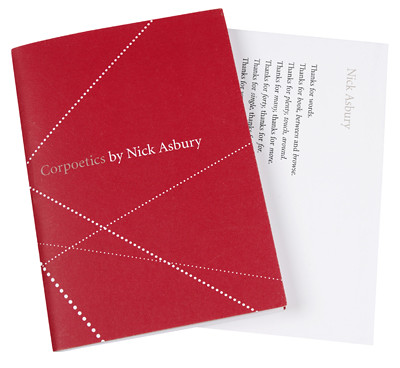
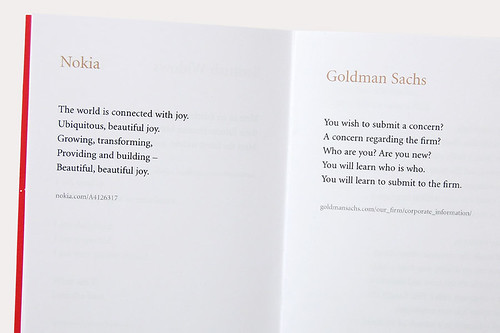
I was quite taken with the lovely design and gentle subversion of  Corpoetics — a chapbook collection of ‘found’ poetry taken from the ‘Corporate Overviews’ of well-known brands and corporations — when I first saw it at Ace Jet 170 in February.

Author Nick Asbury was kind enough to get in touch after I mentioned the project here, so when Corpoetics recently won a Yellow Pencil for Writing for Design at the 2009 D&AD Awards, it seemed like a perfect excuse to talk to Nick a bit more about the project, the corporate use of language, and interesting not-for-profit work…

What inspired Corpoetics?

My day job is as a writer for businesses and brands, so I’ve long been immersed in the corporate world. I’ve often sought refuge in reading and occasionally writing poetry, so I guess it was inevitable that the two would cross over at some point.

How would you describe ‘found’ poetry?

I came across a good quote by Annie Dillard, talking about the ‘doubling effect’ you get in found poems. ‘The original meaning remains intact, but now it swings between two poles.’ I think that’s about right. You get an interplay between the original meaning and where you’ve taken it — and there’s a lot of potential for humour and subversion, particularly when the source material is from the corporate world.

The language of several of the poems is almost Orwellian. Do you have a sense that corporations (deliberately or otherwise) dehumanise language?

Yes, dehumanise is exactly the word. A lot of corporate language is designed to erase any sense of individual responsibility. It’s much safer to talk about how ‘a decision was taken’ rather than saying ‘I took a decision’. So you get this very passive, depersonalised way of talking. Then there’s the widespread tendency to hide behind jargon and non-committal abstractions. In some cases, it’s deliberately intended to conceal or exclude. But a lot of businesses drift into it without realising — it just becomes the norm for writing in a business context.

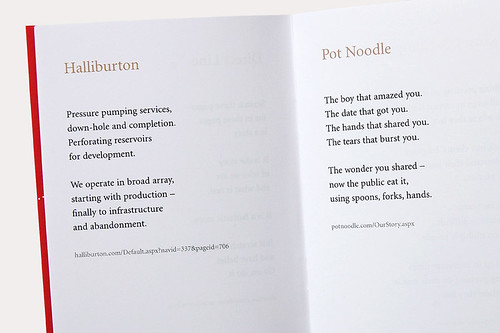
The poem I wrote about Halliburton is probably the most Orwellian in tone. It takes their words and lets their emptiness ring out in this very eerie way. But it didn’t take a lot of rearranging — it’s more like a condensed version of the original.

As a copywriter and consultant, do you feel a certain irony in the subversion of corporate language in Corpoetics?

Definitely. When I first had the idea, I was very aware of biting the hand that feeds me. But then the aim is not just to subvert corporate language and hold it up to ridicule (although some poems do). I also wanted to pick brands that I liked. People like Greggs The Baker — a fixture on British high streets — or Pot Noodle, a famously throwaway junk food here in the UK. It was interesting taking their words and seeing where they went. Pot Noodle became a story of a relationship that begins in furtive excitement and ends in squalor, much like the experience of the product itself.

Is it possible for business writing to have warmth and wit, or is it inherently evil?

That depends whether you think all businesses are inherently evil. I don’t. We all need to earn money and make a living — and work is a noble and necessary thing. Whether it’s the local bakery or a multinational giant, plenty of businesses make an honest living and do good things. Those businesses have a good story to tell — and there’s room for warmth and wit in the telling. Of course, the unfortunate truth is that a lot of ‘good’ business writing is a matter of spin — making companies seem better than they are. But the very best writing will always be for good companies with something truthful to say.

Have you had any response from the companies featured in Corpoetics?

Yes, KPMG got in touch. I took a deep breath when the email arrived, expecting a stern ultimatum from the legal team. But it was very positive. They said they wanted to feature it in their internal company newsletter and run a competition to get people to send in their own poems. I’d like to have seen the results, but still haven’t managed to track them down.

Why did you decide to publish Corpoetics as a book rather than make it a web-based project?

It seemed a very natural thing to do. Poetry just feels more satisfying when it’s in print. I work as one of a partnership (Asbury & Asbury) alongside my wife Sue, who is a graphic designer. So we thought about turning it into a design project as well as a writing project — taking graphic elements from the companies featured and rearranging them in some way. But we decided it was overkill. It’s ultimately a project about language and we wanted to let the words do the work.

Is the visual presentation of written language important to your work?

Yes — ever since I started out in business writing (about 12 years ago), I’ve worked closely alongside graphic designers. In fact, most of my work is commissioned by design and branding companies, so it’s a natural fact of life. I’d find it hard to write anything without having some sense of the way it will be presented visually. It’s never just about the words or the design, but the overall act of communication.

So good writing and good design go hand-in-hand?

Yes, ideally. I find a lot of the best designers are pretty good with words. Both professions have the same base skills. You need to analyse a brief, empathise with an audience, spot lateral connections, tell a story, make an imaginative leap. The disciplines only separate out right at the end, when the designer goes off to do the pictures and the writer gets typing.

What other projects are you currently working on?

I usually have three or four paying projects at any one time. At the moment, I’m writing an annual review for a British charity, some marketing literature for a hotel operator, and an advertising campaign for an Austrian law firm. Alongside all that, as Asbury & Asbury, we continue to work on our own projects. The latest is a collection of children’s poetry called ‘Songs For Animals‘, but it may not see the light of day for a while yet.

Can you tell me about 26?

It’s a not-for-profit collective of writers, editors, journalists, designers, publishers — anyone with an interest in language, both in a business context and more generally. As you might have guessed, the name comes from the letters of the alphabet, the DNA of language — and naturally, it costs £26 a year to be a member. I got involved shortly after it started up in 2002 and am now one of the directors responsible for running the whole thing — or trying to. It’s operated entirely on voluntary time and can be quite chaotic, but they have produced some really interesting collaborations, resulting in books, exhibitions and a whole series of public talks and events. It’s principally UK-based, but there are chapters springing up in South Africa, Sweden and elsewhere. I’d urge anyone with an interest in the subject to join. You’ve got nothing to lose. Except maybe £26.

Thanks Nick. Corpoetics is available for £5 plus p&p from  Asbury & Asbury , with proceeds going to the National Literacy Trust, a UK charity dedicated to changing lives through literacy.

1 Comment