Skip to content

Tag: Writing

Q & A with P. D. Smith

City A Guidebook for the Urban Age is the fascinating new book by British writer and reviewer by Peter D. Smith. Published by Bloomsbury, it is a wonderfully meandering collection of essays on cultural history of the world’s cities and an exploration of architecture and urban life from the earliest cities in Mesopotamia to the future dystopias of The Sleeper Awakes and Blade Runner.

I first came across Peter via his reviews for The Guardian newspaper and his lively Twitter feed which, if you are interested, provides the curious with steady stream links about books, history, science and architecture of the kind one might expect from another cultural magpie, William GibsonCity was still a work in progress at that point and having followed it’s development over the past couple of years, I was glad to finally have the opportunity to read it last month. It didn’t disappoint.

Peter and I talked by email…

When did you first become interested in writing?

As a child I was always writing stories, usually fantasy or science fiction. When I was about thirteen we had to write a story for school during the summer holiday. Mine was a space opera about bug-eyed aliens on a distant world. By the end of the holidays I had filled a whole exercise book and even designed a cover for it. I doubt my poor teacher read it all. But I got top marks for effort at least.Afterwards the other kids in my class started reading it and passing it around. Then this boy from another class got hold of it. He had close-cropped hair and wore Doc Martens boots. Weedy bookworms like me generally tried to keep out of his way, but one day he stopped me outside the school gates. I thought he was going to hit me. Instead he started talking about my story. He liked it! I was astonished and I’ve never forgotten that moment. It taught me something about writing and its ability to connect with people.

Your previous books are about superweapons and Albert Einstein. Why did you decide to write a book about cities?

My doctorate was about scientific ideas in German literature, from Goethe to Brecht. The biography of Einstein and the cultural history of doomsday weapons grew directly out of my interest in the way science and culture influence each other. But for my next book I wanted to do something a bit different, from the point of view of both subject and style. I like subjects that cross boundaries and, right from the start, I loved the idea of writing a history of cities. It allowed me to explore everything from the technology of cities to the invention of writing and theatre. It also gave me the opportunity to experiment with different narrative structures. The vast scale of the subject meant it was impossible to explore in a straightforward narrative. Eventually I decided to write it as a guidebook to an imaginary Everycity. Of course, this brought its own challenges, but it was also fun. Most importantly, it made the whole project – which is in a sense a survey of civilisation – manageable as well as opening up the idea of the city, both as an idea and as a physical reality.

Is learning more about the subject you’re interested in part of the impulse for your writing?

Absolutely. I love researching a new idea. Writing a book is a bit like juggling with different bits of information, ideas, places, and characters. You have to keep them all up in the air, then gradually bring them down to the ground in some kind of order. It’s always an immense challenge and sometimes you feel you’re not up to it. But it’s a great thrill when you find something new – an idea, a fact, a juxtaposition. That’s what makes it all worthwhile.

Which books most influenced your thinking about cities?

Lewis Mumford’s The City in History was one of the books that inspired me initially. It’s an immensely impressive survey. Similarly impressive in both scale and erudition is Peter Hall’s Cities in Civilisation. The sheer imaginative range of Geoff Manaugh’s writing on architecture and urbanism on BLDGBLOG is also a constant source of inspiration. And, of course, Italo Calvino’s wonderful Invisible Cities was always there in the background. It’s such an evocative piece of writing about cities and the urban experience.

Why do you think there has been renewed interest in urban living in recent years?

In the US, the 2011 census showed that more young people are choosing to live in cities. For the first time in a century, big cities in America are growing at a faster rate than the suburbs. That’s happening elsewhere too. Perhaps this is because, after the recession, people are less inclined, or able, to buy homes and prefer to rent instead. Or it could be that a new, wired generation has rediscovered the joys of urban life: of living somewhere with public transport, where you can experience diverse cultures and lifestyles, and where you can tap into the creative buzz of city life. In the developing world cities are also growing at an unprecedented rate, morphing into megacities of 20 or even 30 million people. They are the largest artificial structures ever built. People are drawn to them as they have always been – to find work, education, health care, or to escape the confined world of the village. As the medieval German saying goes: Stadtluft macht frei – city air sets you free.

The book covers a lot of different topics, but the idea of ‘the city’ is a vast, open-ended subject. Were there things you were sorry to leave out?

Yes, certainly. There were many topics that had to be dropped. They included urban myths, street painters, and secret cities, like the ones built during the cold war. Even without these, the first draft was too long and more material had to be cut. But I’m very happy with the finished text. Sometimes in a book like this, less is more.

One of the more sobering part of the book addresses climate change. But you see cities as part of the solution. Why is that?

The population of the world is rising inexorably and cities are growing larger. We need to reduce the ecological footprint of our cities. This can be done with good planning and the use of cutting-edge technologies to reduce greenhouse gas emissions. Cities can be green: they can generate their own energy, they can provide bicycle lanes and efficient public transport, they can even grow some of their food in rooftop greenhouses. Concentrating people in cities is a highly efficient way of supplying large numbers of people with clean water, healthcare and energy. By contrast, suburban living, where everyone drives cars and lives in detachedhouses, is wasteful of scarce resources and is unsustainable as a model for the world as a whole. Although New Yorkers produce many times more greenhouse gasses than those who live in Mumbai, New Yorkers are responsible for only a third of the carbon dioxide of the typical American. City living can certainly be part of the solution to the environmental challenges of the future.

Has new technology changed how we live in cities?

Yes, new technologies are always changing the shape of cities. Think of the automobile. The internal combustion engine has had a huge impact on cities and how we live in them, as did railways and subways. In the future, cities will be more aware of their inhabitants. Surveillance technologies and electronic chips and sensors will pervade the structures and spaces of the city. Buildings and streets will respond to your presence, automatically adjusting things like air temperature and lighting. But no matter how advanced our technology becomes, cities will still have to satisfy the same kind of demands that city dwellers have had for millennia. We are social animals and our greatest cities will always be dynamic centres of work, culture, entertainment, and shopping.

Why do you think Blade Runner’s dystopian portrayal of Los Angeles has become the prevalent cinematic vision of the city of the future? 

It’s true – in modern fiction and film, future cities are usually depicted as dystopias. Blade Runner – one of my favourite films – draws on a rich fictional tradition, including HG Wells’ The Sleeper Awakes and Fritz Lang’s Metropolis. But this has not always been the case. In the Renaissance, dreaming up ideal cities seems to have been something of a philosophical game among intellectuals and artists. They wanted to reform society and they believed people could be improved by creating perfect cities. The quest for ideal cities continued among architects and city planners into the twentieth century. But writers and filmmakers became more pessimistic about the urban future. Today these dystopian visions have become something of a cliché. People are no longer fleeing the city as they were in the second half of the twentieth century. Maybe the time is ripe for a new idealism about the urban future. As Calvino said, ‘With cities, it is as with dreams: everything imaginable can be dreamed…’.

Do listen to music while you write? What did you listen to writing City?

Yes, I do usually listen to music, both while reading and writing. If I’m writing non-fiction it tends to be classical music, such as Mozart or Bach, especially the cello suites played by Paul Tortelier, which I really love. But it depends on my mood. Sometimes I’ll choose something by Michael Nyman, Keith Jarrett or Brian Eno’s Apollo soundtrack, which is one of my favourites. If I’m writing fiction then it can be anything from Radiohead or Bjork, to Pink Floyd or Talking Heads.

What books have you read recently?

Fiction: Balzac’s Old Man Goriot, Dashiell Hammett’s Red Harvest, Nick Harkaway’s Angelmaker, and Sam Thompson’s Communion Town. Non-fiction: Taras Grescoe’s Straphanger, Roger Crowley’s City of Fortune, and Man Ray’s Self-Portrait.

Do you have a favourite book?

Mervyn Peake’s Titus Groan. Gormenghast is such a powerful imaginary architectural space – a kind of Gothic megastructure. It’s a remarkable creation.

What are you working on right now?

A new non-fiction book about the city of crime. It’s still in its early stages but I’m enjoying it immensely. It’s a wonderful excuse to watch film noir and to read lots of great crime fiction.

Are you concerned about the future of books and book reviews?

Not really. The world of publishing – both of books and newspapers – is certainly changing. I’m writing this on my new iPad which I’ve bought mostly in order to be able to read e-books. I’ve run out of shelf space in my house, so I’m going to expand my library into the digital realm. I’ll always love paper books, just because that’s the technology I’ve grown up with. But a new generation will grow up using e-readers and they’ll see (and read) things differently. I think people will always want to read book reviews in newspapers, whether they are on paper or online. But now book lovers also read and write book blogs and they want to discuss what they’re reading on Twitter. Once if your book didn’t get reviewed in the press that was probably the end of the story. Now a book can become a bestseller because enough people rave about it online. Clearly there are major challenges facing publishers, especially regarding piracy and the pricing of books in an age when many people seem to think they should be free. There’s no doubt it’s a tough time to be making a living as a writer! Plus ça change…

Thanks Peter!

Comments closed
Something for the Weekend

Do It Yourself — John Self, of the excellent Asylum blog, on the power of independent readers, at The Guardian:

if publishers and authors are limited in what they can do for a book online, who is left? They want to harness word of mouth, and power lies collectively in the independent readers – you and me. Can we make a difference when the bookselling world is full of outlets, online and off, which primarily sell what already sells, or can be related to a proven success (“It’s Fifty Shades of Grey meets Harry Potter!”)? If social media has inspired a new age of grassroots political activism, why not literary activism, too?

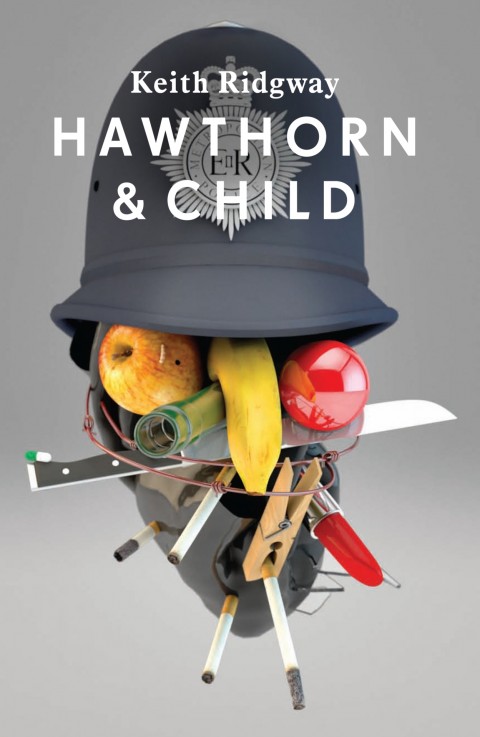
I picked up Keith Ridgway’s new book Hawthorn & Child almost entirely on the basis of John’s recommendation (I also read Colony by Hugo Wilcken, one of my favourite books of recent years, as a result of John’s review). The astonishing cover (pictured above) is by Tom Darracott by the way.

(Semi) Colonoscopy — Mary Norris on how to use the semicolon, at The New Yorker:

So the semicolon is exactly what it looks like: a subtle hybrid of colon and comma. Actually, in ancient Greek, the same symbol was used to indicate a question.

And it still seems to have a vestigial interrogative quality to it, a cue to the reader that the writer is not finished yet; she is holding her breath.

And finally…

Imaginary Buildings — Jimmy Stamp on the locations of 221B Baker Street, for The Smithsonian:

The mystery of 221B Baker Street is not one of secret passages or hidden symbols. Rather, it could be described as a sort of existential spatial riddle: how can a space that is not a space be where it is not? According to Arthur Conan Doyle’s stories, Sherlock Holmes and John Watson lived at 221B Baker Street from 1881 to 1904. But 221B Baker street did not exist in 1881, nor did it exist in 1887 when A Study in Scarlet was published and Baker Street house numbers only extended into the 100s. It was a purely fictional address – emphasis on was. Time marches on, Baker Streets are renumbered, and 221Bs are revealed…

Comments closed

New York Types

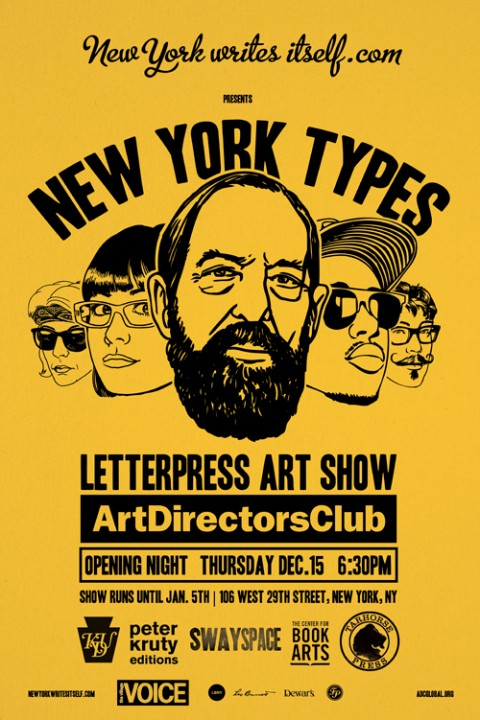
‘New York Types’ is a short film about New York, letterpress, and the art exhibition of the same name at the Art Directors Club last year. Inspired by the ʻThe Scriptʼ at  New York Writes Itself, the exhibition illuminated the sights and sounds of New York City:

Comments closed

Behind Every Great Novelist Is… by Grant Snider

Another charming illustration by Grant Snider for the New York Times Book Review. It appears alongside a review of John Sutherland’s Lives of the Novelists. Nicely done, sir. Nicely done.

Comments closed

Monday Miscellany

It is all hands to the pump at The Optimist HQ right now (meetings, deadlines, house maintenance, and vomit-propelled kids), but apologies for the missing links on Friday. Here’s a very quick Monday round-up to make up for it:

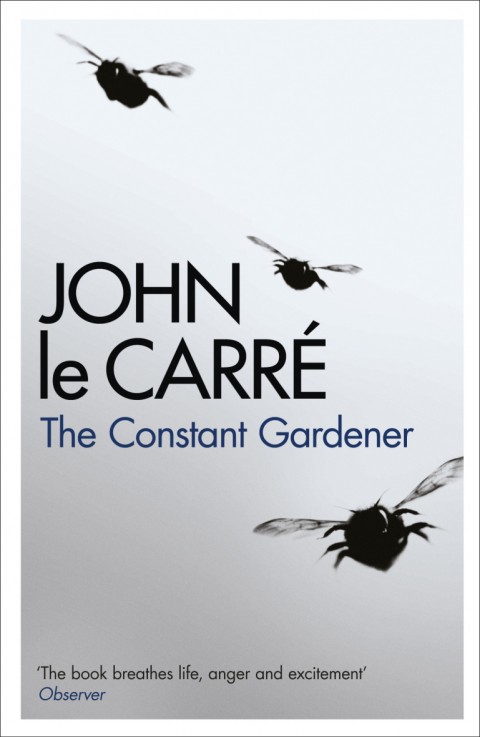
Designer Stuart Bache talks to Faceout Books about his John Le Carré covers.

I also talked to Stuart about his designs here.

Nicholas Carr, author of The Shallows, chooses five books on the impact of the information age at The Browser.

The Writer’s Job — Tim Parks on writing as a career choice:

Creative writing schools are frequently blamed for a growing standardization and flattening in contemporary narrative. This is unfair. It is the anxiety of the writers about being excluded from their chosen career, together with a shared belief that we know what literature is and can learn how to produce it that encourages people to write similar books. Nobody is actually expecting anything very new. Just new versions of the old. Again and again when reading for review, or doing jury service perhaps for a prize, I come across carefully written novels that “do literature” as it is known. Literary fiction has become a genre like any other, with a certain trajectory, a predictable pay off, and a fairly limited and well-charted body of liberal Western wisdom to purvey. Much rarer is the sort of book… where the writer appears, amazingly, to be working directly from experience and imagination, drawing on his knowledge of past literature only in so far as it offers tools for having life happen on the page.

1 Comment

Something for the Weekend

Adrift in the World — Tim Parks on fiction and place for the NYRB Blog:

If there is a problem with the novel, and I’m agreed with [David] Shields that there is, it is not because it doesn’t participate in modern technology, can’t talk about it or isn’t involved with it; I can download in seconds on my Kindle a novel made up entirely of emails or text messages. Perhaps the problem is rather a slow weakening of our sense of being inside a society with related and competing visions of the world to which we make our own urgent narrative contributions; this being replaced by the author who takes courses to learn how to create a product with universal appeal, something that can float in the world mix, rather than feed into the immediate experience of people in his own culture.

The Degree-Zero of Typeage — The “un-Google-able” Jenny Hendrix on Tintin for LA Review of Books:

Hergé himself described Tintin as the “degree-zero of typeage — a typographic vanishing point.” The formulation suggests Samuel Beckett, and there is indeed something Beckettian about Tintin. In French, appropriately, the phrase “faire tintin” means something approximating “to go without” or “to be frustrated.” Tintin may be a reporter, motivated, like any good journalist, by the hint of a good story, but only in his very first of his 24 adventures does he actually file copy. He was born 15, and supposedly stays that way, though it is hard to imagine he’s any age at all. He has no last name, no parentage and no past, no desires and no sexual identity. Even his appearance has little to say about him: his face is just a circle, with two black dots for eyes and a black, semi-circular wedge of mouth. He could be anyone, and frequently is…

Super-Punch — The New York Times reviews ‘Printing for Kingdom, Empire & Republic: Treasures From the Archives of the Imprimerie Nationale’, an exhibition of historical steel punches, copper matrices, and typefonts at the Grolier Club in New York:

[T]hese exquisite artifacts… offer a reminder, in the ethereal era of bitmapping, that type was once the tangible province of engravers and metal casters who labored in unforgiving but enduring media. To make a C with a cedilla, for example, involved a lot more effort and thought than holding down the Option key on your Mac. A comma-shaped steel appendage had to be lashed with string to the bottom of the C punch to produce a new matrix.

“People are practically printing books with their smartphones,” Mr. Fletcher said, in a tone suggesting that he did not think this was such a good idea. “It’s much more gratifying to be able to touch something and find out it’s real, rather than a matter of bits and bytes.”

Comments closed

Literary Devices

The Random Analogy Generator and other literary devices from Grant Snider:

(via This Isn’t Happiness)

Comments closed

Something for the Weekend


Read This — Alex Ross, author of The Rest is Noise and Listen To This, on books about music at FiveBooks:

There’s a long list of bad examples of vague and gushy writing about music in literature, but there’s also a string of distinguished examples. I wrote a piece for The New Yorker a couple of years ago where I talked about my favourite composers in literature. It makes me very happy when I see a novelist going to the trouble of getting the musical details right, because this is part of the conversation on classical music that we very much need. To have plausible and vivid representations of composers and classical musicians in literature and in film is very important.

(Disclosure: the paperback editions of The Rest is Noise and Listen To This are published by Picador in the US and are distributed in Canada by my employer Raincoast Books)

Building from the Bones of a Superstore —  Businessweek on the decline of Borders and the opportunities for independent bookstores in the US:

Despite rising online book sales and digital downloads and the Great Recession, bookstores in the area were profitable—right up until they closed. Even Davis-Kidd, locally owned until the Joseph-Beth Booksellers chain purchased it in 1997, had been solvent, undone not by the collapse of the local market but by the bankruptcy of the parent company… Nashville lost its bookstores not because people there had abandoned physical books and retailers. For the most part, it lost them remotely, at the corporate level.

It’s Just a Device — Errol Morris talks to Stephen King about the Kennedy assassination and his new novel 11/22/63:

When you write about the past, the more you write, the clearer the past becomes. It’s like being regressed under hypnosis. My view of the past is that attitudes change, but they change very slowly. Underneath, they stay pretty much the same. “The fundamental things apply as time goes by.”

The Artist and The Scientist — Paola Antonelli, critic and curator at MoMA, on type design for Domus magazine:

Font designers who are able to marry critical and commercial success are a unique mixture of two basic clichés: the artist and the scientist. They are eclectic, curious, obsessive and absorbed, as well as rigorous, punctilious, enamoured of rules and limitations, and loyal to a higher code of design behaviour. They are an even more different breed among the many different breeds of designers working today. Contending now with the dynamic methods of communication provided by tablet computers, smartphones and other supports for text and brand, they deal with each family of fonts as if it were truly made of individuals, live characters that need to be able to fend for themselves once released into the wider world. In this vein, font design might just be the most advanced form of design existing today.

And finally…

Failure and Disappointment — Comedian Ricky Gervais on the difference between American and British humour:

Americans say, “have a nice day” whether they mean it or not. Brits are terrified to say this. We tell ourselves it’s because we don’t want to sound insincere but I think it might be for the opposite reason. We don’t want to celebrate anything too soon. Failure and disappointment lurk around every corner. This is due to our upbringing. Americans are brought up to believe they can be the next president of the United States. Brits are told, “it won’t happen for you.”

Have. A. Nice. Day.

Comments closed

Something for the Weekend

Project Thirty-Three, one of my favourite mid-century modern design blogs, is now using Blogger’s “Dynamic Views” template. It looks great using the new ‘Flipcard’ feature.

The Crash — Alan Hollinghurst talks about writing and his new novel The Stranger’s Child with the New York Times:

Mr. Hollinghurst said he modeled his work habits on another friend and novelist, Kazuo Ishiguro. “He has this thing he calls ‘the crash,’ ” Mr. Hollinghurst explained. “He takes a lot of time to prepare a novel, just thinking about it, and then he draws a line through his diary for three or four weeks. He just writes for 10 hours a day, and at the end he has a novel.”

He laughed and pointed out that for him the Ishiguro method was only partly successful: at the end of three or four nonstop weeks he is still years away from being done.

Also in the New York Times, author Adam Thirlwell (The Escape) on translation and David Bellos’ new book Is That a Fish in Your Ear?:

Google Translate, no doubt about it, is a device with an exuberant future. It’s already so successful because, unlike previous machine translators, but like other Google inventions, it’s a pattern recognition machine. It analyzes the corpus of existing translations, and finds statistical matches. The implications of this still haven’t, I think, been adequately explored: from world newspapers, to world novels. . . . And it made me imagine a second prospect — confined to a smaller, hypersubset of English speakers, the novelists. I am an English-speaking novelist, after all. There was no reason, I argued to myself, that translations of fiction couldn’t be made far more extensively in and out of languages that are not a work’s original.

Counter-Culture — Loren Glass on Barney Rosset and the history of Grove Press at the LA Review of Books:

Philip Larkin famously dated the beginning of sexual intercourse to the end of the Lady Chatterley ban and, more recently, Fred Kaplan has used Rosset’s campaign to situate 1959 at the crux of an epochal transformation. Whatever its larger historical significance, it surely marked a turning point in the fortunes of Grove Press. On the brink of a decade in which the geopolitical order would be transformed, flush with cash for the first time, and well connected to the international avant-garde, the West Coast scene, and the nascent counterculture in college towns across the country, Grove was positioned in the eye of the coming storm. At the nexus of an emergent international vanguard, Grove became a potent symbol of the counter-culture, increasingly drawing radical authors, readers, translators, professors, lawyers and activists into its expanding network.

Part two of Glass’ history Grove Press is here.

And finally…

A slightly weird  interview with the David Lynch in The Guardian:

Film is dead, Lynch tells me. It is too heavy, too much of a dinosaur, and its time has largely past. But digital is alive and well and pointing to the future. He admits he’ll miss shooting on celluloid (“because it’s so beautiful”), but is more than happy to shoot on digital instead – as and when the opportunity arrives.

Until then he’s happy pottering around his studio and slurping his coffee; painting his spooky black houses and singing his eerie songs of love gone sour. “I can understand why people might be frustrated with me: ‘Let’s give up on these side ventures and go make a film instead.'” He chuckles. “But all these other things feed into the future. And if the ideas aren’t there for cinema, and if the pressure is on, then you might pick a bad idea and find yourself forced to marry something you’re not totally in love with. So I’m happy to wait.”

Comments closed

Something for the Weekend

The Dark Room — Filmmaker Grant Gee talks to BookForum about his new film Patience, which explores the work of author W.G. Sebald and his book Rings of Saturn:

There is one reference in an essay he wrote about Kings of the Road by Wim Wenders. He opens the essay with an interesting recollection of watching the film. He’s that generation; he’s absolutely of Wenders’ generation. Once you know that, you can feel the similarities between Wenders and Sebald, but Sebald willfully took himself away from that culture. I think of Sebald more as a photographer. There’s a quote I read somewhere where says he wasn’t very interested in school and he spent most of his time in the darkroom of the school’s photography lab. And there is something—I’m not sure if I’ve made this up or imagined it—about the way images work in his book: it feels to me like a black-and-white print developed under a red light, like it comes up out of whiteness, and if you leave it there it will black out in the tray.

Baggage — David Cronenberg talks to FilmComment  about A Dangerous Method, his film on Freud, Jung and Sabina Spielrein:

I don’t care what baggage people think I will bring to the movie. I don’t have that baggage. Once I decide on a project, I am honorable about how I treat it. I am not trying to put some false Cronenbergian imprint on it. Let’s just do the movie. Part of the project was the resurrection of the people and the era. That means it has to be as accurate as possible. I want the people to be as alive as they can be. I want to be able to smell them and hear them in a way that we can’t. It’s a matter of affection. I would like to have known them. That’s the only agenda I have—to honor the accuracy of these people and what they said.

And on the subject of Freud… Comic book creators discuss how mainstream comics portray women and how things can be improved at Comics Alliance. An interesting read.

And finally…

SUPERTYPE! — A collection of vintage comic book mastheads from the man who brought you 4CP and Comic Book Cartography (via Subtraction).

Comments closed

Private Library

In this short film, New York architect Andrew Berman discusses a commission to design a beautiful writing studio in the woods in Long Island:

Comments closed

Something for the Weekend

Not My Type — Paul Shaw really doesn’t like Just My Type by Simon Garfield:

This is the second time I have tried to write a review of Just My Type. It is a frustrating book—warm and friendly on the surface but obnoxious underneath. The first time, I methodically tore it to pieces in my blue-pencil style, pointing out its deficiencies in niggling detail. When I was done, I felt satisfied but also uncomfortable. Did Simon Garfield really deserve such a bashing? After all, the book is full of fascinating stories and odd trivia about type, and the author has a charming, breezy style that makes each bit of typographic arcana easy to swallow. Is it really that bad? Yes, it is.

Ouch.

“I just call them books” — Robert Birnbaum interviews author John Banville for The Morning News:

I don’t like this ghettoization of books. When I started publishing fiction it is was good, not so good, bad, you know. Now there is a ghetto for crime fiction. I would like to have books listed alphabetically—no distinction.

And finally…

Control+A / Control+ C / Control+V  — A provocative excerpt from Uncreative Writing: Managing Language in the Digital Age by Kenneth Goldsmith in the Chronicle of Higher Education:

There’s been an explosion of writers employing strategies of copying and appropriation over the past few years, with the computer encouraging writers to mimic its workings. When cutting and pasting are integral to the writing process, it would be mad to imagine that writers wouldn’t exploit these functions in extreme ways that weren’t intended by their creators… The previous forms of borrowing in literature, collage, and pastiche—taking a word from here, a sentence from there—were developed based on the amount of labor involved. Having to manually retype or hand-copy an entire book on a typewriter is one thing; cutting and pasting an entire book with three keystrokes—select all / copy / paste—is another.

Comments closed