Skip to content

Tag: new yorker

The Four Undramatic Plot Structures by Tom Gauld

gauld-four-undramatic-plot-structures-1200

Tom Gauld for The New Yorker.

Comments closed

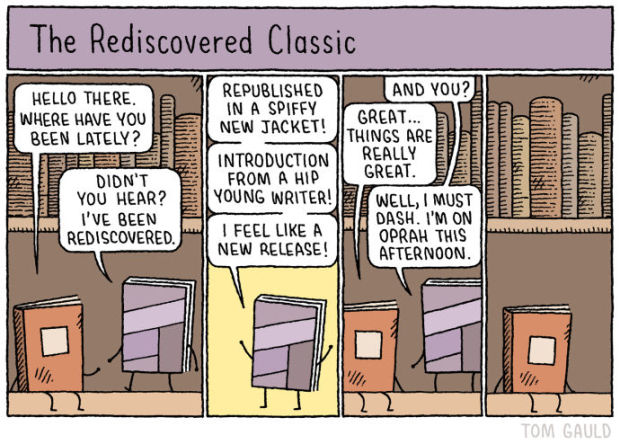
The Rediscovered Classic

Rediscovered-Classic-Gauld

Tom Gauld for The New Yorker.

Comments closed

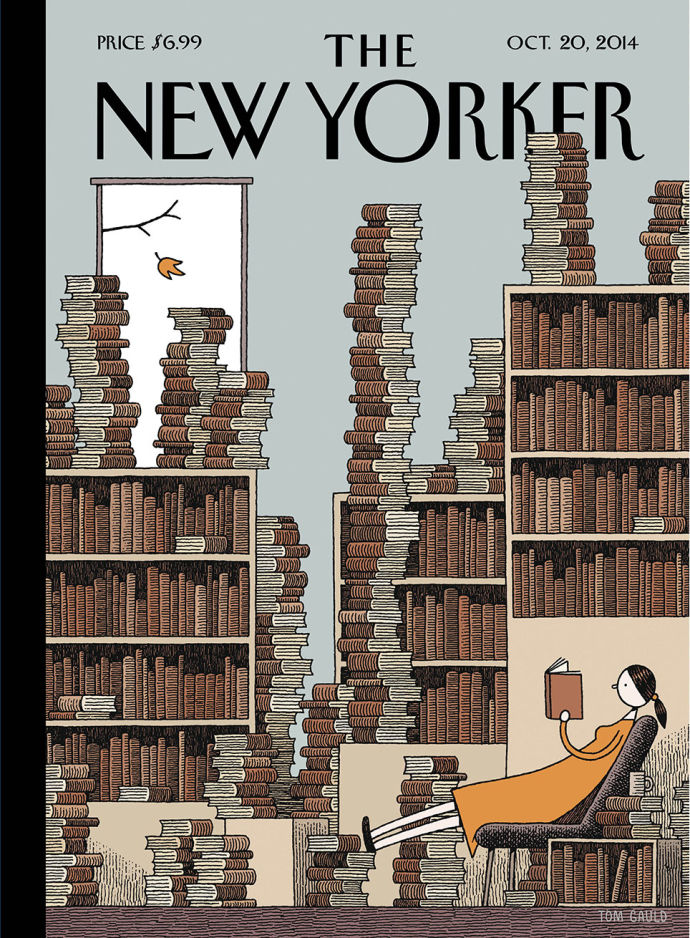
Tom Gauld’s Fall Library

CoverStory-Fall-Library-Tom-Gauld-690-938
Tom Gauld‘s new cover for The New Yorker.

(Happy Canadian Thanksgiving!)

1 Comment

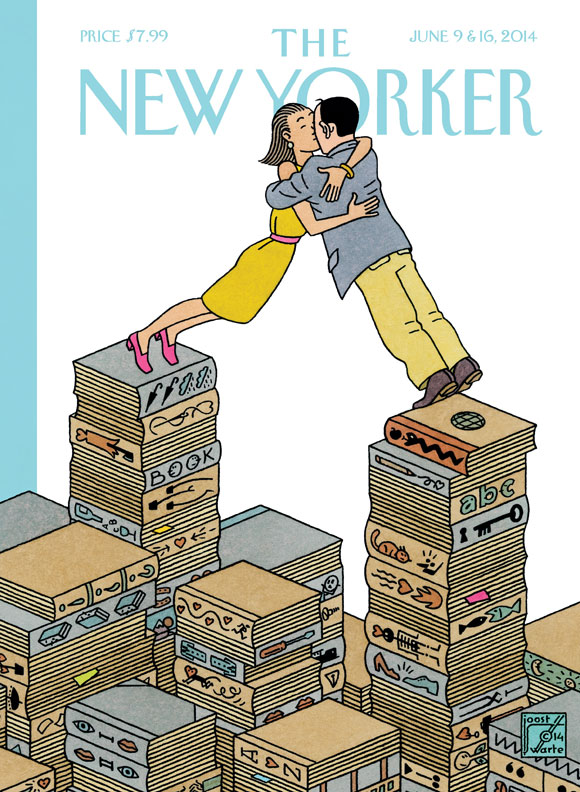
Joost Swarte’s Summer Love Stories

2014_06_09_Swarte_Love_Stories

Dutch cartoonist and designer Joost Swarte has drawn the cover for The New Yorker‘s new Summer Fiction issue.

1 Comment

Mourning Local Bookstores

Writing for the New York Times, Julie Bosman recently looked at how surging rents are forcing bookstores from Manhattan:

The closings have alarmed preservationists, publishers and authors, who said the fading away of bookstores amounted to a crisis that called for intervention from the newly minted mayor of New York City, Bill de Blasio, who has vowed to offer greater support to small businesses.

[Author Robert] Caro said in an interview that he is heartbroken by the loss of bookstores from Manhattan, calling it “a profoundly significant and depressing indication of where our culture is.”

“How can Manhattan be a cultural or literary center of the world when the number of bookstores has become so insignificant?” he asked. “You really say, has nobody in city government ever considered this and what can be done about it?”

There has, of course, been a similar trend in Toronto with the Cookbook store, the Annex location of Book City, and the Bloor West Village Chapters all closing (or about to) in recent months.

On a happier note though, Bosman notes that some stores are thriving by locating to other, more affordable neighbourhoods in New York (and beyond):

just as many writers have fled to Brooklyn or Queens in search of more affordable housing, some bookstore owners have followed. Greenlight Bookstore in Fort Greene opened in 2009 to robust business and year-over-year increases in sales.

In December, Christine Onorati, the co-owner of Word bookstore in Greenpoint, Brooklyn, opened a second store in Jersey City. Ms. Onorati said she never looked seriously at Manhattan because the rents were so unaffordable…

…After spending years scouring Manhattan for a second location, Ms. McNally of McNally Jackson abandoned her search. At the urging of a former employee, she began looking in Brooklyn and settled on Williamsburg, where she found a “magnificent,” loftlike space with a 20-foot ceiling.

I hope this will be true of Toronto too even though it is much smaller than New York (New York has more than twice the population of Toronto). But here, despite some well-defined neighbourhoods, bookstores seem to have been slow to follow their customers (and their families) to more affordable areas of the city. My neighbourhood, where I’ve lived for 8 years, is filling up with young families and yet many store fronts remain stubbornly empty. And while I consider myself lucky to still have a bookstore, Book City’s Danforth location, only four subway stops away, it feel like a very different neighbourhood. I would love to be able to walk to a bookstore with my kids, or stop in to browse on my way home.

Perhaps the bookstores further afield, in communities like Burlington and Hamilton, are doing better? I hope so.

Still, I will leave the final word to Rebecca Mead, author of My Life in Middlemarch, who has written a sharp response to the New York Times article for  The New Yorker:

Those of us who cherish our local bookstores do so not simply because they are convenient—how great to be able to run out for milk and also pick up the new Karl Ove Knausgaard!—but also because we feel a duty to support them, because we believe in their mission. When books can be bought so cheaply online, or at one of the dwindling number of discount retailers, paying more to shop at a local bookstore feels virtuous, like buying locally sourced organic vegetables, or checking to see if a T-shirt is made in the U.S.A. It can be gratifying to the point of smugness to feel that one is being pluralistic, liberal, and humane; shopping at an independent bookstore may be one of the diminishing opportunities to experience that feeling in first-class New York City. Still, when I consider the vanished bookstores of Manhattan, I mourn not just their passing but the loss of a certain kind of book-buying innocence—a time when where one bought a book did not constitute a political statement, and reading it did not feel like participating in a requiem.

Comments closed

Cheap Words: George Packer on Amazon

The book folks have surely seen this already, but at The New Yorker George Packer takes a long hard look at Amazon:

Before Google, and long before Facebook, Bezos had realized that the greatest value of an online company lay in the consumer data it collected. Two decades later, Amazon sells a bewildering array of products: lawnmowers, iPods, art work, toys, diapers, dildos, shoes, bike racks, gun safes, 3-D printers. Amazon’s code of corporate secrecy is extreme—it won’t confirm how many Seattle employees it has, or how many Kindle e-readers have been sold—so it’s impossible to know for sure, but, according to one publisher’s estimate, book sales in the U.S. now make up no more than seven per cent of the company’s roughly seventy-five billion dollars in annual revenue.

Origins, though, leave lasting marks, and Amazon remains intimately tangled up in books. Few notice if Amazon prices an electronics store out of business (except its staff); but, in the influential, self-conscious world of people who care about reading, Amazon’s unparalleled power generates endless discussion, along with paranoia, resentment, confusion, and yearning. For its part, Amazon continues to expend considerable effort both to dominate this small, fragile market and to win the hearts and minds of readers. To many book professionals, Amazon is a ruthless predator. The company claims to want a more literate world—and it came along when the book world was in distress, offering a vital new source of sales. But then it started asking a lot of personal questions, and it created dependency and harshly exploited its leverage; eventually, the book world realized that Amazon had its house keys and its bank-account number, and wondered if that had been the intention all along.

It’s very comprehensive piece and well worth taking the time to read all the way through. At the LA Times Jacket Copy blog, Carolyn Kellog spoke to Packer about how the article came about:

Packer… included a suggestion from super-agent Andrew Wylie that publishers stop selling their books to Amazon altogether. Does Packer think that’s viable? “It’s a pretty radical solution, if you think about what it would do to their sales” he said. “I don’t know enough to agree or disagree.”

But in terms of telling the story, it was helpful. “It seemed like a way to jolt the picture productively. When you’re been an industry for a long time, you can’t imagine things differently. Maybe publishers need to think disruptively and not be victims.”

UPDATE: Packer has posted a short, but interesting, follow-up essay, ‘Amazon and the Perils of Non-Disclosure, at The New Yorker:

To Amazon, any piece of information could give its competitors an advantage. But what if those competitors’ main advantage is the walled-off, impenetrable nature of the company? If Amazon were just selling clothes, this might not be a potentially fatal flaw. But, as I wrote, the company has become a book publisher and a production company, and its owner has bought a major newspaper. Amazon is up to its neck in the world of culture, where nothing good can be done without a little light and air. The fact that Bezos visited his newspaper last month with more stealth than George W. Bush flying into Baghdad—a visit that was so well hidden even from people at the famously wide-open Post that I managed to break the story in these pages—struck me as particularly bizarre. Why not just show up? Because secrecy is in Amazon’s marrow. I’m certain that, sooner or later, this is going to create problems for Bezos’s newspaper, and I’m fairly sure that one reason for the failure of Amazon’s trade-publishing arm has to do with its isolation from the larger publishing world. If editors can’t gossip, speak to reporters, and pick up intel, they’re less likely to spot new talent and incubate ideas. They’re also less likely to be trusted by writers. Book culture and non-disclosure agreements are inimical.


1 Comment

Françoise Mouly and the One-Image Narrative

R. Fiore reviews In Love With Art, Jeet Heer’s shory book on Françoise Mouly, for The Comics Journal:

At this point is there any more important editor in periodical illustration than Françoise Mouly? With so many erstwhile venues for illustration being driven online, where any illustration is rendered into spot illustration, The New Yorker could be the big time all by itself. Unless Spiegelman comes into the office with her we have to assume this is an adventure without him. The New Yorker cover of the William Shawn era was essentially wallpaper, the perfect decoration for the better kind of dentist’s office. (Not least because it didn’t matter how old the magazine was.) The New Yorker cover of the Mouly era is not only more topical than it used to be, but is also frequently a one-image narrative. The ultimate Mouly-era narrative cover is Adrian Tomine’s November 8, 2004 cover: A young man and woman spot each other reading the same book in subway trains going in opposite directions, and not only have not encountered but will lose each other in a second’s time. (Though it would have been a hell of an advertisement for Chance Encounters classifieds if they had them.) The effect is to put the cartoonist at the center of the world of illustration.

Comments closed

Teju Cole on Photographer Saul Leiter


Teju Cole, author of Open City and a photographer himself, on the late Saul Leiter at The New Yorker:

The content of Saul Leiter’s photographs arrives on a sort of delay: it takes a moment after the first glance to know what the picture is about. You don’t so much see the image as let it dissolve into your consciousness, like a tablet in a glass of water. One of the difficulties of photography is that it is much better at being explicit than at being reticent. Precisely how the hypnotic and dreamlike feeling is achieved in Leiter’s work is a mystery, even to their creator.

Leiter died aged 89 on Tuesday this week. Read The New York Times obituary.

3 Comments

Françoise Mouly: “Can I just show you, and not have to tell?”

At the L.A. Review of Books Sarah Boxer interviews Françoise Mouly, art editor of The New Yorker and the editorial director of Toon Books:

At RAW, I felt I was the advocate for white space. There’s a certain kind of comic esthetic that is chock full, you know, very Mad magazine, with a million different details. Art is more tolerant of this. I can be brought to tears by a few simple lines. There are so many things where we complement each other very well.

To me design and printing are important. For Art these are a means to an end. When I met him, and he was doing production for [his first book] Breakdowns, he was thinking about printing because the cover was about the printing process. For him, this was something he had to master to sell his ideas. I’m a much more limited thinker. I’m not an abstract person. I can only find things when I’m touching them and making them. I’m eager to do paste-up, mechanical, production. I love to learn new programs, techniques to art, I like things that stand in the way… Art makes things because that’s something he has to do in order to express his ideas. I don’t have ideas outside of making things. I can’t do what he does, expounding on the theory of this and that. I’m like, “Can I just show you, and not have to tell?”

I know I’ve been posting a lot of links to interviews with Mouly recently, but I think it’s really interesting that an art director — someone deliberately behind the scenes — is talking so much about her work and her approach to magazines right now.

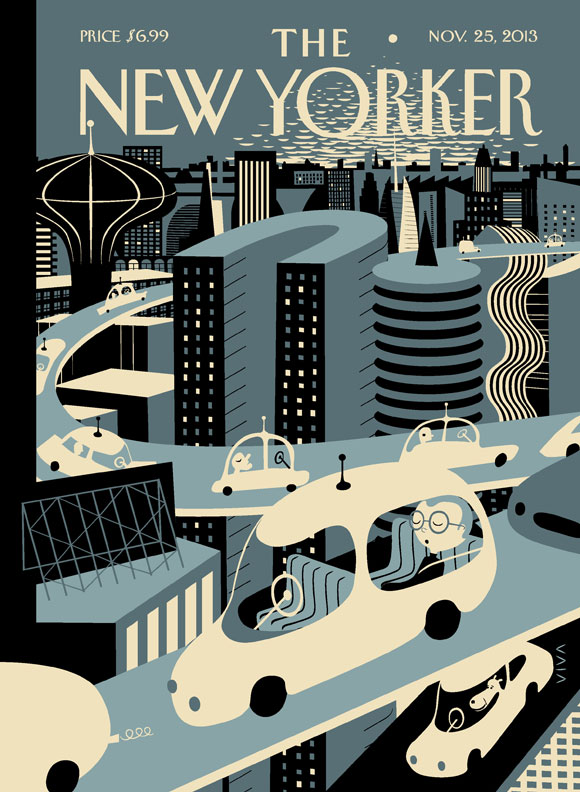
(Pictured above: the cover of the most recent New Yorker by Frank Viva)

Comments closed

Gene Luen Yang: The In-Between World of the Graphic Novelist

The New Yorker‘s book blog Page-Turner have posted a wonderful interview with cartoonist Gene Yang:

I grew up reading comics, and I just have this deep attachment to the medium. I think a lot of the things in my life that I become most passionate about, and most excited about, are all from comics…  In traditional Asian arts, the word and the picture always sit next to each other. I have an aunt, a Chinese brush painter, who told me that when you do a Chinese brush painting, you have to pair the image up with some poetry. A complete work is not masterful unless both of those elements are masterful. So maybe there’s some sort of attachment there—the idea of words and pictures working together is part of my family history.

You can read my interview with Gene, posted yesterday, here.

1 Comment

Wyatt Mitchell on The New Yorker Redesign


The New Yorker‘s creative director, Wyatt Mitchell, discusses the magazine’s update of  their whimsical font Irvin, and some of the other recent design changes at the magazine:

You can read more about the magazine’s subtle redesign at The New York Times:

Many of these changes are subtle enough that David Remnick, the magazine’s editor, said that if the magazine fell on the floor and were three feet away, it would still be identifiable to longtime readers… “We’ve kept the DNA and added some modern elements,” Mr. Remnick said… “It’s a living thing. It should also have a sense of fun and improvisation and experiment,” Mr. Remnick said about the magazine.

(via It’s Nice That)

UPDATE:

Apparently House Industries type designer Ben Kiel and Christian Schwartz worked with Mitchell to make a custom version of Schwartz’s Neutraface for the magazine. House Industries also worked on two different versions of the original Irvin typeface. Read more here.

Comments closed

Françoise Mouly: In Love With Art

Jeet Heer discusses the work Françoise Mouly and his new book, In Love With Art: Françoise Mouly’s Adventures in Comics with Art Spiegelmanwith Dave Berry at The National Post:

She’s open to the wider world in a way that was very rare for North American comics, which was a very provincial scene. But combined with that is not just the European comics themselves, but the European fine art tradition, which she had been educated in and made her very responsive to certain types of art. That’s very distinct from North America, even in the undergrounds, which were much more rooted in satire and lowbrow comedy and pulpishness. The other thing that she brought to the table is a sense of design, which is very rare in comics to that point. There was no one designing magazines and books in that format. Even people who believed in mature comics, they didn’t have that. Fantagraphics, their comics in the ’80s, even though the content is great, when they put it together in a book, they have no idea how to design that kind of product.

In a lot of ways, that sense of design really made the whole idea of the graphic novel possible. The distinguishing thing of the graphic novel isn’t just the length, but that it’s conceived of as a book. In the ’70s and ’80s, people thought that if you had a 64-page Hulk story, that’s a graphic novel – better paper, but all the same design elements as the regular comic… what made Maus and the other books that she did seem like bookstore material, library material was her book design sensibility. Everybody who’s doing interesting comics since then has learned from that.

Earlier this week, The Atlantic ran an excerpt from the book about the now iconic 9/11 New Yorker cover created by Mouly and Spiegelman:

It was a true example of collaborative art. Many of the hallmarks of Mouly’s tenure as New Yorker art editor can be seen in the 9/11 cover, including a direct engagement with current events—an enormous tonal shift in New Yorker cover history. But the cover doesn’t deal with this tragedy in the didactic manner of, say, a political cartoon, but rather through artful means: using subtlety and ambiguity, strong design, a compelling use of color (or in this case, a memorable absence of color) and the distillation of experience (rather than ideas or ideologies) into an iconic image. The dialogue between Mouly and Spiegelman was also typical of the strongly collaborative way she always has worked with, and continues to work with, her artists.

In Love With Art: Françoise Mouly’s Adventures in Comics with Art Spiegelman is published by Toronto’s Coach House Press, and if you are in Toronto this evening, Françoise Mouly and Sean Rogers will be in conversation Jeet Heer at Revival on College Street, starting at 7:30pm

Comments closed