Skip to content

Tag: New York

Little Failure: It’s Funny and It’s True


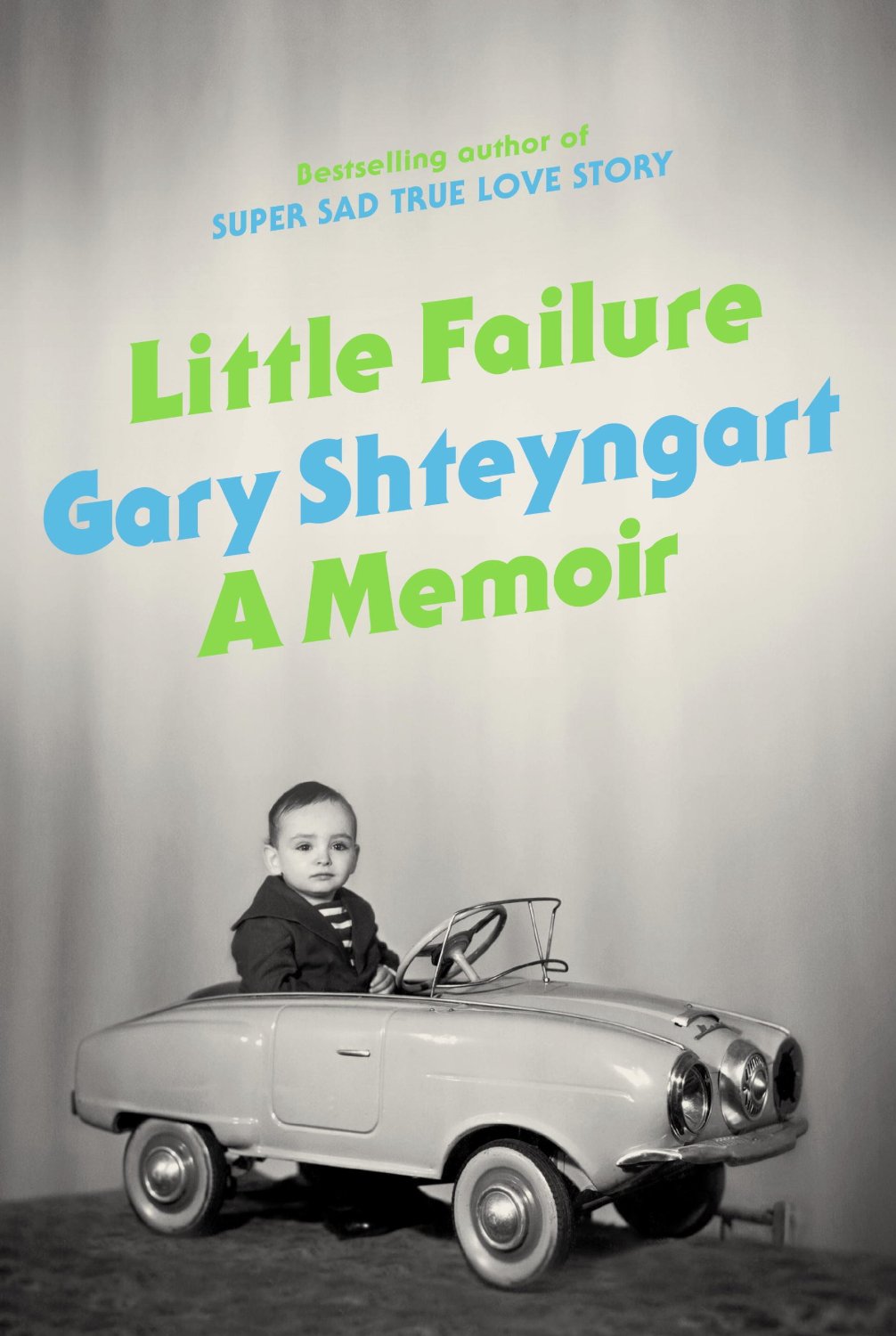
Surely just about everyone has seen this already, but in case you missed it, the new video for Gary Shteyngart’s forthcoming memoir Little Failure, which features James Franco as his husband and Jonathan Franzen as his therapist, is pretty great:

The video also stars David Ebershoff, Rashida Jones, Sloane Crosley, and Alex Karpovsky.

2 Comments

Projection: 85 Years of the Projection Booth in Movies

The Booth: The Last Days of Film Projection Joseph Holmes

Created by photographer Joseph O. Holmes, this charming (if occasionally grisly!) 12-minute super-cut features clips of projection booths from 46 different films, from Buster Keaton’s Sherlock, Jr. to Quentin Tarantino’s Inglorious Basterds:

The film debuted at New York’s The Museum of the Moving Image in October as part of the opening reception for Holmes’s The Booth: The Final Days of Film Projection, an exhibition of photographs which runs until January 2014.

(via Khoi)

Comments closed

Barbara Epstein, David Levine, and Graydon Carter on Magazine Publishing


Monday’s edition of CBC Radio show Ideas featured Michael Enright in conversation with the New York Review of Book‘s co-founder Barbara Epstein, caricaturist David Levine, and long-time Vanity Fair editor Graydon Carter:

CBC Radio IDEAS: Barbara Epstein/David Levine/Graydon Carter mp3

Comments closed

Teju Cole on Photographer Saul Leiter


Teju Cole, author of Open City and a photographer himself, on the late Saul Leiter at The New Yorker:

The content of Saul Leiter’s photographs arrives on a sort of delay: it takes a moment after the first glance to know what the picture is about. You don’t so much see the image as let it dissolve into your consciousness, like a tablet in a glass of water. One of the difficulties of photography is that it is much better at being explicit than at being reticent. Precisely how the hypnotic and dreamlike feeling is achieved in Leiter’s work is a mystery, even to their creator.

Leiter died aged 89 on Tuesday this week. Read The New York Times obituary.

3 Comments

Everybody Street

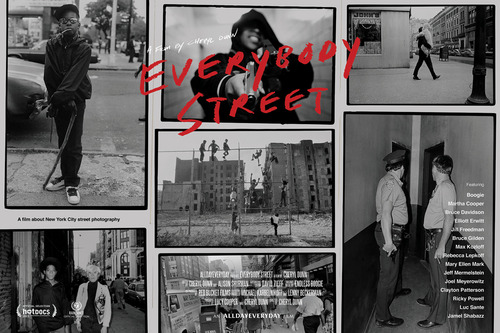
Everybody Street is a new documentary about the lives and work of New York’s street photographers and the city that inspires them. The film features photographer Bruce Davidson, Elliott Erwitt, Jill Freedman, Bruce Gilden, Joel Meyerowitz, Rebecca Lepkoff, Mary Ellen Mark, Jeff Mermelstein, Clayton Patterson, Ricky Powell, Jamel Shabazz, Martha Cooper, and Boogie, as well as historians Max Kozloff and Luc Sante. It looks amazing:

Everybody Street can be watched on demand at Vimeo, and you can read an interview with director Cheryl Dunn here.

Comments closed

Design Is One: Lella & Massimo Vignelli


Design is One, the new documentary film by Kathy Brew and Roberto Guerra about designers Lella and Massimo Vignelli, opened at the IFC in New York yesterday:

Comments closed

Wyatt Mitchell on The New Yorker Redesign


The New Yorker‘s creative director, Wyatt Mitchell, discusses the magazine’s update of  their whimsical font Irvin, and some of the other recent design changes at the magazine:

You can read more about the magazine’s subtle redesign at The New York Times:

Many of these changes are subtle enough that David Remnick, the magazine’s editor, said that if the magazine fell on the floor and were three feet away, it would still be identifiable to longtime readers… “We’ve kept the DNA and added some modern elements,” Mr. Remnick said… “It’s a living thing. It should also have a sense of fun and improvisation and experiment,” Mr. Remnick said about the magazine.

(via It’s Nice That)

UPDATE:

Apparently House Industries type designer Ben Kiel and Christian Schwartz worked with Mitchell to make a custom version of Schwartz’s Neutraface for the magazine. House Industries also worked on two different versions of the original Irvin typeface. Read more here.

Comments closed

Françoise Mouly: In Love With Art

Jeet Heer discusses the work Françoise Mouly and his new book, In Love With Art: Françoise Mouly’s Adventures in Comics with Art Spiegelmanwith Dave Berry at The National Post:

She’s open to the wider world in a way that was very rare for North American comics, which was a very provincial scene. But combined with that is not just the European comics themselves, but the European fine art tradition, which she had been educated in and made her very responsive to certain types of art. That’s very distinct from North America, even in the undergrounds, which were much more rooted in satire and lowbrow comedy and pulpishness. The other thing that she brought to the table is a sense of design, which is very rare in comics to that point. There was no one designing magazines and books in that format. Even people who believed in mature comics, they didn’t have that. Fantagraphics, their comics in the ’80s, even though the content is great, when they put it together in a book, they have no idea how to design that kind of product.

In a lot of ways, that sense of design really made the whole idea of the graphic novel possible. The distinguishing thing of the graphic novel isn’t just the length, but that it’s conceived of as a book. In the ’70s and ’80s, people thought that if you had a 64-page Hulk story, that’s a graphic novel – better paper, but all the same design elements as the regular comic… what made Maus and the other books that she did seem like bookstore material, library material was her book design sensibility. Everybody who’s doing interesting comics since then has learned from that.

Earlier this week, The Atlantic ran an excerpt from the book about the now iconic 9/11 New Yorker cover created by Mouly and Spiegelman:

It was a true example of collaborative art. Many of the hallmarks of Mouly’s tenure as New Yorker art editor can be seen in the 9/11 cover, including a direct engagement with current events—an enormous tonal shift in New Yorker cover history. But the cover doesn’t deal with this tragedy in the didactic manner of, say, a political cartoon, but rather through artful means: using subtlety and ambiguity, strong design, a compelling use of color (or in this case, a memorable absence of color) and the distillation of experience (rather than ideas or ideologies) into an iconic image. The dialogue between Mouly and Spiegelman was also typical of the strongly collaborative way she always has worked with, and continues to work with, her artists.

In Love With Art: Françoise Mouly’s Adventures in Comics with Art Spiegelman is published by Toronto’s Coach House Press, and if you are in Toronto this evening, Françoise Mouly and Sean Rogers will be in conversation Jeet Heer at Revival on College Street, starting at 7:30pm
Comments closed

Sarah McNally in The Lab Magazine

The Lab Magazine interviews Sarah McNally, owner of McNally Jackson Books in New York:

From Winnipeg, Canada, McNally was born to a bookselling family, but made her way New York-wards after college, eventually working as an editor at Basic Books – “I loved editing because I had never done anything deeply collaborative before, and to be trusted inside a writer’s vision of his or her art 
is a profound and moving privilege.” She then branched out on her own, and whether 
by nature or nurture, she’s clearly found where she’s meant to be. “I love bookselling because I can run around thinking about a million things, from the mundane to the transcendent, and it all matters… The dirt in the corner 
is my problem. What Proust’s birthday means in downtown New York is my problem. I have to walk through the store allowing every book 
I see, even if I haven’t read it, to resonate deeply within me, and if it saddens or irritates even the most inconsequential part of my soul, 
I have to take it off display.”

I miss being a bookseller. I really do.

1 Comment

Jonathan Lethem: The Author Looks Inward

Jonathan Lethem talks about writing his new novel, Dissident Gardens, with Brian Gresko at the Los Angeles Review of Books:

Of course, in the writing, Dissident Gardens couldn’t bear much of what I’d learned. Novels don’t want to be crammed with factual stuff. I mostly left it aside, including some astonishing truths, which when you first come across them, you think, holy shit, I’ve learned this crazy thing and now I’ll blow people away by revealing this knowledge in the book! But at the juncture where you’d insert such a thing, you flinch, seeing the cost is too high. The facts will intrude — either on the reader’s experience, or my own relationship to the page, to the dream. You’ve heard of killing your darlings? You’ve got to kill plenty of the world’s darling’s too

Dissident Gardens is out this week in the US & Canada (I believe you have a bit longer to wait in the UK). The book was reviewed in Sunday’s New York Times Book Review.

Comments closed

The Birdman


The Birdman is a wonderful — and an award-winning — documentary short by Jessie Auritt about Rainbow Music in New York’s East Village and it’s eccentric owner.  The store just has to be seen to be believed:

With CDs, VHSs and old cassette tapes stacked head high, Rainbow Music is a hoarder’s paradise. However, its quirky owner, known as ‘The Birdman’, knows exactly where everything is. Amidst the Starbucks and Subways popping up on every corner of the East Village, Rainbow Music maintains its mom and pop feel, and is a hidden gem to its patrons. Due to the weak economy, online music sales and pirating, and the changing neighborhood, this charismatic curmudgeon is struggling to sell what he has in his store. Despite these challenges, The Birdman carries on to his own tune.

Comments closed

Semi-Outsiders

At Vulture, Jonathan Galassi, the current president of Farrar, Strauss & Giroux, reflects on Boris Kachka’s new book Hothouse, a history of the New York publishing house:

FSG came into its own at a moment when postwar America was opening up and out—when “semi-outsiders,” in the words of critic Irving Howe, were “starting to break into the central spaces of American culture.” What made FSG significant, though, was its ability to catch a long series of literary waves. Straus and Giroux and a whole series of talented younger editors made stars out of Southerners (and Catholics) like Flannery O’Connor and Walker Percy and Jews like Bernard Malamud, Philip Roth, and the émigré Isaac Bashevis Singer. There were the poets of the ­Lowell-Bishop-Berryman generation; Susan Sontag, an entire typhoon on her own, who clued Straus in to great, obscure European writers; and the late-sixties Latin American “boom” (Fuentes, Vargas Llosa, Neruda). There were the New Journalists (Tom Wolfe, Joan Didion) and New Yorker epigone John McPhee; the internationalist poets Derek Walcott, Seamus Heaney, and Joseph Brodsky; and great children’s writers like Maurice Sendak, Madeleine L’Engle, and Roald Dahl. All contributed to what Kachka calls “FSG culture,” which he ­describes as “high-minded and scrappy, aggressive and refined, quintessentially American but thoroughly international.”

Comments closed