Skip to content

Tag: New York

Ersnt Reichl: Wide Awake Typographer


Elizabeth Hawes, Fashion is Spinach (Random House, 1938; AIGA 50 Books 1939)

At Design Observer, design historian Martha Scotford discusses the work of German-American book designer Ernst Reichl:

Midway in his career, Reichl began to reflect on many of the books he designed in written comments; he spent more time on this during the period 1977-1978, shortly before his death in 1980. In the end, there were approximately 550 3 x 5 inch index cards on which he hand-wrote his thoughts about selected books he designed. In lively prose Reichl comments on myriad elements of book design and details of book production, several for each book. He covers typography, binding design and jackets, illustration, publishers, the publishing industry in New York, design colleagues (revered and annoying), production triumphs and problems, how well the book sold, his opinion of the book and his philosophy of book design as applied to that title. He also critiques his own work, sometimes in the moment, sometimes from the perspective of more time and experience. These comments, often sharp and humorous, are highly entertaining and informative. I know of no other book designer who has done this so extensively.

Reichl’s comments about book design have now been transcribed from the cards and accompany a selection of over 100 examples of his work in an exhibition curated by Scotford, ‘Ernst Reichl: Wide Awake Typographer,’ currently on display at Columbia University’s Rare Book and Manuscript Library in New York until September 13, 2013.

On a related note, Scotford has previously written about the US publication of James Joyce’s Ulysses and the role of Ernst Reichl, who designed the typographic cover for Random House.

Comments closed

The Open Book by Bob Staake


A young reader goes on an adventure in this charming wordless comic by Bob Staake for the New York Times.

Publishers Weekly recently posted an interview with Staake about his new book, Bluebird, which is also wordless:

I love writing visually, and wordlessly, because this is was how I read books as a kid. I didn’t really read, but I was a voracious page turner. Nothing would delight me more than pulling out old National Geographics and encyclopedias and looking through the pictures. For years, I have said that this is how children learn how to read. They don’t read, they look. Parents sometimes denigrate the importance of looking in favor of reading the words. It is just as important.

Great stuff.

Comments closed

Another Hipster In The Business: God Help Me

CBC Radio’s The Sunday Edition profiles Sarah McNally, owner of McNally-Jackson in Soho, New York:

McNally-Jackson opened in December 2004, just as mega booksellers Barnes and Noble and Borders were expanding and online booksellers were rapidly gaining ground. More than 1,000 independent bookstores stores, one in every two, closed down. But Sarah McNally was cocky and figured she could make it… The lessons Sarah McNally learned as a daughter of booksellers on the Canadian prairies continue to help her survive in the Manhattan jungle.

Listen to the audio.

Comments closed

Out of Print

Out of Print, a documentary by Vivienne Roumani about “the turbulent and exciting journey from the book through the digital revolution,” will première at  the Tribeca Film Festival on April 25th:

[vimeo http://vimeo.com/54234607 w=480]

The film features interviews with Scott Turow, Ray Bradbury, and Amazon.com founder and CEO Jeff Bezos among others.

Comments closed

Finding Vivian Maier Documentary

The official trailer for a new documentary film about street photographer Vivian Maier:

3 Comments

Something for the Weekend

Wondrous Horrors — Ariella Budick on the centenary of the 1913 Armory Show in New York, for the Financial Times:

Critics did not reject every European innovation. They nodded at the impressionists, puzzled respectfully over Cézanne, and tolerated Gauguin. But cubism blew their minds. The impact was not merely aesthetic. American writers perceived a defiant rejection of rules and a contempt for tradition – qualities they associated with violent political movements. Painters who blasted convention with their brushes gave comfort to bomb-throwing subversives. When critics invoked anarchy, it was not just a figure of speech.
See also: Rethinking the Armory in the New York Times:
New York viewers, including artists, to some degree knew what they were in for. Pictures of avant-garde art had been included, often with mocking commentary, in New York newspapers and magazines for years. And by no means were all Armory reviews pans; one critic wrote that he was grateful for “these shocks to our aesthetic sense.” Others were glad for a certain perspective the show offered: compared with avant-garde work from Europe, American art looked sane.
Making It Up — William Deresiewicz on the work of Geoff Dyer, for The New Republic:
Freedom from conventional and institutional expectations—freedom even from his audience—means that Dyer is also free to make it up, like jazz, as he goes along. Every book is different, and every book is different from everybody else’s books. Zona is a running commentary, almost shot-by-shot, on a single film. But Beautiful consists of a series of quasi-imagined episodes—vivid, textured, saturated with feeling—from the lives of the jazz greats. Out of Sheer Rage is memoir, travelogue, criticism—“about” Lawrence in the physical sense of the word: spinning around and around him with a manic, comic, centrifugal energy. The Ongoing Moment makes a poem of the history of photography by considering not artists or schools, technics or techniques, but, improbably, subjects (hats, benches, stairs): a ridiculous idea, it seems, until you figure out that Dyer’s real quarry is the relationships we have with those quotidian objects, the way they can be made to stand for the lives that move among them. “Spare me the drudgery of systematic examinations,” he writes in Out of Sheer Rage, “and give me the lightning flashes of those wild books in which there is no attempt to cover the ground thoroughly or reasonably.”
See also: Rose Mclaren on Zona for The White Review:
[Dyer] claims, ‘if I had not seen Stalker in my early twenties my responsiveness to the world would have been radically diminished’. He shares with his idol an artistic ideal of awareness, describing Tarkovsky’s aesthetic as a length of take demanding ‘a special intensity of attention’. The inverse dominates much contemporary culture where, ‘a lot of what’s being shown on the world’s screens is fit only for morons’ with the result that ‘there are more and more things from which one has to avert one’s ears and eyes’. Rubbish art that warrants ignorance. A bit broad-brush and heavy-handed, but its Dyer’s reason for writing. Against a social dystopia of willed numbness, Zona documents a profound engagement with an artwork. It is not so much homage to the film alone, but to the dialogue it inspires.

And finally…

What Is This Shit? — Brian Dillon interviews photographer and filmmaker William Klein:

I didn’t know how to do a book. I was just discovering photography and once I had all these pictures, I showed them to editors in New York and nobody thought it was worthwhile to do a book with these photographs. They said, “What is this shit?” I came back to Paris and discovered there was a series of travel books called Petite Planète. I called them up and got an appointment and I went to this office which looked like NASA. Chris Marker was there with a laser gun in his belt, and he saw the photographs and said, “We’ll do a book!” In fact he said, “We’ll do a book or I quit!”

Comments closed

Teju Cole on Writers and Company

Author Teju Cole, author of Open City, in conversation with Eleanor Wachtel on CBC Radio’s Writers & Company:

CBC RADIO Writers and Company: Teju Cole Open City mp3

Comments closed

Midweek Miscellany

Look Closer — Adrian Tomine talks about moving to New York, and his new book of drawings with The New Yorker:

I’m not one of those artists with an incredible imagination who can just make things up out of nothing, and I’m not the kind of person who would throw himself into some exciting or dangerous situation just to get material. So I tend to go about my normal, boring life, and just try to look at things a little more closely. And even though I’ve lived in New York for eight years now, I still feel like a recent transplant, and I think that’s a big influence on how I see and draw the city.

Invisible — Jeanette Winterson on Tove Jansson and the Moomins, for The Telegraph:

I keep the Moomin books in my study and if I am tinkering about preparing for work I will often open one at random and read a page – they are funny and subversive, (Hemulens of either gender only wear dresses). And playful. Whatever happened to playfulness? Why, as adults, is serious/superficial the boring binary of our lives?… Tove Jansson believed in happy endings… Not the Disney kind but more solid and ambiguous, which is a paradox, but more truthful than black-and-white solutions. Ever-after is what is invisible on the next page.

Approaching Zero — Michael Faber reviews How Music Works by David Byrne, for The Guardian:

Everyone knows that the music industry is in terminal decline. Unlike many doomsayers, however, Byrne feels the changed landscape is good for musicians. Even 20 years ago, any artist wishing to make a record needed a huge sum of money to pay for studio time (and thus needed a large corporation to loan it to him). A lucky few shifted the millions of units necessary to repay the industry’s investment, but the majority got hopelessly into debt. Nowadays, recording costs are “approaching zero”. Distribution costs in the digital era are also negligible compared to the days of physical warehousing. As long as artists can find ways of holding on to a fair percentage of their income (an impossible challenge in the heyday of the record companies), even modest sales can sustain a career. Indeed, says Byrne, “there have never been more opportunities for a musician to reach an audience.”

And finally…

A Short Lesson in Perspective — A fantastic essay by Linds Redding. First published in March of this year, this seems to have taken on a life of its own. If you work in a ‘creative industry’ and haven’t read it yet, make sure you read the whole thing:

The compulsion to create is unstoppable. It’s a need that has to be filled. I’ve barely ‘worked’ in any meaningful way for half a year, but every day I find myself driven to ‘make’ something. Take photographs. Draw. Write. Make bad music. It’s just an itch than needs to be scratched. Apart from the occasional severed ear or descent into fecal-eating dementia the creative impulse is mostly little more than a quaint eccentricity. But introduce this mostly benign neurosis into a commercial context.. well that way, my friends lies misery and madness.


Comments closed

William Klein: In Pictures

In this interview for Tate Media, William Klein, one of the 20th century’s most important artists, photographers and film-makers, discusses his experience photographing on the streets of New York, the challenges of publishing his first book and how he working with filmmaker Federico Fellini:

Klein’s work is featured in the exhibition William Klein + Daido Moriyama at Tate Modern, 10 October 2012–20 January 2013. You can watch a Tate interview with Daido Moriyama here.

Comments closed

Jon Contino

Talented (and much-imitated) designer and letterer Jon Contino talks about his work in this short film by Kevin Steen:

Comments closed

Something for the Weekend

The brilliant Jon Gray and Jamie Keenan reveal the 20 irrefutable theories of book cover design. All of them are great.

Also at The Guardian: Ahdaf Soueif, author most recently of Cairo: My City, Our Revolution, on fiction and the revolution in Egypt:

Attempts at fiction right now would be too simple. The immediate truth is too glaring to allow a more subtle truth to take form. For reality has to take time to be processed, to transform into fiction. So it’s no use a story presenting itself, tempting, asking to be written, because another story will – in the next minute – come roaring over it, making the same demand. And you, the novelist, can’t grab one of them and run away and lock yourself up with it and surrender to it and wait and work for the transformation to happen – because you, the citizen, need to be present, there, on the ground, marching, supporting, talking, instigating, articulating.

The Last Book Sale — A charming piece for the NYRB by Larry McMurty, book dealer and author of The Last Picture Show, on an auction of his books in Archer City:

Everything sold but the fiction. Everyone who deals in fiction has plenty, and more is spilling onto the market from the sale of the Serendipity Bookshop stock now being dispersed on the West Coast. Many people asked me if I was sad to see so many books go. I wasn’t—mainly I was irritated to discover that I still had 30,000 novels to sell.

And finally…

 Put A Bird On It — The New York Times on the city’s boutique art bookstores:

perhaps because the physical book is coming to seem more like an object than ever before, the current landscape of shops blurs the line between bookstore and gallery in rollicking, unpredictable fashion. And because the shops are not nearly as tethered to high-end economics as art galleries, the mélange of stuff that results, some for sale and some not, can be strange and wonderful, like highly personalized cross sections cut from the culture at large.

1 Comment

New York Types

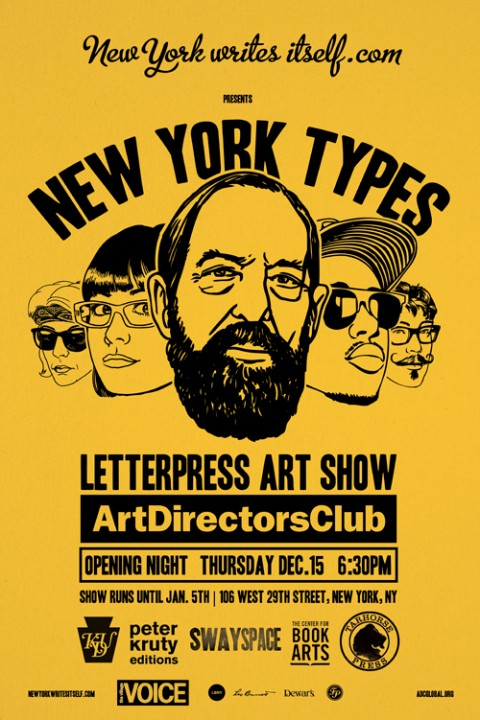
‘New York Types’ is a short film about New York, letterpress, and the art exhibition of the same name at the Art Directors Club last year. Inspired by the ʻThe Scriptʼ at  New York Writes Itself, the exhibition illuminated the sights and sounds of New York City:

Comments closed