Skip to content

Tag: New York Times

Mourning Local Bookstores

Writing for the New York Times, Julie Bosman recently looked at how surging rents are forcing bookstores from Manhattan:

The closings have alarmed preservationists, publishers and authors, who said the fading away of bookstores amounted to a crisis that called for intervention from the newly minted mayor of New York City, Bill de Blasio, who has vowed to offer greater support to small businesses.

[Author Robert] Caro said in an interview that he is heartbroken by the loss of bookstores from Manhattan, calling it “a profoundly significant and depressing indication of where our culture is.”

“How can Manhattan be a cultural or literary center of the world when the number of bookstores has become so insignificant?” he asked. “You really say, has nobody in city government ever considered this and what can be done about it?”

There has, of course, been a similar trend in Toronto with the Cookbook store, the Annex location of Book City, and the Bloor West Village Chapters all closing (or about to) in recent months.

On a happier note though, Bosman notes that some stores are thriving by locating to other, more affordable neighbourhoods in New York (and beyond):

just as many writers have fled to Brooklyn or Queens in search of more affordable housing, some bookstore owners have followed. Greenlight Bookstore in Fort Greene opened in 2009 to robust business and year-over-year increases in sales.

In December, Christine Onorati, the co-owner of Word bookstore in Greenpoint, Brooklyn, opened a second store in Jersey City. Ms. Onorati said she never looked seriously at Manhattan because the rents were so unaffordable…

…After spending years scouring Manhattan for a second location, Ms. McNally of McNally Jackson abandoned her search. At the urging of a former employee, she began looking in Brooklyn and settled on Williamsburg, where she found a “magnificent,” loftlike space with a 20-foot ceiling.

I hope this will be true of Toronto too even though it is much smaller than New York (New York has more than twice the population of Toronto). But here, despite some well-defined neighbourhoods, bookstores seem to have been slow to follow their customers (and their families) to more affordable areas of the city. My neighbourhood, where I’ve lived for 8 years, is filling up with young families and yet many store fronts remain stubbornly empty. And while I consider myself lucky to still have a bookstore, Book City’s Danforth location, only four subway stops away, it feel like a very different neighbourhood. I would love to be able to walk to a bookstore with my kids, or stop in to browse on my way home.

Perhaps the bookstores further afield, in communities like Burlington and Hamilton, are doing better? I hope so.

Still, I will leave the final word to Rebecca Mead, author of My Life in Middlemarch, who has written a sharp response to the New York Times article for  The New Yorker:

Those of us who cherish our local bookstores do so not simply because they are convenient—how great to be able to run out for milk and also pick up the new Karl Ove Knausgaard!—but also because we feel a duty to support them, because we believe in their mission. When books can be bought so cheaply online, or at one of the dwindling number of discount retailers, paying more to shop at a local bookstore feels virtuous, like buying locally sourced organic vegetables, or checking to see if a T-shirt is made in the U.S.A. It can be gratifying to the point of smugness to feel that one is being pluralistic, liberal, and humane; shopping at an independent bookstore may be one of the diminishing opportunities to experience that feeling in first-class New York City. Still, when I consider the vanished bookstores of Manhattan, I mourn not just their passing but the loss of a certain kind of book-buying innocence—a time when where one bought a book did not constitute a political statement, and reading it did not feel like participating in a requiem.

Comments closed

Triumph of the English Major

Book editor Gerald Howard had lovely op-ed in this weekend’s New York Times called ‘Triumph of the English Major’:

Almost any cultural transaction involving a sum of money represents, as Samuel Johnson famously said of second marriages, the triumph of hope over experience. We live in a time when college enrollment in the humanities is declining precipitously, in good part because majoring in such subjects seems unlikely to result in gainful employment in a strapped economy and thus would be a waste of hard-earned (or usuriously borrowed) tuition dollars.

Somehow our culture has persuaded itself that the naked quest for financial gain, often through the devising and trading, on monstrous amounts of (very low interest) borrowed money, of what Warren Buffett has called instruments of mass destruction, is a more urgent and honorable calling than the passionate pursuit of truth and beauty.

I’ve tried to suggest that at least a portion of that pursuit can have gratifying economic results. (Plus it will not plunge us into an endless recession!) But that’s not really the point. The point is truth and beauty, without which our lives will lack grace and meaning and our civilization will be spiritually hollowed out and the historical bottom line will be that future epochs will remember us as a coarse and philistine people who squandered our bottomlessly rich cultural inheritance for short-term and meaningless financial advantage.

Read it. It’s a wonderful thing (and I’m not even an English Major).

Comments closed

Nicholas Blechman’s Best Book Covers of 2013

The great book designer George Salter once said that a good jacket “must be in perfect accord with the literary quality of the book. It must be even more if it is to function as an important sales factor, if it is to ‘stop’ the eye of the person passing by.” Of the thousands of books that come through the offices of the Book Review each year, these are the covers and jackets that caught my eye, that compelled me to flip them over to check the back flap to see who designed them.

If you weren’t satisfied with my 2013 covers list (and why would you be?), then the infinitely more qualified Nicholas Blechman, art director at New York Times Book Review, has selected his best book covers of the year.

Ulysses, redesigned by Peter Mendelsund for Vintage, is on Nicholas’s list,  and I also liked Paul Sahre‘s design for the cover of That Smell and Notes From Prison by Sonallah Ibrahim, and the cover of Without Their Permission by Alex Ohanian designed by Oliver Munday:

We agreed on Gabriele Wilson‘s beautiful cover for Middle C by William Gass, but I think I should compile a list of all the great covers from 2013 that I’ve seen since I posted my list on Tuesday. (I’m kidding. Sort of).

Comments closed

Beyond a Man’s Machines: The Art of Rube Goldberg

All else aside, though, it’s his Rube Goldberg inventions that made him a lasting cultural presence. Goldberg once said his machines — which he drafted with strict but rollicking precision — were a “symbol of man’s capacity for exerting maximum effort to achieve minimal results.” It sometimes took him as long as 30 hours to execute one single-panel piece.


The New York Times takes a look at The Art of Rube Goldberg by Jennifer George:

1 Comment

Teju Cole on Photographer Saul Leiter


Teju Cole, author of Open City and a photographer himself, on the late Saul Leiter at The New Yorker:

The content of Saul Leiter’s photographs arrives on a sort of delay: it takes a moment after the first glance to know what the picture is about. You don’t so much see the image as let it dissolve into your consciousness, like a tablet in a glass of water. One of the difficulties of photography is that it is much better at being explicit than at being reticent. Precisely how the hypnotic and dreamlike feeling is achieved in Leiter’s work is a mystery, even to their creator.

Leiter died aged 89 on Tuesday this week. Read The New York Times obituary.

3 Comments

The Joy of Reading by Grant Snider

After illustrating the special sex issue of the New York Times Book Review last week, cartoonist Grant Snider has turned his cover illustration and two unused sketches into a series of posters titled The Joy of Reading. The posters are available from Grant’s shop.

Comments closed

Joost Swarte: Tumult in the Book World


This wonderful illustration by Dutch cartoonist Joost Swarte accompanied a discussion on traditional bookstores in the digital marketplace in last Sunday’s New York Times.

4 Comments

The Story Coaster by Grant Snider


Another gem for the New York Times Book Review by Grant Snider. Love the Unreliable Narrator.

Comments closed

Haruki Murakami Bingo by Grant Snider

‘Haruki Murakami Bingo’ by Grant Snider for the New York Times Book Review. Well played, sir.

Comments closed

Midweek Miscellany

Comics critic Paul Gravett profiles cartoonist and illustrator Luke Pearson. Coincidently, Pearson has created an amazing cover for a new Penguin edition of Lucky Jim by Kingsley Amis (pictured above).

Desirable Comparisons — Part three of Mark Medley’s series on House of Anansi for The National Post:

“We want it to appear as a very serious, big, ambitious book,” Bland says. “Which is hard to do in a way that doesn’t look like other big books.”

He shows [Pasha] Malla some text-heavy covers that bring to mind the likes of David Foster Wallace, Jonathan Franzen and Jonathan Lethem.

“For Pasha, for various reasons that aren’t mine to say, these are not desirable comparisons,” Bland says. “For us, they’re very desirable comparisons.”

Thousands of folk songs and interviews recorded by Alan Lomax are now available for free online.

See also: NPR ‘Alan Lomax’s Massive Archive Goes Online

Neue Haas Grotesk — Christian Schwartz has restored the classic Swiss sans serif typeface for the digital era. There’s a history of Neue Haas Grotesk / Helvetica here.

The Books in My Head — The Quill and Quire profile Canadian independent comics publisher Drawn & Quarterly:

Part of what sets D&Q apart is its focus on high-quality design, incorporating elements like glossy embossing on covers. “We want to treat the comic as the nicest object possible,” says [creative director Tom] Devlin.

While Devlin says he collaborates with authors on design, D&Q’s willingness to cede creative control has given the company a reputation as something of an artist’s haven. Seth says he prefers to work independently, providing the publisher with camera-ready artwork for computer production. “They almost never interfere with my design plans,” he says. “I would not be the designer I am today without D&Q allowing me to make the books I see in my head.”

(Full disclosure: As mentioned in the story, D+Q are distributed in Canada by my employer Raincoast Books)

And finally…

With a retrospective at the Oakland Museum of California and the publication of The Art of Daniel Clowes: Modern Cartoonist, Carol Kino profiles Daniel Clowes for The New York Times:

“I never thought of myself as a museum artist who’s doing work for the wall,” he said. “For me the book is the final result.” He assumes that most people who see his work at the museum won’t know who he is. “But if they have some connection to something they see,” he added, “and then they read the book, the more I’ll feel like the show was a success.”

1 Comment

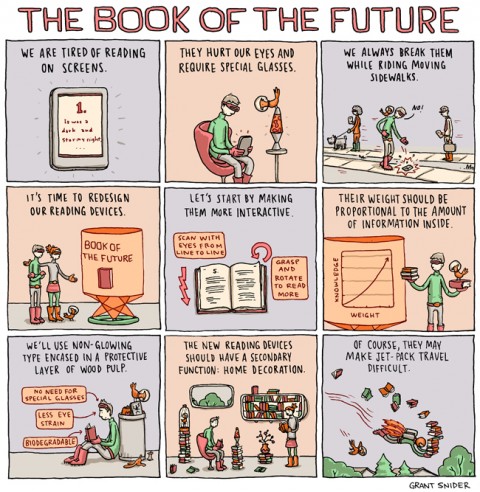
The Book of the Future by Grant Snider

Lava lamps, egg chairs, and “and outfits that would look great in a B-52s music video”… Grant Snider’s vision of the book of the future for The New York Times Sunday Book Review!


Comments closed

Earl Kallemeyn Letterpress

The New York Times has posted a short video interview with Earl Kallemeyn of Kallemeyn Press about the beauty of letterpress:

Comments closed