
Amanda Cox, graphics editor at The New York Times, discusses data visualization with Nora Young for CBC Radio’s Spark:
Books, Design and Culture
Amanda Cox, graphics editor at The New York Times, discusses data visualization with Nora Young for CBC Radio’s Spark:
Lost Libraries — With the personal book collection of David Markson ending up at The Strand bookstore in New York, Craig Fehrman examines the fate authors’ libraries for The Boston Globe (via The Second Pass):
Most people might imagine that authors’ libraries matter — that scholars and readers should care what books authors read, what they thought about them, what they scribbled in the margins. But far more libraries get dispersed than saved. In fact, David Markson can now take his place in a long and distinguished line of writers whose personal libraries were quickly, casually broken down. Herman Melville’s books? One bookstore bought an assortment for $120, then scrapped the theological titles for paper. Stephen Crane’s? His widow died a brothel madam, and her estate (and his books) were auctioned off on the steps of a Florida courthouse. Ernest Hemingway’s? To this day, all 9,000 titles remain trapped in his Cuban villa.
Fehrman expands on this article — and the reasons we should not have been surprised that Markson’s books found their way to The Strand — at his blog.
Eating Each Other is Wrong — Evan Scnittman, Managing and Director of Sales and Marketing at Bloomsbury, argues that e-books don’t cannibalize print:
The most important lesson I can convey to book publishing professionals is that they must understand that those of us who have made the transition to ebooks, buy ebooks, not print books. Ebook reading device users don’t shop in bookstores and then decide what edition they want; ebook device readers buy what is available in ebookstores. Search an ebookstore for a title and if it doesn’t come up, it doesn’t exist – no matter how many versions are available in print.
Ebooks aren’t a better value, ebooks aren’t more attractive nor are they a threat to the print version of any immersive reading book. This isn’t the same as paperback versions vs hardcover – where the platform and convenience are the same – the timing and pricing are the key ingredients. Books that aren’t in ebook form are do not exist to ebook reading consumers. There is no cannibalization if in the mind of the buyer if there is no version available to them.
The Forgotten Mimics — In the 11th installment of The National Post’s ‘Ecology of Books’ series, Mark Medley talks to to some of Canada’s foremost literary translators:
“We’re not robots,” says [Lazer] Lederhendler, 59, who won the Governor General’s Literary Award for his translation of Dickner’s last novel, Nikolski. “We have a way of reading a book. We have a way of using the language. We have our own vocabulary, our likes and dislikes in terms of this phrase or that phrase. It’s a kind of balancing act between observing the fact that you’re at the service of someone else’s work, but at the same time it’s an artistic mission.”
Four Decades of Art — A mini-documentary about illustration in The New York Times Op-Ed page, featuring interviews with art directors and illustrators.
And finally…
Type designer Matthew Carter and writer David Simon (creator of The Wire) were recently named MacArthur Fellows. The Fellowship is a $500,000 (US), no-strings-attached grant for people who have shown exceptional creativity in their work and promise to do more (via How Magazine):
Comments closed
The typographical cover for Oscar Guardiola-Rivera’s What If Latin America Ruled the World designed by Sarah Greeno at Bloomsbury UK.
The Gall — The inimitable John Gall, VP and Art Director of Vintage / Anchor Books, interviewed for a rather super looking new magazine called Design Bureau:
[O]nce you have a nice solid concept, the rest of the process can almost seem effortless; enjoyable, even. And these, of course, are usually the best ones.” Gall describes his creative process as threefold: research, concept and execute. “Read the books, come up with some ideas, flesh them out, see what is sticking,” he says. However, it’s the process of getting a book’s cover approved that poses the greatest challenge for Gall and his team. “If the publisher comes back and says, well, ‘This needs really big type with a chicken on it’, that obviously means they think this is kind of important,” he says. “The re-working, dealing with all the feedback (some warranted, some moronic) ‘make this bigger’, ‘make this smaller’, ‘my psychic thinks it should be blue’—that is what separates the men from the boys,” he says.

The article is accompanied by photographs by Noah Kalina, and includes John’s tips for lunch in New York. What more could you ask for? An interview with designer Abbott Miller you say? Well, Design Bureau have one of those as well.
Exit Interview — Former New York Times Design Director Khoi Vinh on designing the newspaper’s paywall, and his decision to walk away, in the New York Observer:
One way of trying to make logical design decisions is through research. Mr. Vinh’s team has been studying traffic patterns on the site and watching test subjects, real readers, in a lab to see how their eyes move across the page when they are reading The Times online.
“I take it all with a grain of salt,” he said. “Everything is so measurable now, theoretically. But the truth of the matter is, there’s never enough data to substitute for raw decision-making abilities. At the end of the day, you still need to make the decision.”
Designing Madison Avenue — The New York Review of Books blog on the look of TV show Mad Men:
Among many things that make Mad Men so intriguing is its broad definition of what constitutes design. For example, its cunningly detailed, not-quite-couture female costuming—the B.H. Wragge-style coat-and-dress ensembles, the Koret handbags, the Coro costume jewelry—makes the female characters … seem as if they have stepped straight out of the Sunday New York Times during the twilight of Lester Markel… Equally fanatical attention is paid to interior design. The offices of Sterling Cooper were done up in the spacious, late International Style corporate mode epitomized by the boxy glass-and-steel skyscrapers that rose along Park Avenue after World War II.
And on a somwhat related note, Eleanor Wachtel interviews legendary designer Milton Glaser for CBC Radio. Good stuff.
1 CommentThe latest Gestalten.tv video podcast is a conversation with New York Times Graphics Director Steven Duenes and Graphics Editor Archie Tse. Duanes and Tse talk about creating daily images, diagrams, charts, and interactive media for the newspaper, and providing the clearest possible visualization of data:
A true miscellany here: letterpress to Gil Scott-Heron with a lot of meat sandwiched in between… This is quite possibly why I blog…
Ditoria — An amazing video about showing the letterpress printing process by Roberto Bolado.
The Cost of Creating — Harvard Law Professor Lawrence Lessig, author of Free Culture (and others), discussing the Google Book Settlement on NPR’s On The Media last month (via INDEX//mb):
[W]e need to once again think about what the balance should be between free access to culture and metered access to culture, because both extremes are mistakes, either the extreme that says everything is free because then lots of people won’t create because they can’t cover their cost of creating, or the regime that says everything needs to be licensed, because in that world there’s a whole range of creativity… that can’t begin to happen because the cost of negotiating and clearing those rights is just so extreme.
Stopping Saying “Innovation” — Scott Berkun, author of The Myths of Innovation, in The Economist (via Frank Chimero):
Worry more about being good because you probably aren’t. If your organization struggles to make half-decent products, has the morale of a prison, and nothing ever changes much less improves, why are you obsessing about innovation? You need to learn the basics of how to make something good, that solves real problems, works reliably, is affordable, and is built by a happy, passionate well rewarded staff that believes good ideas have a chance. If you can make the changes necessary for these basic but all too rare attributes to be true, then innovation, in all its forms, will be much easier to achieve, and it might just happen all on its own.
New Type York — A (beautifully designed) photoblog by graphic designer James Patrick Gibson recording the typographic artifacts of New York City.
And thinking of New York… The NY Times is planning to spin off its Book Review as a separate e-reader product.

A Wry Return — Sean O’Hagan profiles musician Gil Scott-Heron in The Observer, revealing an somewhat unexpected connection to Jamie Byng, director of Canongate Books. I say “somewhat” unexpected because having lived in Edinburgh just before Byng wrapped up his funk and soul club Chocolate City, it seems entirely reasonable to me now I stop and think about it:
The story of how Gil Scott-Heron’s new album came to be made is a long and convoluted one. It is, among other things, a testament to the abiding power of great music outside the mainstream to spread like a virus across cultures, across decades. It begins back in 1987 in a rented house in Edinburgh when a young student is mesmerised by his friend’s collection of soul and funk music from the halcyon days of the early 70s… “I was just taken aback by the voice, the words, the poetry,” remembers Jamie Byng who, 22 years on, is the director of Canongate Books and still a fervent soul fan… “Discovering those songs was an epiphanic moment for me…” So taken was Byng by those songs that, having bought and rebranded Canongate, he tracked down his hero and, in 1996, republished his two long-out-of-print novels, The Vulture and The Nigger Factory.
And here’s Gil Scott-Heron’s painfully appropriate cover version of Robert Johnson’s Me and the Devil:
Gil Scott-Heron’s books The Vulture and The Nigger Factory were recently reissued by Canongate.
3 Comments
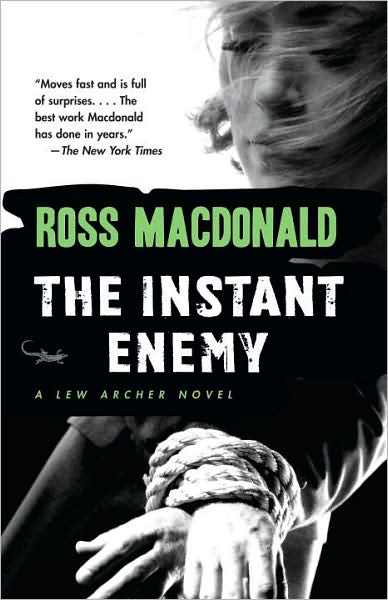
Hard-boiled — New designs for Ross MacDonald’s Lew Archer books by Joe Montgomery seen at FaceOut Books. I know I link to FaceOut just about every other week, but it’s an awesome site and the juxaposition of images in this series are great (as are some of the unused comps).
The Concierge and the Bouncer — Publishers Weekly report on Richard Nash (formerly of Soft Skull) and Dedi Felmen (formerly of Simon & Schuster) and their plans to “push back against the outmoded idea of publisher as cultural gatekeeper” with their new venture Round Table (announced at BEA this week):
The key is a shift from a caretaker mentality to a service mentality, from a linear supply-chain model to the idea of a free-floating, non-hierarchical “ecosystem” of readers, writers and authors… Nash and Felman’s idea of Publishing 2.0 could make a semi-professional reader, writer, editor and critic out of anyone with the desire.
Reading in a Digital World — A killer line in an otherwise blah article for Wired by Clive Thompson:
“We need to stop thinking about the future of publishing and think instead about the future of reading.”
Book Distribution in Canada — A Canadian Heritage study on book distribution in English Language Canada produced by Turner-Riggs dropped this week.
Can Editors Change Their Spots — David Hepworth’s thoughts on Robert G. Picard’s CS Monitor article ‘why journalists deserve low pay’, and what “the new dispensation” means for editors:
Magazine editors spend most of their time deciding what they’re *not* going to do and trying to arrive at a mix that the majority of people will like. They then find that whatever they’ve arrived at is too much for some people and not enough for others. This is made more difficult by the fact that their readers, being the most engaged in their particular area, are the people most likely to tap into other sources themselves. The people who value your mix most are also the people who would feel most qualified to mix it themselves.
The italics are mine.

Cover to Cover — Steven Heller reviews newly released ‘visual books’ in the New York Times with a nice accompanying slide-show. (See image above, but hey NYT, when are you going to let people embed your slide-shows? When?).
Comments closedAmazon launched the new large-screen Kindle DX in the US on Wednesday. The device, apparently aimed at newspaper readers and the textbook market was met with much fanfare in the New York Times (who had leaked the announcement earlier in the week), the Financial Times, Publishers Weekly and elsewhere.
Despite the immediate gadget-lust, the hype was also met with skepticism (and more than certain amount of unlinkable ambivalence). The DX’s $489 price tag, ‘blah’ design, lack of colour and Amazon’s decision to release the new device so soon after launching the Kindle 2 have been common complaints.
But for all these (fixable) flaws, what really nags at me about the Kindle is that whilst I can see what’s in it for Amazon, I just can’t see what’s in it for me the reader. With each launch it seems that readers continue to be secondary to Amazon’s business strategy.
I’m unlikely to buy a Kindle because, all things being equal, I’m always going to choose a paper book over an electronic one. If convenience is the primary concern, then I’m going to read an e-book on the phone I carry in my jacket pocket.
The Kindle DX won’t change my habits either. I already read newspapers on my laptop and I don’t want to carry 2 large devices. If I was a student, I’d want to my textbooks on my laptop too — if only because of the 2 magic words: “copy” and “paste”.
Comments closed
Oh. My. Gosh — Jon Klassen’s lovely illustrations and designs for the movie adaptation of Coraline.
Schadenfreude — Literary agent Nathan Bransford on the “death” of the publishing business:
There are definitely problems with the business… But the industry is not stupid. Like any massive industry that is comprised of tens of thousands of individuals, it is a human institution with some institutional problems and weaknesses. But despite a reading public whose appetite for books is not growing at a particularly fast rate, despite tremendous competition from other media, we’re still here, and we’re doing way better than a lot of industries, including ones comprised of supposed geniuses and masters of the universe.
Japan’s 21st Century Cultural Ambassador — Roland Kelts, author of Japanamerica, profiles Haruki Murakami for 3:AM Magazine.

Isolating the Commonplace — The New York Times Book Review‘s photography editor Jeffery Scales discusses the William Eggleston photograph used illustrate Edmund White’s review of Everything Ravaged, Everything Burned by (the improbably — yet charmingly — named) Wells Tower.
Give me Twitter or give me death — The Globe and Mail‘s Ian Brown possibly overthinks things…
1 Comment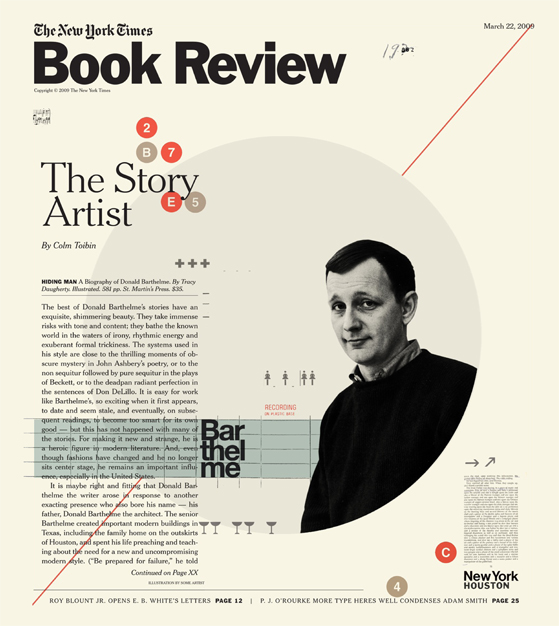
The Story Artist — Stand back and admire Cristiana Couceira’s cover for the New York Times Book Review (pictured above) illustrating Colm Toibin’s review of Hiding Man: A Biography of Donald Barthelme by Tracy Daugherty (St. Martin’s Press). You can see more of Cristiana’s fabulous work at her blog Sete Dias.

ma collection de boîtes de conserves — Cartoonist Guy Delisle, author of Shenzhen, Pyongyang, and Burma Chronicles, displays his charming recycled pen-holders. Guy also has some great sketches of Jerusalem on his blog (an experience that is probably even better if your French is not rubbish like mine). (Via the D+Q blog and full disclosure etc: Raincoast Books distribute D+Q in Canada).

And speaking of D+Q, John Wray’s much-praised novel Lowboy features a cover by the very talented Adrian Tomine (pictured above). And über-critic James Wood reviews Lowboy in the latest New Yorker.
Paper Egg — Tobias Carroll has posted an interesting interview with Jonathan Messinger, co-publisher at Featherproof Books:
[T]he line we’ve been delivering for a while now is that printed books will, eventually, go the way of vinyl. At some point, digital distribution will be the predominant method, but there will still be those who value and collect print, as people do records now (a fact that, it seems, has created a strong niche market for cool vinyl releases). But I’m not so sure that I completely buy that analogy, as fun as it is to repeat. Really, the debate seems pointless to me. What it always devolves to is one person clinging to what they’ve grown up with and accustomed to—the printed book, this classic, vaunted, untouchable commodity—and self-appointed visionaries who see digital distro as the obvious wave of the future, plowing down the fogies and fuddy-duddies.
If we de-politicize it, it becomes a much more open, interesting discussion. My feeling is that both media offer something that the other doesn’t. So why should one replace the other? … I’d rather just think about how best to use print creatively—what can it do that nothing else can, what are its limits and how do we test them?
Information revolution, c. 1455 — Murray Whyte looks at the “Gutenberg moment” in the Toronto Star:
Comments closedas we appear finally to face the end, or partial end, of the Gutenberg era … it’s worth noting that sometimes, those things we view in hindsight as revolution are, in their own time, little more than a pebble in the pond, the resulting ripples needing generations, if not centuries, to be fully felt.

David Mirvish Books, the best fine art bookstore in Toronto, is to close. Damn. At least the Art Gallery of Ontario’s bookstore has re-opened with a decent selection of art books.
“It’s not something you should really do unless you feel really compelled to do it” — An interesting interview with Doug Seibold about founding Chicago-based publisher Agate over at Slate’s Bizbox:
As in a lot of other businesses, there’s a bunch of giant multinational conglomerates that are the big players, and they leave a lot of waste behind them. My feeling was a company that functioned efficiently at the appropriate scale could do a lot of business by being cost-effective and opportunistic. Not too little, but not too grandiose: growing at a careful, natural pace.
Attack of the “renegade cybergeeks”: New York magazine meets the team behind the New York Times’ online operation:
[T]here is something exhilarating about watching web innovation finally explode at the Times, with its KICK ME sign and burden of authority… Despite the effectiveness of blogs, the majority still mainly provide links and commentary. The Times Online suggests what might happen when technology fuels in-depth reportage
A little up it’s own arse and not short on hyperbole (“the New York Times is less a newspaper and more an informative virus”? Really?), it’s still definitely worth a read. Gawker’s predictably acerbic response can be found here.
“Poetry is both flourishing and floundering” — Neil Astley, editor of Bloodaxe Books, argues poetry must be responsive to readers not academic cliques, in the New Statesman:
The producers of poetry aren’t in tune with the lovers of poetry. Many poets and publishers are actually hostile to the promotion of poetry… They see marketing as a dirty word instead of simply the means by which their books are made available to more readers.
“Publishers… lost control of their industry” — a somewhat melodramatic (and therefore much-linked to) “autopsy” of the book business by Jason Epstein in the Daily Beast. I have a lot respect for Epstein, who is indeed a “publishing legend”, but it is worth keeping in mind that he said most of this in Book Business, published in 2001, and in an article for Technology Review from January 2005. He’s also the man behind the futuristic-yet-seemingly-redundant (is there a word for that? Apart from ‘segway’?) Espresso Book Machine, so he’s not an entirely dispassionate observer.
Grant Morrison talks Batman with Publishers Weekly:
I wanted to assemble all the classical tropes of the pulp noir crime genre: the diabolical mastermind, the femme fatale, the inescapable traps, the secret societies of evil…and push them beyond all reasonable limits to a kind of screaming Death Metal crescendo.
Nice.
The Pelican Project: A collection of Pelican Book covers from the 1930’s through to the 1980’s (pictured). (I was reminded of this wonderful project by the eclectically brilliant FFFFound)
1 Comment“I have always enjoyed photographing loners” — A lovely BBC audio slideshow of “Writers’ Rooms” narrated by award winning photographer Eamonn McCabe. The project, appearing weekly in The Guardian and currently on show Madison Contemporary Art in London, captures the working environments of novelists, biographers and poets.
Book Industry Enters Shaky Chapter: NPR’s Lynn Neary looks at last week’s horrorshow.
The 10 Best Books of 2008 according to The New York Times Book Review. Interesting that they’ve also created a mini-site which has promotional material for the top 10 books, including shelf talkers, bookmarks, and posters for bookstores to download . There are also web banners and a video with author Toni Morrison. This is has to be a good idea.
“The news is still big. It’s the newspapers that got small”: A spectacular Roger Ebert rant about the death of criticism :
The celebrity culture is infantilizing us. We are being trained not to think. It is not about the disappearance of film critics. We are the canaries. It is about the death of an intelligent and curious, readership, interested in significant things and able to think critically. It is about the failure of our educational system. It is not about dumbing-down. It is about snuffing out.
Spot. On. I actually met Roger Ebert a few years back in Pages bookstore. The Toronto International Film Festival must have been on. I had no idea who he was at the time (a colleague told me later), but he was very nice about it.
“The Most Dangerous Man in Publishing”: A profile of publisher Barney Rosset in Newsweek:
Before Rosset challenged federal and state obscenity laws, censorship (and self-censorship) was an accepted feature of publishing. His victories in high courts helped to change that. Rosset believed that it was impossible to represent life in the streets and in the dark recesses of the heart and mind honestly without using language that in the mid-20th century was considered “obscene”—and therefore illegal to sell or mail. To a significant extent, the books he published convinced others that this was true.
The Well-Tended Bookshelf— Laura Miller on culling one’s book collection:
There are two general schools of thought on which books to keep, as I learned once I began swapping stories with friends and acquaintances. The first views the bookshelf as a self-portrait, a reflection of the owner’s intellect, imagination, taste and accomplishments… The other approach views a book collection less as a testimony to the past than as a repository for the future; it’s where you put the books you intend to read.
Which leads me rather nicely to…
Books At Home: A blog about bookshelves. It is possible that this just too nerdy. Even for me.
Relevance: Brian at daxle.net interviews author Tim Manners , editor and publisher of The Hub and Reveries.com. It’s a fascinating discussion that covers innovation, brands, and the consequences of overabundant advertising (amongst other things).
3 Comments