Skip to content

Tag: music

Midweek Miscellany

A fantastic new cover for the Vintage (UK) edition of Gravity’s Rainbow by Thomas Pynchon, designed by Matt Broughton (via the Vintage Books design Tumblr CMYK)

CTRL+C; CTRL+P — Music critic Simon Reynolds, author of Retromania, on remix culture and ‘recreativity’ at Slate:

Recreativity has many proponents and represents a wide spectrum of opinion. Still, it’s striking how easily some of these critics and theorists glide from relatively sensible talk about the role of appropriation and allusion in art to sweeping claims of an ontological or biological nature. They seem so confident. How they can be certain that nobody has ever just come up with some totally new idea, ex nihilo? The remixed nature of everything (not new) under the sun has become an article of faith. Impossible to prove, these assertions tell us way more about our current horizons of thought and our cultural predicament than they do about the nature of creativity or the history of art.

The A.V. Club list their 50 best films of the ’90s. (Their list of their most-hated movies is here).

Picture This — Cartoonist Adrian Tomine discusses his work and his new book New York Drawings with the The Paris Review:

If you were to go back in time and talk to the people who invented cartooning, and were doing it for newspapers, and told them that there were going to be guys who were going to do twenty-four-page long stories, they would think that was a strange use of the medium. And if you then said, they’re going to try and inject that with a singular vision and personal experience and do six-hundred-page long stories—I mean, their heads would have exploded.

See also: Adrian on his first cover for The New Yorker at the The Thought Fox, the blog of his UK publisher Faber & Faber.

And Finally…

Speaking of The Paris Review, an interview with editor Lorin Stein at the LA Review of Books:

The tradition of discovering new writers makes it easy to go out and find stuff that excites me, and at the same time feels of a piece with the history… To me it’s like that line in the great Italian novel, Lampedusa’s The Leopard. If you want things to stay the same, everything’s going to have to change. Nowadays we have to exist in the digital world if we don’t want to be strictly of the digital world.

2 Comments

Midweek Miscellany

City Air Sets You Free — Mark Lamster interviews P.D. Smith about his new book City: A Guidebook for the Urban Age, for Design Observer:

It was never my intention to write an architectural history. Cities are much more than the sum of their architecture or infrastructure. A city is made great by its people. Nevertheless, you cannot ignore the structures and spaces of a city. Winston Churchill once famously said: “We shape our buildings and afterwards our buildings shape us.” Our urban environments undoubtedly shape us as people. That’s why between each of the eight sections in the book there are essays on more concrete features of the urban landscape, such as the Central Station, the City Wall, the Skyscraper or even the Ruins. But I hope that even here I don’t lose sight of the people who use these architectural spaces. After all, they are the life-blood of the city.

Pop Detritus — Peter Paphides reviews When Ziggy Played Guitar by Dylan Jones, for The Observer:

For many critics, Ziggy was the last desperate act of a craven opportunist. A New Yorker writer flown to see the Ziggy shows fretted that “Bowie doesn’t seem quite real”. But, as long as music journalism has existed, performers – be it Bowie in 1972 or Lana Del Rey in 2012 – have been docked points for their apparent lack of authenticity.

And, besides, it was those very notions of authenticity with which Bowie was playing when he created Ziggy. After several hapless reinventions, the only hit he had to show for his efforts was Space Oddity, but, as Jones points out, Ziggy Stardust was the result of a decade spent sifting through pop cultural detritus and working out which bits he could use to turn him into a pop star.

Don’t Believe the Type — Estimable Jon Gray on the recently revealed cover design for J.K. Rowling’s new novel:

JD Salinger famously had a clause written into his contract stating that no imagery could appear on his covers. Günter Grass will only allow his own drawings. The classic orange Penguins, the poetry covers of Faber: they tell us nothing other than this is a book of note, a book of importance. JK Rowling’s name is the important piece of information, the quality assurance mark, and it is stated very simply and boldly in the brightest and clearest way possible.

(Needless to say, Jon’s thoughts are more interesting that the cover itself).

Material World — An interview with mighty Coralie Bickford-Smith:

I always start by asking myself ‘what is the most effective set of book covers I can produce using just standard materials which are simple but incredibly effective to be within the usual budget constraints?’ To marry design with materials in the most considered and best way possible. So in a way it always starts with the materials so I can make my design suit that method of printing. With the cloth classics its was all about creating a book that would be loved and cherished and not throw away. The materials were the starting point. The foiling was a real struggle at first, the detail of the design cant be too intricate. So the patterns were all designed with this in mind so that the printers could reproduce the design easily. Every material has its limits and its all about getting to grips with those limits to produce an end product that looks effortless and deceptively simple.

My interview with Coralie is here.

And finally…

The Long History of the Espresso Machine

In the 19th century, coffee was a huge business in Europe with cafes flourishing across the continent. But coffee brewing was a slow process and, as is still the case today, customers often had to wait for their brew. Seeing an opportunity, inventors across Europe began to explore ways of using steam machines to reduce brewing time – this was, after all, the age of steam. Though there were surely innumerable patents and prototypes, the invention of the machine and the method that would lead to espresso is usually attributed to Angelo Moriondo of Turin, Italy, who was granted a patent in 1884 for “new steam machinery for the economic and instantaneous confection of coffee beverage.”

Great stuff… (see also: The Once and Future Coffeehouses of Vienna)

Comments closed

Midweek Miscellany

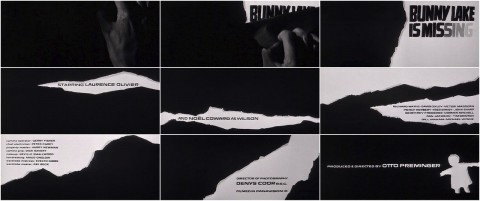
The excellent Art of the Title looks at the opening sequences to Anatomy of a Murder and Bunny Lake is Missing by Saul Bass.

Just Getting Started — Bill Moran on the Hamilton Wood Type and Printing Museum in Two Rivers, Wisconsin, for Design Observer:

When you hold a piece of wood type in your hands this deceptively simple piece of mass communication rewards you with its grace but also surprises with its weight. End grain maple is cut from the cross section of a tree yielding a harder and heavier piece of wood. Using the end grain of the wood improves durability with most wood type that was made in the nineteenth century still fully functional a century after its date of manufacture.

Leading the Blind — Nick Harkaway, author of The Blind Giant: Being Human in a Digital World, on book publishers and technology at The Guardian:

There’s a willingness to think: we’ll let everyone else figure out how the market should work, and then we’ll just supply books in the same way that we did to bookshops to electronic sellers like Amazon, Apple and Google. But booksellers are tied to publishing – they need conventional publishing models to continue – but for those companies that’s not the case. Amazon is an infrastructure company; Apple sells hardware; Google is really an advertising company. You can’t afford as a publisher to have those companies control your route to market.

Creative Paralysis — Michelle Dean on the future of ‘serious’ publishing at The Rumpus:

I don’t think there is anyone out there who has recently looked at the state of book publishing, I mean really looked, and not tightened her grip on her wineglass… I don’t work inside or report on publishing, but what limited exposure I do have suggests that there is indeed a crisis on the horizon. Anyone who’s ever wanted to see their name in print on the cover of a book — biography or novel, chapbook or memoir — ought to be thinking about that, about how to sustain the world of books. But the focus on the internet as the death of culture, which drones on in tired refrain on certain book sites, strikes me as bizarre, and overstated, not to mention creatively paralyzing.

And finally…

Eleanor Wachtel interviews composer Philip Glass for CBC Radio:

CBC Radio Ideas: Wachtel on the Arts with Philip Glass mp3

Comments closed

Midweek Miscellany

Comics critic Paul Gravett profiles cartoonist and illustrator Luke Pearson. Coincidently, Pearson has created an amazing cover for a new Penguin edition of Lucky Jim by Kingsley Amis (pictured above).

Desirable Comparisons — Part three of Mark Medley’s series on House of Anansi for The National Post:

“We want it to appear as a very serious, big, ambitious book,” Bland says. “Which is hard to do in a way that doesn’t look like other big books.”

He shows [Pasha] Malla some text-heavy covers that bring to mind the likes of David Foster Wallace, Jonathan Franzen and Jonathan Lethem.

“For Pasha, for various reasons that aren’t mine to say, these are not desirable comparisons,” Bland says. “For us, they’re very desirable comparisons.”

Thousands of folk songs and interviews recorded by Alan Lomax are now available for free online.

See also: NPR ‘Alan Lomax’s Massive Archive Goes Online

Neue Haas Grotesk — Christian Schwartz has restored the classic Swiss sans serif typeface for the digital era. There’s a history of Neue Haas Grotesk / Helvetica here.

The Books in My Head — The Quill and Quire profile Canadian independent comics publisher Drawn & Quarterly:

Part of what sets D&Q apart is its focus on high-quality design, incorporating elements like glossy embossing on covers. “We want to treat the comic as the nicest object possible,” says [creative director Tom] Devlin.

While Devlin says he collaborates with authors on design, D&Q’s willingness to cede creative control has given the company a reputation as something of an artist’s haven. Seth says he prefers to work independently, providing the publisher with camera-ready artwork for computer production. “They almost never interfere with my design plans,” he says. “I would not be the designer I am today without D&Q allowing me to make the books I see in my head.”

(Full disclosure: As mentioned in the story, D+Q are distributed in Canada by my employer Raincoast Books)

And finally…

With a retrospective at the Oakland Museum of California and the publication of The Art of Daniel Clowes: Modern Cartoonist, Carol Kino profiles Daniel Clowes for The New York Times:

“I never thought of myself as a museum artist who’s doing work for the wall,” he said. “For me the book is the final result.” He assumes that most people who see his work at the museum won’t know who he is. “But if they have some connection to something they see,” he added, “and then they read the book, the more I’ll feel like the show was a success.”

1 Comment

Something for the Weekend

Ways of Designing — Steven Heller chats with British graphic designer Richard Hollis, who designed the original cover for the classic Ways of Seeing by John Berger (among other things), at Imprint:

My generation went from hot-metal to photosetting to digital. Computers have changed everything, bringing total control to the designer. But they haven’t changed the way I design. Perhaps they should have. But the way people read hasn’t changed, the sequence, letter –words–sentences–paragraphs– columns of text. Fifty years ago the printer made the corrections and changes were expensive. Now clients know that changes can be made, and designers pay with their time. The alphabet hasn’t changed, while the range of type designs available is astonishingly increased. Two or three are plenty for me.

Fringe Behaviour — Richard King, author of How Soon is Now?, on the indie record labels that changed the British music industry at The Guardian:

The improvisatory space in which the indies thrived has shrunk for several reasons. One is the ever-prevalent and finely tuned ability for corporate culture to absorb fringe behaviour and repackage it and market it as cutting edge. Another is the formalising of Britain’s creative industries, a process that has seen the development of college degrees in music business, music journalism and, indeed, being in a band, lead to industry standardisation. The independent sector’s greatest attributes – its ability to ad-lib, to trust its instincts and to hang the consequences are both impracticable and unteachable in such rigid frameworks. The sort of behaviour that allowed Wilson, McGee, Watts-Russell and their contemporaries to conceive some of their more extreme and fanciful ideas would also be something of a stretch for a human resources department to manage.

Also in The Guardian, a profile of author of author Peter Carey.

Value the Medium — Mark Thwaite interviews Benjamin Eastham and Jacques Testard, editors of literary journal The White Review, at ReadySteadyBook:

[We] believe in the value of the book as a physical object. Neither do we consider this to be an old-fashioned attitude. Publishing will go down two different routes: there’s no point knocking out a cheap, poorly bound paperback on crap paper any more because you’re as well to read the content on an electronic reader. The book as a medium has to justify itself now, it’s no longer the default option, and this is to its benefit. We’ve witnessed an upsurge in beautifully produced books, with enormous amounts of time and creativity invested in them – check out Visual Editions, for just one example, and the work of artists and independent galleries exploring the possibilities offered by the book form. The design of The White Review is important to us – the quality of the images we reproduce, the balance of the colours, the alignment and legibility of the text. We value the content, so we value the medium in which it is reproduced.

The White Review is beautifully designed by Ray O’Meara in case you were wondering.

And finally…

Robert Lane Greene on the origins of the term “dude” for More Intelligent Life:

Though the term seems distinctly American, it had an interesting birth: one of its first written appearances came in 1883, in the American magazine, which referred to “the social ‘dude’ who affects English dress and the English drawl”. The teenage American republic was already a growing power, with the economy booming and the conquest of the West well under way. But Americans in cities often aped the dress and ways of Europe, especially Britain. Hence dude as a dismissive term: a dandy, someone so insecure in his Americanness that he felt the need to act British. It’s not clear where the word’s origins lay. Perhaps its mouth-feel was enough to make it sound dismissive.


Comments closed

The Evolution of Music Online | Off Book

Related to the previous, the latest PBS Arts Off Book documentary short is about the massive changes that have occurred in the music industry in the last twenty years as a result of new technology and the Internet:

Comments closed

PressPausePlay

The full-length documentary PressPausePlay is now available to watch on Vimeo. The film, which somehow manages to be simultaneously both inspiring and melancholic, looks at the effects of digital technology and the Internet on the creative economy. Worth watching if you have a spare hour (although depending on your attitude to these things it might make you smile in joyful validation or retreat to your bed for about a week to weep quietly to yourself:

PressPausePlay was made by creative agency House of Radon.

Comments closed

Ice Cube Celebrates The Eames

This is doing the rounds today, but it’s simply too good not to post…

Ice Cube, who apparently studied architectural drafting before joining NWA, on the architecture of Los Angeles and the design of Charles and Ray Eames:

The New York Times has an interview with Ice Cube  about the video:

 I had learned about them when I was studying architectural drafting. Back then, I didn’t know I was going to make money. So being that they put together a house in two days and used discarded materials — something about their style caught on.

As I got older, I could equate it to sampling. I see that’s what we were doing, taking discarded records from the ’60s and ’70s and revamping them.

Awesome.

Comments closed

Something for the Weekend


Read This — Alex Ross, author of The Rest is Noise and Listen To This, on books about music at FiveBooks:

There’s a long list of bad examples of vague and gushy writing about music in literature, but there’s also a string of distinguished examples. I wrote a piece for The New Yorker a couple of years ago where I talked about my favourite composers in literature. It makes me very happy when I see a novelist going to the trouble of getting the musical details right, because this is part of the conversation on classical music that we very much need. To have plausible and vivid representations of composers and classical musicians in literature and in film is very important.

(Disclosure: the paperback editions of The Rest is Noise and Listen To This are published by Picador in the US and are distributed in Canada by my employer Raincoast Books)

Building from the Bones of a Superstore —  Businessweek on the decline of Borders and the opportunities for independent bookstores in the US:

Despite rising online book sales and digital downloads and the Great Recession, bookstores in the area were profitable—right up until they closed. Even Davis-Kidd, locally owned until the Joseph-Beth Booksellers chain purchased it in 1997, had been solvent, undone not by the collapse of the local market but by the bankruptcy of the parent company… Nashville lost its bookstores not because people there had abandoned physical books and retailers. For the most part, it lost them remotely, at the corporate level.

It’s Just a Device — Errol Morris talks to Stephen King about the Kennedy assassination and his new novel 11/22/63:

When you write about the past, the more you write, the clearer the past becomes. It’s like being regressed under hypnosis. My view of the past is that attitudes change, but they change very slowly. Underneath, they stay pretty much the same. “The fundamental things apply as time goes by.”

The Artist and The Scientist — Paola Antonelli, critic and curator at MoMA, on type design for Domus magazine:

Font designers who are able to marry critical and commercial success are a unique mixture of two basic clichés: the artist and the scientist. They are eclectic, curious, obsessive and absorbed, as well as rigorous, punctilious, enamoured of rules and limitations, and loyal to a higher code of design behaviour. They are an even more different breed among the many different breeds of designers working today. Contending now with the dynamic methods of communication provided by tablet computers, smartphones and other supports for text and brand, they deal with each family of fonts as if it were truly made of individuals, live characters that need to be able to fend for themselves once released into the wider world. In this vein, font design might just be the most advanced form of design existing today.

And finally…

Failure and Disappointment — Comedian Ricky Gervais on the difference between American and British humour:

Americans say, “have a nice day” whether they mean it or not. Brits are terrified to say this. We tell ourselves it’s because we don’t want to sound insincere but I think it might be for the opposite reason. We don’t want to celebrate anything too soon. Failure and disappointment lurk around every corner. This is due to our upbringing. Americans are brought up to believe they can be the next president of the United States. Brits are told, “it won’t happen for you.”

Have. A. Nice. Day.

Comments closed

Something for the Weekend

Project Thirty-Three, one of my favourite mid-century modern design blogs, is now using Blogger’s “Dynamic Views” template. It looks great using the new ‘Flipcard’ feature.

The Crash — Alan Hollinghurst talks about writing and his new novel The Stranger’s Child with the New York Times:

Mr. Hollinghurst said he modeled his work habits on another friend and novelist, Kazuo Ishiguro. “He has this thing he calls ‘the crash,’ ” Mr. Hollinghurst explained. “He takes a lot of time to prepare a novel, just thinking about it, and then he draws a line through his diary for three or four weeks. He just writes for 10 hours a day, and at the end he has a novel.”

He laughed and pointed out that for him the Ishiguro method was only partly successful: at the end of three or four nonstop weeks he is still years away from being done.

Also in the New York Times, author Adam Thirlwell (The Escape) on translation and David Bellos’ new book Is That a Fish in Your Ear?:

Google Translate, no doubt about it, is a device with an exuberant future. It’s already so successful because, unlike previous machine translators, but like other Google inventions, it’s a pattern recognition machine. It analyzes the corpus of existing translations, and finds statistical matches. The implications of this still haven’t, I think, been adequately explored: from world newspapers, to world novels. . . . And it made me imagine a second prospect — confined to a smaller, hypersubset of English speakers, the novelists. I am an English-speaking novelist, after all. There was no reason, I argued to myself, that translations of fiction couldn’t be made far more extensively in and out of languages that are not a work’s original.

Counter-Culture — Loren Glass on Barney Rosset and the history of Grove Press at the LA Review of Books:

Philip Larkin famously dated the beginning of sexual intercourse to the end of the Lady Chatterley ban and, more recently, Fred Kaplan has used Rosset’s campaign to situate 1959 at the crux of an epochal transformation. Whatever its larger historical significance, it surely marked a turning point in the fortunes of Grove Press. On the brink of a decade in which the geopolitical order would be transformed, flush with cash for the first time, and well connected to the international avant-garde, the West Coast scene, and the nascent counterculture in college towns across the country, Grove was positioned in the eye of the coming storm. At the nexus of an emergent international vanguard, Grove became a potent symbol of the counter-culture, increasingly drawing radical authors, readers, translators, professors, lawyers and activists into its expanding network.

Part two of Glass’ history Grove Press is here.

And finally…

A slightly weird  interview with the David Lynch in The Guardian:

Film is dead, Lynch tells me. It is too heavy, too much of a dinosaur, and its time has largely past. But digital is alive and well and pointing to the future. He admits he’ll miss shooting on celluloid (“because it’s so beautiful”), but is more than happy to shoot on digital instead – as and when the opportunity arrives.

Until then he’s happy pottering around his studio and slurping his coffee; painting his spooky black houses and singing his eerie songs of love gone sour. “I can understand why people might be frustrated with me: ‘Let’s give up on these side ventures and go make a film instead.'” He chuckles. “But all these other things feed into the future. And if the ideas aren’t there for cinema, and if the pressure is on, then you might pick a bad idea and find yourself forced to marry something you’re not totally in love with. So I’m happy to wait.”

Comments closed

Midweek Miscellany

On Record — Rick Poynor at Design Obsever waxes all lyrical about Continuum’s 33 1/3 music series:

The best 33 1/3 titles… have an urgent personal mission, even obsession, and they tunnel deep down into an album’s defining moment and milieu: dark sixties Los Angeles in Forever Changes, isolated seventies Berlin in Low, creative nineties Athens, Georgia in In the Aeroplane over the Sea… Usually around 30,000 words, these detailed studies are hugely challenging to research and write. Continuum has let it be known that a batch of previously announced titles has been canceled after initial high hopes: the authors just couldn’t deliver.

Movies on Paper — Tom McCarthy, author of Tintin and the Secret of Literature (as well as Remainder and C), reviews Steven Spielberg’s The Adventures of Tintin: The Secret of the Unicorn:

Tintin was always premised on a set of implicit borrowings and relocations from one medium to another. Hergé’s earliest strip-cartoons were billed as “movies” on paper; creatively, he was as indebted to the films of Buster Keaton and Harold Lloyd as to the novels of Jules Verne or the illustrated poems of Benjamin Rabier (which, long forgotten now, featured a tuft-headed boy called Tintin-Lutin and his dog). Hergé’s remarkable achievement with the Tintin series was to pluck all these elements from their original contexts and join them together, holding them in perfect equilibrium, in a new, hybrid format whose conventions (speech-bubbles joined with left-to-right action, for example) he established in the very act of assembly.

McCarthy loathes the movie by the way.

See also: Nicholas Lezard getting really quite upset about it.

(If you’re wondering why the British are so bothered by the Speilberg’s movie, my take on it is that we view Tintin as an eccentric, quintessentially British hero — not unlike T.E. Lawrence — rather than a Belgium one, and Spielberg is well… just so American. Or it might just be a shit movie.)

And finally…

Gum-Chewers of the World (Unite and Take Over) — Canadian cartoonist Seth on being awarded the Harbourfront Festival Prize at the International Festival of Authors in Toronto:

I’ve always believed the comics medium was capable of genuine subtly and grace and complexity… and of telling stories that would appeal to an adult mind. Stories that reflect real human experience. That said, it didn’t look too likely that the literary world or the art world…or even the mainstream pop culture was likely to cut the comic book much slack. Comics were considered entertainment for the gum-chewers of the world. Kid junk at worst – nerd culture at best.

Comments closed

Monday Miscellany

I’m sorry for the lack of a weekend post, but to make up for it, here is a Monday round-up to get your week started right…

Owned — Josh Davis AKA DJ Shadow interviewed on the Intelligent Life blog:

My sense of value comes from the fact that music is my life… People always think it’s about money or my personal wealth or something like that. It’s about this art form that’s taken a drubbing in the last decade. I’m not talking about what a wonder it is that music has been democratised. Music between 1960 and 1970: how can you even chart that progress? Music between 1970 and 1980: entire genres come and go, massive leaps. Music between 2001 and 2011: I don’t think there’s a massive difference… We have access to all this music now and I’ve been hearing for 12 years what a miracle that’s going to be and how it’s going to revolutionise music. But I work in the clubs and I’m not seeing any evidence of this shift. People seem to think we own the internet as a collective brain-trust. We don’t own the internet. The internet is owned by the same people that own everything else. They make money from the advertising that you’re being shown as you look at somebody’s life’s work, and they’re not being given a dime.

You can listen DJ Shadow’s new album The Less You Know, The Better on NPR.

And on a semi-related note: Chuck Klosterman on music and nostalgia for Grantland.

The Idiot — Cartoonist Daniel Clowes interviewed at Flavorpill:

If I ever met a young cartoonist who is really amazing I would say just don’t do any interviews, don’t do any public appearances. Just remain a mystery. Because once you do one, then that becomes your opinion on record. Unless you get it exactly right that first time, you have to keep modifying it over the years, because I’m certainly not the same person I was when I did my first interview. I was probably 26 years old. I was an idiot.

Playing the Part — Grant Morrison’s Supergods reviewed at Robot 6:

[M]any creators Morrison discusses are his peers, rivals, colleagues and bosses — it’s nice to get a book like this that’s unafraid to engage in industry gossip from a working creator, but, at the same time, it makes one suspicious of the writer, who becomes an unreliable narrator of his own career. This is perhaps exacerbated by the fact that early on in the book, Morrison says he was acting a part, an invented persona as a sort of demonic, enfant terrible punk early in his career, publicly sneering at Alan Moore’s work and engendering animosity. How does a reader know he’s not still playing a part?

And finally…

From Business WeekAmazon, the company that ate the world:

Although the decision to design and build its own hardware is a high-stakes bet, it’s equally true that Bezos had no choice but to enter the tablet business. About 40 percent of Amazon’s revenues comes from media—books, music, and movies—and those formats are rapidly going digital. Amazon was late to understand the speed of that transition; Apple, which launched the iPod in 2001 and iTunes two years later, wasn’t. The iPad has only strengthened Apple’s hold over digital media. There’s a Kindle app for the iPad, but Apple takes a 30 percent slice of all content that app makers sell on the tablet and has restricted Amazon from directing iPad users to its website in order to avoid giving Apple its cut. Doing business on the iPad threatens Amazon’s already thin profit margins.

Bezos claims he doesn’t think defensively. “Everything we do is driven by seeing opportunity rather than being worried about defending,” he says. Given Apple’s inroads into the media business, that’s hard to believe. Bezos is magnanimous toward Jobs. “On a personal level we have a tremendous amount of respect for Apple and Steve. I think that’s returned,” he says. “Our cultures start in the same place. Both companies like to invent, both companies like to pioneer, both companies start with the customer and work backwards. There’s a like-mindedness.” Pause. “Are two companies like Amazon and Apple occasionally going to step on each others toes? Yes.”

Comments closed