
Brian Eno talks about art, music and his creative process in this video for Alfred Dunhill:
(via David Pearson on Twitter)
Comments closedBooks, Design and Culture
Brian Eno talks about art, music and his creative process in this video for Alfred Dunhill:
(via David Pearson on Twitter)
Comments closed
Typgraphica’s favourite typefaces of 2012. There’s a lot to love about Balkan Sans by Nikola Djurek and Marija Juza. But check out the ligatures on Levato by Felix Bonge:

Chasing the White Rabbit — Francine Prose on dreams and literature, at the New York Review of Books blog:
Literature is full of dreams that we remember more clearly than our own. Jacob’s ladder of angels. Joseph saving Egypt and himself by interpreting the Pharoah’s vision of the seven fat and lean cows. The dreams in Shakespeare’s plays range as widely as our own, and the evil are often punished in their sleep before they pay for their crimes in life. Kafka never tells us what Gregor Samsa was dreaming when he awakens as a giant insect, except that the dreams were “uneasy.” Likely they were not as uneasy as the morning he wakes into. By the end of the first paragraph of “The Metamorphosis,” Gregor has noticed his arched, dome-like brown belly, his numerous waving legs. “What has happened to me? he thought. It was no dream.”

Krautrock on the Underground — An excerpt from Earthbound by Paul Morley, part of the Penguin Lines series for the 50th anniversary of the London Underground, at The New Statesman:
“Krautrock” was the convenient collective name given in a slightly jokey, slightly wary and affectionately patronising way to an eclectic collection of radicalised German groups from very different parts of the country that contained musicians who were born in the few years before, during or just after the Second World War. Another collective name for these groups, still frivolous but more descriptive of their mission to create sound never heard before on our planet and invent music that could make you feel you were leaving the earth behind, was “kosmische”. As well as Can, these groups included Kraftwerk, Tangerine Dream, Amon Düül II, Cluster, Popol Vuh, Harmonia, Neu! and Faust, and they were looking for ways to repair their traumatic recent history, remove the crippling infection of fascism, break free of totalitarian artistic repression, negotiate turbulent social and emotional currents, and radically, romantically reinstate the positive, progressive elements of their mortified national psyche.
See also: Jonathan Gibbs looks at the design of the Penguin Lines series at The Independent.
And finally…
Fact-Checking at the New Yorker, an excerpt from a new book called The Art of Making Magazines:
When the new, remade The New Yorker of the last decade was gearing up and we started getting all these late-breaking stories, issues such as logic and fairness and balance—which previously had been the responsibility of the editors—began to fall on the checkers. This wasn’t by anybody’s design. It was because the editors were really busy putting these stories together and they wanted us to look at things from the outside and see how they were framed, and look at them from the inside and look at the logic and the way they were reported and the way quotes were used and many other such things.
That responsibility came to us not in the way of anybody saying suddenly, “You’re doing that.” It just became that when a problem arose, they would come to us and say, “Why didn’t you warn us?” And so it just became clear that there was this gap between editing and checking that had opened up under the pressure of later-breaking stories, and it just seemed logical that we should fill it. It made our job more challenging, and more fun.
(via Kottke)
1 Comment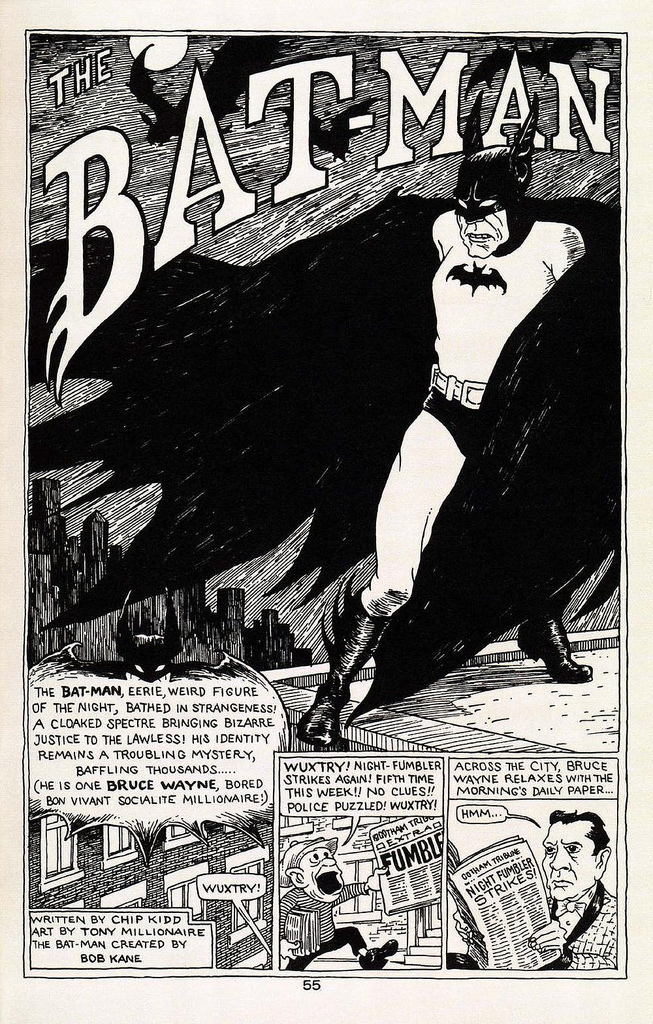
“The Bat-Man” by Chip Kidd and Tony Millionaire from Bizarro Comics #1. I can’t quite believe I haven’t seen this before… (via Martin Klasch)
Could Have Been Something — José da Silva interviews Billy Childish for The White Review:
Critics want you to get in your box and shut up. That’s why they don’t like it that I’m a writer, musician and painter. That’s totally unacceptable to their small minds… I’m looking for freedom from being categorised or identified with aspects of myself. But at the same time I use this very strong biographical information to negotiate a world – a world which I find quite mental, by the way. So I still refuse to identify myself as Billy Childish the artist, painter, writer or musician, because in my estimation only an idiot would want to be something.
Accommodating the Mess — Tim Martin on B S Johnson, ‘Britain’s one-man literary avant-garde’, for The Telegraph:
In principle, at least, Johnson’s declared mission echoed the great Modernist cry to make it new. Politically socialist and from a working-class London background, he cultivated pithy distrust for the complacency of his novelist peers, “neo-Dickensian” writers, as he called them, who were using a 19th-century form to gratify the “primitive, vulgar and idle curiosity of the reader to know ‘what happens next’”. A truly modern novel would seek, in Beckett’s phrase, a form to accommodate the mess, stripping readers of their escapist illusions while remaining ruthlessly true to the writer’s experience.
This obsession with so-called narrative truth runs through Johnson’s work, accounting for its most unorthodox experiments as well as its greatest flaws.
See also: Juliet Jacques review of Well Done God! Selected Prose and Drama of B S Johnson for The New Statesman.
And finally…

The mild-mannered Richard Hell in the New York Times:
After running away to New York in 1967, at the age of 17, with dreams of becoming a writer, Mr. Hell collected some good editions of favorite books. Then, in the 1970s, when he became a drug addict, he traded them for cash.
“Those were pretty much my only liquid resource,” he said. “So I sold them all over the years.”
Since getting his health and career back on track in the ’80s, he has replaced most of the ones that got away. Given the number of books now neatly stacked into the East Village apartment where he has lived for the last 38 years, he has more than made up for lost time.
Hell’s memoir, I Dreamed I Was a Very Clean Tramp, is out this week. The cover was designed by Steven Attardo.
Comments closed
French duo Cauboyz have created a wonderful new type-orientated music video for Husbands ‘Dreams’:
It’s all the more impressive when you realise that it was created with light boxes and switches rather than digitially. Watch the ‘making of’ video:
And this isn’t the first time Cauboyz have created a deceptively simple looking typographic music video. They also created this beauty for The Black Keys ‘Make You Free’:
You can watch the ‘making of’ video here.
Comments closed
Deciphered — Designer Peter Saville on his designs for New Order, particularly Blue Monday and Power Corruption and Lies, at Upon Paper:
To me a record cover is part of the everyday, the now. And regularly there were phases of reference and quotation that – for whatever reason – I found relevant or pertinent. There were things going on in fashion or architecture that I would be aware of… things that I would take a reading from. I was interested in how the arts in general, but in particular the applied arts, were in some way evoking the mood, the appetite or the direction, the direction of the now. I always had a sense of what direction ‘the now’ was, it started with my own senses and then I would double-check and double-check to determine that what I was thinking was not merely insular. Around ’82 to ’83, I began to feel confident in my own sensibility.

Txtng teh Apclyps — The Guardian rock critic Alexis Petridis talks to Nick Cave about this new album:
“Texting is apocalyptic on some level,” he muses, when the title of Push The Sky Away’s first single, We No Who U R is mentioned. “It’s a reduction of things. Maybe the last book, the last thing that ever gets written is just a bye, you know, goodbye in text speak.”
And finally…
Teju Cole on literature, Barak Obama, dirty wars and drone strikes, at The New Yorker:
Comments closedThe plain fact is that our leaders have been killing at will.
How on earth did this happen to the reader in chief? What became of literature’s vaunted power to inspire empathy? Why was the candidate Obama, in word and in deed, so radically different from the President he became? In Andrei Tarkovsky’s eerie 1979 masterpiece, “Stalker,” the landscape called the Zona has the power to grant people’s deepest wishes, but it can also derange those who traverse it. I wonder if the Presidency is like that: a psychoactive landscape that can madden whomever walks into it, be he inarticulate and incurious, or literary and cosmopolitan.

Guardian journalist Alexis Petridis on the first performance of KRAFTWERK — THE CATALOGUE 1 2 3 4 5 6 7 8 at the Tate Modern in London:
Comments closed
Thrills — As part of British Comics Week, Colin Smith looks at the success of science fiction comic 2000AD, for The New Statesman:
The past year has been a remarkable success for 2000AD and its publisher Rebellion Press. The transformation of the entertainment landscape means it’s no longer able to rely on a mass audience of young readers inculcated with the habit of reading comics. But Rebellion has responded by nurturing new markets for its huge library of characters and stories through book collections, digital distribution, films, gaming, audio plays, and more… The content itself is typically a touch more measured now, aimed at an older audience. But the comic’s never lost its signature fusion of out-there excitement, ever-ambitious craftsmanship and smart, challenging content.
And if science fiction art is your thing, take a look at the 2000AD Covers Uncovered blog. The ABC Warriors cover above is by artist Clint Langley.
Also at The New Statesman: Alex Hearn on comics journalism; Seb Patrick on British football comics; and Laura Sneddon on kids comics.
And on a somewhat related note… Ian Jack’s memories of the The Dandy at The Guardian are interesting (if you can get passed his ridiculously prim “get off my lawn” dismissal of modern comics):
Nearly 40 years ago, the writer George Rosie compared Desperate Dan to the works of Magritte and appeared in Pseuds Corner for it, and yet, as Rosie pointed out, what could be more surreal than a town, Cactusville, which combined hitching rails and wild west saloons with tramcars and pillar boxes, and where a cow pie with two horns poking through pastry could be bought from a corner shop that looked suspiciously like a Scottish bakery.
And finally… an interview with Tony Fletcher, author of A Light That Never Goes Out: The Enduring Saga of The Smiths, at Salon:
Part of Morrissey’s personality that I found liberating was growing up in Britain — and I’m sure it’s true in America — at 19 years old and you don’t have a girlfriend, people are going to say to you, “What’s wrong with you, mate? You a poof?” And maybe you are, but you can’t come out and say it because you’ll get beaten up. And maybe you aren’t, but it’s just not working out in your life. And maybe you just want someone to say, “It doesn’t matter.” I think that that was a genius element. So whether or not he didn’t have the confidence to come out, I think there was also a sense of, “No, I refuse to let you identify me.”
Quite.
Comments closedRuined… For Life — Yuka Igarashi on the consequences of copy-editing at Granta:
There is a danger to copy-editing. You start to read in a different way. You start to see the sentence as machinery. You focus on the gears and levers that connect words to one another; you hunt for the wayward semicolon, the unintentionally ambiguous phrase, the clunky repeated word. You even hope they appear, so you can kill them. You see them when they’re not even there, because you relish slashing your pen across the paper. It gets a little twisted.
As with any kind of technical knowledge or specialization, it is possible to take copy-editing too far, to be ruled by it, to not quite be able to shut it off when it ought to be shut off.
(As if to prove the point, the article itself is copy-edited in the comments)
The Undercoat of Modernity — Mathias Schreiber on Berlin in the ‘Golden Twenties’ for Der Spiegel:
Looking back on the period, playwright Carl Zuckmayer… who lived in Berlin from 1924 to 1933, wrote: “The arts blossomed like a meadow just before being mowed. This explains the tragic yet brilliant charm that is associated with this era, often seen in the images of poets and artists who died prematurely.”
The realization that this euphoria could not last undercoats the best works of art of these years with the metallic tone that soon became the trademark of artistic modernity. This applied, quite literally, to the refined simplicity of the anti-plush, steel-tube furniture of Bauhaus designer Marcel Breuer and the architecture of the same movement, fashioned from strictly functional steel skeletons… Metaphorically speaking, the tendency toward metallic, unadorned expression also applied to the literature of the period, and certainly to the objectivist collage technique employed by Alfred Döblin in his novel “Berlin Alexanderplatz” (1929). Döblin blends together the sound of wind, the rhythmic thud of the steam pile-driver, quotations from newspaper advertisements, stock market reports, soldiers’ songs, nursery rhymes and prostitutes’ patois with expressive, poetic flights of fancy, and injects all of these noises and fragments of language into the protagonist’s stream of consciousness… This first important big-city novel in the German language was also the first great 20th-century novel about the working classes.
And finally…
Purpose in the Wreckage — Simon Hattenstone’s endlessly quotable interview of media-shy musician Scott Walker, for The Guardian:
When [Walker] returned in 1995, it was as a fully fledged modernist composer. On the surface, there couldn’t have been a more unlikely transformation – imagine Andy Williams reinventing himself as Stockhausen. Yet in a way it was all of a piece. His latest album, Bish Bosch, is only his third in 17 years, all of them elaborate, epic and inaccessible. It is a post-apocalyptic opera of sorts, with blasts of rams’ horn, dog barks, scraping swords, machetes. The music nods at Gregorian chant, doffs its cap to Shostakovich, gives a thumbs up to industrial metal, and is uniquely Scott Walker. The lyrics reference sexual disease, brown dwarf stars, court jesters and dictators, all delivered in a strangulated baritone, as if Walker’s testicles were being squeezed. At times there’s a terrible beauty to his poetry (“Earth’s hoary/fontanelle/weeps softly/for a/thumb thrust”) while at others there’s a bloodthirstiness that could be straight out of Jacobean tragedy (“I’ve severed my reeking gonads, fed them to your shrunken face”). It’s brilliant and bonkers. The opposite of a guilty pleasure: a guilty torture.
And why not?
Comments closed
Accidental Effects — Rick Poynor on the street photography of designer Robert Brownjohn, at Design Observer:
Brownjohn tended to include enough of the setting to give a strong sense of the look and atmosphere of the place where he found the lettering or graffiti. The British capital’s dour post-war street texture was fascinating and meaningful to him. As an American and a recent arrival in London, he would have seen everything with the newcomer’s hungry and hypersensitive eye, whether the pictures were taken in a single day touring around town by taxi, as the story would have it, or in the course of several trips. Brownjohn shows the bricks, the stone, the doorways and window frames, the railings, the adjacent fixtures, the surrounding structure… [He] valued the accidental effects wrought by dilapidation, the elements, or human hands, in their own right, as a kind of visual music or poetry, irrespective of the formal design applications that these expressive details might go on to inspire.
Drowning in Film — Movie critic David Thomson, author most recently of The Big Screen, in conversation with Greil Marcus, at the LA Review of Books:
I have become more and more interested in the way different movies are like the water in a river. They’re constantly flowing into each other. Indeed, it’s a form that you can’t actually think of or describe as separate items. It’s the flow, it’s the sequence. And I think that we’re at a point in history where it’s not really as significant who makes what particular movies, it’s the constant flow. And like any flow of that kind, you say it’s like being carried down a river, and a lot of time perhaps you feel it’s on a sunny day and it’s very pleasant, but you can drown in a river. It seems that a lot of the culture, elements that I would hope to see maintained, are in danger of being drowned.
And finally…
Abnormal Activities — Patrick Ambrose interviews Iggy Pop for The Morning News:
Comments closedIggy Pop… obliterated the barrier between the artist and spectator. “I’m interested in being able to do that while maintaining the formality of the dinner engagement,” he says with a hearty laugh. “There has been a tremendous change in the cybernetics of rock and roll over the past 50 years. If you look back to the mid- to late-’50s, you’ve got maybe Elvis or Eddie Cochran playing on a flat-bed truck in a gas station parking lot with presumably 1,200 doomed teenagers dancing, chewing gum and knifing each other while religious leaders burn records and make racial slurs about the music. Now, you’ve got thousands of people obediently shuffling into these concrete civic centers to sponge up something in places where nothing really happens.”

In Search of Lost Time — Jimmy Stamp on Chris Ware’s Building Stories, at Design Decoded:
If there’s a central theme to Building Stories, it is the passing of time – and our futile struggle against it. The comic book is the perfect medium to explore this idea. After all, what is a comic but sequential, narrative art? Unlike a photograph, a comic panel does not typically show a single moment in time but is, rather, a visual representation of duration. That duration might be the time it takes Superman to punch out a giant robot, the seconds that pass while a failed artist chops a carrot, or the years it takes for a single seed to travel around the world. In every comic book, time passes within the panel. More noticeably though, time passes between the panels. This is where the art of storytelling comes in. There are no rules in comics that standardize the duration of a panel or a sequence of panels. In Building Stories, sometimes milliseconds pass between panels, sometimes entire seasons, and sometimes even centuries can expire with the turn of the page.
See also: Mike Doherty interviews Chris Ware for the National Post.
Nuts — Jon Ronson, author of The Psychopath Test, interviewed at The Awl:
the stuff I was gravitating towards at the beginning was people who lived on the fringes of society and funny, absurd stories about the kind of crazy things that see us through. You know, belief systems that seemed kind of completely irrational to me. And I’ve got to admit, at the time, in my early 20s, I probably thought I was better than them. They were kind of nuts and I was, you know, sane and rational. But the older I get, the less I feel that. Now I feel completely on a par of irrationality with them.
And finally…
Cents — Damon Krukowski of Galaxie 500 and Damon & Naomi on musicians and streaming music services, at Pitchfork:
Comments closedthe sale of recorded music has become irrelevant to the dominant business models I have to contend with as a working musician. Indeed, music itself seems to be irrelevant to these businesses– it is just another form of information, the same as any other that might entice us to click a link or a buy button on a stock exchange.
As businesses, Pandora and Spotify are divorced from music. To me, it’s a short logical step to observe that they are doing nothing for the business of music — except undermining the simple cottage industry of pressing ideas onto vinyl, and selling them for more than they cost to manufacture.
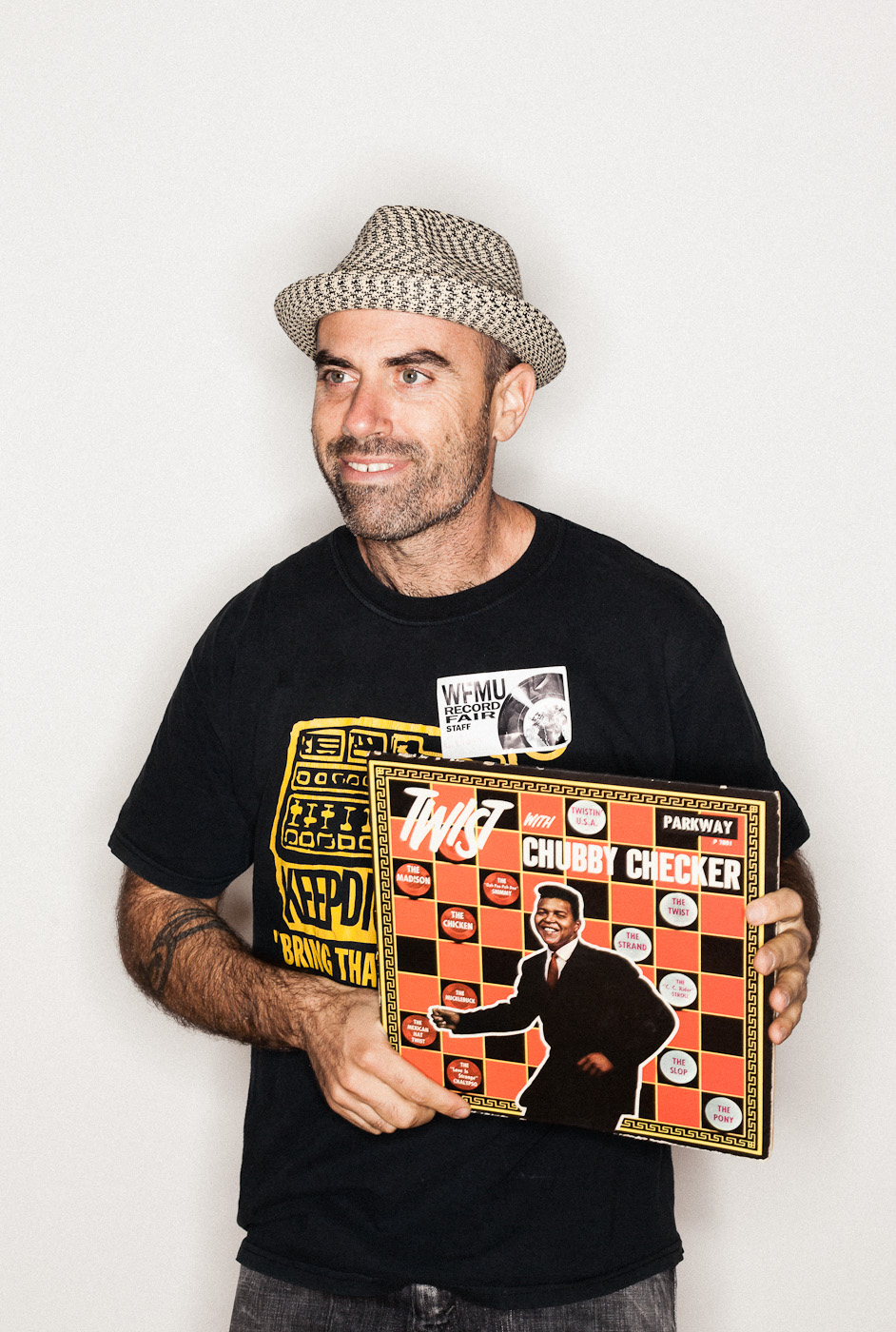
Digital formats are really convenient, but they are easily forgotten as well. If you ask anyone what was their first vinyl they bought they’ll probably remember that, but I don’t think a lot of people will remember what was their first mp3 download.
When you play a vinyl record it demands your attention and this is a way to connect to the music. You have to take it out, you have to put it on the turntable, you have to put the needle on… These are all actions that demand attention from you and then you have to keep your attention and wait until the side is done and then you have to flip the record…
Photographer Eilon Paz, Dust and Grooves
A new short documentary from PBS Off Book on the attraction of physical formats in the digital age:
Eilon Paz successfully raised funding for a Dust and Grooves book with Kickstarter early this year.

See more of Eilon’s photos here.
Comments closed
Designer Peter Saville discusses the iconic cover of Joy Division’s 1979 album Unknown Pleasures:
1 Comment