Skip to content

Tag: literature

Tim Parks: Life Transformed into a Series of Categories

Gustave Doré: Canto VII—Hoarders and Wasters, from Dante's Inferno

Tim Parks on literature and bureaucracy for the New York Review of Books blog:

So could it be—and this is the question I really want to ask—that however much literature may appear to be opposed to bureaucracy and procrastination, it actually partakes of the same aberration? Balzac’s Comedie humaine with his declared ambition to “compete with the civil registry”; Proust’s monstrous, magnificent Recherche, which he likened to a cathedral, tediously extending the analogy to every section of the work; Joyce’s encyclopaedic aspirations in Ulysses, his claim that Finnegans Wake would be a history of the entire world. Or go back to Dante, if you like, and his need to find a pigeonhole in hell for every sinner of every category from every sphere of society. Or fast forward again to Bouvard and Pécuchet, Flaubert’s two incompetents who react to practical failure by becoming obsessive copiers of literary snippets. This without mentioning the contenders for the Great-American-Novel slot, so eager to give the impression that their minds have encompassed and interrelated everything across that enormous continent (one thinks of the interminable lists of contemporary paraphernalia in Franzen’s writing). In each case, however different in tone and content the texts, life is transformed into a series of categories, made more mental, more a matter of words and intellect; we revel in the mind’s ability to possess the world in language, rather than to inhabit it or change it.

(pictured above: Gustave Doré: Canto VII—Hoarders and Wasters, from Dante’s Inferno)

Comments closed

Nabokov’s 1964 Playboy Interview


Longform has posted a Playboy interview with Vladimir Nabokov from January 1964:

When I remember afterwards the force that made me jot down the correct names of things, or the inches and tints of things, even before I actually needed the information, I am inclined to assume that what I call, for want of a better term, inspiration, had been already at work, mutely pointing at this or that, having me accumulate the known materials for an unknown structure. After the first shock of recognition—a sudden sense of “this is what I’m going to write”—the novel starts to breed by itself; the process goes on solely in the mind, not on paper; and to be aware of the stage it has reached at any given moment, I do not have to be conscious of every exact phrase. I feel a kind of gentle development, an uncurling inside, and I know that the details are there already, that in fact I would see them plainly if I looked closer, if I stopped the machine and opened its inner compartment; but I prefer to wait until what is loosely called inspiration has completed the task for me.

(read the full interview)

Comments closed

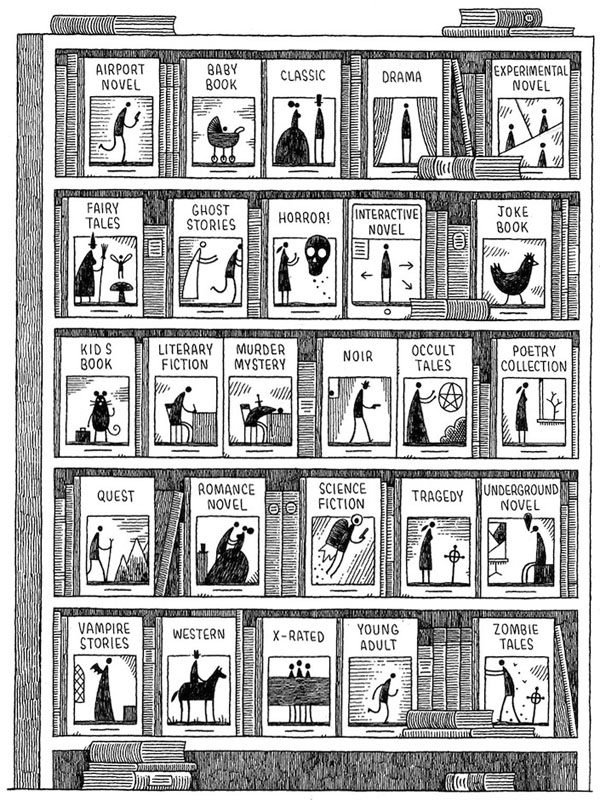
An Alphabet of Books by Tom Gauld

Tom currently also has a new ‘A Noisy Alphabet‘ print for sale.

Comments closed

Jonathan Lethem: Nibbling Around the Edges of Culture

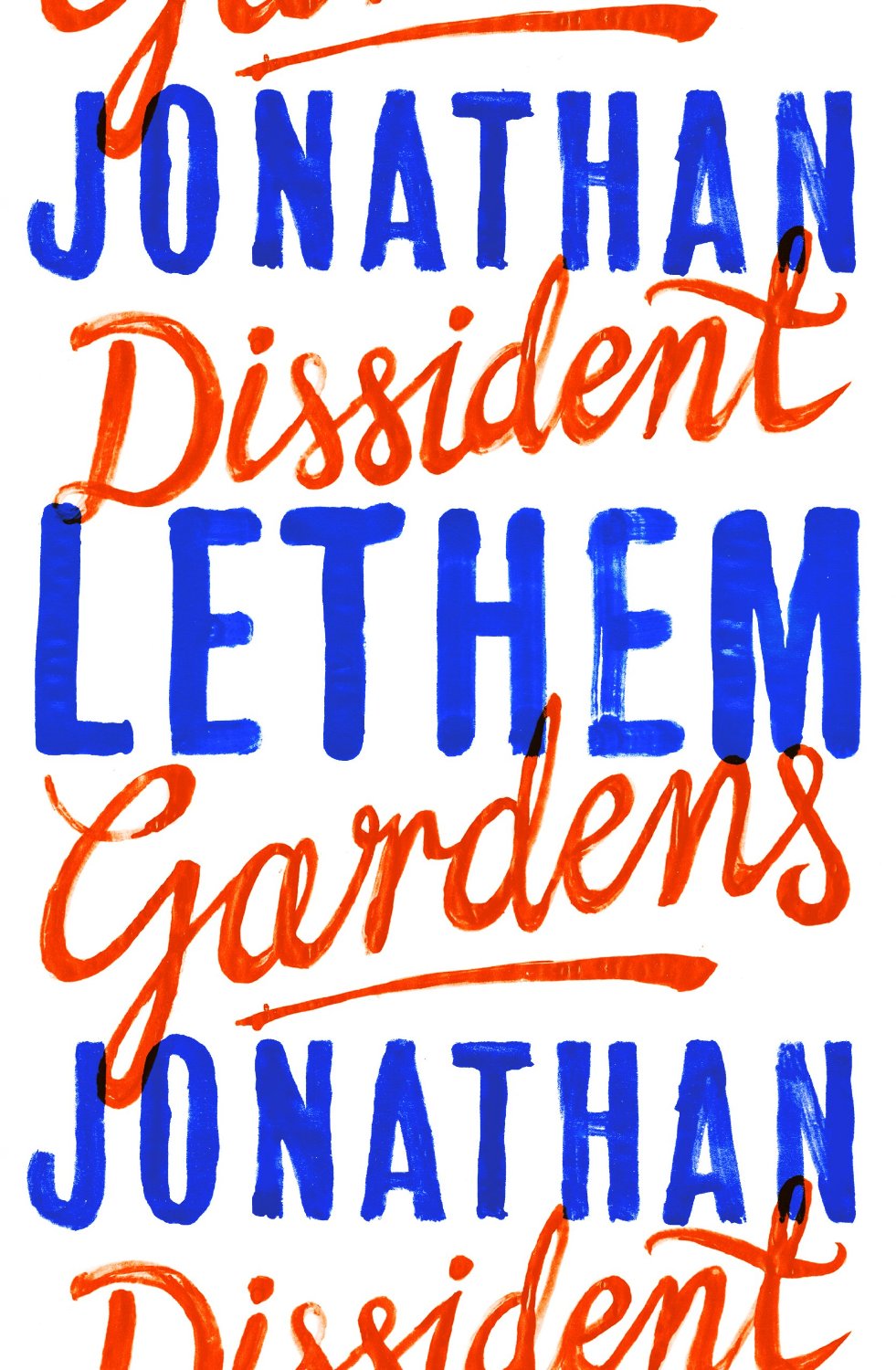
Jonathan Lethem discusses science fiction, comics and his new novel Dissident Gardens with Jesse Hicks at The Verge:

I like that Philip K. Dick and the science fiction writers that I fell in love with were intrinsically in this termite role, nibbling around the edges of the culture. I know it was uncomfortable for them, and it certainly didn’t pay as well as they might have liked, but it meant that their work had a relevance and vitality and disreputable energy that, for me as a younger reader, hands-down won over the official literary product of the same time period.

Though one of the things that’s wrong with marginal identities is that you tend to act as though the big hegemonic center is all one thing itself. “The mainstream” doesn’t agree with itself or make any kind of sense or have a coherent position, except in the very small matter of believing itself to be the only action. That’s the only thing it agrees about. [laughter] The rest of it, if you really pay any attention and care, and I started to care about all kinds of novels and all kinds of literary ventures, and possibilities — different kinds of lives that writers led — the rest of the mainstream is pretty much at one another’s throats over various matters of style and politics, minor grudges and so forth. But it looks like one big thing if you’re in exile from it.

Comments closed

Jonathan Franzen Says No

So good, Tom… So, so good.

4 Comments

Jonathan Lethem: The Author Looks Inward

Jonathan Lethem talks about writing his new novel, Dissident Gardens, with Brian Gresko at the Los Angeles Review of Books:

Of course, in the writing, Dissident Gardens couldn’t bear much of what I’d learned. Novels don’t want to be crammed with factual stuff. I mostly left it aside, including some astonishing truths, which when you first come across them, you think, holy shit, I’ve learned this crazy thing and now I’ll blow people away by revealing this knowledge in the book! But at the juncture where you’d insert such a thing, you flinch, seeing the cost is too high. The facts will intrude — either on the reader’s experience, or my own relationship to the page, to the dream. You’ve heard of killing your darlings? You’ve got to kill plenty of the world’s darling’s too

Dissident Gardens is out this week in the US & Canada (I believe you have a bit longer to wait in the UK). The book was reviewed in Sunday’s New York Times Book Review.

Comments closed

Robert Walser: The Monotony of Things

Colors fill up your mind too much with all sorts of muddled stuff. Colors are too sweet a muddle, nothing more. I love things in one color, monotonous things. Snow is such a monotonous song. Why shouldn’t a color be able to make the same impression as singing? White is like a murmuring, whispering, praying. Fiery colors, like for instance Autumn colors, are a shriek. Green in midsummer is a many-voiced song with all the highest notes. Is that true? I don’t know if that is right. Well, the teacher will surely be so kind as to correct it.

At The New Yorker, Ben Lerner considers the writing of Robert Walser:

There is the typically Walserian statement “I love things in one color, monotonous things.” Praise for the monotonous, the uniform, the mundane, the insignificant—such sentiments are everywhere in Walser’s work, and maintain a crucial ambiguity. On the one hand, they are expressions of poetic attunement to those aspects of the world we too readily overlook, and for which writers concerned with heroic exploits often have no time. On the other hand, Walser’s celebration of the monotonous or uniform returns us to his fascination with subservience, with relinquishing all personality to imposed order: “Modestly stepping aside can never be recommended as a continual practice in strong enough terms.”

The force of Walser’s writing derives from this simultaneous valorization of irreducible individuality and of sameness, smallness, interchangeability.

Lerner has written the introduction to a new NYRB collection of Walser short stories, A Schoolboy’s Diary and Other Stories, translated by Damion Searls.

Comments closed

Will Self on J.G. Ballard’s The Drowned World


Will Self on J.G. Ballard’s The Drowned World at The Telegraph:

To coincide with the 1962 publication of The Drowned World – his own post-apocalyptic novel in which men of the future also venture into a flooded London, intent on looting the city of its treasures – JG Ballard wrote an article for The Woman Journalist in which he explained the mise en scène thus: “On reflection it seems to me that the image of an immense half-submerged city overgrown by tropical vegetation, which forms the centrepiece of The Drowned World, is in some way a fusion of my childhood memories of Shanghai and those of my last 10 years in London.”

According to Ballard, “My own earliest memories are of Shanghai during the annual long summer of floods, when the streets of the city were two or three feet deep in brown silt-laden water, and where the surrounding countryside… was an almost continuous mirror of drowned paddy fields and irrigation canals stirring sluggishly in the hot sunlight.”

There seems no reason to doubt Ballard at his word on this question; one that he proposes himself rhetorically at the outset of the piece: “How far do the landscapes of one’s childhood, as much as its emotional experiences, provide an inescapable background to all one’s imaginative writing?”

The Drowned World by J.G. Ballard, with an introduction by Will Self and illustrations by James Boswell is published by the Folio Society.

A paperback edition of The Drowned World published by W.W. Norton, with a cover design by Darren Haggar (pictured above), is also available.

Comments closed

The Mounting Tide of a Mass Avant-Garde

Phil Ford, author of Dig: Sound and Music in Hip Culture, reviews Loren Glass’ new book on Grove Press, Counterculture Colophon: Grove Press, the Evergreen Review and the Incorporation of the Avant-Garde, for the LA Review Books (which is, by the way, probably the most consistently interesting place around to read about books right now):

Grove Press and its charismatic owner, Barney Rosset, sit right at the center of postwar intellectual history. Glass notes early that if Rosset made a lot of impulsive bad decisions, he was guided steadily by a shrewd understanding of where American culture was headed. In the 1950s, Americans were beginning to go to college en masse, and when they got there they would seek out whatever was chic, daring, avant-garde, experimental — in a word, hip. Counterculture, the notion of seceding from the mainstream and dwelling in an autonomously created realm of liberated culture, was perhaps the most potent dream of the postwar age. Everybody wanted in. Against the mounting tide of a mass avant-garde, the old censorship codes could not long endure.

But while it’s hard not to be inspired by the story Grove Press, it’s also important to note the less savoury side of it, and how it was overtaken by the cultural changes Rosset helped start:

Those who harkened to Evergreen Review’s call to “join the underground” constituted the higher-brow version of the man who read Playboy: a 1966 advertising survey discovered that he was “a 39-year-old male, married, two children, a college graduate who holds a managerial position in business or industry, and has a median family income of $12,875.” (That’s about $92,000 in 2013.) It turns out that “Chuck,” the everysquare in a 1965 Evergreen Review spoof of Charles Atlas ads, painted a pretty realistic portrait of the Grove readership. But with the emergence of a feminist critique made possible by the very cultural revolution Rosset served, the masculine literati no longer enjoyed the privilege of guiltless consumption, and modernist experimentalism no longer provided a dignified alibi for it. In the 1970s, the Evergreen Review image of the hip intellectual soured. We might imagine Chuck a decade later, up to his ears in alimony, parted hair modishly grown out though thinning and combed-over on top, paunch swelling under a safari suit coat, leering at younger women who wish he would drop dead.

Read the whole review.

Comments closed

Midweek Miscellany

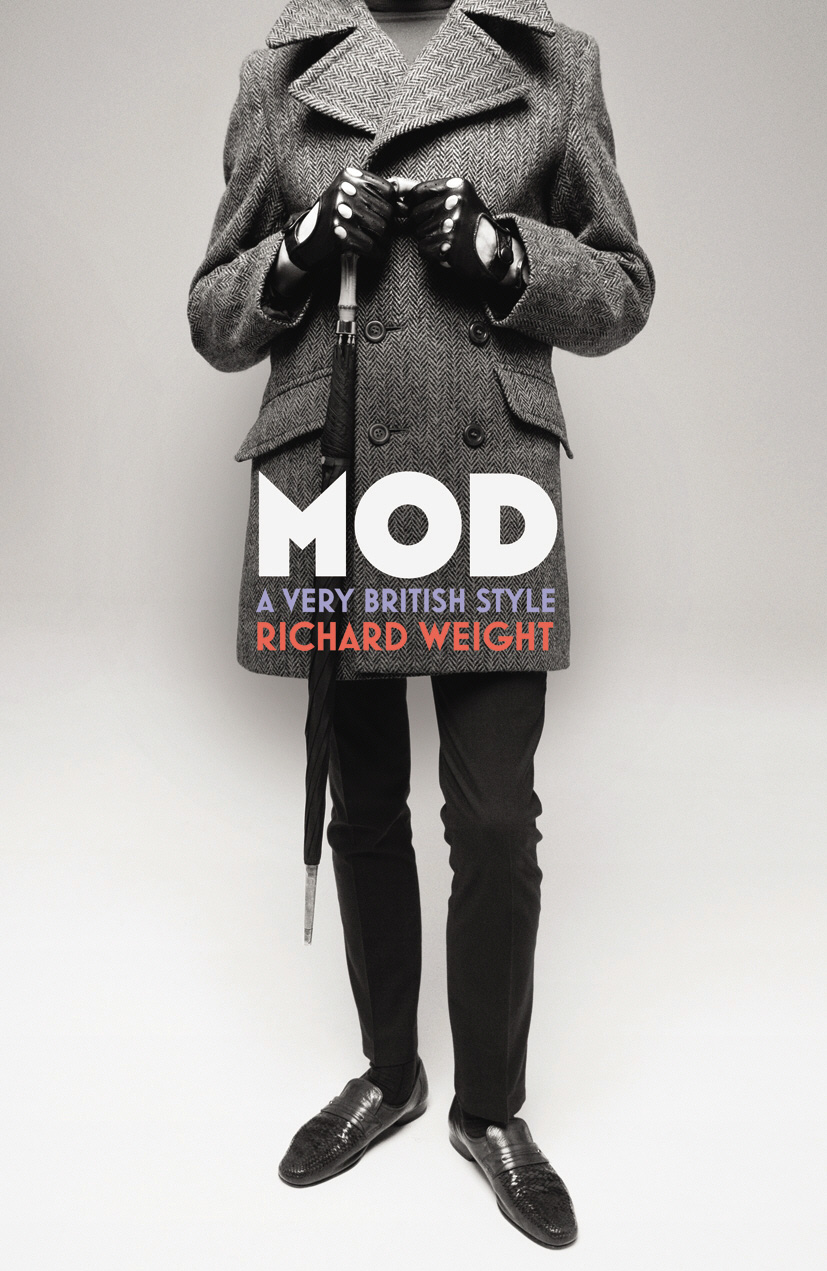
Ian Thompson reviews Mod: A Very British Style by Richard Weight for The Observer:

Mod’s first choice of music was jazz, Richard Weight reminds us. Miles Davis in particular became a fashion icon for blue-eyed soul brothers everywhere in Britain. The photograph of Davis on the cover of his celebrated 1958 Milestones album – Sta-Prest trousers, button-down Ivy League shirt – became a sort of mod pin-up. Mods (“modernists”) were among the first white Britons to embrace west-coast jazz, which had been galvanized by the Birth of the Cool sessions led by Davis in New York from 1949-50.

See also: Gavin James Bower’s review for The Independent.

It is What it is  — Five designers, Craig Mod, Rodrigo Corral, Michael Fusco, John Gall, and Jon Gray, on the books that inspire them, at the Virginia Quarterly Review.

Here’s Mr. Gall:

The clearest explanation of a good cover that I have ever heard came from Michael Beirut. I was a guest invited to critique a book-cover project he had given to his Yale students. As I was struggling to express some notion about why a particular concept may or may not be working, he got right to the point: “It has to look like what it is.” Indeed.


The Darkness — Sarah Weinman profiles Canadian author and illustrator Jon Klassen (I Want My Hat Back, This is Not My Hat, and The Dark) for Maclean’s:

Klassen’s style shies away from sentimentality. Instead it shows young children the consequences of bad behaviour through the prism of humour, a technique that hearkens back to books for children by the likes of Shel Silverstein and Roald Dahl.

And finally…

On the Exaggerated Reports of a Decline in British Fiction at the White Review:

Our peculiar creed is mortally suspicious of untrammelled aestheticism, endlessly asserting the primacy of content over form. In accounts of British writing, even now – long after such a thing could be anything other than a rather quaint anachronism of an old culture war – the avant-garde features as a kind of bogeyman. One whose dandified aestheticism belies a questionable politics, a moral compass gone awry; who must be beaten back by decency and common sense. Literary experiment still tends to be perceived as a pernicious form of French ‘flu: of course we should still be bloody grateful for the English Channel, separating, as it does, steady, dependable old Blighty from that kind of thing.

1 Comment

Midweek Miscellany

WHAAM! — Comics historian Paul Gravett on Roy Lichtenstein’s appropriation from comics:

Lichtenstein’s… success, his getting away with turning supposedly anonymous ‘found’ comic art into high-priced paintings, continues to directly encourage others to do the same. But there is a difference—comics are no longer uncredited, trashy mass culture, and what worked as a lucrative schtick back in the Sixties art world is now largely drained and devoid of any shock value or irony… Five decades on… it is high time for the comics world and the art world to properly debate these issues, and to celebrate these hugely talented but still largely ignored visual storytellers.

(Pictured above: a page from ‘The Star Jockey’ drawn by Irv Novick, from All-American Men of War #89 February 1962)

See also: David Barsalou’s Deconstructing Lichtenstein project

(If Gravett underestimate’s Lichtenstein’s ingenuity in recontextualizing comic book panels, and his lasting influence on art AND comics, it is truly astonishing to see how poor Lichtenstein’s paintings are in direct comparison to the work he borrowed from.)

Blowing Shit Up — A long essay by Richard Nash on the business of literature at the VQR:

Selling a book, print or digital, turns out to be far from the only way to generate revenue from all the remarkable cultural activity that goes into the creation and dissemination of literature and ideas. Recall again all the schmoozing, learning, practice, hustling, reading upon reading upon reading that goes into the various editorial components of publishing; the pattern recognition; the storytelling that editors do, that sales reps do, that publicists do, that the bookstore staff does. Recall the average feted poet who makes more money at a weekend visiting-writer gig than her royalties are likely to earn her in an entire year. You begin to realize that the business of literature is the business of making culture, not just the business of manufacturing bound books. This, in turn, means that the increased difficulty of selling bound books in a traditional manner (and the lower price point in selling digital books) is not going to be a significant challenge over the long run, except to free the business of literature from the limitations imposed when one is producing things rather than ideas and stories. Book culture is not print fetishism; it is the swirl and gurgle of idea and style in the expression of stories and concepts—the conversation, polemic, narrative force that goes on within and between texts, within and between people as they write, revise, discover, and respond to those texts.

See Also: Book Publishers Scramble to Rewrite Their Future by Evan Hughes for Wired.

And finally…

The New Statesman has posted five classic book reviews from their archive, including V. S. Pritchett’s review of 1984 by George Orwell:

Nineteen Eighty-Four is a book that goes through the reader like an east wind, cracking the skin, opening the sores; hope has died in Mr Orwell’s wintry mind, and only pain is known. I do not think I have ever read a novel more frightening and depressing; and yet, such are the originality, the suspense, the speed of writing and withering indignation that it is impossible to put the book down. The faults of Orwell as a writer – monotony, nagging, the lonely schoolboy shambling down the one dispiriting track – are transformed now he rises to a large subject. He is the most devastating pamphleteer alive because he is the plainest and most individual…


Comments closed

Midweek Miscellany

‘The Art of Harvey Kurtzman’ curated by Monte Beauchamp and Denis Kitchen opens at the Museum of American Illustration in New York on March 6th. Boing Boing has more (via Drawger).

On a related note: Steven Heller on Al Capp at The Atlantic:

[Denis] Kitchen…loved Capp’s unpredictable plots, his sexy women, and his uncouth, often grotesque cast. But as a college student, Kitchen told me, he witnessed Capp’s transformation “from a progressive figure to a student-hating, pro-Vietnam War pal of Richard Nixon and Spiro Agnew. And not long afterward saw sex scandal headlines gut his fame. Almost overnight he lost everything.” This intense love-hate feeling toward Capp and his work is what led Kitchen to want to understand the man better.

And: Kitchen talks to Michael Dooley about the new book Al Capp: A Life to the Contrary, at Imprint:

“I thought Al Capp was a flat-out genius. That said, I had also known for many years that he had quite a dark side. I’d been collecting every article and scrap for years and interviewing any associate I could find, so I fully expected our biography to depict a deeply flawed and even tortured man…  The ‘monster’ we discussed earlier was also a devoted son and father, an often generous man with assistants and strangers, a man capable of great charity, a man who wouldn’t tolerate a racist or homophobic joke.”

(To be honest, Capp still sounds kind of irredeemable.)

Every day. Onwards. — A. L. Kennedy on writing for love (and money), at The Guardian:

The first novel was treated gently and coddled probably more than it deserved to be. This wouldn’t happen now. The short story anthology as a first book is rarer than unicorn pie. (May contain traces of horse.) The hope of making even 50% of your income as a published author any more in the UK has probably also gone – unless you are lucky enough to produce a bestseller, preferably involving porn. This may change when UK publishers discover that the production of ebooks reduces overheads as well as cover prices. Who knows – it does tend to take a while for UK publishers to notice most things. I worry in case, for example, their offices catch fire and they all burn to death over a period of weeks, coming and going, sadly unable to realise that their coffees are boiling away to nothing in their melting cups. And this is, of course, a hard time for all industries, from the sprightly to the moribund.

Kennedy’s new book On Writing has just been published in the UK by Jonathan Cape.

See also: a short interview with Kennedy in Metro.

Comments closed