Skip to content

Tag: literature

Midweek Miscellany

Killing Her Softly — Joseph O’Neil reviews Martin Stannard’s biography of Muriel Spark for The Atlantic (thx Ben):

In one of her memoirs, [Doris] Lessing suggests: “Writers, and particularly female writers, have to fight for the conditions they need to work.” This sounds like an understatement, particularly in relation to the last pre-feminist generation, to which she belonged. Dipping into it, we see that Penelope Fitzgerald, a mother of three, did not publish until the age of 58, that Iris Murdoch and Flannery O’Connor and Patricia Highsmith were childless. Spark may not have been alone in associating motherhood with artistic and personal annihilation. (Other patterns emerge. Highsmith, Lessing, and Spark all loved cats, and in fact Spark received a cat from Highsmith, with whom she also shared itinerancy and a gleefully vicious imagination. If you took scoops of the temperaments of Doris Lessing and Patricia Highsmith and added a dollop of Flannery O’Connor—for the cold Catholicism—the resulting gelato would taste a lot like Muriel Spark.)

Sensory Deprivation — The ubiquitous Jonathan Franzen, author of Freedom,  interviewed at the A.V. Club:

Where does this stuff come from? It comes from sensory deprivation. It comes from turning down all the volume knobs to the one setting—or somewhere between zero and one—on everything, so I can actually hear myself think and I can actually poke around inside myself. We’re all so used to cultural noise being played at full volume. It can come as a surprise, even to myself, how much you can know about what’s going on by listening to almost nothing. It’s important, because if you have it up at full volume, you can’t hear yourself think, and all you want to do is chase after the stuff that’s going on.

And if you think Mr Franzen might have got a little too big for his boots, then following Emperor Franzen on Twitter might be for you (“I was on the cover of TIME. That’s TIME magazine, bitches…”).

Fighting the Last War — John Le Carré talks to the BBC Radio 4 Today Programme about his new novel Our Kind of Traitor (released next month):

“I was laughed at, in a way, when the Cold War ended and the wall came down… ‘Poor old Le Carre, what will become of him? Nobody’s spying anymore.’ The reality is, the budgets have never been bigger, the recruitment has never been more wholesale.”

Boredom — Lee Rourke, author of The Canal, interviewed for 100th issue Bookslut:

We’re in constant thrall, either waiting to be used by technology or desperately trying to catch up with it. Boredom is the realization of an acute emptiness caused by this widening void… There’s nowhere for us to go now. We are stranded. We have been marooned. My novel, The Canal, is a summation of this sense of dread: this slow realization that things, everything, is speeding up and moving away from us. We have been left with the inability to deal with what this distance creates within us…

And finally…

Living in Conservative Times — Tom McCarthy reviews What Ever Happened to Modernism? by Gabriel Josipovici for The Guardian:

In cultural terms, we live in deeply conservative times… We shouldn’t imagine, though, that things were that different in the golden age of modernism. Ulysses was printed, in 1922, on a small, private press in Paris, in a run of 1,000; Kafka’s Metamorphosis, on its small-press publication in 1915, sold 11 copies – of which 10 were bought by Kafka. Yet can anyone, now, name the successful middlebrow writers of 1922 or 1915? Of course not.

(And, as this is a blog for people who like to live under rocks, Tom’s novel C was shortlisted for the 2010 Man Booker Prize yesterday.)

3 Comments

The Books That Made Me: China Miéville

China Miéville, author of one of my favourite novels this past year The City and the City, talks to Claire Armitstead about the six books that inspired him for a new Guardian Books podcast series ‘The Books That Made Me’. The books range from Beatrix Potter’s Tale of Jeremy Fisher to Max Ernst’s surrealist Une Semaine de Bonté:

The Books That Made Me: China Mieville

Miéville latest novel is Kraken.

4 Comments

McCarthyism

Best known previously for his art-house novel Remainder and saving literature from itself, author Tom McCarthy has been pretty much everywhere since the somewhat surprising inclusion of his new novel C on the Booker long-list. Tom may not actually be bigger than Jesus — or the bookies favourite — but he certainly does give good interview…

To James Purdon for The Observer :

“The avant garde can’t be ignored, so to ignore it – as most humanist British novelists do – is the equivalent of ignoring Darwin. Then you’re just a creationist. It’s ostrich-like. It needs to be worked through – which is not the same thing as imitation…

People use [‘experimental’] when what they actually mean is ‘not conforming to a certain type of realism’, and that’s just as much a literary convention as anything else. Burroughs said his ‘cut-up’ writing was more realistic than Jane Austen. I think he was right. You’re being assailed by associations and networks. Everything is a code…”

To Tim Robey for The Telegraph :

“We exist because we are awash in a sea of transmission, with language and technology rushing through us…”

And to Stuart Evers for The New Statesman:

“Commentators and critics seem to want fiction either to be blatantly avant-garde and postmodern, or to be realist and 19th century; but really most literature is neither nor… ‘The avant-garde’ describes a specific historical moment that belongs to the early part of the 20th century. Certainly in C there is a huge amount of that moment behind the writing; the avant-garde is definitely embedded in it. But at the same time I think it gets used as catch-all term now for something that isn’t retrograde, anything that’s not a kind of nostalgic, kitsch version of the 19th-century novel, which is what much of middlebrow fiction right now is.”

C has been reviewed by Christopher Taylor at The Guardian and by John Self at Asylum, and you can keep track of Tom various comings and goings at Surplus Matter.

My interview with Tom McCarthy and book designer Peter Mendelsund is here.

Update: The fine folks at 3:AM Magazine have also posted an interview with Tom about C.

4 Comments

Midweek Miscellany

A nice post about the US cover for The Girl With Dragon Tattoo — designed by Peter Mendelsund — and why it is so different from all international versions at the Knopf website:

[Peter] decided to shift away from the more traditional murder-mystery vibe of the foreign editions, instead providing a neon yellow in-your-face punch, a jolt of energy comparable to what Salander brings to the narrative… Knopf’s twist was achieved with the subtle interaction of the Trade Gothic type and a great piece of art in yellow and orange Day-Glo inks. Add a dash of cyan (shades of colors in the blue/green spectrum) to create the green dragon lurking in the background and a tablespoon of black for the title, flap copy, and Stieg’s photo, and voilà!

HP Sauce — Anis Shivani interviews Calvert Morgan, vice president and editorial director of Harper Perennial, for the Huffington Post:

[T]here’s an intensity of dialogue about writing online–and about fiction in particular–that was not happening ten years ago. A lot of the writers I work with are finding like-minded peers and readers, having a forum for discussion now that simply wasn’t available when the only venues you had to get published were little magazines that were distributed to a handful of shops across the country in physical form. We’re passionate proponents of the physical book and we don’t think it’s ever going to go away, but we also know that these online forums… are promoting the interest that these writers have in each other and in fiction generally in a way that can only be good for contemporary writing.

The 11th Plague — In an extract from his new book, My Experimental Life, author A.J. Jacobs gives up multitasking for a month:

Multitasking makes us feel efficient, but it actually slows down our thinking. Our brains can’t handle more than one higher cognitive function at a time. We may think we’re multitasking, but in fact we’re switchtasking, toggling between one task and another. The phone, the email, the phone, back to the email. And each time you switch, there’s a few milliseconds of start-up cost. The neurons need time to rev up.Apparently, multitasking costs the US economy $650bn a year. I’m starting to think this isn’t a problem along the lines of love handles or bad mobile phone service. This is the 11th Plague.

My first day without multitasking… My brain is not cooperating. What the hell is going on? it whines. Where’s my damned stimulation? I sit at my desk and read the newspaper. That’s all. Without checking my emails or eating breakfast at the same time.

This is awful. I feel as if my brain has entered a school zone and has to slow down to 25mph. My plan is to leave my BlackBerry off until noon. I break down at 11.30am.

See also: James Sturm quits the internet.

And finally…

Last Generation of Typewriter Repairmen — Wired visits 3 typewriter repair shops in the Bay area:

Typewriter repair may be a dying art, but it is not a dying business. All three of the shops…  seemed to generate a comfortable living for their respective owners, supported by an eclectic clientele of collectors, design enthusiasts, prison inmates and tweenage girls.

In every case, however, the technicians in charge say that there won’t be a next generation to take their places. If they are right, as time goes on fewer and fewer of the old manual machines will remain in working order. That said, crops of amateur enthusiasts have sprung up to save other obsolete technologies from disappearing entirely…

For many people, the limitations of early writing machines, with their mono-font and unforgiving keyboards, are part of their charm. That bodes well for the future of typewriters, even after the last professional repairman hangs up his apron.

3 Comments

Midweek Miscellany

Born Modern Alvin Lustig

I’m currently in Vancouver for the Raincoast Books sales conference and I was very happy to see Born Modern: The Life and Design of Alvin Lustig by Steven Heller and Elaine Lustig Cohen on Chronicle Books Fall 2010 list. Design:Related has a short piece about the book here.

(Obvious disclosure: Born Modern will be distributed in Canada by my employer Raincoast Books).

Lessons from Allen LaneJames Bridle on what publishers can learn from the founder of Penguin Books:

Amazon is an infrastructure company, Apple a technology and design company, Google is a search engine. None of them will be able to replicate publishers’ passion for books.

But to take advantage of this, publishers need to look… beyond one-size-fits-all definitions of our product, and beyond publicity-grabbing, short-term management and imprint rearrangements that have nothing to do with readers’ demands.

In short, we need to walk down that platform with Allen Lane again, take a long look at where and how people are reading, and help them to find a good book.

Unknown — The Guardian discusses lost and undiscovered literature, including the work Sigizmund Krzhizhanovsky:

Eventually Krzhizhanovsky succumbed to despair and stopped writing, choosing instead to compose his narratives in his skull. Even those works that were written down, however, feel internal, hermetic. Clearly Krzhizhanovsky expected to remain unread, and so could be as dense and complex as he wished. But if the stories are not always easy to follow, they’re always worth the effort.

The marvelous NYRB recently published Memories of the Future, a collection Krzhizhanovsky’s short stories (and it’s very good).

48 Hour Magazine — Can you write, photograph, illustrate, design, edit, and ship a magazine in two days? An interesting team of people want to find out…

A Lack of Ideas — at The New York Times book blog Paper Cuts tries to define what makes a cliché:

“Words can be overused, or used thoughtlessly…but a cliché… is a phrase that substitutes for a thought. The dictionary calls it ‘an expression or idea that has become trite.’ Individual words don’t become trite — except in a context…”

[W]hat ought to concern readers, writers and editors most is not necessarily the overused words (we all get sick of “lyrical” and “compelling” and their ilk), but rather the intellectual laziness their overuse might signal.

And finally…

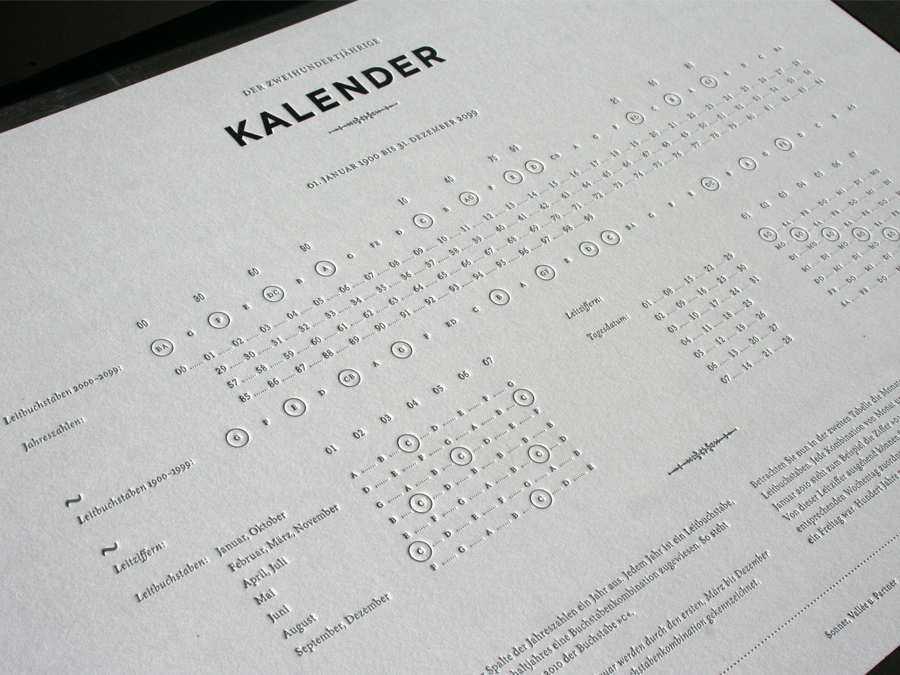
200 Year Kalendar — A beautiful letterpress calendar produced by German design studio Sonner, Vallée u. Partner, seen at Studio on Fire’s blog Beast Pieces (via ISO50).

Comments closed

Q & A with Peter Mendelsund and Tom McCarthy

In the early days of The Casual Optimist I scribbled out a short list of book designers I wanted to interview. More designers have been added since then, but a few of the original list remain un-interviewed. At the top of the list has been the name I actually wrote down first: Peter Mendelsund.

As Senior Designer at Knopf, Mendelsund’s designs feature here regularly. Much as I love his covers, however, Peter has been interviewed extensively elsewhere. I just haven’t known how to approach his work in a way that he would find interesting.

That was until I saw the shockingly subversive jacket design for Tom McCarthy‘s new novel “C”. The pairing of Mendelsund, the designer who is a musician, and McCarthy, the author who is an artist, was — it seemed to me — inspired.

A perfect opportunity…

What follows is primarily an interview with Peter about that design for “C”. But over the course of a few emails, Peter and I both decided to bring Tom into the conversation. I had met Tom shortly after the release of his debut novel Remainder and Peter had, it transpired, met Tom in New York after Knopf had signed “C”. It made sense to both of us.

It is a long, but absolutely fascinating exchange. Peter kindly answered my questions more fully than I had any right to expect and Tom, who was contributing from Stockholm, was more than gracious in less than ideal circumstances. I’m grateful to them both.

7 Comments

The Silver Lining Top 5

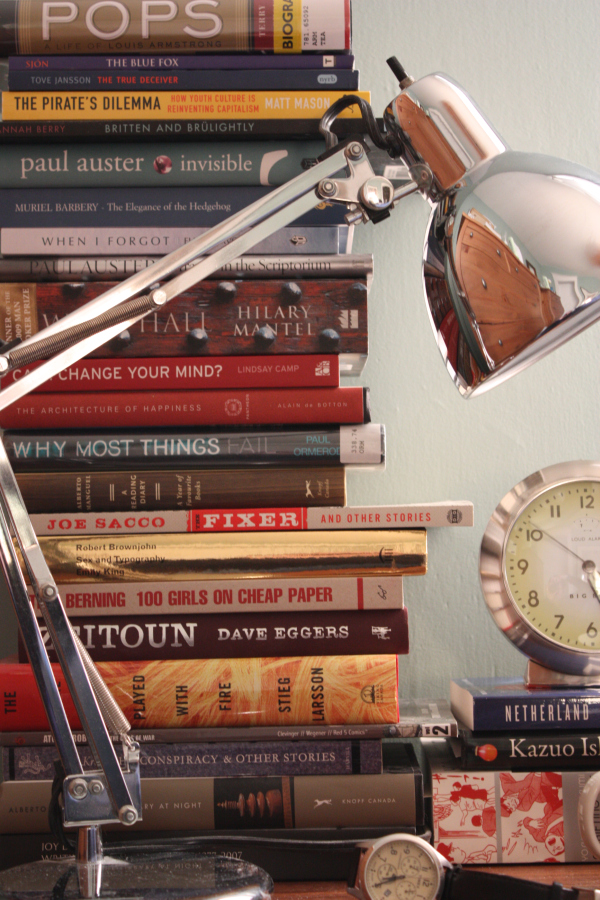
The nice folks at The Silver Lining blog — consistently one of my favourite blogs for vintage design goodness — were kind enough to ask me for a contribution to their ‘Top 5’ feature last month, and so, as of today, the top 5 books beside my bed are online for everyone to see.

The Top 5 are:

  1. Pops: A Life of Louis Armstrong by Terry Teachout
  2. The True Deceiver by Tove Jansson
  3. The Blue Fox by Sjón
  4. Britten and Brülightly by Hannah Berry
  5. The Pirate’s Dilemma: How Youth Culture Reinvented Capitalism by Matt Mason

I actually just finished reading Pops at the weekend, but there is no guarantee that I will read the rest in that order — the list really is just a happy accident of stacking. You you can read more about each of the selections in the post at The Silver Lining.

Comments closed

Books of the Decade

Back in November, the chaps at The National Post asked me and a selection of eminently more qualified Canadian book types what we thought the most important publishing story of the past 10 years was. They ran the results at the weekend and the smart answers ranged from decline of literary magazines to the rise of Google.

I have to admit, I was at a bit of loss as to how answer the question. Decades are such arbitrary periods of time. I read somewhere that the 19th Century didn’t really end until 1914, and in a way I feel like the 21st Century didn’t really start until the day after 9/11 2001. And who is to say that epoch is over? So many things still look the same…

Of course I really have no idea what any of the last 10 years meant for books. I don’t have enough perspective. All I knew is that I wanted to say something positive (nobody likes a whiner) and avoid saying anything too obvious, boring or bullshitty (i.e. definitely no talk about either the “death of publishing” or “teh internetz”).

In the end I equivocated and then gushed about something close to my heart — comics:

“J.K. Rowling’s Harry Potter and online retailer Amazon dominated the decade, but they have their roots in the previous century (Amazon was founded in 1994, Harry Potter and the Philosopher’s Stone was published in 1997). George W. Bush surely has a claim — his crimes and misdemeanours created an industry within an industry and produced many fine books including The Dark Side by Jane Mayer and The Forever War by Dexter Filkins — but the very thought of the 43rd President of U.S. being the publishing story of the decade is simply too horrifying to contemplate seriously. Many people will no doubt say e-books, but I think they will be the story of the next decade. So I’m going to go with the popular success and the critical acceptance of long-form comics (the “graphic novel” if you must) as the big story. With the likes of Asterios Polyp, Black Hole, Bone, Epileptic, Fun Home, George Sprott, The Hunter, Jimmy Corrigan, Louis Riel, Paul Moves Out, Persepolis, Safe Area Gorazde, Scott Pilgrim, Skim and Shortcomings (not to mention the beautiful reprints of Peanuts and translations of Tezuka and Tatsumi) to name just a few, we really have had a wonderful decade.”

Perhaps, not the wisest thing I’ve ever written, but hey…

The Post also asked us to nominate our best books of the decade.

As I’ve said before, I’m really not terribly qualified (at least compared to some) to make a call on “best” (especially when it comes to Canadian literature), but I did strive to be more objective than I was with my personal list of the books of 2009, which meant leaving out eclectic favourites ranging from Stet and How To Be Alone at one end of the spectrum to Hellboy: Conqueror Worm and Hard Revolution at the other, with the likes of I’ll Go To Bed At Noon, Lush Life, Mother’s Milk and The Dark Room stuck somewhere in the middle. And that’s not to mention all the art and design books I chose to leave out: 79 Short Essays on Design, Penguin By Design, The Curiously Sinister Art of Jim Flora, Charley Harper, to name just a few of the top of my head…

But with all those caveats firmly in place, here is my annotated and abridged list of the best books of the decade compiled for The Post:

Remainder by Tom McCarthy (Metronome 2005, subsequently published by Alma and Vintage)

Tom McCarthy’s Remainder was the first book I worked on at Raincoast Books — We briefly distributed the Alma Books hardcover before Vintage published their own paperback edition (pictured above, cover design by John Gall of course,with the most unlikely of blurbs from Jonathan Lethem) in the US and Canada — so it has a special place on my shelf. Oh and it’s really good.

Here’s what I wrote for The National Post:

“If only for a fleeting moment Remainder, a dark and spare novel about personal authenticity and murderous re-enactment, seemed to offer a creative alternative to the cul-de-sac of overwrought and twee novels emanating from Brooklyn (and creative writing classes everywhere). Sadly the bloated and banal seem to have made a decided comeback (if they ever went away), but even so, the unashamedly intellectual Remainder stands out, perfectly capturing the fears and anxieties of the decade.”

The Amazing Adventures of Kavalier and Clay by Michael Chabon (Random House 2000)

Possibly the polar opposite of Remainder, Chabon’s literary Boy’s Own adventure hit a lot of my buttons: Golden Age Comics, Eisner, Steranko, European folklore, New York, and WWII. Really, what’s not to like? But my affection for this book ebbs with every new effort — including Chabon’s own — to repeat the formula and turn pulp into something politely literary. (And NB the Picador paperback cover design above is by Henry Sene Yee — you can see his sketches here).

Jimmy Corrigan: The Smartest Kid on Earth by Chris Ware (Pantheon 2000)

Perhaps not my favourite graphic novel favourite of the decade (that slightly dubious honour would probably go to Tekkon Kinkreet — and although the English edition I own was published in 2007, the series itself is actually from the mid-90’s, so I didn’t think it qualified for this list), but Ware’s breakthrough graphic novel began the decade and went on to creatively define it for graphic novels. No Jimmy Corrigan, no McSweeney’s Issue 13.

Never Let Me Go by Kazuo Ishiguro (Knopf 2005)

Like Kavalier and Clay, Ishiguro’s quietly evocative SF novel justifiably appeared on a lot of other Best of the Decade lists. It’s just beautifully, beautifully written and has a silver sliver of ice at its heart.

The Dark Side by Jane Mayer (Doubleday 2008)

It’s almost impossible to think about books that are representative of the decade without including at least one on the Bush Presidency, 9/11 and the awful ‘war on terror’. The Dark Side could easily have been the aforementioned Forever War by Dexter Filkins, or Ghost Wars by Steve Coll, or Imperial Life in the Emerald City by Rajiv Chandrasekaran, or one of the many other excellent books on these topics. But Mayer’s exposé of state-sanctioned torture chillingly underlines the bureaucratic banality of evil and the horror lived long in the mind after I finished reading it.

And, you know what? The Dark Side reminded me that books are important. They can and should be more than vehicles of self-promotion. Research — real research — requires more than Wikipedia. And — fuck it — we need to keep paying writers to write.

Louis Riel: A Comic Strip Biography by Chester Brown (D+Q 2003)

I suspect Louis Riel is now a creative and stylistic albatross for poor ol’ Chester Brown, but it was my joint first choice for the Canadian book the decade. This is what I wrote for The National Post:

“Not only is Louis Riel a uniquely Canadian story, it was published by Drawn + Quarterly (surely the most interesting Canadian publisher of the decade) and it epitomizes their success at unearthing and supporting creative talent. It isn’t a coincidence that Daniel Clowes—author of Ghost World and one the cartoonists of his generation—has decided to publish his new book with them.”

Pattern Recognition by William Gibson (GP Putnam And Sons 2003)

Although Pattern Recognition did not receive good reviews when it was first published and I bought the hardcover out of a reminder bin, it was my other pick for Canadian book of the decade. The book’s obsession with the fringes of pop culture and the dislocation and horror of the globalized world seemed to me (in some small way) to make it the first novel genuinely about the 21st Century. Even if it dates horribly (which many critics seemed to think it would), I think it’s a something of a cult classic. This is what I said to The National Post:

“A prescient post-September 11th novel about viral media, [Pattern Recognition is] the antithesis of the clunking, insular, parochial Canadian novel so beloved of literary prizes. The book is not without its flaws – it was not well received by the critics when it was published in 2003 – but it just fizzes with ideas, oddness, and energy. I can’t think of another Canadian novel that I refer to quite as often in everyday conversation. Give me flawed and brilliant over dull and worthy any decade of the century.”

OK — I love Pattern Recognition and I do talk about it a lot — but I was being a bit of a shit disturber here (which is probably why The Post ignored it). That said, Pattern Recognition is better than several other books (that shall remain nameless) that did make the cut that’s for sure.

So, that’s my list. You can read the Post’s selections here. What did we miss out?

5 Comments

Why Roth Is Wrong About the Novel

Philip Roth believes books will soon be dead. Paul Auster respectfully—and strenuously—disagrees.”


Isn’t this great? A full interview with Paul Auster is at Big Think.

(via Norton Fiction on Twitter)

Comments closed

Something For The Weekend, August 7th, 2009

Winnie and Wolf — cover design by Alex Camlin (the chap behind that rather wonderful Harvard Review overhaul). I’m hoping to speak to Alex for the designer Q & A series later this month.

And just while were on the subject, Caustic Cover Critic looks at the new designs for the Penguin World War II Collection.

In Search of Lost Time — David L. Ulin, Book Editor of the LA Times, on the lost art of reading:

Today, it seems it is not contemplation we seek but an odd sort of distraction masquerading as being in the know. Why? Because of the illusion that illumination is based on speed, that it is more important to react than to think, that we live in a culture in which something is attached to every bit of time.

Here we have my reading problem in a nutshell, for books insist we take the opposite position, that we immerse, slow down… Yet there is time, if we want it. Contemplation is not only possible but necessary, especially in light of all the overload.

But, if you sympathize with this perspective be warned: you are weak and you just don’t love books enough (and you’re probably a calcified narcissist).

Talking Books — I don’t agree with everything here (OK I actually disagree with a lot of it and, I’m sorry, describing the Globe & Mail as “daring” is just  delusional), but Ian Brown, writer, arts journalist and broadcaster has some interesting things to say about Canadian literature and culture in a sprawling interview over at Conversations in the Book Trade:

[T]he novel is no longer the prime example of literature. Nor does it need to be. Too much attention can ossify a genre. If anything is in trouble, it’s literary fiction–but again, only because there are so many alternative ways to consume good writing these days. The book itself is a fantastic technology, but literary fiction has some serious competition for my attention.

And as this has been something of slow week, and because I was chatting about it with book designer Jason Gabbert on Twitter (who is responsible for the lovely C.S. Lewis redesigns above), I’m just going to take this opportunity to (re)plug my image library on Image Spark and (while I’m at it) my slightly stream-of-consciousness inspiration blog The Accidental Optimist.

4 Comments

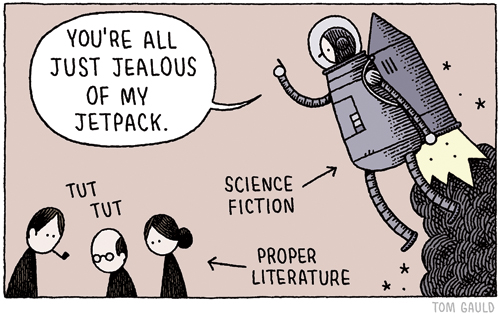
Jetpack

jetpack

Tom Gauld of course…

Comments closed

Monday Miscellany

A bolt of electricity: PW polls publishers on the challenges and opportunities facing their digital publishing programs. It’s a fascinating glimpse of where the likes of Random House, Simon & Schuster, and Penguin are heading… A must read I would say…

Narrative medicine: Exposure to literature can influence how young doctors approach their clinical work according to the New York Times (via Guy Kawasaki):

“The idea of combining literature and medicine — or narrative medicine as it is sometimes called — has played a part in medical education for over 40 years. Studies have repeatedly shown that such literary training can strengthen and support the compassionate instincts of doctors.”

In need of a good editor: Book Lover Cynthia Crossen laments the decline of editorial rigour in the WSJ:

“Editors are the invisible heroes of the publishing industry, and as publishing companies cut corners, they cut editors… But without strong editors, writers are like cars with accelerators but no brakes”

Comments closed