Skip to content

Tag: literature

Edward St. Aubyn on Writers & Company and Bookworm

In a fascinating conversation, Eleanor Wachtel talks to Edward St. Aubyn about his Patrick Melrose novels on CBC Radio’s Writers and Company:

CBC Radio Writers & Company: Edward St. Aubyn mp3 

KCRW’s Bookworm also recently broadcast a two-part interview with St. Aubyn about the books.

Part One:

KCRW Bookworm: Edward St. Aubyn Part One mp3

Part Two:

KCRW Bookworm: Edward St. Aubyn Part Two mp3

Full disclosure: The collected edition of the first four Patrick Melrose novels has just been published in the US by Picador Books who are distributed  in Canada by my employer Raincoast Books. At Last, the latest Patrick Melrose novel is published separately by Farrah, Strauss & Giroux who are distributed in Canada by Douglas & McIntyre (not my employer).

Comments closed

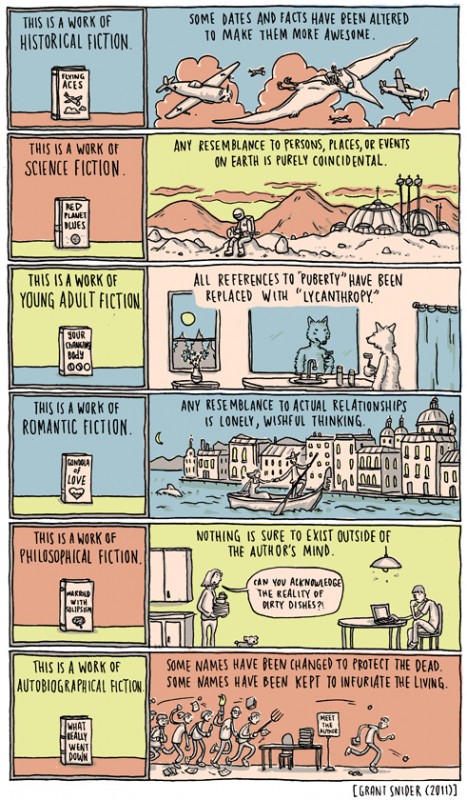
Works of Fiction by Grant Snider

Here’s a nice way to follow my post about covers:  a new literary comic by Grant Snider:

Comments closed

Raincoast Spring Books

I was out west for the Raincoast Books spring 2012 sales conference last week. Sadly I didn’t get to see much of Vancouver or catch up with half the people I meant to, but I did get to hear about a lot of great new books including one about building (and losing) an android Philip K. Dick. It’s non-fiction. Thanks Henry Holt!

Henry Holt also have a new novel by Herta Mueller, winner of the Nobel Prize in 2009, called The Hunger Angel, and the latest from John Banville’s alter-ego Benjamin Black, Vengeance.

Picador are publishing a collected edition of Edward St. Aubyn’s Patrick Melrose trilogy in January — the first time they’ve all been properly available in the US I believe — to coincide with the US edition of his new book At Last (Farrar, Strauss & Giroux). They also have a collection of essays by Siri Hustvedt, Living, Thinking, Looking.

While there was nothing on the list quite of the magnitude of this season’s long-awaited Saul Bass: A Life in Film and Design, there are a few art and design titles that caught my eye. Princeton Architectural Press are publishing Woodcut, a book of beautiful prints by artist Bryan Nash Gill (you have surely have seen his work even if you don’t recognise the name immediately) and Up on the Roof, a collection of photographs by Alex MacLean of New York’s hidden rooftop spaces. They are also publishing a long overdue paperback edition of Michael Bierut’s Seventy-Nine Short Essays on Design, and a paperback edition of the beautiful, if overlooked, Typography Sketchbooks by Steven Heller and Lita Talarico. Lawrence King are publishing a new book on the history of picture books, Children’s Picturebooks: The Art of Visual Storytelling by Martin Salisbury and Morag Styles,  and a new edition of The End of Print by David Carson.

On the comics side, Drawn & Quarterly are publishing Jerusalem: Chronicle from the Holy City, the latest travelogue from Guy Delisle who previous books include The Burma Chronicles, Pyongyang and Shenzhen. D+Q are also publishing a new edition of Chester Brown’s controversial, scatological and long out-of-print comic Ed The Happy Clown.

I’m also looking forward to finally seeing more of Baby’s in Black: Astrid Kirchherr, Stuart Sutcliffe, and The Beatles in Hamburg by Arne Bellstorf which is being published by First Second in April (I just wish they’d gone in a different direction with the typography on the cover — the German and UK edition’s  have lovely swooping hand-drawn lettering).

And lastly — because I am big nerd and recently finished his earlier book Batman Unmasked — I’m excited about Will Brooker’s Hunting the Dark Knight: Twenty-First Century Batmanwhich is being published by I. B. Tauris in July.

Now, back to the Toronto grindstone…

Comments closed

Midweek Miscellany

Design Auteur — Steven Heller on Erik Nitsche for Print Magazine:

For some, book publishing was akin to the Internet of the sixties and seventies, a means of communicating information to large numbers in large volumes. In this milieu Nitsche practiced design auteurship before it was given a name, and the body of work he produced is extraordinary even by today’s standards. After moving to Geneva in the early 1960s Nitsche Founded ENI, S.A. (Erik Nitsche International) to produce some of the finest illustrated history books ever designed. The first series, a twelve volume The New Illustrated Library of Science and Invention, with a multilingual print run of over two million copies, covered the histories of communication, transport, photography, architecture, astronomy, and the machine, and flight… The second ENI series on the History of Music was even more ambitious — twenty volumes — that covered an expansive range of musical experience from composition to instrumentation, from classical to jazz.

Our Dreams of Ourselves — An interview with Alan Moore in The Independent:

Moore was always ahead of the times with respect to female fans – unlike much of the comics industry, – and was the creator of the revolutionary The Ballad of Halo Jones, a sci-fi strip to run alongside Judge Dredd in the UK comic 2000AD. First appearing in 1984, Halo was one of the first non-superhero women to headline her own series, at a time when most girls’ comics had folded.

“There wasn’t a single – I mean, I was annoyed – there wasn’t a single girls’ comic in Britain,” Moore remembers. “I thought, well if you do more stories that are aimed at women, you’ll get more women reading the comics. It would seem fairly simple and straightforward, but there was a lot of resistance [to the idea].”

Insane, Not Crazy — Chip Kidd, book designing Bat-thusiast, reviews The Joker: A Visual History of the Clown Prince of Crime by Daniel Wallace:

Created by artist Jerry Robinson and writer Bill Finger in 1940 for “Batman” issue #1—though Batman himself first appeared in “Detective Comics” #27 the previous year—the Joker, with his garish purple suit, ashen skin and emerald hair, was imagined as the maniacally taunting yang to Batman’s unrelentingly stern yin. Thus was born perhaps the single most classic pair of adversaries in comics history. Really, does it get any better than the Dark Knight Detective and the Harlequin of Hate matching wits and ultimately duking it out? I don’t think so.

Step by Step — Umberto Eco talks about his new book The Prague Cemetery at The Paris Review:

For me, the process of writing usually takes six years. In those years I collect material, I write, I rewrite. I am in a sort of a private world of myself with my characters. I don’t know what will happen. I discover it step by step. And I become very sad when the novel is finished because there is no more pleasure, no more surprise.

And finally…

Melvyn Bragg on John Steinbeck’s The Grapes of Wrath for The Guardian:

It was the bestselling book in America in 1939. A film version starring Henry Fonda and directed by John Ford followed, itself a classic. Arthur Miller wrote of Steinbeck, “I can’t think of another American writer, with the possible exception of Mark Twain, who so deeply penetrated the political life of the country.” And yet Steinbeck was also called “a liar”, “a communist” and “a Jew acting for Zionist-Communist interests”. The book was burned in the streets; it was banned in schools and libraries, with its explicit sexuality given as the excuse. It was virulently attacked in Congress, and Steinbeck’s subsequent success in Russia eroded his reputation from the cold war onwards. He bought himself a revolver for self-defence and had good reason to fear for his life. The book has sold about 14m copies and still sells steadily.

Comments closed

Literary Devices

The Random Analogy Generator and other literary devices from Grant Snider:

(via This Isn’t Happiness)

Comments closed

Something for the Weekend

Project Thirty-Three, one of my favourite mid-century modern design blogs, is now using Blogger’s “Dynamic Views” template. It looks great using the new ‘Flipcard’ feature.

The Crash — Alan Hollinghurst talks about writing and his new novel The Stranger’s Child with the New York Times:

Mr. Hollinghurst said he modeled his work habits on another friend and novelist, Kazuo Ishiguro. “He has this thing he calls ‘the crash,’ ” Mr. Hollinghurst explained. “He takes a lot of time to prepare a novel, just thinking about it, and then he draws a line through his diary for three or four weeks. He just writes for 10 hours a day, and at the end he has a novel.”

He laughed and pointed out that for him the Ishiguro method was only partly successful: at the end of three or four nonstop weeks he is still years away from being done.

Also in the New York Times, author Adam Thirlwell (The Escape) on translation and David Bellos’ new book Is That a Fish in Your Ear?:

Google Translate, no doubt about it, is a device with an exuberant future. It’s already so successful because, unlike previous machine translators, but like other Google inventions, it’s a pattern recognition machine. It analyzes the corpus of existing translations, and finds statistical matches. The implications of this still haven’t, I think, been adequately explored: from world newspapers, to world novels. . . . And it made me imagine a second prospect — confined to a smaller, hypersubset of English speakers, the novelists. I am an English-speaking novelist, after all. There was no reason, I argued to myself, that translations of fiction couldn’t be made far more extensively in and out of languages that are not a work’s original.

Counter-Culture — Loren Glass on Barney Rosset and the history of Grove Press at the LA Review of Books:

Philip Larkin famously dated the beginning of sexual intercourse to the end of the Lady Chatterley ban and, more recently, Fred Kaplan has used Rosset’s campaign to situate 1959 at the crux of an epochal transformation. Whatever its larger historical significance, it surely marked a turning point in the fortunes of Grove Press. On the brink of a decade in which the geopolitical order would be transformed, flush with cash for the first time, and well connected to the international avant-garde, the West Coast scene, and the nascent counterculture in college towns across the country, Grove was positioned in the eye of the coming storm. At the nexus of an emergent international vanguard, Grove became a potent symbol of the counter-culture, increasingly drawing radical authors, readers, translators, professors, lawyers and activists into its expanding network.

Part two of Glass’ history Grove Press is here.

And finally…

A slightly weird  interview with the David Lynch in The Guardian:

Film is dead, Lynch tells me. It is too heavy, too much of a dinosaur, and its time has largely past. But digital is alive and well and pointing to the future. He admits he’ll miss shooting on celluloid (“because it’s so beautiful”), but is more than happy to shoot on digital instead – as and when the opportunity arrives.

Until then he’s happy pottering around his studio and slurping his coffee; painting his spooky black houses and singing his eerie songs of love gone sour. “I can understand why people might be frustrated with me: ‘Let’s give up on these side ventures and go make a film instead.'” He chuckles. “But all these other things feed into the future. And if the ideas aren’t there for cinema, and if the pressure is on, then you might pick a bad idea and find yourself forced to marry something you’re not totally in love with. So I’m happy to wait.”

Comments closed

Jay Rubin on Translating Murakami

In an interview for the New Yorker, Haruki Murakami’s longtime translator Jay Rubin talks about the work of the Japanese author (whose new book 1Q84 has just been published) and his own work as a translator:

New Yorker Outloud: Translating Murakami mp3

The New Yorker also published a Murakami short story, Town of Cats, translated by Rubin, in September.

Comments closed

Something for the Weekend

Words and Pictures — An interview with cartoonist Tom Gauld at The Rumpus:

Format, words and pictures all work together to make a good comic. I started at college doing pure illustration and only gradually got into making stories and using words. I’m still more comfortable with pictures than words: I’m happy doodling away on drawings for hours, but putting words together is always more of a struggle. I  usually like to keep things as simple as I can so it’s interesting seeing what I can remove and still keep the story: you don’t want to say something in words which is better said in the pictures (and vice versa).

There is also a preview of Tom’s new book, Goliath, on the D+Q blog and you can read my interview with Tom here.*

A General Contempt for Small Talk — Edward Docx, author most recently of The Devil’s Garden, on Tolstoy, Russia, and literary prizes. So much good stuff here:

[I]f there’s one thing that novelists love to talk about, it’s how to make things real when, obviously, they are not. This in turn leads naturally into something novelists like to talk about even more: the terrible struggle of writing itself. (My favourite line about writers: “Writers are people who find writing more difficult than other people.”)… Metaphors rise from the table like disturbed lepidoptera. Writing a novel is like attempting to solve an extremely complicated maths equation, which seeks to represent reality, and through which you are trying to lead the public without them ever getting wind that said equation is, in fact, impossible to solve or that, actually, it might not represent reality at all. We are getting carried away. Deciding to write a novel is like visiting an obscure, half-forgotten and slowly-evaporating planet entirely comprised of swimming pools and deciding that what is needed is… yes, another swimming pool! But, for obscure reasons, a swimming pool that must be built single-handedly from scratch and then filled using only a syringe.

And finally…

Critical Authority — New York Times film critics A. O. Scott and Manohla Dargis discuss Brian Kellow’s new book Pauline Kael: A Life in the Dark and the ongoing legacy of the (in)famous New Yorker film critic. Here’s A.O. Scott:

[T]he idea of critical authority has always struck me as slippery, even chimerical. Authority over whom? Power to do what? The importance of particular critics can’t be quantified in lumens of fame, circulation numbers or box office returns, though by all of these measures Kael, in her heyday, certainly enjoyed unusual prominence. But like every other critic, she was above all a writer, and a writer only really ever has — or cares about — one kind of power, which is the power to engage readers.

I think Kael is remembered not for her particular judgments or ideas, but rather for her voice, for an outsized literary personality that could be enthralling and infuriating, often both. A lot of people read her for the pleasure of disagreement, and the resentment she was able to provoke — in critical targets and rival critics — is surely evidence of power. An awful lot of our colleagues are still, in both senses, mad about her. To reread her is to understand why.

*Just so you know: D+Q are distributed in Canada by my employer Raincoast Books.

Comments closed

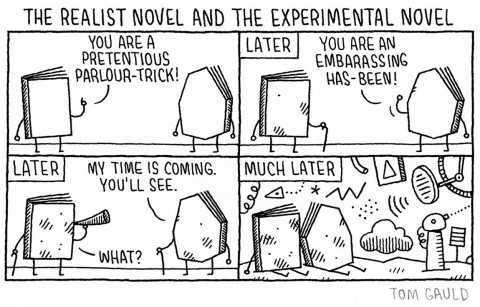
The Realist Novel and the Experimental Novel

The usual genius for The Guardian from Tom Gauld. You can read my interview with Tom here.

Comments closed

The Beauty and Horror of Vasily Grossman

The Economist’s international editor,  Edward Lucas, discusses the work of Vasily Grossman and the BBC adaptation of his novel Life and Fate:

The Economist: The Beauty and Horror of War

The Economist reviews the BBC adaptation here.

Comments closed

Trailer for Life and Fate

London-based creative agency Devilfish has created this fantastic Saul Bass-inspired animated trailer for a new BBC Radio dramatisation of Vasily Grossman’s novel Life and Fate:

Kenneth Branagh and David Tennant star in the eight-hour dramatisation of the book, which will be broadcast from 18 to 25 September on Radio 4. All the episodes will be available for download(!).

(via Creative Review)

Comments closed

Something for the Weekend

The Technological Sublime — Rick Poyner on the science fiction artist Chris Foss and Hardwarea new book collecting his work, at Design Observer:

These visionary images have a stillness, a control of atmosphere and a mood of mystery and wonder, even when something huge, alien, imponderable and beyond our terrestrial grasp is taking place. Foss loves the paintings of J.M.W. Turner and his finest pictures, often from the 1970s, seem as much concerned with ambience and painterly effect — they are cosmic cousins of Turner’s Rain, Steam and Speed, at least in spirit — as with the engineering of the vast structures they depict. They are also early visual encapsulations of what came to be known in the 1990s as the technological sublime. The vertiginous sense of awe, wonder, poetry and terror that people experienced in nature, when opening their senses to the sky, mountains, forests, rivers or oceans, could now be felt when contemplating the frightening immensity of a machine’s harnessed power, the magical effectiveness of electricity, or the boundless matrix of digital connection.

(Pictured above: Chris Foss, The Bloodstar Conspiracy by Stephen Goldin and E. E. “Doc” Smith, Panther, 1978)

Those Who Can… — Eric Olsen, journalist, editor and co-author of We Wanted To Be Writers, discusses writing and picks 5 books on the subject:

There are always ways that you can help a writer along. You’re not going to take a mediocre writer and turn him or her into a great writer, and there are also some things that can’t be taught, like the basic desire to be a writer. That seems to be a given. You’re not going to make someone want to be a writer. Sometimes what goes on in a writing workshop is that you convince the writer that he doesn’t want to be a writer. That is a kind of teaching too…

 The Source Code of Our Being — Tom McCarthy, author of Remainder and C, on the influence of Freud:

As a writer, I’m in love with Freud. I can’t imagine any serious writer not being. Freud, ultimately, concerned himself not with the mind, nor with the individual, but with the question of meaning’s emergence in the world, and of the mechanisms through which this emergence takes place. What, according to him, are these mechanisms? Why, they’re substitution and elision, condensation and displacement, metaphor, metonymy — in short, the very mechanisms at work in a poem or a novel. For Freud, if you want to understand mental and social life you don’t take a biopsy of a murderer’s brain or observe groups of people in a room: you study Antigone and Hamlet. That’s why his case-histories read like Gothic novels. It’s why his best patients are fictional characters like Jensen’s Norbert and Goethe’s Werther. And it’s why his preferred model for memory is a mystic writing pad.

And finally…

A short film homage to author Jorge Luis Borges by Ian Ruschel:

Comments closed