Skip to content

Tag: E-books

A Question

I’ve been staying clear of the publishing shit-storm du jour — Random House’s claim to backlist e-book rights and Stephen Covey’s decision to sell exclusive digital rights to two of his bestselling books to Amazon rather than his traditional publisher Simon & Schuster — because I simply don’t know enough about rights. But, Peter Ginna, publisher and editorial director of Bloomsbury Press, (who should know a thing or two) has a couple of interesting related posts, ‘The E-Book Wars Have Really Begun’ Part 1 and 2, on the issues.

Leaving the specifics of Covey aside (because I just don’t think you can generalize from his position), Peter Ginna doesn’t seem to think Random House has much of a leg to stand on. Nor, for that matter, does Richard Curtis, or the Author’s Guild. And agents are understandably unhappy…

But my question (to someone who does know something about rights) is if e-books remain essentially shovelware and aren’t substantially transforming the original book as edited and designed by the publisher, don’t Random House kind of have a point?

[Before you yell at me — I’m just curious!]

5 Comments

E-Reading the Tea Leaves

While The Wall Street Journal recently suggested that e-readers are more eight-track than iPod and Forrester Research predicted that B&N will steal market share from Amazon and Sony in 2010, Joe Wikert, General Manager & Publisher at O’Reilly Media, made the even bolder prediction that Amazon — in the face of stiff competition from other e-readers and multi-use devices like the iPhone — “will completely exit the Kindle hardware space within the next 3 years”.

Although predicting the future is a mug’s game (and Amazon are particularly adept at being at least 2 or 3 steps ahead of the pundits), I think that Joe — an early Kindle advocate — might actually be onto something and Amazon really might be prepared to let the device, if not the format or apps, die quietly.

Does this mean that Amazon made a mistake in launching their own e-reader?

I don’t think so.

If publishers had rushed to embrace the Kindle, Amazon would have completely pwned the distribution of e-books (and had publishers even further over the proverbial barrel).

But even though this hasn’t quite worked out, Amazon are still sitting pretty. The Kindle has undoubtedly increased the popularity of e-books and Amazon — the best known and largest online bookstore — is the natural beneficiary. Even if manufacturing the hardware becomes too much like hard work, Amazon will still sell a lot of e-books and the Kindle will surely have served its purpose as a beachhead…

Kindle and Shortcovers

And on the subject of the Kindle, it’s been interesting to see Indigo, Canada’s biggest book retailer, respond to Amazon launching their e-reader north of the border.

Joel Silver, President of Indigo, — who apparently reads on his Blackberry — discussed e-readers and e-books on Business News Network last week (there’s also an interesting follow up interview with the estimable Jason Epstein) and Michael Serbinis, President of Indigo’s e-book initiative Shortcovers, took a few (slightly uncharitable) pot-shots at the Kindle in a recent interview with The National Post.

But, as Shortcovers clearly demonstrates, Indigo have been preparing for the arrival of the Kindle for a while, and — if you have a spare hour — it worth listening to Michael Tamblyn, their VP of Content, Sales & Merchandising, re-enact his Tools of Change presentation Your Reading Life, Always With You to see where they are going…

So what do you think is the future of e-readers? Any thoughts?

Comments closed

The World’s Most Advanced E-Reader or the Worst Product Name Ever?

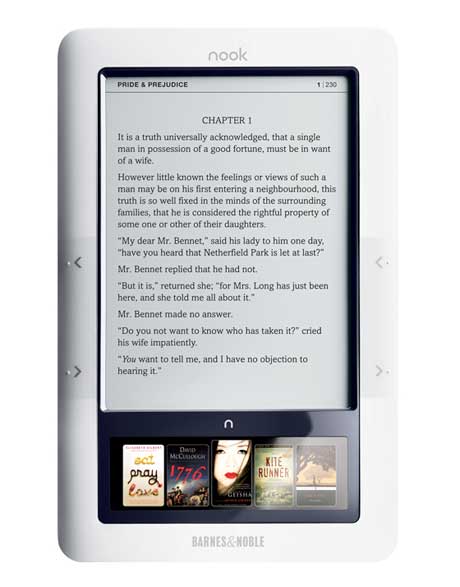
Despite being lumbered with “the worst product name in recorded history”, Barnes & Noble‘s new dual screen e-reader the ‘Nook’ is getting a lot of favourable reviews.

An appallingly kept secret, the Nook was officially unveiled earlier this week and is being widely touted as a ‘Kindle Killer’ (whatever that actually means).

Direct comparisons with Amazon’s e-reader are inevitable of course — especially given the Nook will go on sale for $259, the same price as the Kindle 2.  And, if nothing else, US publishers seem relieved that Amazon finally has some serious competition from the country’s largest bookstore chain.

As reported in Publishers Weekly and the New York Times, part of what is attractive to publishers (aside from the simple fact it is not owned by the Amazon) is that the Nook is relatively flexible and supports formats, including ePub. and — perhaps more crucially in the short term — PDFs, that can be read on other devices.

Of course, that B&N has 1,300 stores and already understands books (and the publishers that publish them) doesn’t hurt.

Much is also being made of the Nook’s promising ‘LendMe’ feature, which will let readers share their books (within limits) with others, even though some people aren’t entirely happy about it.

Unsurprisingly, B&N are describing the Nook as “The World’s Most Advanced eBook Reader”, although it is unclear whether the Nook will be available outside the US, which could be problematic in the long run (especially as Amazon and Sony both have global reach). The Guardian Technology Blog does point out, however, that the Nook’s 3G wireless is provided by AT&T, “one of the GSM [Global System for Mobile Communications] providers in the US, so from a technical standpoint, it should be easy to launch the reader internationally.”

But does B&N really have the will or the way to make the Nook available beyond its US home base? And could it do so successfully?

Ultimately perhaps, the real question though is whether there is actually a mass market — either in the US or internationally — for single purpose e-readers. Some smart people clearly think so, but given that non-proprietary formats like ePub can be read on more useful, convenient and competitively priced multi-purpose devices such as laptops and cellphones (and whatever else Apple are currently cooking up), and that books still look like the most robust, simple and elegant format — I’m not so sure…

Comments closed

Midweek Miscellany, October 21st, 2009

The lovely folks at Book City Jackets (mentioned previously here) have just released Artist Edition No.2 featuring original work by Nishat Akhtar, Cheeming Boey and Michael C. Hsiung.

“Can’t We All Just Get Along?” — Steve Ross, Former President at HarperCollins and Sr. VP at Random House, on publishing, e-books, and pricing at the Huffington Post:

Permeating… the conversation… is the sense that publishers are resistant to e-books for some reason. But publishers want e-books to succeed because they have the potential not only to expand readerships but leapfrog us over the historically insuperable and tenacious cancer at the heart of the business model; returnable books.

The New Old Thing — Jane Friedman, former president and chief executive of HarperCollins Publishers Worldwide, has launched Open Road which will focus on publishing e-book editions of backlist titles by well-known authors. Does this sound a lot like the original Penguin model for paperbacks to anyone else? There are more details at PW

Stet — editor and author Diana Athill is interviewed by Vit Wagner in today’s Toronto Star. Granta recently released Life Class, which collects Athill’s memoirs Yesterday Morning, Instead of a Letter, Stet, and Somewhere Towards the End in a single volume. Athill is appearing with Alice Munro at IFOA this evening.

Vit also interviewed the fascinating Antony Beevor, author of the Stalingrad and Berlin: The Downfall 1945, earlier this week.

Designer and design blogger David Airey has launched a graphic design bookstore on Amazon with his book recommendations.

And finally…

I came across this lovely looking new book on the Bauhaus while browsing  D.A.P.‘s Fall 09 catalogue. The book accompanies the exhibition Bauhaus 1919-1933: Workshops for Modernity at MoMA in New York, November 8, 2009 — January 25, 2010.

The Museum of Modern Art, New York
2 Comments

Missed Things: Wednesday

Henry Sene Yee, Creative Director of Picador, discusses the elegantly understated cover design for Time by Eva Hoffman, the latest addition to Picador’s BIG IDEAS // small books series.

And I’ve mentioned this before but it bears repeating: Picador are putting their catalogues — and, therefore, their outstanding cover designs — on their Facebook page.

Logicomix by Apostolos Doxiadis and Christos H. Papadimitriou reviewed in The New York TimesThe Guardian, and FT. It sounds kind of awesome. The book also has a nice website with lots of content.

The Inevitable Frontier — Jennifer de Guzman, editor-in-chief at the independent comics publisher SLG Publishing, on digital comics in PW:

Right now, sales from digital comics aren’t going to mean we can pack up print publishing. Not even close. But despite being in the midst of it rather than a wide-eyed observer, I can see that in the near future digital comics are going to be playing a bigger role for all publishers than they do now. And it’s better to be so integrated in the change that you don’t notice that it’s happening than to find yourself left behind and marveling at “the things they can do now.”

“Issues” — A less than warm reception for the Kindle in Australia:

Jeremy Fisher, executive director of the Australian Society of Authors, said he was advising his 3000 members to resist publishing through the Kindle.

“As I understand at this point in time, Amazon asks for a very, very big discount from publishers for their works to be included in Kindle so that the return coming back to the publisher is smaller and the return coming back to the author is smaller,” he said.

“The person making the most money is Amazon.”

Hmm… Yes, well, moving swiftly on…

Jacket Whys — A really nice blog about children’s and YA book covers.

And on the subject of kids books…

Who The Wild Things Are –Artist Roger White looks at the inspiration Maurice Sendak’s Wild Things for the Boston Globe:

The Wild Things looked like nothing ever seen in a children’s book. Rendered in simple ink-hatch over watercolor sketches, they evoked a perfect mixture of proto-adult dread and anarchic, childlike glee – an eternal, platonic form of the kindly monster. From the moment they appeared in 1964, they seemed bracingly and completely original. But in fact Sendak’s monsters had a long series of ancestors and descendants…

But according to Bruce Handy, deputy editor at Vanity Fair, (and his children) kids don’t actually like Where the Wild Things Are… Umm… What?

Comments closed

Midweek Miscellany, September 2nd, 2009

Watching Gideon — A nice new cover design with some great typography from Nate Salciccioli. Read my Q & A with Nate here.

A Manifesto for Slow Communication — An excerpt from The Tyranny of E-Mail by John Freeman, AKA acting editor of Granta, in the Wall Street Journal:

Slow communication will preserve these threads and our ability to sensibly choose to use faster modes when necessary. It will also preserve our sanity, our families, our relationships and our ability to find happiness in a world where, in spite of the Internet, saying what we mean is as hard as it ever was. It starts with a simple instruction: Don’t send.

And on the topic of slow communication…

On Feeding — an older, but lovely, post from A Working Library on the difference between unread books and an unread RSS reader (via booktwo.org):

those two sights—the stack of books and the unread count in my feed reader—evoke dramatically different responses. To the books, I feel excitement, eagerness… The act of reading is always unfinished…

Yet my feed reader—also always unfinished—evokes within me a dread… I grow weary as the unread count increases, as it fills up with new articles before I can skim the old ones. In it’s timeliness—most blog posts have short half-lives and so must be read now—and the mathematical precision with which the reader measures its contents, I am stripped of my eagerness to read and filled, instead, with despair. Instead of a thing to enjoy, it makes reading a thing to get done with… It’s reading made efficient.

The minimal design of the A Working Library site is really nice too by the way.

Book Cover Design in India 1964-1984 at A Journey Round My Skull.

Prix Fixe — Arnaud Nourry, chief executive of French publishing group Hachette Livre, makes some interesting comments on e-book pricing in the Financial Times, notably that publishers are “very hostile” to Amazon’s pricing strategy:

“On the one hand, you have millions of books for free where there is no longer an author to pay and, on the other hand, there are very recent books, bestsellers at $9.99, which means that all the rest will have to be sold at between zero and $9.99,” Mr Nourry said…

There was a “muscular” debate in the industry in the US, he added. Retailers were paying publishers more than $9.99 for each e-book, so were selling them at a loss: “That cannot last . . . Amazon is not in the business of losing money. So, one day, they are going to come to the publishers and say: ‘by the way, we are cutting the price we pay’. If that happens, after paying the authors, there will be nothing left for the publishers.”

Mike Shatzkin has written an interesting follow-up piece about pricing.

Noury also makes more interesting observations about consolidation in the industry in a separate article in the FT, which seem very prescient in light of Disney’s acquisition of Marvel this week.

And finally…

46 Essential Rock Reads — A list to argue over on the LA Times‘ Jacket Copy blog.

2 Comments

More Knots

As has been widely, widely reported, Amazon remotely deleted copies of books by George Orwell from their customers’ Kindles last week after a rights issue with the publisher MobileReference.

Even if it was not actually a huge surprise that Amazon had the ability to claw back e-books it had sold (or — to be honest — that someone might publish something that didn’t belong to them on the Kindle), there has been a predictably hysterical reaction, fuelled — at least in part — by antipathy towards DRM and Amazon, and the delicious irony of the particular books involved.

Even Michael Bhaskar, who reignited the online DRM debate last week on The Digitalist by having the audacity to suggest that DRM might not be all bad (twice), is having second thoughts:

When I wrote the piece I was perhaps slightly self consciously swimming against the tide. However all that is made a mockery of when something like this happens – faith in the system is, well, annihilated and the issues of trust that came up are starkly thrown into relief.

Apparently the problem was a rights one and somewhere down the line the wrong books got into the system in the wrong way. Everyone was re-imbursed and the books are widely available. Does this make any difference to the body blow of seeing 1984 automatically deleted from people’s devices?

…Lets just say if this had come out last Monday, I don’t think the blog posts on DRM would have got written.

But — and perhaps I am alone on this —  I don’t think this debacle is really about DRM. I actually think it is about a publisher not knowing (or not caring) that Orwell isn’t in the public domain in the Kindle’s primary market, and a vendor — who is unable (or unwilling) to thoroughly vet submissions — making an awful customer service decision and overreacting to rectify an awkward situation (which perhaps they felt they were partially responsible for).

Of course, as Cory Doctorow rightly points out, DRM is a the ‘loaded gun’ that allowed Amazon to kill the books. In the traditional book world this would not have been possible, and it really does bring home some the scariness of ‘remote deletion’. And yet this really came about not because of DRM (the issue could have been resolved without deleting the books) but because of poor judgement (by a publisher and the vendor) and, perhaps, as Paul Biba at Teleread suggests, because Amazon still does not fully understand what they’ve got themselves into.

Comments closed

Knots

I usually avoid discussions of digital rights management (DRM) as much as possible. It’s a Gordian Knot. We can spend a lot of time and energy painstakingly untangling it, never to find a form of DRM that keeps everyone happy. Or we can  end DRM altogether with one bold stroke (“mission accomplished!”) only to discover that cutting the knot takes longer than we expected and is more complicated than we first thought. Either way, my sense is that we will continue to have some kind of hybrid situation — with some e-books ‘protected’ by DRM and some not — as we both cut and untangle all the issues…

And for all that I’m often left wandering if DRM really matters as much as we tend to think it does. Do people outside of our strange intersection of media and technology really care about it as much as we do? Are there other pressing issues that we should direct energy towards?  I have this nagging sense that as we agonise over the do-we-don’t-we of DRM, most people just want to read good books.

Nevertheless, the great DRM debate has come to the fore again as a result of Michael Bhaskar’s seemingly mild assertion that DRM Is Not Evil on Pan Macmillan’s The Digitalist blog, which resulted in the (predictable) slew of comments.  Michael has now posted a response which has garnered another slew of comments.  It’s all worth reading if you can summon the energy and want some insight into the issue (although I don’t think anyone mentions foreign rights, but perhaps some one will get to that yet…)

3 Comments

Turning Towards Our Shelves

Ellen Lupton, author of Thinking With Type (interviewed by me here), interviews graphic designer David Barringer about his new collection of essays There’s Nothing Funny About Design over at Design Observer today.

It’s a wide ranging interview — mostly about design unsurprisingly — but a couple of paragraphs about books caught my eye:

I do think that ebooks are a step backwards, however. It’s like the fax. It’s not flexible or useful enough. Handheld computers should have greater power, and the Kindle instead has less. You should be able to access encyclopedias, dictionaries, and other searchable resources, just like we can on the computer or the iPhone. That’s where the real benefit of portable handheld units are. Who cares about downloading Twilight? I care about having access to entire online libraries of reference works, maps, and encyclopedias.

I’ve sort of come to the same conclusion. If e-readers are less convenient than cell phones, less useful than laptops, and less durable than books, what’s the point?

Anyway, David Barringer goes on to discuss our enduring emotional connection with book-books:

I’ve seen many friends who are avid readers turn toward their shelves of books and regard them as they would a photo album of their own lives. We take the contents of books into our imaginations, and our personalities are influenced by them. Looking at the books on my shelves, I feel memories bloom, my own life come back to me. Books are triggers for remembering where we have been, and who we are. A book is like a body part, and when you die and your connection to the book is broken, the book dies a little, too.

I thought that was rather touching…

Link

(NB Full Disclosure: Thinking With Type and There’s Nothing Funny About Design are published by Princeton Architectural Press, who are distributed in Canada by my employer, Raincoast Books)

Comments closed

Midweek Miscellany, May 20th, 2009

Cut It Out — Dioramas made from the covers of pulp novels by Thomas Allen, seen at We Made This (via Ingrid Paulson on Twitter).

You Can’t Be SeriousThe Guardian takes a gloomy look at fate of  non-fiction and bookselling in the UK, managing to summon up  some half-hearted optimism towards the end:

Despite decades of predictions to the contrary, the appetite for demanding non-fiction has survived the advent of newspapers, radio and television – and, in Britain, a popular culture with a particular ability to absorb talent and themes that in other countries would be channelled into grand state-of-the-nation volumes. In fact, many publishers think the noise and immediacy of the web will make slow, quiet immersion in a book seem more, not less, appealing. And books, unlike most digital media, are not directly dependent on recession-affected advertising revenues.

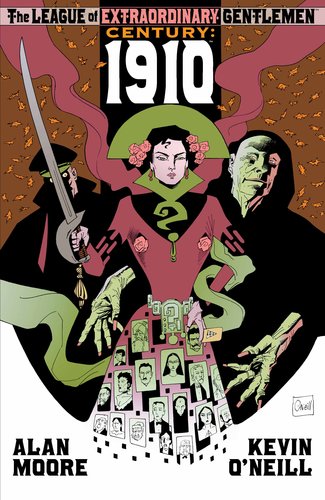
Boy’s Own Misadventure3:AM Magazine’s Mat Colgate gets to the heart of why volume 3 of The League of Extraordinary Gentleman Century: 1910 (published by Top Shelf)  is mildly disappointing (by Alan Moore standards). Could it really be that Moore writes better when subverting restrictions of form and genre than when he has free reign?

It’s Not Just Your Type — Priya Ganapati talks to designers, including Henry Sene Yee, about the problems of  e-book design at Gadget Lab.  (And Joshua Tallent’s commentary at TeleRead about the problems of formatting for ePub is also worth reading).

Restraint — I mentioned Marian Bantjes’ gorgeous new typeface at the weekend, and now you can download a rather lovely Restraint desktop from the folks at Typenuts (via I Love Typography on Twitter).

1 Comment

Bigger May Be Better, But Old Problems Persist

Amazon launched the new large-screen Kindle DX in the US on Wednesday. The device, apparently aimed at newspaper readers and the textbook market was met with much fanfare in the New York Times (who had leaked the announcement earlier in the week), the Financial TimesPublishers Weekly and elsewhere.

Despite the immediate gadget-lust, the hype was also met with  skepticism (and more than certain amount of unlinkable ambivalence). The DX’s $489 price tag, ‘blah’ design, lack of colour and Amazon’s decision to release the new device so soon after launching the Kindle 2 have been common complaints.

But for all these (fixable) flaws, what really nags at me about the Kindle is that whilst I can see what’s in it for Amazon, I just can’t see what’s in it for me the reader. With each launch it seems that readers continue to be secondary to  Amazon’s business strategy.

I’m unlikely to buy a Kindle because, all things being equal, I’m always going to choose a paper book over an electronic one. If  convenience is the primary concern, then I’m going to read an e-book on the phone I carry in my jacket pocket.

The Kindle DX won’t change my habits either. I already read newspapers on my laptop and I don’t want to carry 2 large devices. If I was a student, I’d want to my textbooks on my laptop too — if only because of the 2 magic words: “copy” and “paste”.

Comments closed

Q & A with Ellen Lupton

“Ellen Lupton makes this industry smarter. If graphic design has a sense of its own history, an understanding of the theory that drives it and a voice for its continuing discourse, it’s largely because Lupton wrote it, thought it or spoke it.” — Katherine Feo, AIGA

Dedicated to raising design awareness, Ellen Lupton is the Director of the Graphic Design MFA program at Maryland Institute College of Art (MICA) and curator of contemporary design at the Cooper-Hewitt National Design Museum.

A regular columnist  for ReadyMade Magazine, she has contributed to Print, Eye, I.D., and Metropolis, and writes regularly about design at both Design-Your-Life and her own website Design Writing Research.

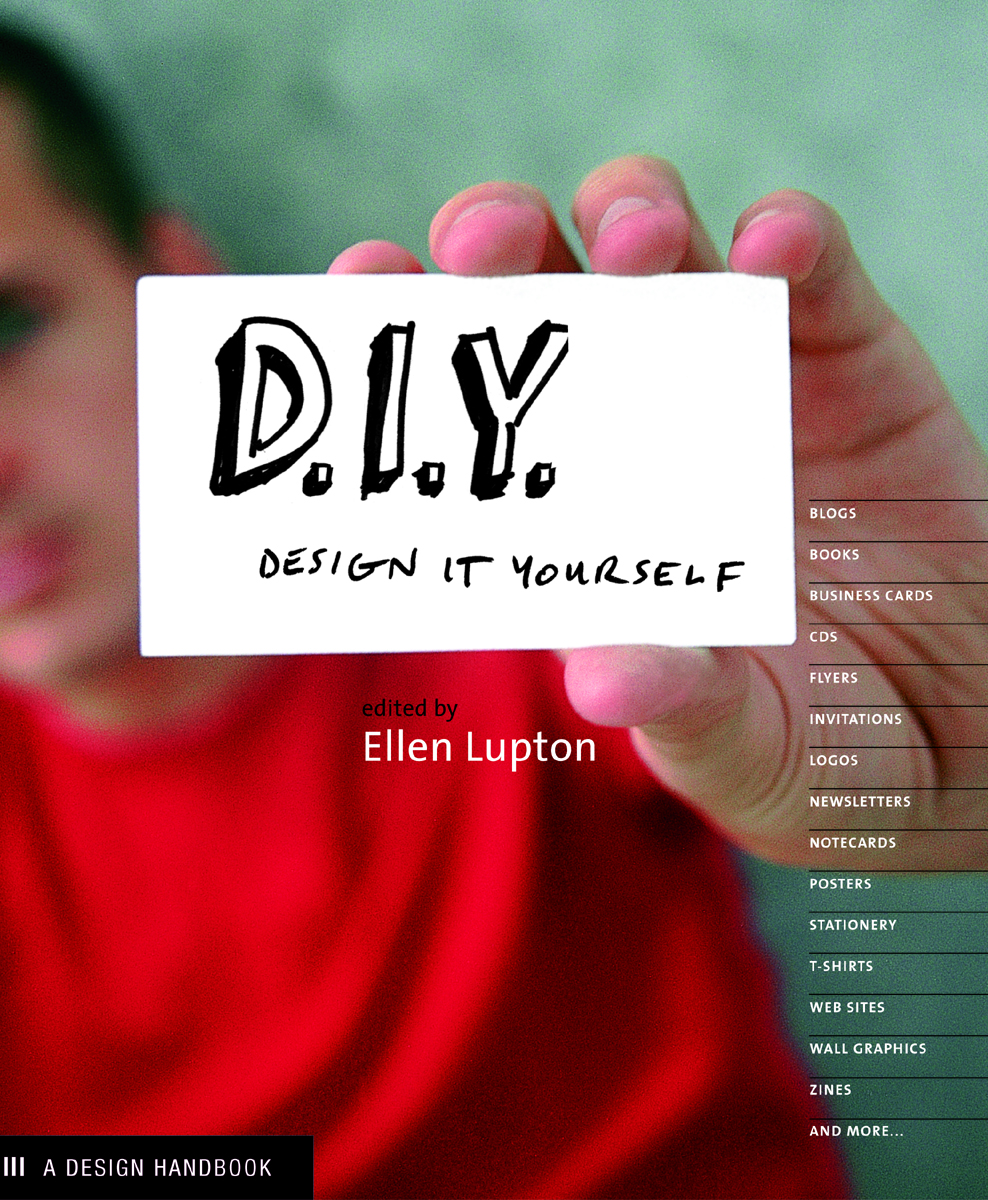
Her books include the indispensable introduction to typography Thinking with Type, DIY: Design It Yourself, D.I.Y. Kids,  co-authored with her identical twin sister Julia Lupton, and Graphic Design: The New Basics, co-authored with Jennifer Cole Phillips.

Design Your Life: The Pleasures and Perils of Everyday Things , another collaboration with her sister Julia, will be published by St. Martin’s Press later this year.

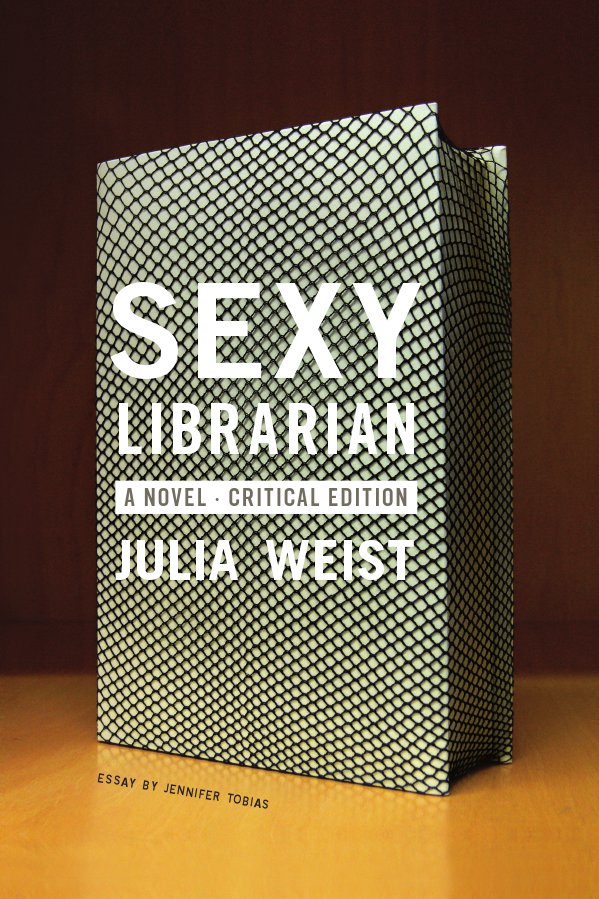
But, not content with being an  author, curator, designer, and educator, Ellen recently became a publisher, founding  Slush Editions to independently publish the novel Sexy Librarian by artist Julia Weist.

Sexy Librarian also features as a case study in Ellen’s latest book  Indie Publishing— a guide for independent authors written, researched, and designed in collaboration with graduate students at MICA — published in December 2008 by Princeton Architectural Press.

Ellen kindly replied to my questions about design and indie publishing by email.

And for the sake of full disclosure, I should make absolutely clear that several of Ellen’s books are published by New York’s Princeton Architectural Press who are distributed by Raincoast Books in Canada. But, for the record, that only explains why I have her email in my address book, not why I chose to interview her.

I have also interviewed Ellen previously for the Pages bookstore in Toronto.

How would you define ‘indie publishing’?
Indie publishing is author-driven. The traditional publishing industry is controlled by publishing professionals — editors, marketing people, promotional staff, and the publishers in charge. These are all skilled people. In our book, we use the term broadly, to encompass everything from handmade zines to print-on-demand books to offset publications distributed by the authors to small imprints created by design firms who wanted to get into the content business.

How is it different from the traditional publishing industry?
Because it’s author-initiated, indie publishing side-steps the traditional barriers of the publishing industry. It gets beyond the gatekeepers. Now, those gatekeepers act as guardians of quality to some degree, but they also contribute to a homogeneous and profit-driven publishing industry that many authors find hostile and hard to penetrate. Indie publishing often serves niche or local markets that can’t be addressed by mainstream publishing.

What are the benefits of publishing yourself?
If you have had difficulty breaking into the mainstream publishing world, going independent is liberating. If you end up producing a successful book, the profits can be substantial, but this shouldn’t be the main motive to get into publishing. Few authors make substantial bucks on their books — regardless of who publishes them. For most of us, writing and producing books is a labor of love.

What are the risks?
Most forms of indie publishing cost money, and that’s a risk. When you work with a commercial publisher, they foot the printing bill. Publishers also provide essential services like editing, proofreading, design, distribution, and marketing. The indie publisher has to take on all these tasks alone (or find friends to help out). It’s not easy, especially the distribution part. Self-published books are still viewed as less legitimate than commercially published books, although this is starting to change.

Do you see indie publishing as part of a wider D.I.Y. movement?
We are seeing more independent production in all creative fields — music, art, theater, design, etc. Younger creative people are interested in creating new institutions and networks outside the official art world or music/literature establishments. They are comfortable using technology to disseminate their ideas.

How has the internet affected the development of indie publishing?
The internet allows indie publishers to reach potential readers outside the bookstore system. Today, anyone can set up an Amazon Marketplace account or sell publications directly from their web sites. Print-on-demand publishers like Lulu and Blurb produce books when someone buys them, sending the finished book directly to the customer. These technologies are creating new possibilities for authors, especially those whose work is directed at narrower, smaller audiences.

What advice would you give someone publishing their first book?
Love your book. Get advice from lots of people in order to have the best possible content. Consider the different avenues that exist for publishing your work, including mainstream publishing as well as independent ventures.

Think about your audience and the best way to reach them. And think about your own primary goals for publishing a book. For example, an artist having a gallery exhibition might use a print-on-demand book as a tool for building his or her career via grant applications, networking with galleries and curators, securing lecturing and teaching opportunities, and more. A well-designed, carefully authored book has many functions. Selling copies to lots of people is just one of them. You might use a book as professional portfolio for landing a job or attracting clients — maybe all you need is a few copies.

What are some of the common mistakes people make designing books?
It’s important to use good software. The industry standard today is Adobe InDesign, which is available for both Mac and PC and can be easily learned via software manuals or technical workshops. Programs like Microsoft Word or Publisher are extremely cumbersome and will ultimately be frustrating to a person trying to design a refined and elegant book. Choosing a good typeface is also important. Avoid Times Roman, which was originally designed for newspapers and is so widely used as to be banal. Beautiful, high-quality typefaces such as  Garamond often come bundled with layout software and computer operating systems. Keeping your design simple and consistent from page to page is a rule of thumb for any book design. You also need to “unlearn” some habits from high school, such as leaving two spaces between sentences — this is not done in formal typesetting, and it will make your book look amateurish.

What do you look for in good book design?
Beautiful type, elegant margins, consistent pages.

Have you ever bought a book just for its cover?
Of course! Cover design is extremely important. A cover is not only a billboard advertising your book on a shelf, it’s also an online logo for your book that needs to look great at 100 pixels high. Getting help from a good graphic designer on your book cover is a worthwhile investment.

What will be the impact of e-books on publishing?
I believe that e-books are going to be very, very good for authors. By lowering the cost of publishing, e-books will make it easier for more authors to get their work published and to reach specific audiences who want their content. What I’m less sure about is how e-books will affect graphic designers!

Are we finally seeing the ‘End of Print’?
I do believe there is a sea change going on. After decades of unsuccessful attempts at creating electronic book readers, suddenly the time seems right. I don’t think print will disappear, but I think we will see less of it. It remains a tactile, permanent, stable medium that users can feel a personal attachment to.

What role do you think print-on-demand will play in the future?
Print-on-demand is where digital media and print meet. I think we will see a lot more of this as prices go down in the future. Ultimately, it is a more sustainable way to publish and involves less financial risk, but right now, it is too expensive for large-scale endeavors.

How will e-books and print co-exist?
E-books are great for disposable reading — magazines, casual fiction, newspapers. Perhaps every physical book in the future will come with an e-book supplement. I often want to quickly reference a book I read, and e-books would be great for that. Personally, I collect books, but I don’t need to keep the latest Richard Price book on my shelf forever.

As a designer, do you feel an attachment to print?
I am very attached to print. I don’t want to see it disappear in my own lifetime, that’s for sure. I love the tactility, permanence, and scale. But I do find myself reading more and more online.

Thanks very much Ellen!
4 Comments