Skip to content

Tag: art

Janet Malcolm: The Messiness of Truth

Zoë Heller reviews Janet Malcolm’s new book, Forty-One False Starts: Essays on Artists and Writersfor the New York Review of Books:

Mess has always inspired fervent emotions in Janet Malcolm. It agitates her. It depresses her. She considers it her enemy. The job of a writer, she likes to remind us, is to vanquish mess—to wade onto the seething porch of actuality, pick out a few elements with which to make a story, and consign the rest to the garbage dump. Images of clutter and panic-inducing domestic chaos crop up frequently in her work, not just as metaphors for the failure or absence of art, but as advertisements for her own narrative discipline. This is what real life looks like, they tell us. This is the tedium and confusion that Malcolm’s elegant rendering of things has spared you. 

But if literal messes appall Malcolm, they also fascinate and attract her… Malcolm has a secret, writerly sympathy for the hoarder. She understands the mad desire to hold on to every piece of accumulated material, the fear of throwing out something precious. Art, she is fretfully aware, can be too ruthless in its cleaning operations… There is something awe-inspiring and at the same time a little barren about an environment from which all trace of “disorderly actuality” has been removed.

New York Review of Books

Comments closed

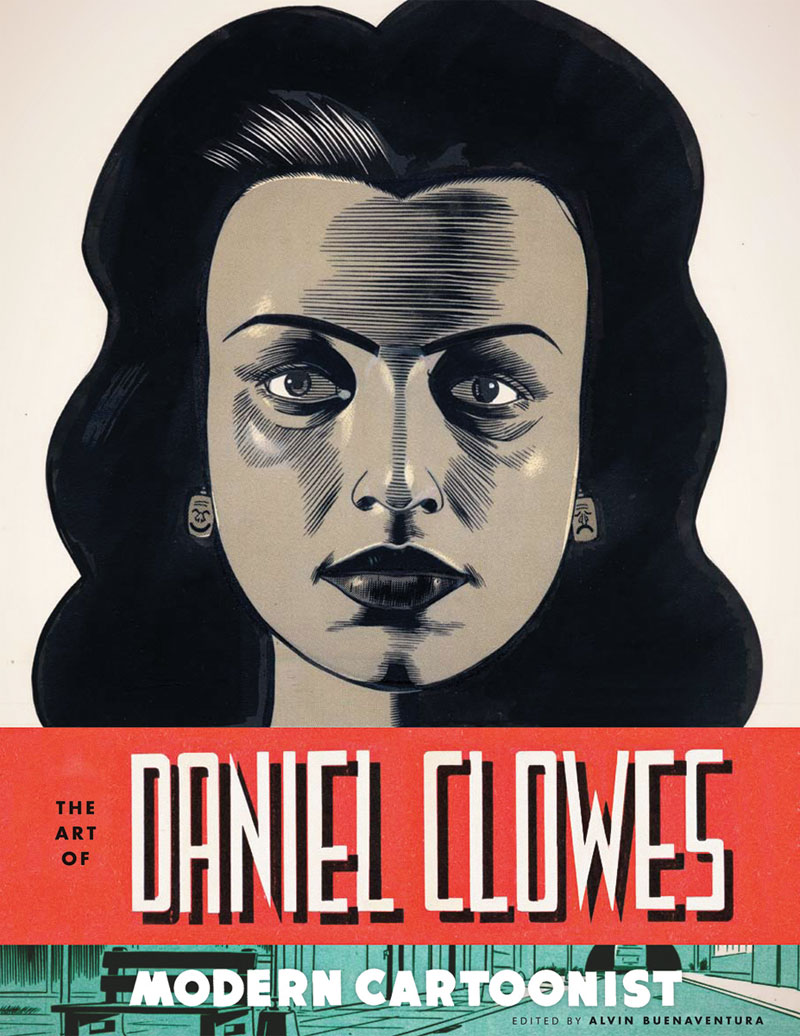
‘Modern Cartoonist: The Art of Daniel Clowes’ in Chicago


The exhibition of cartoonist Daniel Clowes’ art work that first appeared at the Oakland Museum of California last year, is travelling to the Museum of Contemporary Art in Chicago. Opening at the end of June, Portuguese TV channel Canal180 has (weirdly / not weirdly?) posted a short (English-language) video about the show:

The show is accompanied by the book Modern Cartoonist: The Art of Daniel Clowes published by Abrams.

Comments closed

Alan Moore: The Believer Interview

At The Believer magazine, Peter Bebergal, author of Too Much to Dream: A Psychedelic American Boyhoodtalks to Alan Moore about his epic work-in-progress Jerusalem, magic, art, gods, and demons:

Magic and art tend to share a lot of the same language. They both talk about evocation, invocation, and conjuring. If you’re trying to conjure a character, then maybe you should treat that with the respect that you would if you were trying to conjure a demon. Because if an image of a god is a god, then in some sense the image of a demon is a demon. I’m thinking of people like Malcolm Lowry, the exquisite author of Under the Volcano.There are kabbalistic demons that are lurking all the way through Under the Volcano, and I assume they were probably similar forces to the ones that eventually overwhelmed Lowry’s life, such as the drinking and the madness. When I hear alcoholics talk about having their demons, I think that they’re probably absolutely literally correct.

Thankfully, they also talk a little bit about comics as well:

Superheroes are the copyrighted property of big corporations. They are purely commercial entities; they are purely about making a buck. That’s not to say that there haven’t been some wonderful creations in the course of the history of the superhero comic, but to compare them with gods is fairly pointless. Yes, you can make obvious comparisons by saying the golden-age Flash looks a bit like Hermes, as he’s got wings on his helmet, or the golden-age Hawkman looks a bit like Horus because he’s got a hawk head. But this is just to say that comics creators through the decades have taken their inspiration where they can find it.

The accompanying illustration of Moore is, of course, by American cartoonist Charles Burns (Black Hole / X’ed Out / The Hive ).

An exhibition of Burns‘ portraits for The Believer is running at the Adam Baumgold Gallery in New York until July 26, 2013.

Comments closed

Grant Snider ‘Who Needs Art?’


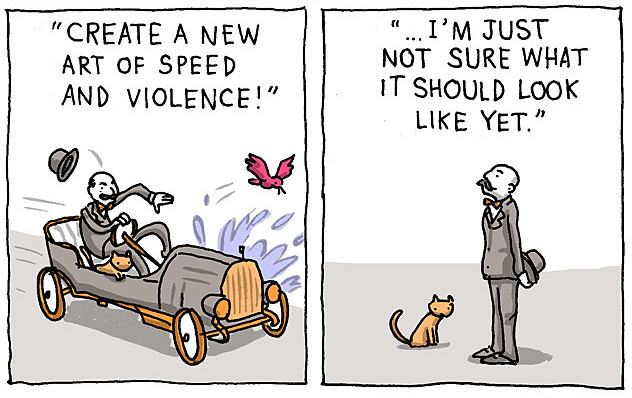
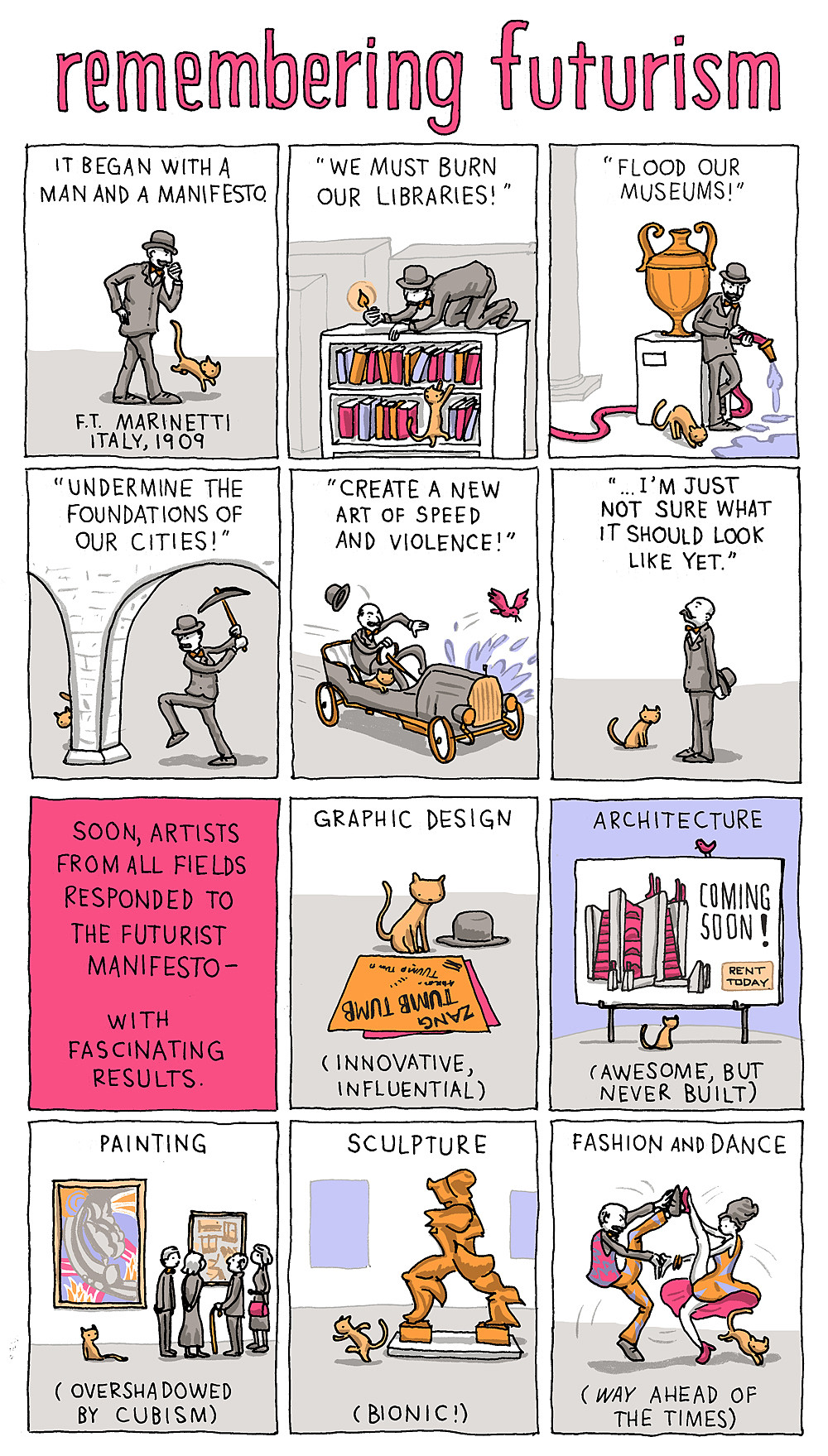
Incidental Comics cartoonist Grant Snider has started a new comic series for Medium.com called ‘Who Needs Art?’ about movements and concepts in art and design.

His first piece, Remembering Futurism, is about Filippo Tommaso Marinetti and Italian Futurist movement.

Read the whole comic here.

Comments closed

Midweek Miscellany

I was locked a conference room last week looking at books coming out in the fall, so tI have a lot of catching up to do…

At the Financial Times, Andrew O’Hagan on the influence of other art forms on writers:

Writing novels is quiet work: it can reveal astonishments but it doesn’t usually proceed from them. Maybe that is why novelists are so often attached to second art forms that wear their physicality or their beauty outwardly. Ernest Hemingway considered bullfighting an art form and, indeed, he thought writers should be more like toreadors, brave and defiant in the face of death. For Japanese novelist Yukio Mishima it was the art of the samurai – he loved the poise, the nobility, the control, tradition, all things you would say of good prose – and he died in a ritual self-killing. But most novelists take their influence seriously without letting it take over. They are emboldened by a love of opera, as were Willa Cather and the French novelist George Sand, or by modernist painters, as Gertrude Stein was, each of these brilliant women finding in the spaciousness and drama of the other art form an enlarged sense of what they themselves were setting out to deal with on the little blank page.

And at The Guardian, O’Hagan talks to six novelists, including Kazuo Ishiguro and Sarah Hall, about their passion for a second art forms.

And on a somewhat related subject… Charlotte Higgins profiles painter Leon Kossoff for The Guardian:

His father, a first-generation immigrant from Ukraine, owned a bakery round the corner in Calvert Road; he was one of seven siblings. It was “absolutely not”, he says, an artistic household. “Painting didn’t exist in my family.” What drew him to art as a boy was finding himself, almost without knowing how he had got there, in the National Gallery. “At first the pictures were frightening for me – the first rooms were hung with religious paintings whose subjects were unfamiliar to me.” Later they became old friends: Kossoff spent a long period visiting the National Gallery before opening hours, working from the old masters, making not copies but what you might call translations.

An exhibition of Kossoff’s drawings and paintings of London opens at the Annely Juda Gallery May 8th.

Shuffle — At the Center for Fiction, Dawn Raffell interviews Renata Adler:

I always shuffle. And there, the computer is just a disaster because the only thing I’ve ever been compulsively neat about is typing. I type with two fingers, and so I would always make a mistake near the end of the page, and since White Out is no use, I would throw the thing out and start again at the beginning. Then along came the computer and I thought it was going to help because you can move everything around all the time and you can change every sentence 50 different ways in seconds. But that’s exactly what I don’t want, because then what was I doing? If the computer can shift everything in a split-second, then what am I doing here? That’s what I used to do so carefully. One of the things that’s almost comically a problem is AutoCorrect, and what AutoCorrect thinks I’m saying.

The Amanda Palmer Problem‘ — Nitsuh Abebe at Vulture:

The web offers an opportunity to fall into the open arms of fans, in ways that weren’t available before. Here’s the catch: The web also makes it near-impossible to fall into the arms of just one’s fans. Each time you dive into the crowd, some portion of the audience before you consists of observers with no interest in catching you. And you are still asking them to, because another thing the web has done is erode the ability to put something into the world that is directed only at interested parties… Telling the world all about your life can look generous to fans and like a barrage of narcissism to everyone else.

Also from New York Magazine, the faintly ridiculous ‘At Home with With Claire Messud and James Wood‘:

“There’s been a great deal of closely spaced difficulty to sort through,” she says. “You know that Katherine Mansfield story, ‘The Fly’?” It’s about a fly being slowly drowned in ink. “Well, I am the fly. Every time I hope that things will get better, somebody drops another inkblot on me. So it seems to me if there were a divine lesson it would be to stop hoping that the blots will cease, and instead to come to terms with it … At some point you have to think, All right, it’s not as if someone is promising you something easier or better. You have to be grateful to get it done at all.”

Wood talks about his recent collection of essays, The Fun Stuff, at The Spectator, and Messud’s new novel The Woman Upstairs, was published by Knopf this week

Comments closed

Midweek Miscellany

The Creative Review interviews Richard Littler, the man behind the absolutely bloody terrifying Scarfolk:

For me, the desired effect can only be achieved if the images are visually authentic. The seriousness of presentation and form is absolutely crucial. It lulls the viewer into a false sense of security so that the gap between expectation and reality – the juxtaposition of staidness and absurdity – is as wide as it can be.

The fictional authors, designers and archivists of Scarfolk’s public information material must sincerely believe in the gravity of the message that the subject matter wants to convey and deserves, such as rabies. In addition, the whole concept of Scarfolk has to be internally consistent. There has to be a credible, believable identity.

Greatly Exaggerated — Salon’s Laura Miller on technology, self-publishing, and why publishers and bookstores are still matter:

If print could talk, it would surely be telling the world, Mark Twain-style, that reports of its demise have been greatly exaggerated… New self-publishing enterprises are a godsend for traditional publishers because they can take much of the uncertainty out of signing a new author. By the time a self-published author has made a success of his or her book, all the hard stuff is done, not just writing the manuscript but editing and the all-important marketing. Instead of investing their money in unknown authors, then collaborating to make their books better and find them an audience, publishers can swoop in and pluck the juiciest fruits at the moment of maximum ripeness…. [That’s] exactly what happened with erotica blockbuster E.L. James.

Epitaph — A smart take on the end of Google Reader by Paul Ford for The Financial Times:

This is the downside to apps: when everything is online your ability to labour along in familiar ways is contingent upon money coming to the app provider. This works when we remain consumers, for example of media objects such as paywalled newspapers, Netflix and Spotify. We lease access to the databases, own nothing, and the access makes it worthwhile. But when we work inside these systems we increase our levels of risk. When Google Reader goes away, it will not be like a television show being cancelled – much work is lost, and the ability to access that work is also lost.

The Exploded Mind — A big interview with artist, illustrator and picture book maker Oliver Jeffers at The Great Discontent:

Balancing integrity versus income is tricky; when I make decisions, sometimes I know that I might not be as well off the next year, but I’ll certainly be making the best work. I figured out early on that there are certain things I don’t want to do when it comes to how I’m perceived. I try to stay away from advertising, even though that’s where the big money is. In the visual arts, you are often only as good as your reputation and associations, so you have to think ahead and be smart. As far as commercial commissions, I’m not just a gun for hire; I actually have something I’m trying to accomplish and a way of making work that I want to continue and be known for. Although some lucrative offers came in for illustration work, I realized that taking them would be shortsighted and could possibly stunt other aspects of my practice.

See also: ‘Maurice Sendak’s Jumper and Me‘ by Jeffers at The Guardian:

Sendak was trying to satisfy himself. He was telling these stories, as much a way to make sense of the world around him as anything else. He was using them as a poet uses poetry and a painter uses paint. He was making art that ultimately transcended himself and neat classification. Perhaps as a result he was one of the first contemporary picture-book makers to discover the power of picture book as a way of storytelling for everyone. Perhaps this might go some way to explain why his books have won over so many, regardless of geography or decade – because he is putting himself, and the way he views the world on paper, darkness and all.

And finally…

Dr. Jazz — James Hughes on Stanley Kubrick’s unmade film about jazz in the Third Reich, at The Atlantic:

Kubrick’s interest in jazz-loving Nazis… represents his most fascinating unrealized war film. The book that Kubrick was handed, and one he considered adapting soon after wrapping Full Metal Jacket, was Swing Under the Nazis, published in 1985 and written by Mike Zwerin, a trombonist from Queens who had performed with Miles Davis and Eric Dolphy before turning to journalism. The officer in that Strangelovian snapshot was Dietrich Schulz-Koehn, a fanatic for “hot swing” and other variations of jazz outlawed as “jungle music” by his superiors. Schulz-Koehn published an illegal underground newsletter, euphemistically referred to as “travel letters,” which flaunted his unique ability to jaunt across Western Europe and report back on the jazz scenes in cities conquered by the Fatherland. Kubrick’s title for the project was derived from the pen name Schulz-Koehn published under: Dr. Jazz.

Comments closed

Midweek Miscellany

WHAAM! — Comics historian Paul Gravett on Roy Lichtenstein’s appropriation from comics:

Lichtenstein’s… success, his getting away with turning supposedly anonymous ‘found’ comic art into high-priced paintings, continues to directly encourage others to do the same. But there is a difference—comics are no longer uncredited, trashy mass culture, and what worked as a lucrative schtick back in the Sixties art world is now largely drained and devoid of any shock value or irony… Five decades on… it is high time for the comics world and the art world to properly debate these issues, and to celebrate these hugely talented but still largely ignored visual storytellers.

(Pictured above: a page from ‘The Star Jockey’ drawn by Irv Novick, from All-American Men of War #89 February 1962)

See also: David Barsalou’s Deconstructing Lichtenstein project

(If Gravett underestimate’s Lichtenstein’s ingenuity in recontextualizing comic book panels, and his lasting influence on art AND comics, it is truly astonishing to see how poor Lichtenstein’s paintings are in direct comparison to the work he borrowed from.)

Blowing Shit Up — A long essay by Richard Nash on the business of literature at the VQR:

Selling a book, print or digital, turns out to be far from the only way to generate revenue from all the remarkable cultural activity that goes into the creation and dissemination of literature and ideas. Recall again all the schmoozing, learning, practice, hustling, reading upon reading upon reading that goes into the various editorial components of publishing; the pattern recognition; the storytelling that editors do, that sales reps do, that publicists do, that the bookstore staff does. Recall the average feted poet who makes more money at a weekend visiting-writer gig than her royalties are likely to earn her in an entire year. You begin to realize that the business of literature is the business of making culture, not just the business of manufacturing bound books. This, in turn, means that the increased difficulty of selling bound books in a traditional manner (and the lower price point in selling digital books) is not going to be a significant challenge over the long run, except to free the business of literature from the limitations imposed when one is producing things rather than ideas and stories. Book culture is not print fetishism; it is the swirl and gurgle of idea and style in the expression of stories and concepts—the conversation, polemic, narrative force that goes on within and between texts, within and between people as they write, revise, discover, and respond to those texts.

See Also: Book Publishers Scramble to Rewrite Their Future by Evan Hughes for Wired.

And finally…

The New Statesman has posted five classic book reviews from their archive, including V. S. Pritchett’s review of 1984 by George Orwell:

Nineteen Eighty-Four is a book that goes through the reader like an east wind, cracking the skin, opening the sores; hope has died in Mr Orwell’s wintry mind, and only pain is known. I do not think I have ever read a novel more frightening and depressing; and yet, such are the originality, the suspense, the speed of writing and withering indignation that it is impossible to put the book down. The faults of Orwell as a writer – monotony, nagging, the lonely schoolboy shambling down the one dispiriting track – are transformed now he rises to a large subject. He is the most devastating pamphleteer alive because he is the plainest and most individual…


Comments closed

Monday Miscellany

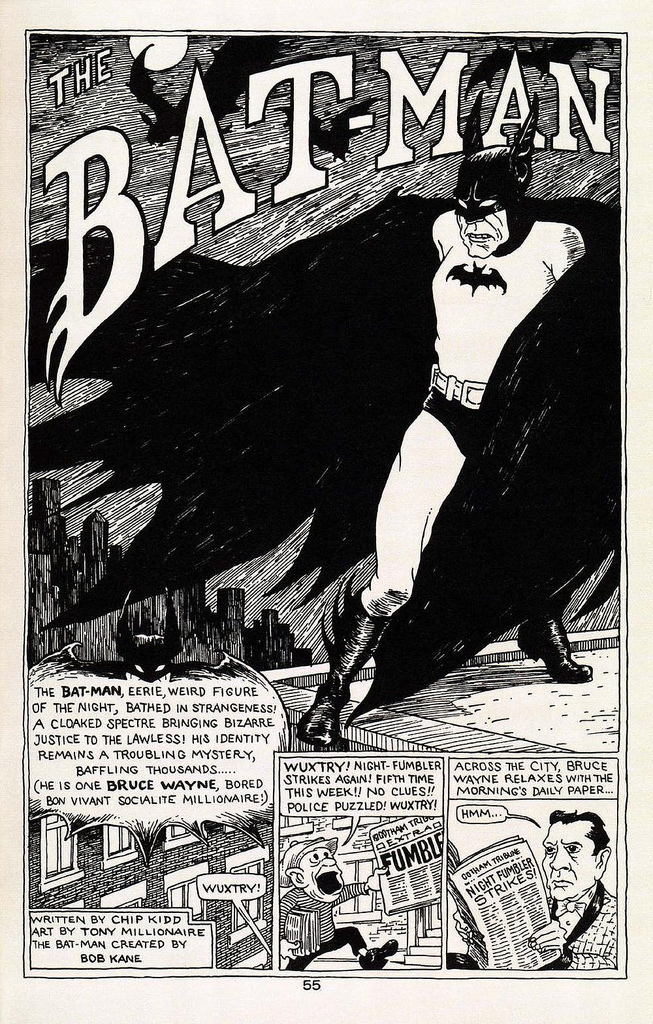
“The Bat-Man” by Chip Kidd and Tony Millionaire from Bizarro Comics #1. I can’t quite believe I haven’t seen this before… (via Martin Klasch)

Could Have Been Something — José da Silva interviews Billy Childish for The White Review:

Critics want you to get in your box and shut up. That’s why they don’t like it that I’m a writer, musician and painter. That’s totally unacceptable to their small minds… I’m looking for freedom from being categorised or identified with aspects of myself. But at the same time I use this very strong biographical information to negotiate a world – a world which I find quite mental, by the way. So I still refuse to identify myself as Billy Childish the artist,  painter, writer or musician, because in my estimation only an idiot would want to be something.

Accommodating the Mess — Tim Martin on B S Johnson,  ‘Britain’s one-man literary avant-garde’, for The Telegraph:

In principle, at least, Johnson’s declared mission echoed the great Modernist cry to make it new. Politically socialist and from a working-class London background, he cultivated pithy distrust for the complacency of his novelist peers, “neo-Dickensian” writers, as he called them, who were using a 19th-century form to gratify the “primitive, vulgar and idle curiosity of the reader to know ‘what happens next’”. A truly modern novel would seek, in Beckett’s phrase, a form to accommodate the mess, stripping readers of their escapist illusions while remaining ruthlessly true to the writer’s experience.

This obsession with so-called narrative truth runs through Johnson’s work, accounting for its most unorthodox experiments as well as its greatest flaws.

See also: Juliet Jacques review of Well Done God! Selected Prose and Drama of B S Johnson for The New Statesman.

And finally…

The mild-mannered Richard Hell in the New York Times:

After running away to New York in 1967, at the age of 17, with dreams of becoming a writer, Mr. Hell collected some good editions of favorite books. Then, in the 1970s, when he became a drug addict, he traded them for cash.

“Those were pretty much my only liquid resource,” he said. “So I sold them all over the years.”

Since getting his health and career back on track in the ’80s, he has replaced most of the ones that got away. Given the number of books now neatly stacked into the East Village apartment where he has lived for the last 38 years, he has more than made up for lost time.

Hell’s memoir, I Dreamed I Was a Very Clean Tramp, is out this week. The cover was designed by Steven Attardo.


Comments closed

Midweek Miscellany

Tell Me a Story From Before I Can Remember — A silkscreen poster of an ideal bookshelf of 100 books designed by Athens-based design studio KEIK Bureau.

Going Back to Bed — Jonathan Jones on the art of Robert Rauschenberg, for The Guardian:

Bed belongs to what is arguably the greatest series of works of art ever made in America. It is said to have been Johns who came up with the word “combines” to describe the works Rauschenberg started to assemble in 1954, putting together found photographs, newspaper clippings, fabrics, furniture, tyres and stuffed animals in intense configuations, all soaked and veiled in abstract expressionist paint. Thinking about them, I find myself struggling to find any match for what Rauschenberg achieved, not just in visual art, but in other arts, such as fiction. For what he created in these complex, tantalising, epic works was that elusive cultural totem, the “great American novel”.

Airstrip 1 — David Aaronovitch on George Orwell’s vision of a totalitarian future, for the BBC Magazine:

I was brought up in a house full of books, none of them by George Orwell.

Simone de Beauvoir was there, as was Sartre and Aldous Huxley and even Lenin. The last is actually a clue as to the absence of the first.

My parents were Communists. To them Orwell was on the other side of politics – someone whose principal writings were hostile to them and what they wanted to achieve….

Comments closed

Something for the Weekend

Wondrous Horrors — Ariella Budick on the centenary of the 1913 Armory Show in New York, for the Financial Times:

Critics did not reject every European innovation. They nodded at the impressionists, puzzled respectfully over Cézanne, and tolerated Gauguin. But cubism blew their minds. The impact was not merely aesthetic. American writers perceived a defiant rejection of rules and a contempt for tradition – qualities they associated with violent political movements. Painters who blasted convention with their brushes gave comfort to bomb-throwing subversives. When critics invoked anarchy, it was not just a figure of speech.
See also: Rethinking the Armory in the New York Times:
New York viewers, including artists, to some degree knew what they were in for. Pictures of avant-garde art had been included, often with mocking commentary, in New York newspapers and magazines for years. And by no means were all Armory reviews pans; one critic wrote that he was grateful for “these shocks to our aesthetic sense.” Others were glad for a certain perspective the show offered: compared with avant-garde work from Europe, American art looked sane.
Making It Up — William Deresiewicz on the work of Geoff Dyer, for The New Republic:
Freedom from conventional and institutional expectations—freedom even from his audience—means that Dyer is also free to make it up, like jazz, as he goes along. Every book is different, and every book is different from everybody else’s books. Zona is a running commentary, almost shot-by-shot, on a single film. But Beautiful consists of a series of quasi-imagined episodes—vivid, textured, saturated with feeling—from the lives of the jazz greats. Out of Sheer Rage is memoir, travelogue, criticism—“about” Lawrence in the physical sense of the word: spinning around and around him with a manic, comic, centrifugal energy. The Ongoing Moment makes a poem of the history of photography by considering not artists or schools, technics or techniques, but, improbably, subjects (hats, benches, stairs): a ridiculous idea, it seems, until you figure out that Dyer’s real quarry is the relationships we have with those quotidian objects, the way they can be made to stand for the lives that move among them. “Spare me the drudgery of systematic examinations,” he writes in Out of Sheer Rage, “and give me the lightning flashes of those wild books in which there is no attempt to cover the ground thoroughly or reasonably.”
See also: Rose Mclaren on Zona for The White Review:
[Dyer] claims, ‘if I had not seen Stalker in my early twenties my responsiveness to the world would have been radically diminished’. He shares with his idol an artistic ideal of awareness, describing Tarkovsky’s aesthetic as a length of take demanding ‘a special intensity of attention’. The inverse dominates much contemporary culture where, ‘a lot of what’s being shown on the world’s screens is fit only for morons’ with the result that ‘there are more and more things from which one has to avert one’s ears and eyes’. Rubbish art that warrants ignorance. A bit broad-brush and heavy-handed, but its Dyer’s reason for writing. Against a social dystopia of willed numbness, Zona documents a profound engagement with an artwork. It is not so much homage to the film alone, but to the dialogue it inspires.

And finally…

What Is This Shit? — Brian Dillon interviews photographer and filmmaker William Klein:

I didn’t know how to do a book. I was just discovering photography and once I had all these pictures, I showed them to editors in New York and nobody thought it was worthwhile to do a book with these photographs. They said, “What is this shit?” I came back to Paris and discovered there was a series of travel books called Petite Planète. I called them up and got an appointment and I went to this office which looked like NASA. Chris Marker was there with a laser gun in his belt, and he saw the photographs and said, “We’ll do a book!” In fact he said, “We’ll do a book or I quit!”

Comments closed

Meeting John Berger

A beautifully shot portrait of English art critic, writer, artist and philosopher John Berger by filmmaker Jos de Putter:

Berger is probably best known for his BBC TV series and book, Ways of Seeing.

3 Comments

Something for the Weekend

A rather brilliant cover for The Yellow World by Albert Espinosa, reminiscent of a Matisse cut-out or a Paul Rand illustration, designed by Jon Gray.

The Sickly Glow — John Banville, author most recently of Ancient Light, reviews The Big Screen by David Thomson, for The Guardian:

Thomson worries that something happened to the cinema around the time of Jaws, something cynical, sinister and perhaps even fatal. Part of the fun of Jaws and the other mindless thrills-and-spills imitations that it spawned, he says, “is that the commotion meant nothing. The sensation eclipsed sensibility”. This is the contentious heart of The Big Screen. The deadening process that, according to Thomson, set in the 1970s has now spread across the billions of tiny screens that infest the world, the combined sickly glow of which must be visible from outer space. Watching has become mere gaping, open-mouthed and slow-breathing. “Facebook already takes our earnest admissions about ourselves and trades them for advertising.”

You can read a short interview with Thomson about the book at The Arts Desk:

I went through a stage, particularly when I was teaching, of saying, “Well, these are the great filmmakers, let us explore them as if they were Charles Dickens or Van Gogh or someone like that.” The auteur theory. And now I’ve got to a stage where I sort of feel that every film is more like other films than anything else. Films are all alike, because the technology is more important. The director is fading away – you don’t think to ask who directs television, and yet television today in America is at a very good stage. So I’ve become increasingly interested in the technology, and what that has done to shape the format.

And on a somewhat glummer note… David Denby, movie critic at The New Yorker and author of Do the Movies Have a Future?, on the economics of Hollywood, at The New Republic:

Most of the great directors of the past—Griffith, Chaplin, Murnau, Renoir, Lang, Ford, Hawks, Hitchcock, Welles, Rossellini, De Sica, Mizoguchi, Kurosawa, Bergman, the young Coppola, Scorsese, and Altman, and many others—did not imagine that they were making films for a tiny audience, and they did not imagine they were making “art” movies, even though they worked with a high degree of conscious artistry. (The truculent John Ford would have glared at you with his unpatched eye if you used the word “art” in his presence.) They thought that they were making films for everyone, or at least everyone with spirit, which is a lot of people. But over the past twenty-five years, if you step back and look at the American movie scene, you see the mass-culture juggernauts, increasingly triumphs of heavy-duty digital craft, tempered by self-mockery and filling up every available corner of public space; and the tiny, morally inquiring “relationship” movies, making their modest way to a limited audience. The ironic cinema, and the earnest cinema; the mall cinema, and the art house cinema.

Viva Hate — Keith Gessen, founding editor of n+1, on Kingsley Amis and Philip Larkin, at The New Statesman:

They had been brought together by their mutual hatred of the universe, which for a while did a fine job of confirming their feelings about it by rejecting and ignoring them. As they began to find their way in the world it became a little harder to hate it, at least with the same intensity. And so their letters to each other dwindled: What was there to say?

They were rescued by the 1960s. Amis and Larkin managed to greet the transformations, disturbances and new thinking with shared hostility. It brought them a whole gamut of things to hate.

And finally…

Lunch with painter Frank Auerbach, at the Financial Times:

It’s funny, this business of a vocation. One starts from a motive one hardly comprehends. In the school holidays I was an office boy – I found the idea of going into an office horrifying. As a painter, I thought there would be bohemianism, freedom, and there was, but gradually the practice of art took over. As Auden says, in any crisis, the break-up of a relationship, the response is to flee to the arms of the muse. At art school you know at least as many talented students as those who became painters, but they get off the train at some point. I met Stephen Spender once, I expected a poet with a vocation but I found a civilised man, gregarious, leading a varied, entertaining, virtuous life – for whom poetry was only one of the facets. He said one of his dreams was to be a poet, the other to have a lovely life, go to France, know lots of people.

Comments closed