Skip to content

Tag: art

Art Spiegelman: The Horror of the Blank Page

Artist Molly Crabapple interviews (and draws!) Art Spiegelman for Vice magazine:

Because of Photoshop we all know that photographs lie every second that they open up their mouths. You can’t really trust a photograph. It could have just as easily been a photoshopped collage. So, it’s probably more plausible to trust an artist. You get to feel whether you trust them or not… Artists tend to have to reveal more of themselves even when they try to be as scrupulous as Joe Sacco. It has a place insofar as concentrating on something has a place. We’re living in an ADD universe. The computer encourages that second-to-second dopamine rush as you go from click to click. What’s valuable about comics and print is they actually are a venue where you end up spending time.

Art Spiegelman’s Co-Mix: A Retrospective runs November 8th – March 23rd at the Jewish Museum in New York City.

1 Comment

Rachel Kushner and the Radical Gesture


Boris Kachka (Hothouse) profiles Rachel Kushner, author of The Flamethrowers, for New York magazine:

It’s tempting to ask just how transgressive a novel, especially a best-selling novel, can be—and whether taking a stand against mainstream values makes you subversive or just modern. In other words: Is Kushner the flamethrower for real?

The answer is, basically, yes, in both senses of the phrase: She knows what she writes about, and she’s dead serious about her ideals. There’s plenty of room in The Flamethrowers for the dark side of that idealism—murdered businessmen, casually discarded girlfriends, movements warped by violence. In many ways it’s the subject of the book. But if something ardent and glamorizing blazes through, like the flashy World War I brigade of the title, that’s because Kushner herself is a believer, a genuine and unself-conscious exponent of what she might call the radical gesture—even if those gestures are more common now among academics and art stars than any genuine underclass. In a forthcoming interview with Tin House, she calls her shimmering mosaic of a second novel a “paean, maybe, to things that have long interested me. Nothing is in the book that I had to learn about. Instead, it is filled with things I already knew … drawn from my taste, my life, my sensibility.”

The paperback edition of The Flamethrowers is out in February 2014.

Comments closed

Norman Rockwell, American Romantic

Christopher Benfey reviews American Mirror, Deborah Solomon’s recently published biography of artist Norman Rockwell, for the New York Review of Books:

Solomon spends more time than Rockwell did worrying about his status in comparison with what she calls the “Abstract Expressionist ilk,” who “glamorized direct and unmediated gestures” and dominated highbrow taste during the 1950s. Rockwell, who was remarkably uncompetitive and nonterritorial, said, disarmingly, “If I were young, I would paint that way myself.” The Connoisseur of 1962, a painting now in the collection of Steven Spielberg that Solomon considers a “masterpiece,” depicts a balding man seen from behind, in a gray suit with hat and umbrella in hand, contemplating what seems to be a Pollock painting. The floor, bluish-gray and white squares and triangles, constitutes a contrapuntal abstraction. Rockwell had fun making his own drip painting, canvas on the floor, and had a photographer record the event just as Hans Namuth, in 1950, had famously documented Pollock wielding a can of paint over the canvas. It’s charming to learn that Willem de Kooning, a longtime admirer of Rockwell, claimed to think that Rockwell’s Pollock was better than the real thing. “Square inch by square inch,” he said, “it’s better than Jackson!”

(American Mirror: The Life and Art of Norman Rockwell is published by Farrah, Straus & Giroux, and is distributed in Canada by my employer Raincoast Books)

Comments closed

Joe Sacco: Putting the Reader in the Picture

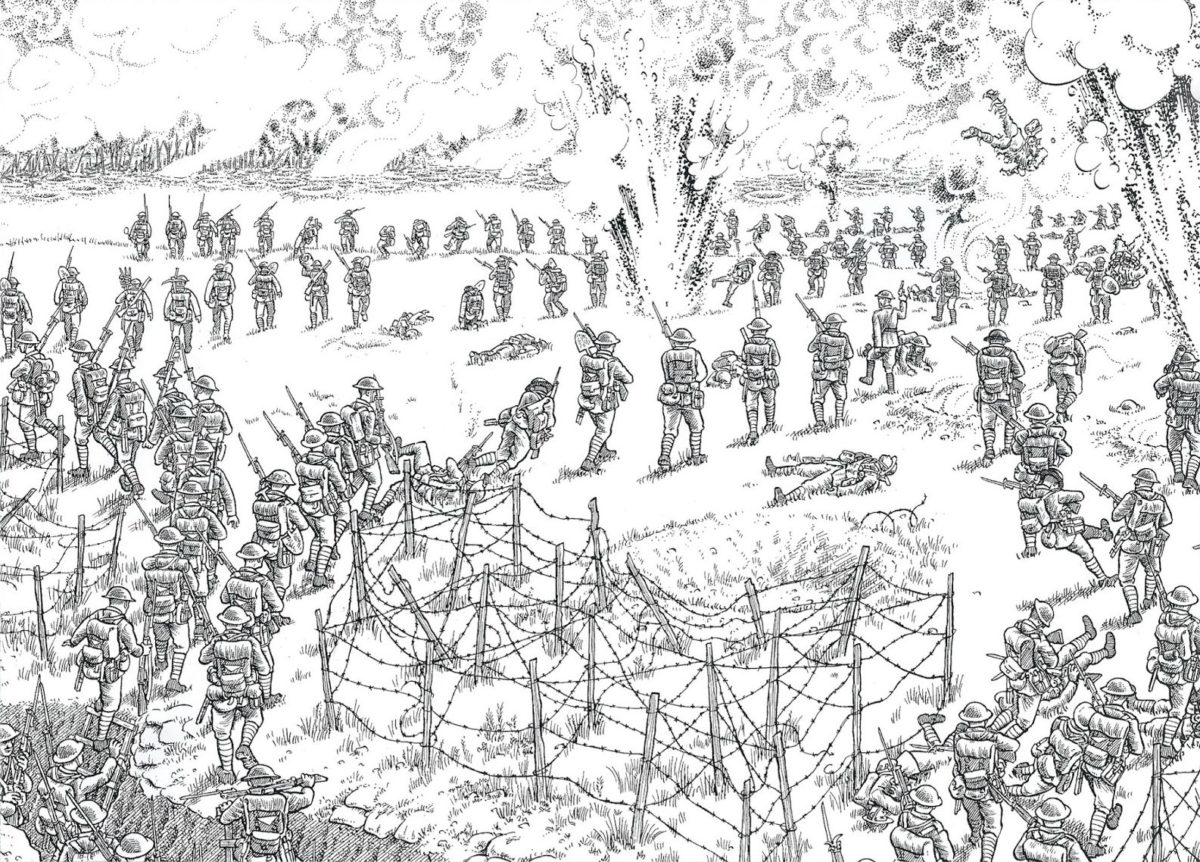
Cartoonist Joe Sacco discusses his new illustration/book The Great War in an interview at Salon:

I think every medium has its strengths. But I think illustrated work puts the reader directly into a picture. You open up, let’s say, a comic book, and I’ve drawn a Palestinian refugee camp — you’re inside it, and with the multiple images, you’ll hopefully get an idea of the atmosphere. As a cartoonist, you’re concentrating on giving visual information — especially in the background — that can be conveyed by multiple images. And things follow the reader around. You know, the architecture will follow the reader from one panel to another, so it becomes part of the atmosphere that the reader is imbibing. With the written word, you can describe the architecture, but you’re not going to keep mentioning it as a figure is walking down the street, you’re not going to keep mentioning what the background is. With comics you can do that.

Comments closed

Julian Barnes on Lucian Freud

Julian Barnes reviews two recent books about the painter Lucian Freud — Man with a Blue Scarf by Martin Gayford and Breakfast with Lucian by Geordie Greig — for The London Review of Books:

Freud was always a painter of the Great Indoors. Even his horses are painted at home in their stables; and though he curated a great Constable show in Paris in 2003, the greenery he depicted himself lived either in pots or was visible from a studio window. His subject matter was ‘entirely autobiographical’. Verdi once said that ‘to copy the truth can be a good thing, but to invent the truth is better, much better.’ Freud didn’t invent, nor did he do allegory; he was never generalising or generic; he painted the here and now. He thought of himself as a biologist – just as he thought of his grandfather Sigmund as an eminent zoologist, rather than a psychoanalyst. He disliked ‘art that looks too much like art’, paintings which were suave, or which ‘rhymed’, or sought to flatter either the subject or the viewer, or displayed ‘false feeling’. He ‘never wanted beautiful colours’ in his work, and cultivated an ‘aggressive anti-sentimentality’. When there is more than one figure in a picture, each is separate, isolated: whether one is reading Flaubert and the other is breastfeeding, or whether both are naked on a bed together. There is only contiguity, never interaction.

An interesting painter, but not a pleasant man, unfortunately.

1 Comment

The Great War by Joe Sacco

Joe Sacco talks to The New Yorker about his new accordion book The Great War, which folds out to create a twenty-four-foot-long panorama of the Battle of the Somme:

When we first talked about my drawing a panorama of the Western front, the idea seemed static. But immediately I thought of the Bayeux Tapestry… which has a narrative. William the Conqueror in France is getting ready for the invasion; they’re building the boats; they’re crossing the English Channel; then there’s the Battle of Hastings, and you basically read it left to right. It just came to my mind that I could show soldiers marching up to the front, going to the trenches, going over the top, and then returning after they’ve been wounded, back through the lines to the casualty-clearing station behind the front. So it seemed like a very simple idea, and to be honest, I just wanted to draw. On a visceral level, it was just a pleasure to think only in terms of drawing.

It was a relief not to think about words, and to do a different kind of research. I did a lot of image research and I actually had to read a lot of books, because sometimes prose takes you where photography never went. I would read and get images in my head, and it was just a matter of putting them down. I’ve spent a lot of time doing journalism, and I still am interested in it, but I think the artist side of me wants to sort of come out now. And that’s what the Great War was to me, letting myself go in that direction.

Sacco talks more about the work in this video for publisher W. W. Norton:

1 Comment

Chris Ware: The Magic of Comics

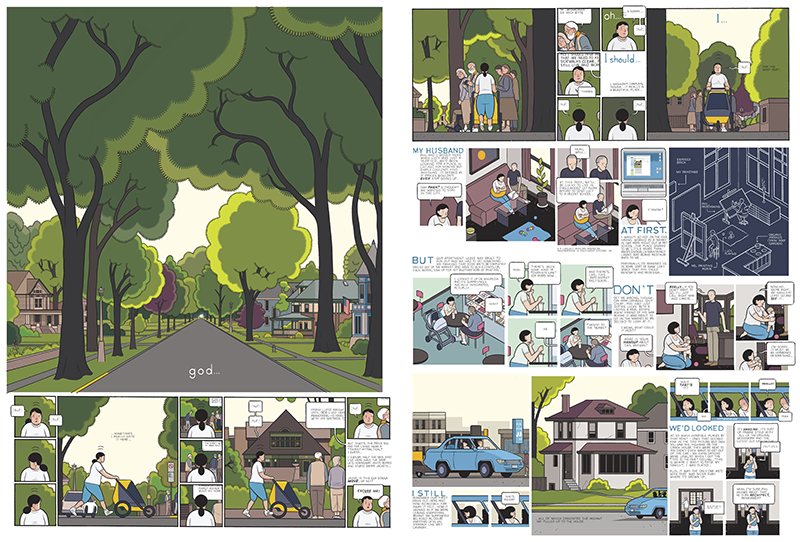
Following his appearance at the Edinburgh international book fair, Cartoonist Chris Ware spoke with Stuart Kelly of The Guardian about his recent work Building Stories:

“As soon as a screen can produce something that can move, it becomes a passive medium, whereas I feel that comics are a very active medium. The appeal is they masquerade as a passive medium, but they’re not at all. It takes a lot of effort to read comics, even though it seems like they’re easy. It seems like they need to be fixed on paper to have a certain power – my wife always tells me never to use the word magic, but I can’t help it, there is no other word: there is a magic when you read an image that you know doesn’t move but you have a sense that something is moving, if not on the page then in your mind.”

Read the whole interview.

Comments closed

Frame By Frame: The Art of Stop Motion

The latest episode of the PBS documentary short series Off Book takes a look at the painstaking art of stop-motion animation:

I’ve always loved stop-motion so it’s nice to know that it’s undergoing something of a resurgence in the digital age.

Comments closed

Chris Ware: An Everyday Genius


The September/October issue of Intelligent Life includes an extensive profile of cartoonist Chris Ware by Simon Willis:

As he worked on “Building Stories”, [Ware] decided he needed a form that allowed the past and the present to co-exist in a jumble, as in our own heads. “Like something you’d see in a dream.” A book wouldn’t do. The answer came to him: lots of little books, in a box.

Ware is not the first artist to use a box to explore memory. The writer B.S. Johnson, “the great lost British novelist of the 1960s” in Jonathan Coe’s view, published a novel, “The Unfortunates”, in 27 fragments of prose about the memories that assail a sports reporter at a football match. But the biggest influence on Ware was the American artist Joseph Cornell, who made artworks out of found objects arranged in small cabinets. Ware fell in love with his work in 1989, and when he got to Chicago he discovered the Bergman collection at the Art Institute, which has several of Cornell’s boxes. One of them, “Ann— In Memory” (1954), contains a few faded photographs and ads for hotels. The box is a physical and metaphorical container. “It’s certainly a good image of the way we recall things,” Ware says. “It has an organisation to it, but also a sort of chaos.”

Comments closed

The Life and Times of Daniel Clowes

The NEA Arts Magazine has a really great interview with cartoonist Daniel Clowes:

I always had this senseand I was very confident about thisthat I knew something that other people didn’t. I knew that this form had great potential, and I knew that great things had been done that people were wilfully ignoring in their dismissal of the entire medium. So I felt like I had it all to myself. Or, you know, me and the ten other people that were thinking of it this way. It was exciting to know that people who were regarded as experts, [like] my teachers and people in the art world, were wrong and I was right. I knew that as well as I knew anything.

Comments closed

Toytown: Architecture on the Carpet

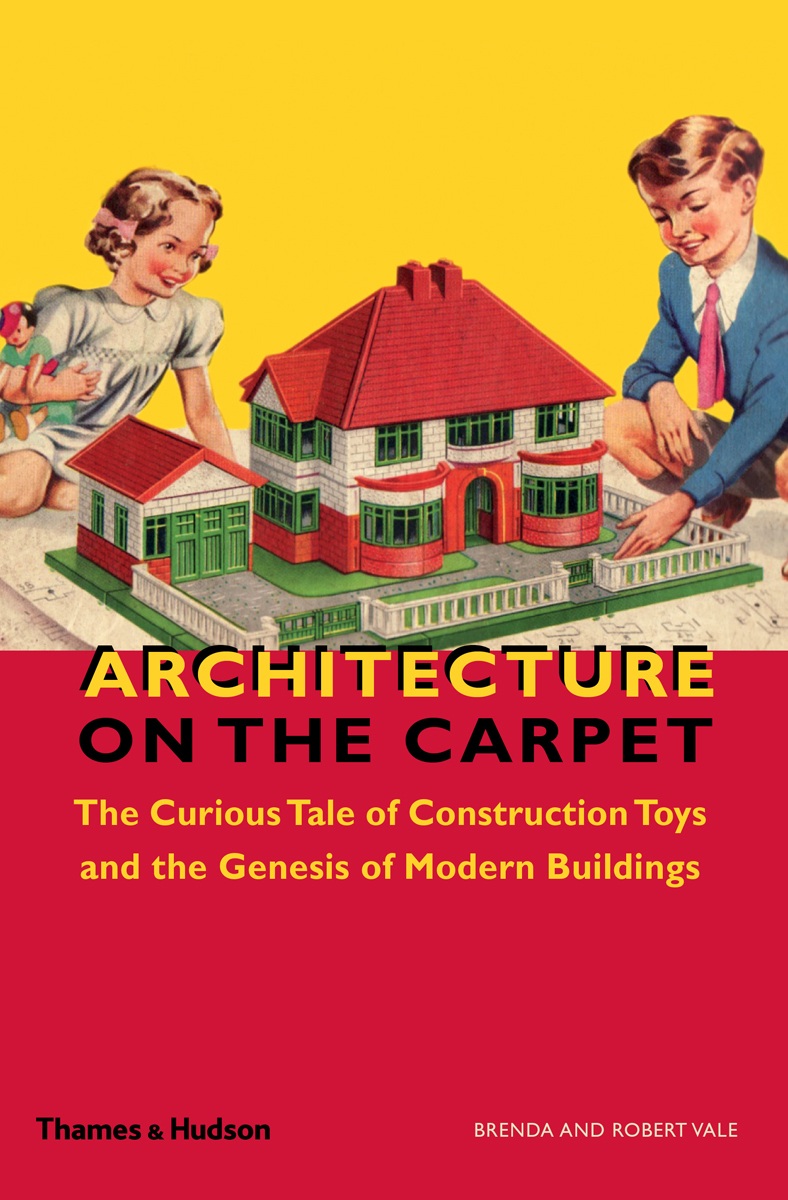
The Financial Times architecture correspondent Edwin Heath reviews Architecture on the Carpet: The Curious Tale of Construction Toys and the Genesis of Modern Buildings by Brenda and Robert Vale, which argues that construction toys such as Lego and Meccano not only reflect the architecture of the real world, but influence the way individual architects design:

Construction toys have always been about what adults would like to play with themselves. Or what they feel their children should be playing with. They are worthy. But somehow Lego has managed the difficult feat of appearing playful, of being versatile and not being overly didactic. If English construction toys reflect a residual, Pooterish suburbanism, Lego, whose first plastic bricks appeared in 1947, is liberated Danish pop art modernism, of the same world as Verner Panton’s fiercely colourful plastic chairs and Claes Oldenburg’s confusion of scales. It is the most urban of the toys, encouraging the building of whole cities.

The company recently brought out a series of kits to make modernist icons by Le Corbusier, Mies van der Rohe and, of course, Frank Lloyd Wright. They are clearly aimed at adults, the kind of gift which confers on the giver culture and playfulness. In their specificity (designed for only one possible outcome), they are exactly what Fröbel and Rudolf Steiner were set against, the latter, one of the most influential of play theorists, being convinced that only the vaguest sense of reality should be designed into a toy so that as much room is left for the imagination as possible. These are toys emulating an already built reality.

It’s a fascinating idea, but I wonder if the younger generation of architects are more influenced by video games than toys?

(Financial Times)

Comments closed

Janet Malcolm: The Devil in the Detail


Gaby Wood interviews journalist Janet Malcolm for The Telegraph:

How Malcolm goes about her journalistic business is clear from her person. Her gaze is remarkably unflinching; unnervous, but not stern. She concentrates on looking at all times. She is difficult to interview, but for reasons much more prosaic than the dramatic ones I had conjured. She simply finds herself uninteresting, and so gives away little. You feel there is much more to know, and that the failure must lie in your ability to ask about it. Because when you listen back to the recording you find that she has not been especially evasive, merely – politely – private. ‘Have a macaroon,’ she says.

Malcolm’s most recent collection of essays, Forty-One False Starts, has just been published in the UK by Granta.  The US edition is available from FSG, (and is, for sake of disclosure etc., distributed in Canada by my employer Raincoast Books).

Comments closed