Skip to content

Tag: art

Shepard Fairey: Obey This Film

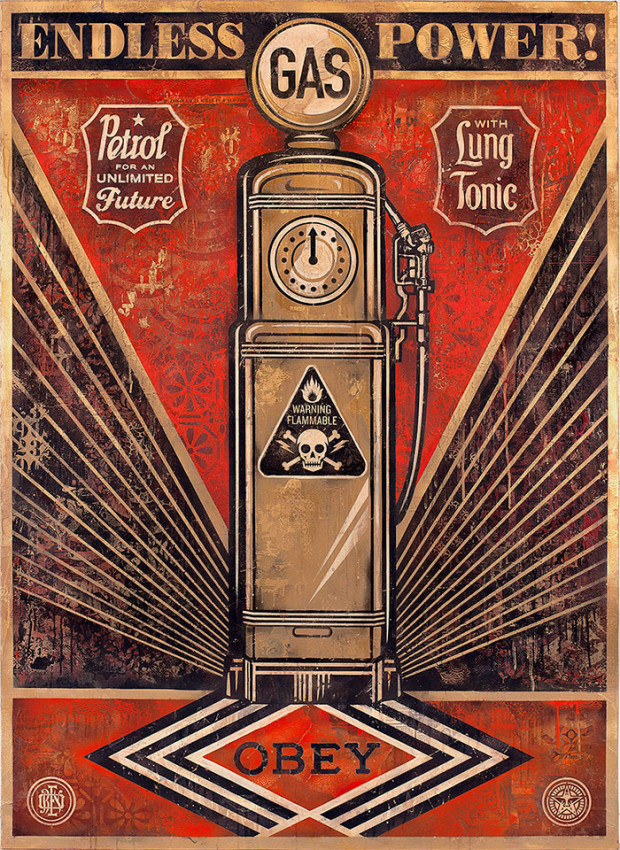
endless-power-canvas_final

Love it or hate it, Shepard Fairey’s bold graphic style with its limited colour-palette and appropriated pop culture imagery, is immediately recognizable and much-imitated.

In this interesting short film by Brett Novak,  the Los Angeles-based artist talks openly about his work, influences, and, yes, the Obama ‘Hope’ poster:


An exhibition of new work by Fairey is currently on display — alongside prints by the artist Jasper Johns — at the Halsey Institute of Contemporary Art in the Fairey’s home town of Charleston, South Carolina.

Comments closed

Gerhard Steidl Interview — The Talks

Steidl_SS_14
The Talks has a nice new interview with German art book publisher Gerhard Steidl:

Most of the publishing houses in the world are owned by shareholder companies and their interest is to make profit. My publishing house is a private business. I founded it in 1968 and it is still owned by me. It is a family business. It is a Manufaktur and we don’t set any limits on cost. A Steidl book is always made in Germany, in Göttingen, in Düstere Straße 4 and there is a guy, Gerhard Steidl, who is hands on. So, believe it or not, I oversee every sheet that tumbles out of our press. This craftsmanship and this know-how we bring to every one of our babies, our books, makes a huge difference compared to the production processes of other companies.

plakat_steidl_lowres

Steidl was, of course, the subject of the 2010 documentary How to Make a Book with Steidl:

Comments closed

Gentlemen of Letters

Well, this is rather lovely… Gentlemen of Letters is a 16 minute documentary about sign painters in Dublin:

The film features the work of Kevin FreeneyColm O’ ConnorMaserJames Earley, and Kevin Freeney Jr.

(via Quipsologies)

Comments closed

Modernity as Catastrophe

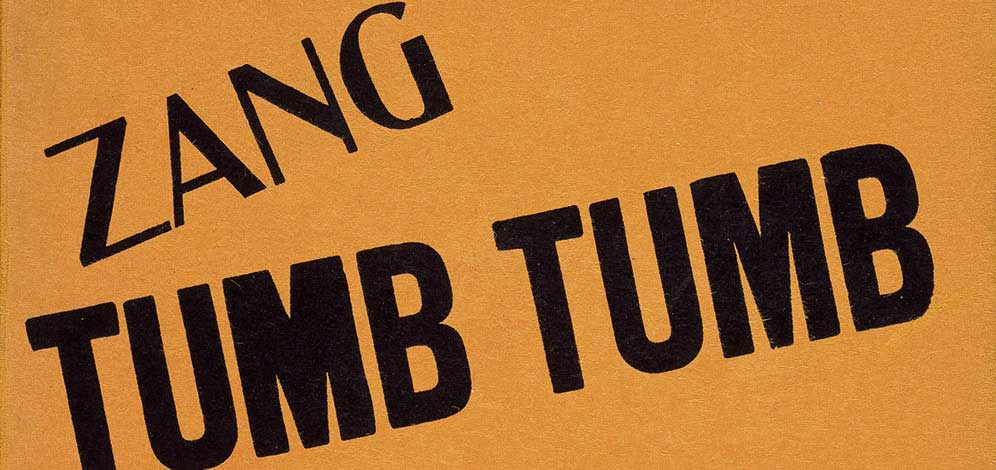
futurism_words_marinetti_zang_tumb_tumb

At the London Review of BooksHal Foster reviews the exhibition of Italian Futurism currently at the Guggenheim in New York:

Futurism wasn’t all bravado; it did have an aesthetic (or anti-aesthetic) of its own, which was to modernise the arts through a mimicry of the effects of new media, such as the adaptation of chronophotography and cinema to painting, photography and sculpture, or the application of the phonograph to musical performance. More ambitiously, the futurists sought to refashion the human sensorium along the lines of these new techniques of perception, and to this end they updated the ideas of synaesthesia, or the fusion of the senses, and kinaesthesia, or the mixing of bodies in motion and at rest. At the same time (and this is just one of many contradictions), the futurists were conservative stylistically; for all their nationalist pride, they relied on French sources, especially the divisionist brushstroke of neo-impressionist painting, which they adapted to themes of the modern city. Thus in Street Light (1909) Giacomo Balla offers the streetlamp as an improvement on the moon: both kinds of illumination are represented as waves of energy, but the artificial light dominates the natural one. So too in The City Rises (1910-11) Boccioni shows us the metropolis as a firestorm of colour greater than any in nature, where construction is difficult to distinguish from destruction; here the futurists thrill to modernity as catastrophe.

Comments closed

Eve Babitz: Muse and Writer

Lili Anolik on the stranger-than-fiction life of Eve Babitz, “an irresistible hybrid of boho intellectual and L.A. party girl”, for Vanity Fair:

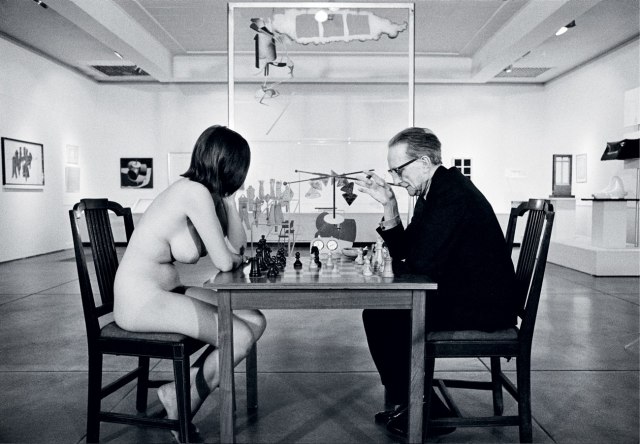
Eve Babitz’s claims to fame rest, in large measure, on her claims on the famous. She’s the goddaughter, of course, of one of the most influential composers of the 20th century. Then there’s that photograph of the chess match with Marcel Duchamp, Eve contemplating her next move without so much as a fig leaf for cover. And what about the series of Adams, better known than the original, some of them, to whom she offered her forbidden fruit? Jim Morrison, Steve Martin, Ed Ruscha, J. D. Souther, Stephen Stills, Glenn Frey, Harrison Ford, Warren Zevon, Ahmet Ertegun all took a bite at one time or another.

If that were her whole story, however, Eve wouldn’t be a whole story. She’d be a footnote. A minor figure of glamour in America’s cultural history. A groupie with a provocative pedigree. She’d be Edie Sedgwick, basically: so relentless a companion to celebrity that she became a bit of one herself, the spotlight just naturally spilling over onto her, making her luminous, too. But she’s not. Eve is Edie cut with Gertrude Stein and a little Louise Brooks thrown in.

Why?… Eve could write.

(pictured above: Eve Babitz, chessboard, and Marcel Duchamp, photograph by Julian Wasser, 1963)

Comments closed

Jasper Johns: Regrets

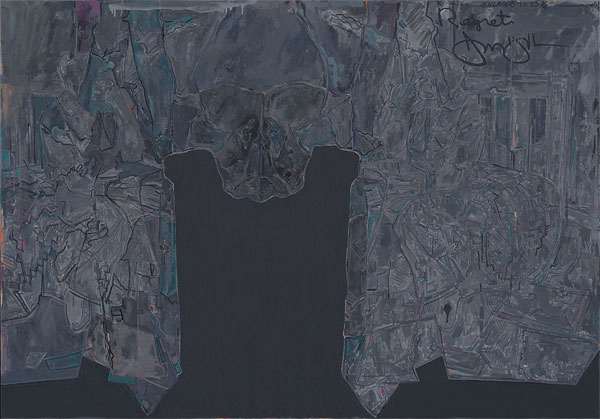
regrets-jasper-johns

At the Financial TimesJulie L. Belcove talks to 83-year-old painter Jasper Johns about ‘Regrets’, a new series of paintings to be exhibited at MOMA next month:

Johns began “Regrets” after he came across an old photograph in a 2012 auction catalogue from Christie’s, London – though he seems little concerned with the image’s context or provenance. “It was a sale of – who’s the other artist? Francis Bacon.” On the block was Bacon’s “Study for Self-Portrait” (1964) and the catalogue had published the source material, a portfolio of photo­graphs found in Bacon’s studio after his death in 1992. Taken by the photographer John Deakin, the pictures were of Bacon’s friend and fellow artist Lucian Freud. Bacon had married Freud’s body with his own face in “Self-Portrait”. “This is the one that struck me,” Johns says, pointing to the image of Freud perched on the quilt-covered bed and hiding his face in his hand, newspapers at his feet. The photograph was paint-splattered and torn, with a large chunk of the lower left side missing ­altogether, and the creases and voids – the photograph as object – were as interesting to Johns as the image itself. “Bacon mistreated the photographs ­physically, is what it looks like,” Johns says. “I just saw that and it caught my eye.”

‘Jasper Johns, Regrets’ opens at the Museum of Modern Art, New York, on March 15, 2014.

Comments closed

Tate Shots: William Eggleston

eggleston-tate

“William Eggleston never takes multiple shots of the same image, just the right picture at just the right moment.”

Curator Simon Baker discusses the work of photographer William Eggleston, currently on display at the Tate Modern in London:

Comments closed

In Thrall to Machines: Italian Futurism, 1909–1944

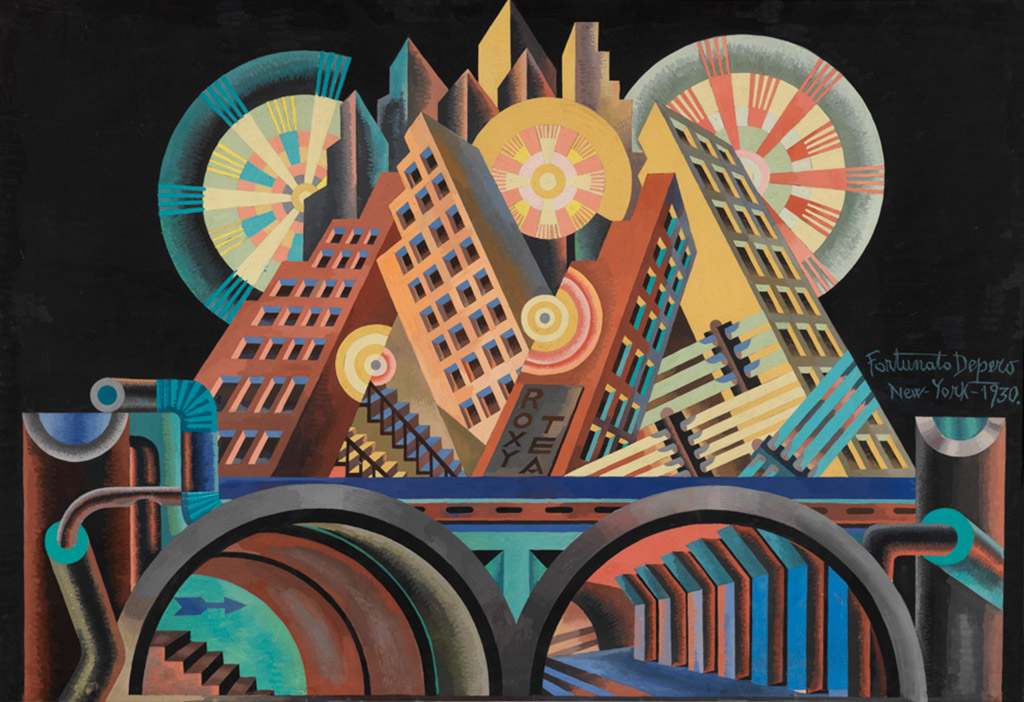
ex_depero_Skyscrapers-and-Tunnels

The New York Times reviews Italian Futurism, 1909–1944: Reconstructing the Universe, a new exhibition at the Guggenheim:

Was any avowedly modern art movement as obnoxious and noisily contradictory as Italian Futurism? By turn aesthetically revolutionary and politically reactionary, farsighted and visually challenged, not to mention officially misogynist, it is both a stain on the Modernist brand and a point of pride. It needs all the help it can get and it receives a large dose from “Italian Futurism, 1909-1944: Reconstructing the Universe,” an epic exhibition at the Guggenheim Museum.

Cool Hunting talks to curator Vivien Greene about the exhibition:

The show has a lot of didactics. Some of the artwork addresses that directly, so it’s easy enough to see their ideas, but we walk people through it as well. They celebrated war as this kind of cleansing medium, and a part of it was because Italy was seen as being so staid and so bourgeois, and after Italian unification in 1860, all those ideals of the Risorgimento really never come to fruition. So this idea of burn down the past and start fresh, be super modern—there were a lot of ideas of regeneration. But they also were very pro war because they wanted to enter World War One to get back the lands that were still under the rule of the Austro-Hungarian empire that were part of the Italian peninsula. So that’s a really practical historical reason that goes beyond you know, Sorelian ideas of the mob and violence—although Georges Sorel does inform them too, but sort of at different levels… [They] also were very aggressive: they start off as a left-wing revolutionary movement and then—how it often happens when you’re at one extreme of something totalitarian—you shift to the other and end up being on the right. They disagreed with the anarchists because the anarchists, although they were running around throwing bombs, had a more pacifist goal in mind.

Italian Futurism, 1909–1944: Reconstructing the Universe opens 21 February 2014 and runs through 1 September 2014.

(pictured above: Fortunato Depero, Skyscrapers and Tunnels (Gratticieli e tunnel), 1930.)

Comments closed

Richard Hamilton, Pop Art and Braun

Also writing at The Guardian, Fiona MacCarthy on British pop artist Richard Hamilton:

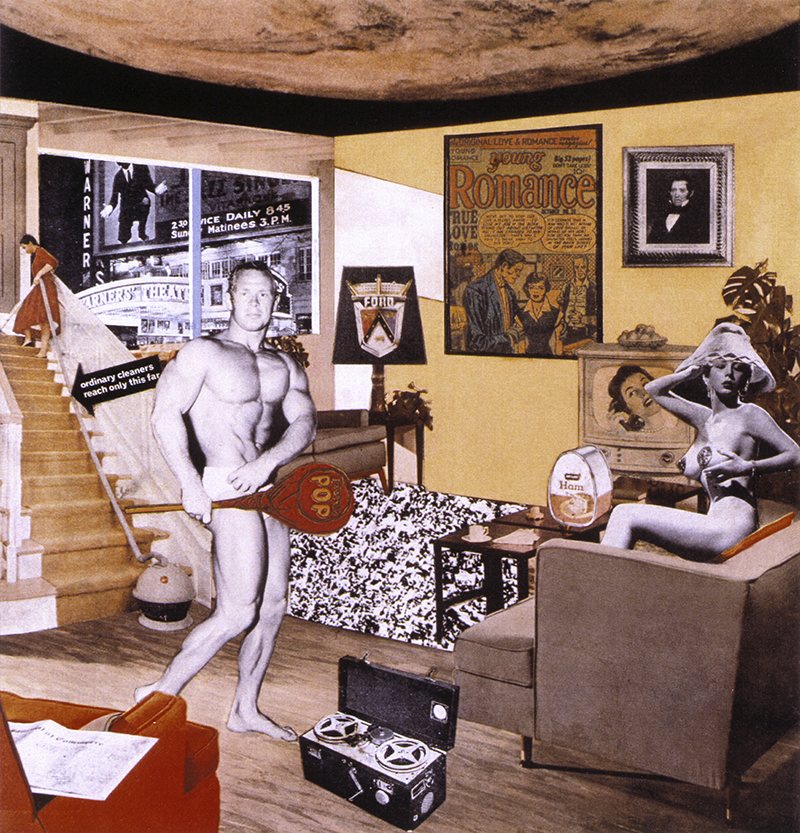
Among the design cognoscenti of the period, Braun products were the creme de la creme, the must-have objects. I remember a time when no trendy living room would seem complete without its Braun stereo player. All image-conscious offices had Braun electric desk fans… The elegance and rigour of Braun products were drawn on by Hamilton in several of his most peculiarly disconcerting works. The Braun catalogues were plundered not only for the pop-up toaster but also the portable combination grill and even the immaculate typography.

His own admiration for Dieter Rams, Braun’s chief designer, verged on the ecstatic. Hamilton said: “I have for many years been uniquely attracted towards his design sensibility; so much so that his consumer products have come to occupy a place in my heart and consciousness that Mont Sainte-Victoire did in Cézanne’s.” All the same – and typically – this attitude of reverence did not prevent him from affixing to the top of his own Braun electric toothbrush the giant set of sugar-pink confectionery teeth his young son had bought him as a present from Brighton. The assemblage was later made into a multiple, The Critic Laughs(1968), complete with its own Braun-style packaging.

A retrospective of Hamilton’s work opens at the Tate Modern in London later this week.

Comments closed

Sounds from a Concrete Island

I’m sure there are some of you who’ve already heard of UK sound artist Janek Schaefer. He has, after all, been recording and creating sound installations for past 20 years, and he even won the British Composer of the Year award in Sonic Art a few years ago. But, personally, I hadn’t heard of Schaefer until I heard a track from his new album on Tom Ravenscroft’s BBC 6Music radio show this evening.

Lay-by Lullaby, released this week on the 12K music label, uses “location recordings made in the middle of the night above the M3 motorway, right at the end of the road where JG Ballard lived, a couple of miles from Schaefer’s studio on the far west edge of London.”

Now, admittedly, the M3 has a special place in my psyche — I drove up and down it rather a lot in my late teens, often late at night — but more significantly Ballard also wrote his “seminal works on car culture” — Crash (1973) and Concrete Island (1974) — as the motorway was being built past the front of his house.

Schaefer’s 73 minute album was created last year as an installation for his show ’Collecting Connections’ at the Agency gallery in London. Apparently the sounds were played on infinite loop through a car radio installed in a little leather travel case and amplified by a pair of reclining traffic cones.

In other Ballard news, director Ben Wheatley announced earlier this week that he would start shooting his adaptation of High-Rise in June with Tom Hiddleston in the lead role.
High-Rise
The teaser poster for the film was created by artist Jay Shaw. You can read more about Shaw’s work, including his poster for Wheatley’s current film, A Field in England, which opened in New York this week, in Adrian Curry’s column for MUBI this week.
Comments closed

Rachel Kushner on Images

Author Rachel Kushner discusses her novel The Flamethrowers (now out in paperback), and the importance of images to her work, with The Quietus:

I’m inspired by visual art and film… Whether or not I’m writing about those mediums directly, as I sometimes do in Flamethrowers, I’m always thinking about images… I always wanted to have images in a book, and with [The Flamethrowers], after I got to have my choice of the image on the North American cover, I got a little bold, and asked about putting images inside. My editor said yes, so I quickly put together a short list of ideal visual passages. I didn’t want anything that would illustrate the narrative. I wanted, instead, images as kind of pauses, or counterpoints, but that would complicate, function in a relation, but not an obvious one. There’s a Richard Prince image, and he’s a shadow presence over the course of the book (one of the characters is also the name of Prince’s alter-ego, John Dogg). There’s a photograph by Aldo Bonasia, of a riot and police tear-gassing the rioters, in Italy. There’s a still from the movie Wanda, which figures in the book…

Funnily enough, I have feeling that Scribner have actually stuck closer to the hardcover for the front of the US paperback edition and slapped needless award stickers all over it, but I prefer the restraint of the version above left. The cover on the right is the UK paperback — a vast improvement on that mystifying hardcover).

Comments closed

Triumph of the English Major

Book editor Gerald Howard had lovely op-ed in this weekend’s New York Times called ‘Triumph of the English Major’:

Almost any cultural transaction involving a sum of money represents, as Samuel Johnson famously said of second marriages, the triumph of hope over experience. We live in a time when college enrollment in the humanities is declining precipitously, in good part because majoring in such subjects seems unlikely to result in gainful employment in a strapped economy and thus would be a waste of hard-earned (or usuriously borrowed) tuition dollars.

Somehow our culture has persuaded itself that the naked quest for financial gain, often through the devising and trading, on monstrous amounts of (very low interest) borrowed money, of what Warren Buffett has called instruments of mass destruction, is a more urgent and honorable calling than the passionate pursuit of truth and beauty.

I’ve tried to suggest that at least a portion of that pursuit can have gratifying economic results. (Plus it will not plunge us into an endless recession!) But that’s not really the point. The point is truth and beauty, without which our lives will lack grace and meaning and our civilization will be spiritually hollowed out and the historical bottom line will be that future epochs will remember us as a coarse and philistine people who squandered our bottomlessly rich cultural inheritance for short-term and meaningless financial advantage.

Read it. It’s a wonderful thing (and I’m not even an English Major).

Comments closed