Skip to content

Category: Miscellany

Something for the Weekend

Sorry (again) for the late (and lack of) posting recently. This week, the BookNet Tech Forum in Toronto kept me out of the office and away from the blog. If you’re interested in the conference, the ACP‘s Sarah Labrie has a great round up of the main day here.

But on to the links…

Alexander S. Budnitz’s INCREDIBLE ASB Cover Archive. This site should definitely be added to this list (via Karen Horton’s ace Daily Design Discoveries).

Thick and Thin — Umair Haque on social media at The Harvard Business Review:

The social isn’t about beauty contests and popularity contests. They’re a distortion, a caricature of the real thing. It’s about trust, connection, and community. That’s what there’s too little of in today’s mediascape, despite all the hoopla surrounding social tools. The promise of the Internet wasn’t merely to inflate relationships, without adding depth, resonance, and meaning. It was to fundamentally rewire people, communities, civil society, business, and the state — through thicker, stronger, more meaningful relationships.

I don’t entirely agree with everything in this post (and I wonder how much of it has to do with Haque’s recent Twitter mauling as SXSW?) but it’s a timely reminder that quality is more important than quantity.

Fine Hypertext Products — A podcast interview at The Pipeline with Jason Kottke founder of one of the most consistently interesting blogs out there (and a big influence on this one) kottke.org. There is also an interesting earlier interview with Jim Coudal president of design studio Coudal Partners.

Straight-Talking — The Book Oven’s Hugh MacGuire interviews Don Linn, former CEO of Consortium Book Sales & Distribution and publisher at The Taunton Press:

Too many titles now are bought (often at way too high a price), produced sloppily and just tossed into the market without adequate support. This benefits no one. Second, I’d like to see all publishers implement workflows (using XML or other flexible tools) and production processes that make their content more agile… Finally, I’d just encourage more intelligent experimentation and attempts at innovation. I sense paralysis on the part of a large number of publishers based on a (not irrational) fear of making the wrong bet during this chaotic time.

(NB: It’s also interesting to read why Don felt digital publishing venture Quartet failed, although I kind of think some of that stuff should have been obvious to them before they started).

And finally…

The Rise of the “Paper-Bounds” — Leif Peng excerpts a 1953 Fortune magazine article on mass-market paper-bounds at the always brilliant Today’s Inspiration. There’s more here, here, and here

Comments closed

Midweek Miscellany

How To Live Safely in a Science Fictional Universe

A new cover from John Gall, seen at Peter Mendelsund’s JACKET MECHANICAL. Am I the only one who wants to hear these two in conversation? Dear NPR, could you get on that please?

Soft in the Middle — James Surowiecki looks at how midrange companies are being pressured by both high-end products at one end and ‘just good enough’ products at the other in the New Yorker (via Kottke):

The products made by midrange companies are neither exceptional enough to justify premium prices nor cheap enough to win over value-conscious consumers. Furthermore, the squeeze is getting tighter every day… This doesn’t mean that companies are going to abandon the idea of being all things to all people. If you’re already in the middle of the market, it’s hard to shift focus—as G.M. has discovered. And the allure of a big market share is often hard to resist, even if it doesn’t translate into profits.

I think we going to see this more in publishing with the midlist losing out to quick, cheap and ‘just good enough’ e-books and expensive, beautifully packaged hardcovers.

Somewhere Between Skeptic and Proselytizer — John Williams founder of The Second Pass interviewed at The Virginia Quarterly Review blog:

I think the way books are written about has been opened up in healthy ways. I like that there are more amateur (and semi-pro and pro) voices on the Internet, in the sense that it’s not just the unimaginative circle wherein writers of a certain kind of book review another example of that kind of book written by someone else. I’m not the first (or even the hundredth) to think that can lead to a lot of back-scratching or dry summation rather than forcefully argued opinion. It’s also true that the Internet has been great for, say, literature in translation, where entire sites (like Three Percent) can be devoted to a subject that gets less attention than it should in mainstream outlets. But as for how literary careers are made, I don’t think that’s changed as much as the tech apostles would like to believe.

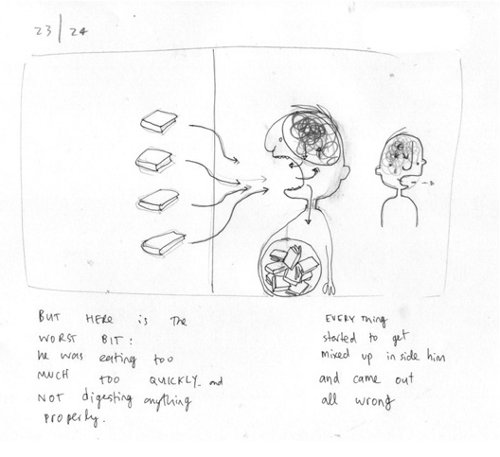
The Incredible Book-Making Boy — Super talented author and illustrator Oliver Jeffers, whose new book The Heart and the Bottle was published earlier this month, interviewed at Seven Impossible Things Before Breakfast:

I begin with a single idea… and then tease that out in my sketchbook with hundreds of other drawings and pieces of writing that explore how the narrative can grow and extend into something that is satisfying. Once I’ve got a basic plot, I work with my editor in streamlining everything down to fit the thirty-two-page format…  Getting the story to flow between those thirty-two pages is probably the most difficult part. It’s like directing a film, where the pace needs to be set and decisions made of what goes where. It’s at this point that many of the compositions get cut. There is a careful balance between what the pictures are showing and what the words are saying, and if something is shown, it often doesn’t need to be said.

And finally…

Contemporaries, He Yanming

Chinese Book Covers seen at the excellent Ephemera Assemblyman.

5 Comments

Something for the Weekend

An illustration by Pascal Blanchet, author of the charming White Rapids*, for the National Post’s Spring Books Quarterly.

Text Without Context An interesting article on reading and the web by Michiko Kakutani in the New York Times, which discusses books by David Shields, Jaron Lanier, Cass Sunstein, Farhad Manjoo and others (and yes, I appreciate the irony of me of linking an article about the fragmentary nature of reading online and only quoting one paragraph):

THESE NEW BOOKS share a concern with how digital media are reshaping our political and social landscape, molding art and entertainment, even affecting the methodology of scholarship and research. They examine the consequences of the fragmentation of data that the Web produces, as news articles, novels and record albums are broken down into bits and bytes; the growing emphasis on immediacy and real-time responses; the rising tide of data and information that permeates our lives; and the emphasis that blogging and partisan political Web sites place on subjectivity.

The Bkkeepr — Book Oven’s Hugh McGuire interviews James Bridle of BookTwo and Bookkake:

We can berate publishers for making what we think are bad decisions about digital, but to accuse them of cluelessness just inflates a very dangerous animosity. Publishers love books as much, if not more, than most readers. It’s one of the very few industries where this is true almost all the way up. And we should be working together for the best of all possible futures for books and authors and readers.

(And you can read Hugh’s response to the Michiko Kakutani article — which he takes issue with — here)

Route One — Sarah Weinman at Daily Finance looks at indie publishers experimenting subscription models that reach readers directly.

And finally…

Designer Matt Avery talks about his beautiful design for Chicago by Dominic Pacyga (University of Chicago Press) at Faceout Books.

* White Rapids is published by D+Q and distributed in Canada by my employer, Raincoast Books.

Comments closed

Midweek Miscellany


Flaunt it — Designer Armin Vit discusses the UnderConsideration book Flaunt: Designing Effective, Compelling and Memorable Portfolios of Creative Work at For Print Only.

How Art Became the Media — Lewis Lapham, editor of Lapham’s Quarterly (formerly editor of Harper’s Magazine), at Guernica magazine (via Bookslut on Twitter):

It isn’t that the country now lacks for painters painting pictures or poets writing poems, nor is it to say that stores of human energy and hope aren’t to be found in the novels of Elmore Leonard or the songs of Bruce Springsteen. It is to say that with the dawn of Reagan’s bright new morning in America, the notion of art as the way into a redemptive future had withered on the vine. Once again, as had been customary throughout most of the country’s history, art was seen as an embodiment of the good, the true, and the beautiful only to the extent that it could be exchanged for money.

George Lois on the iPad in the New York Observer (no, I’m not entirely sure how I missed this last week either):

“magazines will never die because there is a visceral feeling of having that thing in your hands and turning the pages. It’s so different on the screen. It’s the difference between looking at a woman and having sex with her.”

Flying the Coop — Another interesting installment of the National Post‘s ‘Ecology of Books’ series, this time on authors moving from small presses to big publishing. And there’s an interesting follow up from Daniel Wells, the publisher of Biblioasis one of the aforementioned Canadian small/independent presses (via Steven Beattie).

Microdistribution — This is fascinating… The Boulder Bookstore (Colorado) is experimenting with charging self-published authors for shelf-space and promotion (via Sarah Weinman on Twitter):

“Most people will come in at one of the higher fee amounts,” Arsen Kashkashian, the store’s head buyer and the architect of the program, told me. “That surprised us.” In fact, when the store first began charging its consignment authors back in 2007 (the fee-structure idea emerged when the store’s employees found themselves “inundated with self-published books, and there was a lot of work involved and not much reward”), its staff “thought people would grumble and complain” about the charges. But authors, Kashkashian says, have been generally grateful for the opportunity to sell and promote work that might otherwise be seen and appreciated only by their friends/spouses/moms: “‘I want the marketing, I want the exposure. I worked so hard on this project, and you guys are the only ones who could help me with it.’”

And finally…

Four Ways to Combines Fonts by H&FJ, built around a beautifully simple principle: “keep one thing consistent, and let one thing vary.”

2 Comments

Personal Projects

I’ve been thinking a lot about personal projects recently and so I found this presentation for 99% by Ji Lee, Creative Director for Google Creative Lab, really inspiring:

(via The Donut Project/SwissMiss)

1 Comment

Something for the Weekend

Big Shit-Eating Grin — George Lois chooses 12 of his favourite Esquire covers at New York magazine. There are more iconic Esquire covers at George Lois’ website and there is, of course, a new book, George Lois: The Esquire Covers @ MOMA, published by Assouline. (NB the image above is not one of Lois’ 12, but it is great).

Objects of Desire — An interesting University College London podcast about the history of books and publishing featuring Professor Henry Woudhuysen, co-editor of the The Oxford Companion to the Book, and Professor Iain Stevenson,  author of Book Makers: British Publishing in the Twentieth Century (available in the US from University of Chicago Press) (via Ernesto Priego on Twitter).

The Dark SideThe Economist on Scandinavian crime fiction:

The cold, dark climate, where doors are bolted and curtains drawn, provides a perfect setting for crime writing. The nights are long, the liquor hard, the people… “brought up to hide their feelings” and hold on to their secrets.

Somebody’s Sins, But Not Mine — A two part interview with Patti Smith about her new memoir Just Kids at KCRW’s Bookworm. Part two is here.

1 Comment

Midweek Miscellany

A true miscellany here: letterpress to Gil Scott-Heron with a lot of meat sandwiched in between… This is quite possibly why I blog…

Ditoria — An amazing video about showing the letterpress printing process by Roberto Bolado.

The Cost of Creating — Harvard Law Professor Lawrence Lessig, author of Free Culture (and others), discussing the Google Book Settlement on NPR’s On The Media last month (via INDEX//mb):

[W]e need to once again think about what the balance should be between free access to culture and metered access to culture, because both extremes are mistakes, either the extreme that says everything is free because then lots of people won’t create because they can’t cover their cost of creating, or the regime that says everything needs to be licensed, because in that world there’s a whole range of creativity… that can’t begin to happen because the cost of negotiating and clearing those rights is just so extreme.

Stopping Saying “Innovation”Scott Berkun, author of The Myths of Innovation, in The Economist (via Frank Chimero):

Worry more about being good because you probably aren’t. If your organization struggles to make half-decent products, has the morale of a prison, and nothing ever changes much less improves, why are you obsessing about innovation? You need to learn the basics of how to make something good, that solves real problems, works reliably, is affordable, and is built by a happy, passionate well rewarded staff that believes good ideas have a chance. If you can make the changes necessary for these basic but all too rare attributes to be true, then innovation, in all its forms, will be much easier to achieve, and it might just happen all on its own.

New Type York — A (beautifully designed) photoblog by graphic designer James Patrick Gibson recording the typographic artifacts of New York City.

And thinking of New York… The NY Times is planning to spin off its Book Review as a separate e-reader product.

The Vulture Gil Scott-Heron

A Wry Return — Sean O’Hagan profiles musician Gil Scott-Heron in The Observer, revealing an somewhat unexpected connection to Jamie Byng, director of Canongate Books. I say “somewhat” unexpected because having lived in Edinburgh just before Byng wrapped up his funk and soul club Chocolate City, it seems entirely reasonable to me now I stop and think about it:

The story of how Gil Scott-Heron’s new album came to be made is a long and convoluted one. It is, among other things, a testament to the abiding power of great music outside the mainstream to spread like a virus across cultures, across decades. It begins back in 1987 in a rented house in Edinburgh when a young student is mesmerised by his friend’s collection of soul and funk music from the halcyon days of the early 70s… “I was just taken aback by the voice, the words, the poetry,” remembers Jamie Byng who, 22 years on, is the director of Canongate Books and still a fervent soul fan… “Discovering those songs was an epiphanic moment for me…” So taken was Byng by those songs that, having bought and rebranded Canongate, he tracked down his hero and, in 1996, republished his two long-out-of-print novels, The Vulture and The Nigger Factory.

And here’s Gil Scott-Heron’s painfully appropriate cover version of Robert Johnson’s Me and the Devil:

Gil Scott-Heron’s books The Vulture and The Nigger Factory were recently reissued by Canongate.

3 Comments

Something for the Weekend

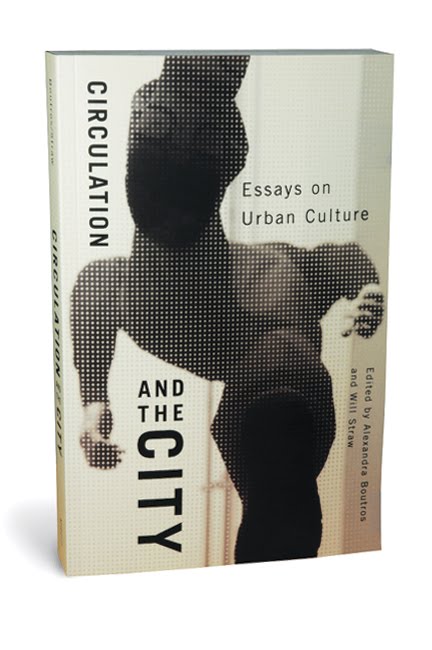
Circulation and the City design by David Drummond

New from David Drummond

The Original Spirit — Toronto indie institution This Ain’t The Rosedale Library (one of the 10 best bookshops in the world according to The Guardian) featured at Books@Torontoist, with some nice quotes from owner Charlie Huisken:

“creative knowledge [is] accumulative and comes from many sources… Being an autodidact has served me well”

Books in the Age of the iPad — Craig Mod’s article on printed books and digital publishing caused much of a flutter on Twitter yesterday. I’m not sure that I entirely agree with his thesis — which seems to imply that some kinds of content can be completely divorced from their media — but his website is beautifully designed, and more importantly he makes some interesting points. I especially like his conclusion:

I propose the following to be considered whenever we think of printing a book:

  • The Books We Make embrace their physicality — working in concert with the content to illuminate the narrative.
  • The Books We Make are confident in form and usage of material.
  • The Books We Make exploit the advantages of print.
  • The Books We Make are built to last

In that vein, more on David Pearson‘s beautiful book cover designs for Cormac McCarthy at We Made This. I love that he used rubber stamps…

And finally… Jaron Lanier, author of You Are Not A Gadget, talks about the failure of Web2.0 with Aleks Krotoski of The Guardian:

3 Comments

Midweek Miscellany

The “Consummate Amateur” — Graphic designer, collector and archivist JP Williams (who blogs at the wonderful amassblog) profiled at Sight Unseen.

Overcoming Creative Block — 25 Artists, designers, and creators share their strategies at ISO50. I rather like Erik Spiekermann’s pithy list:

  1. Avoid
  2. Think
  3. Research
  4. Collect
  5. Sketch
  6. Deconstruct

    Schriftguss AG — A lovely Flickr set of  type specimens  (via The Ministry of Type).

    And Finally…

    American Psycho in six panels by Claire Murray seen at The Creative Review. Genius.

    Comments closed

    Monday Miscellany

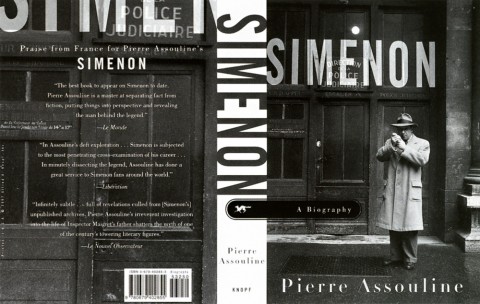
    Simenon designed by Archie Ferguson

    Pub Psychology — Archie Ferguson, formerly of Knopf and now art director at HarperCollins, interviewed at the CoveredUp blog:

    Publishing has always seemed a lot more glamorous than it is. And if it ever was glamorous, those days are long, long gone. These days I spend a lot of time answering emails – not phone calls – from far and wide, running up and down the stairs… doing damage-control, and feeling more like I’m a psychologist as much as anything else.

    Virtual CityJonathan Lethem, author of Chronic City, interviewed in The New Statesman:

    Manhattan, the great secular-commercial metropolis, the world’s first and greatest city founded on concepts other than religious or national identity – and therefore a kind of science-fiction city, a conceptual project, a place unnaturally subject to the distorting forces of capital, ideology, projection, wish-fulfilment and so on – has become…a place both persistently real and unreal. Or, an unreal place where real people are living out their existence… What’s gone wrong and right in this place has a special amount to tell us.

    The difference between Time Roman and Times New Roman — Because I know you’re curious.

    The Form of a Book — Another lovely, insightful post from A Working Library:

    On the page, the rhythm of the text emerges from both the macro design—the pleasing shape of the page, the proper amount of thumb space—and the micro—the right amount of leading, the evenness of the word spacing, the correct break of a line. On the screen, the rhythm of a text encompasses all of these things and more—the placement of a link, the shift from text to video and back again, the movement from one text to another. The rhythm becomes more complex as the orchestra gets larger, but the desire for rhythm does not subside.

    In order to create this rhythm, the book must be designed and composed for the screen. A beautiful digital text can no more be arrived at by “converting” from a print design than a beautiful print book can be created by converting a Word file. The digital book will never come into its own so long as it is treated as a byproduct, unworthy of attention.

    2 Comments

    Midweek Miscellany

    Vintage Dostoevsky, design by Michael Salu

    Precisely and Concisely — The Caustic Cover Critic interviews designer and Artistic Director of Granta magazine Michael Salu:

    Bizarrely, designers looking for employment are often judged by what software they’re able to use. Intellect, cultural awareness and often creativity don’t seem to be values worthy of a resume. There is no substitute for good ideas, the rest are just supportive tools. I have always been quite a craft-led designer, but I am of the generation that studied with a mac in front of them and I think its good to understand the importance of both.

    The Honest Bookseller — Erin Balser of Books in 140 profiles Toronto independent bookstore Ben McNally Books for The Torontoist:

    “I’d rather have a book that sells one copy that no one else will sell than to stock several best sellers you can get anywhere,” McNally says. “That’s what makes this store. That’s why people come… My first responsibility is my customer. When I think a book should be cut by a third or if there’s a subplot that goes nowhere, I have to tell you that… I’m often a very critical reader. When people come and ask me ‘Is this any good?’ I have to be honest.”

    William Kentridge: Five Themes — Beautiful book design from Abbott Miller and Kristen Spilman at Pentagram.

    Speaking of Pentagram… Pentagram partner Paula Scher has some blunt stuff to say about design in a interview with Pr*tty Sh*tty.

    The Rules — Inspired by Elmore Leonard’s 10 Rules of Writing, The Guardian asked authors — including Diana Athill, Margaret Atwood, Richard Ford, Jonathan Franzen, Neil Gaiman, and PD James, Hilary Mantel, Michael Moorcock, Philip Pullman, Ian Rankin, Will Self, Sarah Waters, and Jeannette Winterson — for their personal dos and don’ts. (Part two is here).

    On the subject of writing, the wonderful BBC radio series The History of the World in a 100 Objects has recently touched on the history of writing, literature, and mathematics in episodes about the Early Writing Tablet, the Flood Tablet and the Rhind Mathematical Papyrus. The series is a collaboration with The British Museum. Great stuff.

    Diana Athill, Margaret Atwood, Roddy Doyle, Helen Dunmore, Geoff Dyer, Anne Enright, Richard Ford, Jonathan Franzen, Esther Freud, Neil Gaiman, David Hare, PD James, AL Kennedy
    1 Comment