Following up from last week’s Midweek Miscellany post, here is glass gilder John Downer talking about creating that amazing lettering for Reserve‘s window in Los Angeles:
Reserve Glass Gilding by John Downer from Reserve LA on Vimeo.
2 CommentsBooks, Design and Culture
Following up from last week’s Midweek Miscellany post, here is glass gilder John Downer talking about creating that amazing lettering for Reserve‘s window in Los Angeles:
Reserve Glass Gilding by John Downer from Reserve LA on Vimeo.
2 Comments EndGrain — A “directory and aggregator for wood type and letterpress works and information on the web.” Lovely.
Crash — Iain Sinclair (author, most recently, of Hackney, That Rose-Red Empire — just out in paperback by the way) on JG Ballard’s artistic legacy:
A late moralist, he practised undeceived reportage, not prophecy: closer to Orwell than HG Wells. Closer to Orson Welles than to either. Closer to Hitchcock. Take out the moving figures on staircases that go nowhere and stick with hollow architecture that co-authors subversive drama
Picture Book Report — 15 artists create illustrations inspired by their favourite books. Pictured below: Kali Ciesemier‘s take on Sabriel by Garth Nix. I’m also looking forward to Robot Johnny‘s take on The Hitchhiker’s Guide to the Galaxy (via The Art Department).

Indigo 2.0 — Canadian Business magazine on Indigo and their digital book division Kobo:
“Kobo has been across the smartphone space from the beginning,” says Lisa Charters, senior vice-president and director of digital for Random House Canada. “And that unique offering is really important to us as publishers, because we want consumers to have all options to read e-books, and not necessarily have to purchase a $300 device.”
What’s more, says New York publishing consultant Mike Shatzkin, “they beat Google into the cloud.” Kobo’s library system is based in cloud computing. When you buy a Kobo book, it resides on Kobo’s servers and you access it via your device of choice. So when you squeeze in 20 pages of The Lost Symbol on your laptop in the morning, and later that day open the Kobo application on your BlackBerry, Kobo automatically plops you down on page 21.
Interesting stuff, although I do wish journalists could stay away from the Gutenberg clichés (and Dan Brown. Barf).
And finally…
Reserve Window Design — “We hired our good friend John Downer, who is a professional sign painter & typographer, to fly to LA to do gold leaf lettering on our store window & transom. Glass gilding is becoming a lost art that only a few dozen people in the United States still know how perform” (via We Love Typography):


[A quick note about the poll: thanks to everyone who voted, left a comment or sent me note this week — I really appreciate it. The feedback has been great. I’m going to shut the poll down at midnight tonight, but please let me know if you have any further thoughts about the direction of The Casual Optimist.]


Lauren Kaiser’s Little Red Riding Hood seen at Type Theory (pictured above).
 The Oscars of Type — Ellen Lupton’s list of the year’s top typefaces at Print magazine. “Best Actress” was awarded to Underware’s Liza Pro (pictured above). My interview with Ellen Lupton is here.
Happiness as By-product — Jessa Crispin founder of Bookslut interviewed by Jeff VanderMeer, author of Booklife (which Crispin was critical of interestingly):
I was having a conversation with a writer the other day, and he stated that the best things are always by-products. Happiness is a by-product, and I loved that he said that. You can plot your journey to success or happiness or wealth or whatever it is you’re looking for, but if you’re too focused on the end result, you’re going to miss anything good going on around you… Not that we should all sing songs around the campfire and braid each other’s hair, but there has to be a combination of the two, forward motion and goal planning, but while taking a look at the people around you.
Comics Studies Reader — Jeet Heer on comics and comic scholarship at Books@Torontoist:
I think there’s a wide variety of things that can be done with comics, and I think we’ve only scratched the surface… One of the interesting things about manga is that kids are reading translated manga that reads right to left. Part of the reason that’s possible is because comics are both words and pictures – half of the translation work is already done. So you can look at a comic book in a language you don’t know and you won’t get everything but you can still get a fair bit of what it’s about. And so they have this sort of function as cultural ambassadors. You can actually learn a lot about a culture just by looking at the comics.
The New Yorker 85th anniversary covers by Chris Ware, Adrian Tomine, Dan Clowes, and Ivan Brunetti seen at the Creative Review blog (Adaptation by Tomine pictured below).

Art Spiegelman and Francoise Mouly (art editor at the aforementioned New Yorker) discuss The Toon Treasury of Classic Children’s Comics with (a particularly gushy) Michael Silverblatt for KCRW’s BookWorm :
Comments closedBook wonks are still abuzz about the whole Amazon vs. Macmillan thing (see here previously) — who won, who didn’t, WTF?, and Rupert Murdoch’s shit-stirring — but I’m reliably informed by someone whose job is looking cool at the photocopier* that it is a really boring topic of conversation, so I’m going to move on…

The AIGA Design Archives — including the wonderful 50 Books/50 Covers — has been redesigned by Second Story, mercifully moving it away from its previous Flash interface so we can all link to it properly when we talk about it (pictured above: Brooklyn Modern designed by Projects Projects)
Elements of an Incendiary Blog Post — Painfully on the money (via Kottke):
This sentence contains the thesis of the blog post, a trite and obvious statement cast as a dazzling and controversial insight.
This sentence claims that there are many people who do not agree with the thesis of the blog post as expressed in the previous sentence. This sentence speculates as to the mental and ethical character of the people mentioned in the previous sentence. This sentence contains a link to the most egregiously ill-argued, intemperate, hateful and ridiculous example of such people the author could find.
Coverspy — “publishing nerds hit the subways, streets, parks & bars to find out what New Yorkers are reading…” A cover-oriented variation on Toronto’s Seen Reading (via SwissMiss).

Context and Connections — A great interview with illustrator, graphic designer and writer Frank Chimero:
There’s value to… knowing what your peers are working on, but it’s not a day-to-day concern. You’d probably get further checking a food blog every day, because it triangulates your interests and you’ll naturally come towards it wanting to make connections to what you’re doing and what you already know. Sure, you want your knowledge of the field to be deep, but it’s optimal to have your interests wide and varied. It’s makes your consumption more nourishing too, because all of a sudden you get context!
And finally…
Agent of Chaos — Bonkers and awesome, Werner Herzog (not really) reads Curious George:
(No really, it’s not Werner Herzog).
* Nic: I love you man.
3 Comments
A Wall in Palestine — more quiet mastery from Henry Sene Yee who excels in projects that require maximum discretion and minimal commentary. Like his cover design for Columbine, A Wall in Palestine is notable for what it leaves out. An early contender for cover the year. You heard it here first.
Making the World Fun to Look At — The Cleveland Plain Dealer has (what is believed to be) the first interview with Bill Watterson, creator of Calvin and Hobbes, since 1989:
I think some of the reason “Calvin and Hobbes” still finds an audience today is because I chose not to run the wheels off it.
I’ve never regretted stopping when I did.
Amen.
Seven Things Publishers Need to Remember — A nice post by Kobo Books exec (and compulsive list maker) Michael Tamblyn on e-books and pricing:
A reader should never have to worry about “leaving books behind” or “losing their library”. If you can’t download it and move it somewhere else, it’s worth less. Seriously. They’re books, not Atari 2600 video game cartridges.
(But I’m waiting for the “7 Things E-tailers Need to Remember” post Michael. When’s that coming? You can post here if you want)
The Lost 1970 Man Booker Prize — Commemorating novels missed out because of rule changes in 1971. Bonkers. But kind of great.

Problem Solver — Ian Shimkoviak of The Book Designers interviews the legendary Carin Goldberg for their new blog CoveredUp:
I’m not a sentimentalist. The e-book is inevitable. And they make sense. The publishing industry can’t sustain the old/current model for making/selling books. It’s wasteful and unsustainable. They have to embrace change. Good content will continue to be created whether it’s represented on paper or on a screen. And there will always be a market, albeit small, for beautiful picture books. The role of the graphic designer is shrinking but it’s in our court to get involved in the next wave of imagery and ideas.
And finally…
Jonathan Lethem, author of Chronic City (which I liked, but wanted to like more), interviewed on KCRW’s Bookworm (via the incroyable Largehearted Boy):
2 Comments
 The Backwards Novel Seen Backwards by Tom Gauld.
I also love Tom’s Lost Fairy Tales for a promotional concertina booklet made by his agent Heart (surely there’s a full length book to be had here?).
Ways of Reading from A Working Library:
Every book alights a path to other books. Follow these paths as far as you can.
Lovely.
Back to Basics — Booktwo.org‘s James Bridle on the Apple tablet (what else?):
I’ve spent several years urging publishers to get on board with new technologies and try new things, but equally I hope there’s space for a lot of publishers to get back to concentrating on what they do best: acquiring, editing, producing and publishing books… [W]e should probably stop scrambling to get on the latest bandwagon (vanilla Books-as-Apps, I’m looking at you), and concentrate on the basics: ebook production, metadata, integrated marketing, quality and consideration. There is a lot to be done, but this or that device will never be the be-all-and-end-all of the future of publishing.
I think James has a point. But honestly, no one I know (and that is an admittedly limited sample) believes “this-or-that device” will magically “save” publishing. Surely it is only bloggers in need of straw men and ‘journalists’ paid to hyperventilate who say that kind of shit?
Moving (swiftly) on…

Modern Myths — Will Self on H. G. Well’s The War of the Worlds in The Times:
The War of the Worlds is one of those books that demonstrates our culture’s surprising ability to continue the manufacture of myth. I say surprising, because one would think, with all the technological reproducibility of art now at our disposal — from raw print, to film, to digitisation — that there would be no room left for that hazy instability within which myth thrives.
(Pictured above: The NYRB edition of The War of the Worlds with illustrations by Edward Gorey)
And finally, completely unrelated to books…

Dear Coffee I Love You… Yes, yes, I do. (Pictured above: What I’d Rather Be Doing)
2 CommentsSlim pickings in a week in which book nerds obsessed about the implications of the rumoured Apple tablet (and PS – if anyone else describes it as the fucking ‘unicorn’ it’s clobberin’ time…), while in a completely unrelated move (snarf!), Amazon announced it was going to allow iPhone style apps to be uploaded and sold on the Kindle (begging the question when does the Kindle become the Pontiac Aztek?) and — faster than you can say bait and switch — they offered self-published authors improved royalties.
But, anyway, here’s more fun stuff for your weekend pleasure…

What To Leave Out? — I Love Typography‘s favourite fonts of 2009, including the lovely Phaeton and Biographer (pictured above), as well as Jos ‘exljbris’ Buivenga’s Calluna.
The big graphic novels of 2010 according to Publishers Weekly.
And finally… I’ve been meaning to link to this for ages, at least in part so I could post Erik Mohr‘s cover for Monstrous Affections by David Nickle…

Horror Stories — Waaaaay back in November The National Post chatted with the publishers and authors from dark fiction specialists ChiZine Publications :
Comments closed[W]e wanted to produce beautiful, well-written books. Books you wanted to pick up — and when you did, you wouldn’t be disappointed by what was inside. Essentially, books we ourselves wanted to read…
Genre fiction is notorious for having cheesy, sloppily executed covers with no sense of design or what is attractive to potential book buyers. We’ve been incredibly lucky that Erik has made our books look so good. And by “good” I sometimes mean “disturbing.”
Maybe what we’ve managed to do with CZP is to find a niche that wasn’t being filled…or maybe we created our own niche.
 Catcher in the Rye — Illustration and hand-lettering by Toronto-based Darren Booth (self-directed project). Darren has done a rather fine Lord of the Flies cover as well.
The Catastrophist — Chris Hitchens on J.G. Ballard in The Atlantic:
For most of his life, our great specialist in catastrophe made his home in the almost laughably tranquil London suburb of Shepperton, the sheltered home of the British movie studios. He obviously relished the idea of waking one day to find himself the only human being on the planet, to explore a deserted London and cross a traffic-free Thames, to pillage gas stations and supermarkets and then to drive contentedly home.

I Pledge to Read The Printed Word — Buttons from readtheprintedword.org
“A Day Pass to Fucking Narnia” — Paul Carr’s ‘Anticipating the Apple Tablet: When Journalism becomes Fan Fiction’ at TechCrunch:
I get that an Apple tablet is big news. I agree with those who say that Apple’s product launches deserve more attention than those from other companies as their products tend to be ‘game-changers’… But until the official launch announcement comes, I would rather not hear another word about Apple and their tablet. Not because it isn’t news – but because so many of the journalists anticipating the launch have dropped any sense of responsibility to their readers and replaced it with cloying fanboyism.
(Please note the funny, if slightly schoolboy, URL of the post)
And finally…

A rather fine new cover by David Drummond.
5 Comments Salu, Bonjour! — The Caustic Cover Critic features the awesome work of designer Michael Salu. The typography is great.
And speaking of typography…
Knockout — The New York Times profile type jedis Hoefler & Frere-Jones:
Sitting in their New York studio in the charmingly ramshackle Cable Building, designed in 1892 by the flamboyant Beaux-Arts architect Stanford White, Mr. Hoefler and Mr. Frere-Jones are engaging advocates for their craft. They met in 1989, when they were working independently and found themselves hunting for the same antique typography books. “We’ve given up now because the prices have gone crazy,” said Mr. Frere-Jones. “Between us we own so many that if there’s something we don’t have, it’s either an uninteresting variation or there’s only one in the world and it costs $20,000.”
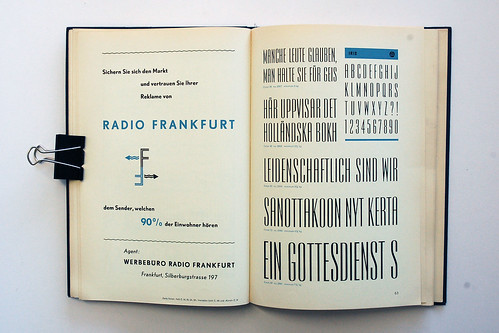
Schriftenkatalog — Beautiful pages from a 1960’s Dutch type catalogue on Flickr (via Inspire Me)
And… The history of the ampersand at the Webdesigner Depot (thanks Nic).
A Guide to Online Publicity (For Dummies) — Freelance writer, editor and blogger Lindsay Robertson’s common sense — but on the money — “do’s and don’ts” for flacks like me approaching bloggers like er… me (via Kottke).
And finally…

Two lovely posts at The Silver Lining featuring the work of Elaine Lustig Cohen: Part 1 and Part 2. There are more Elaine Lustig Cohen book covers at ephemera assemblyman and there is an amazing Flickr pool devoted to the design work of Alvin and Elaine Lustig here.
1 Comment
I’m fairly certain that every architect and designer on the planet has seen Alex Roman’s artful short film The Third & The Seventh already. But I haven’t seen it mentioned on any book blogs as yet, and so for the benefit of other architecturally-inclined book nerds who may not have caught it, I thought I would share it here (although you really should go and watch it in full-screen HD at Vimeo).
Even though it is apparently a full-CG animated piece, the film beautifully captures the light and elegance of the architectural space, and yes, there are even a few books in it…
There is an interview with the filmmaker about the film at Motionographer.
1 Comment
The Silver Lining blog is so good right now it’s giving me a headache: Art, books, ephemera, photography… All the good stuff, all in one place…
That is all. Carry on…
(pictured: De Sainte in New York, book cover by Dick Bruna seen at The Silver Lining)
2 Comments
Megan Wilson‘s new cover design for An Education by Lynn Barber.
Of a Certain Blockheadedness — Scott McLemee on the internet’s “gigantic plot” to get him to write for free:
The idea that new media has somehow abolished the old hierarchical structuring of the field (making everything level and equal and rhizomatic and whatnot) is only half right, at best. The hierarchies aren’t as well-marked as they used to be but they aren’t gone. Talk of an “army of amateurs” is at this point persuasive only to people who enlist without paying any attention to the fine print.
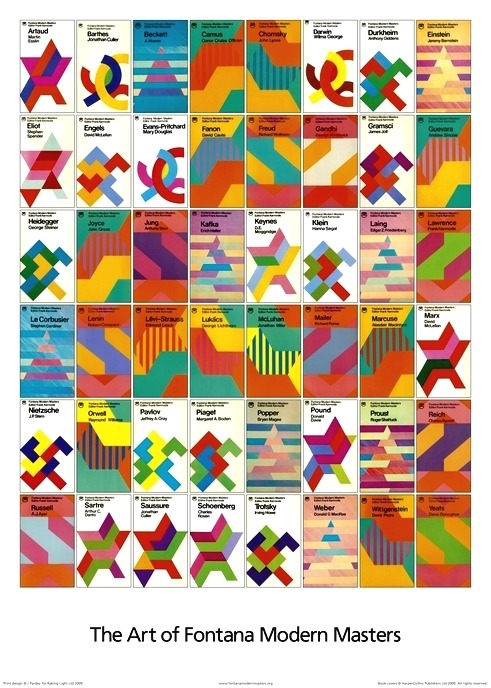
The Art of Fontana Modern Masters — Much linked to elsewhere, James Pardey (of the The Art of Penguin Science-Fiction site mentioned here) has new project on the Op-Art inspired Fontana Modern Masters book cover designs. He’s also written about the series for Eye (via Ace Jet 170 and Daily Discoveries on Design).
The New Sleekness — Ami Greko and Pablo Defendini (and other “bookish types”) try to fill a hole in publishing punditry. Having tried that myself and failed horribly, I can only wish them good luck.

Around The World with the Bodoni Family — A beautiful new 60-page book by graphic designer Teresa Monachino seen at The Creative Review. Each letter of the alphabet is printed in Bodoni to illustrate a place beginning with that letter.
Wave of Mutilation — Tom McCarthy, author of Remainder, on the films of David Lynch in the New Statesman. Yes, it is as weird and unlikely as it sounds (via 3:AM):
Try to count the instances of deformity in Lynch’s work, or of people being deformed on camera, and you’ll lose count pretty quickly… Deformity, for Lynch, is not simply thematic: it is instrumental. In his films, what the continual, almost systematic replacement of body parts and faculties by instruments – crutches, wheelchairs, hearing aids and ever weirder apparatuses sometimes as large as rooms – produces is a whole prosthetic order, a world of which prosthesis is not just a feature, but a fundamental term, an ontological condition.
Information Wants to be Valued — Ian Grant, Managing Director of Encyclopaedia Britannica, at BookBrunch:
The new online world has given book publishers good reason to review everything that they do, from what to publish to how to run their businesses. It is a noisy call to new action and fresh efforts, but publishers are well-placed to respond. The core skills we have had for generations – imagining our users, creating shapely products that meet their needs, and identifying the transfer of value that results in a sale, are precisely the skills that make good publishing online successful and satisfying. Information does not “want to be free”; customers want to be inspired and satisfied.
And finally: It seems I’m not the only one who doesn’t take predictions about the book industry entirely serious… Laurence Hughes over at the Huffington Post:
2 CommentsSome time in the next decade, someone will download both The Bible and The Satanic Bible to their e-reader, triggering the Final Conflict and ushering in Armageddon and the End of Days. Expect a slight dip in book sales during the thousand-year reign of the Antichrist.