Skip to content

Category: Miscellany

Something for the Weekend

David Drummond’s Parker Series for University of Chicago Press.

“a little bit Warhol, a little bit Factory Records” —  Christian Schwartz explains why he started type foundry Commercial Type at I Love Typography:

It’s much easier to be an “armchair quarterback,” second-guessing everyone else’s seemingly questionable decisions regarding everything… than it is to deal with the actual reality of budgets, technology, and timelines. Theorizing about how and why things work is all well and good, but putting our ideas into practice is of course the real test…

Typography and JudaicaSteven Heller interviews book designer and typographer Scott-Martin Kosofsky. Fascinating stuff:

It’s the best of times and the worst of times, but I have a feeling that people have always said that… In regard to print, I think we’re at a great moment, with access to mature technology and aesthetics… There’s no excuse for anything looking less than great. But books (and print in general) have lost their pride of place. Book publishers, a group nearly always behind the curve, have failed to grasp that their online counterparts spend a lot of time and money concentrating on User Experience, while they remain unfamiliar with the concept. It wasn’t always that way, but when the professionalism and discipline that was demanded by metal type fell away, things got worse and worse, especially typographically.

Punk — An interview with Jaime Hernandez about Love and Rockets and the recently published The Art of Jaime Hernandez at NYC Graphic:

“That’s how Love and Rockets started: we were just cocky and didn’t know we could fail. We went ahead and published the first one ourselves and didn’t care what the outcome would be, we just wanted to be printed. Hopefully we could sell it and make money, but there was no one to tell us not to. That was the punk part of it. The more we got good response, the more we kept doing it.”

And finally…

The Pollak Coffee Table Book seen at UnderConsideration’s FPO. Breathtakingly beautiful.

Comments closed
Midweek Miscellany

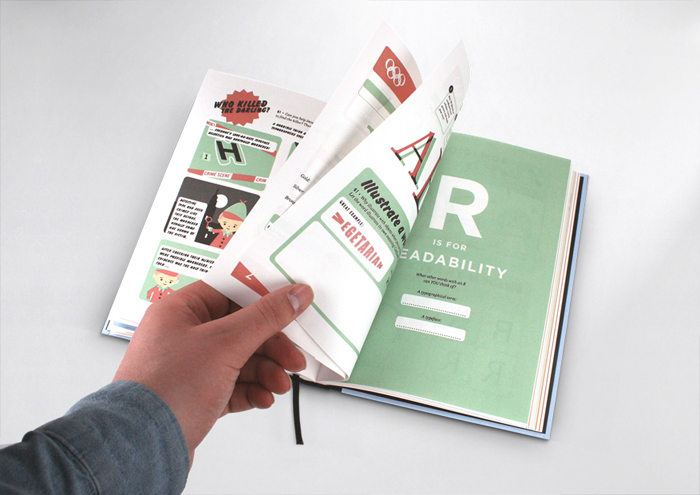
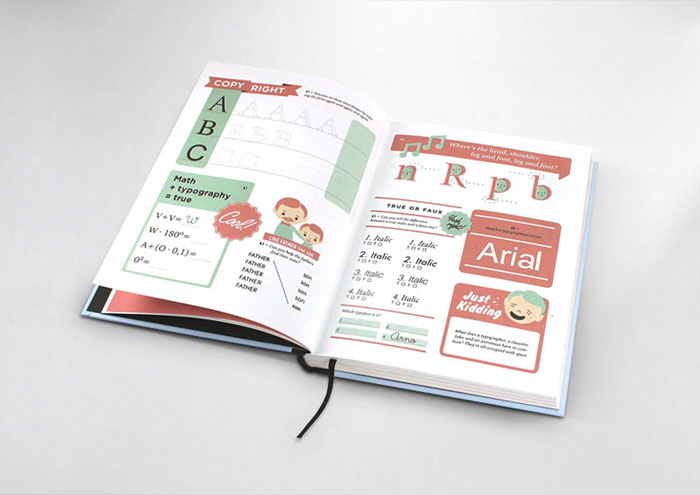
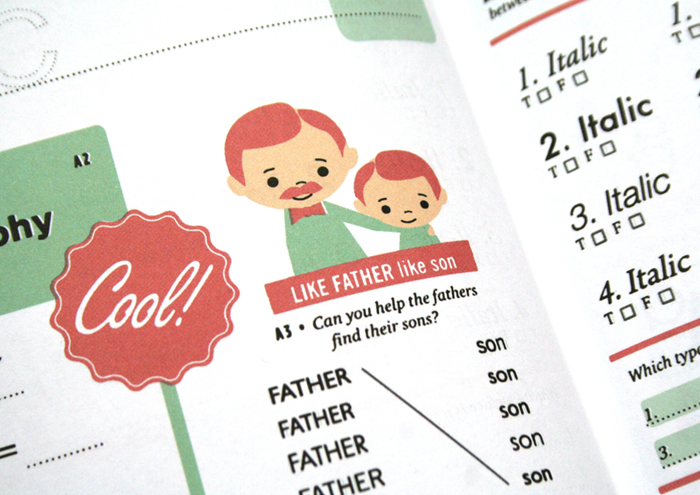
Hyperactivitypography from A to Z — An activity book for typographers (in a lovely retro style) by Norwegian design agency Studio 3. You can flip through the book here.

Life As Lived — Author Sarah Bakewell (How To Live) kicks off a 7-part series on Montaigne in The Guardian:

What is it to be a human being, he wondered? Why do other people behave as they do? Why do I behave as I do? He watched his neighbours, his colleagues, even his cat and dog, and looked deeply into himself as well. He tried to record what it felt like to be angry, or exhilarated, or vain, or bad-tempered, or embarrassed, or lustful. Or to drift in and out of consciousness, in a half-dream. Or to feel bored with your responsibilities. Or to love someone. Or to have a brilliant idea… but forget it before you can get back to write it down…

And also in The Guardian

Alternatives — Tom Lamont asks designers why book covers look different from territory to territory:

Why don’t publishers, then, replicate covers that have been a success abroad? “It does happen but it’s quite rare,” says [Julian] Humphries [art director, Fourth Estate]. Megan Wilson, an art director at Knopf Doubleday in New York, says that American designers are sometimes asked to look at British jackets, “as an example of something that works or doesn’t, but we are rarely asked to use them directly”. [Nathan] Burton tries to avoid looking at alternative covers if he’s working on a book that’s already been published. “It can take you off on odd tangents. It’s always best to work from fresh.”

Great. But, please, can we declare a journalistic moratorium on  “judge a book by its cover” headlines?

“We are your platform”Richard Nash, formerly of Soft Skull, talks about his new start-up Cursor at The Literary Platform. There’s something about this that reminds me of Factory Records in good ways and bad…

A Question of Audience — With Julie Bosman taking over the publishing beat at the NY Times from Motoko Rich, Sarah Weinman breaks down what kinds of book and publishing stories appear in North American newspapers:

I’ve become increasingly aware the longer I’ve written about publishing for a business news site that some stories that are big news within the industry carry little relevance outside of publishing circles. That means certain news items I pay attention to and analyze to death via Twitter… won’t merit larger stories. It also means that certain topics that are discussed endlessly in the publishing bubble (especially the digerati-populated one), while relevant to the outside world, have to be written about in a way that might come off as eye-rolling rehash.

I think Sarah’s being charitable here. Many of the topics discussed endlessly in the publishing bubble and the Twittercosm have absolutely no relevance to, or perceivable impact on, the outside world…

Undercover Icon — A New York Times profile of Irving Harper, the man behind many of George Nelson Associates‘ iconic designs (via The Scout):

“I don’t have a complex mind,” Harper said, and if this assertion seems disarming coming from a designer of his sophistication, the thought is sincere… “With a computer there are too many choices, and I always liked working within limits,” he said. “You know, if you look at Mozart, who had this strict classical framework — an allegro, an andante, a scherzo and a finale — you see that within that formula, he got results he might never have gotten if he had all the options in the world.”

There is more on Harper in a Metropolis Magazine profile from 2001, and a monograph of his paper sculptures by Michael Maharam is apparently on the way (if anyone has details please let me know).

Comments closed

Up There

Up There is a beautiful 12-minute documentary about hand-painted advertising in New York by Malcolm Murray (sponsored by Stella Artois).

It has nothing to do with books — unless you happen to consider print another fading tradition — but I wanted to share it nevertheless:

UP THERE from Jon on Vimeo.

1 Comment

Something for the Weekend

Filthy English — a new cover design by Dan Mogford for Portobello Books.

Hip Flask — An interesting interview with the folks behind 48 Hour Magazine at Gizmodo. There’s some great stuff in the piece, and it’s worth reading from beginning to end, but I particularly liked this insight from Derek Powazek (founder of Fray, co-founder of JPG Magazine, and consultant at MagCloud*):

Print is, at some point, done. However imperfect. It has a rhythm of creation, editing, and publishing. And when it’s done, everyone involved can sit back, look at the thing we made, and feel accomplished.

The web is never done. It’s in a constant state of flux. That’s not good or bad, it just is.

Powazek is also the guy behind Strange Light a print-on-demand magazine that collected photographs of the Australian dust storm that covered New South Wales and Queensland in September last year. He has interesting post about the creation of the magazine on his blog.

No. — A Tumblr that’s apparently devoted to found-type numerals.

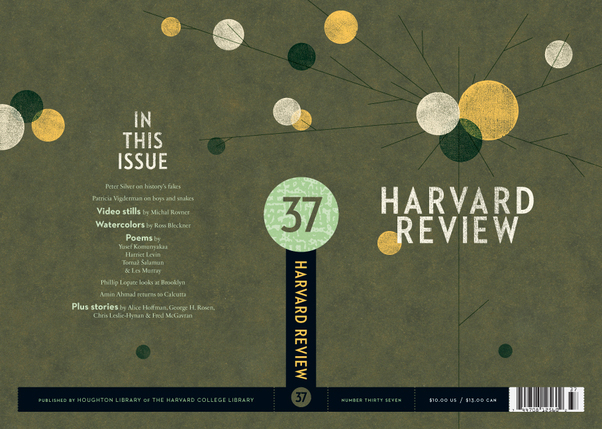
The latest Harvard Review cover by Alex Camlin. My interview with Alex is here.

*Does this make anyone else feel slightly inadequate? — I mean, what have you founded, co-founded or consulted on today?

Comments closed

Midweek Miscellany

Michael Cho‘s cover for the Best American Comics annual 2010 published by Houghton Mifflin Harcourt. Fantastic.

Undefined — The Caustic Cover Critic interviews illustrator and designer Alice Smith:

After sketching ideas, I make compositions using inks and pens to bring collages together, the pen marks might have disappeared in the finished composition, but it’s the pen marks and the rough sketch that helps bring it together. I use old imagery for ethereal effect, playing with visual alchemy and nostalgia. And the quality of printing pre 1950s, photoengravre and proper litho is so much nicer than the pixel fuzz and dots of newer digital printing.

Alice’s portfolio is here.

Scraps of Paper — An interview with superstar designer Rodrigo Corral in Metropolis magazine:

[T]he parts of the process that are unique and special really come from the individual designer’s experience. I think about the people who might read this article, and assuming some will be design students or younger people just getting into book design, I have to say that in order to come up with ideas—which, aside from a solid understanding of typography and typographical context is the most important part of all of this—you have to have an understanding of what has come before and what is current. I’ve spent years in used bookstores and magazine shops looking, admiring, and collecting, and this is all a part of the “design process.” The things I have stored in my brain and all that is still out there to see and learn are all part of the process.

Bought and Discarded — Simon Akam explores the sidewalk booksellers of New York for More Intelligent Life:

What wasn’t clear was what it meant to have a big presence on secondhand stalls. Was it an honour for a book, or a slur on its author’s reputation? Which was more significant—the fact that so many copies had been bought by someone, or the fact that they had since been offloaded again? To add insult to injury, were the titles I encountered in droves lying on the stalls because today’s reading public chose not to pick them up, even at a much reduced price? I needed to find out whether the champions of my survey were much loved, or doubly scorned.

And finally…

The Road: Scenes From the Post-Print Apocalypse by Peter Kuper for the New York Times (via The Ephemerist).

2 Comments

Midweek Miscellany

Born Modern Alvin Lustig

I’m currently in Vancouver for the Raincoast Books sales conference and I was very happy to see Born Modern: The Life and Design of Alvin Lustig by Steven Heller and Elaine Lustig Cohen on Chronicle Books Fall 2010 list. Design:Related has a short piece about the book here.

(Obvious disclosure: Born Modern will be distributed in Canada by my employer Raincoast Books).

Lessons from Allen LaneJames Bridle on what publishers can learn from the founder of Penguin Books:

Amazon is an infrastructure company, Apple a technology and design company, Google is a search engine. None of them will be able to replicate publishers’ passion for books.

But to take advantage of this, publishers need to look… beyond one-size-fits-all definitions of our product, and beyond publicity-grabbing, short-term management and imprint rearrangements that have nothing to do with readers’ demands.

In short, we need to walk down that platform with Allen Lane again, take a long look at where and how people are reading, and help them to find a good book.

Unknown — The Guardian discusses lost and undiscovered literature, including the work Sigizmund Krzhizhanovsky:

Eventually Krzhizhanovsky succumbed to despair and stopped writing, choosing instead to compose his narratives in his skull. Even those works that were written down, however, feel internal, hermetic. Clearly Krzhizhanovsky expected to remain unread, and so could be as dense and complex as he wished. But if the stories are not always easy to follow, they’re always worth the effort.

The marvelous NYRB recently published Memories of the Future, a collection Krzhizhanovsky’s short stories (and it’s very good).

48 Hour Magazine — Can you write, photograph, illustrate, design, edit, and ship a magazine in two days? An interesting team of people want to find out…

A Lack of Ideas — at The New York Times book blog Paper Cuts tries to define what makes a cliché:

“Words can be overused, or used thoughtlessly…but a cliché… is a phrase that substitutes for a thought. The dictionary calls it ‘an expression or idea that has become trite.’ Individual words don’t become trite — except in a context…”

[W]hat ought to concern readers, writers and editors most is not necessarily the overused words (we all get sick of “lyrical” and “compelling” and their ilk), but rather the intellectual laziness their overuse might signal.

And finally…

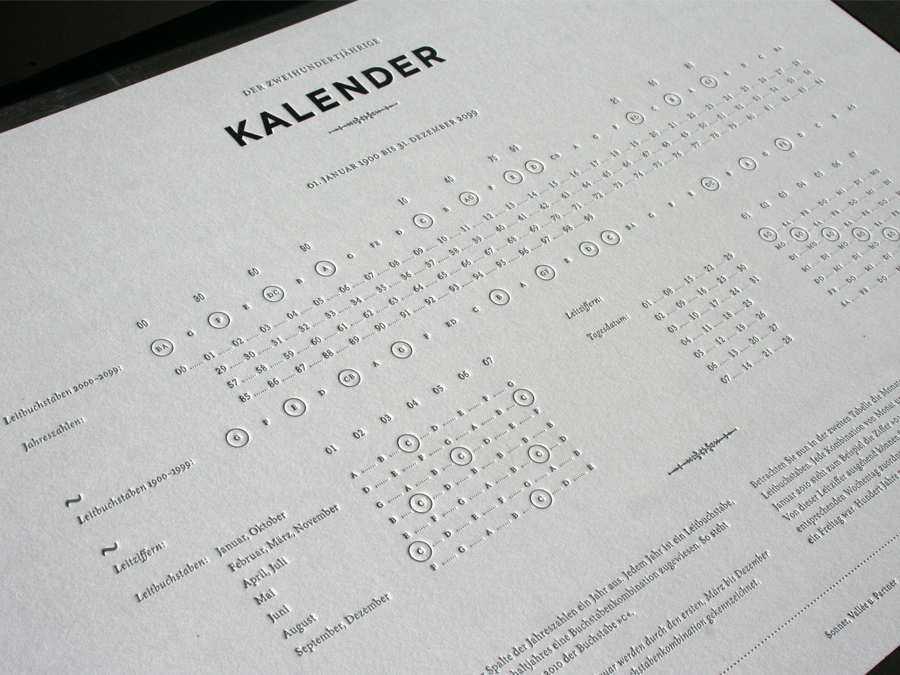
200 Year Kalendar — A beautiful letterpress calendar produced by German design studio Sonner, Vallée u. Partner, seen at Studio on Fire’s blog Beast Pieces (via ISO50).

Comments closed

Something for the Weekend

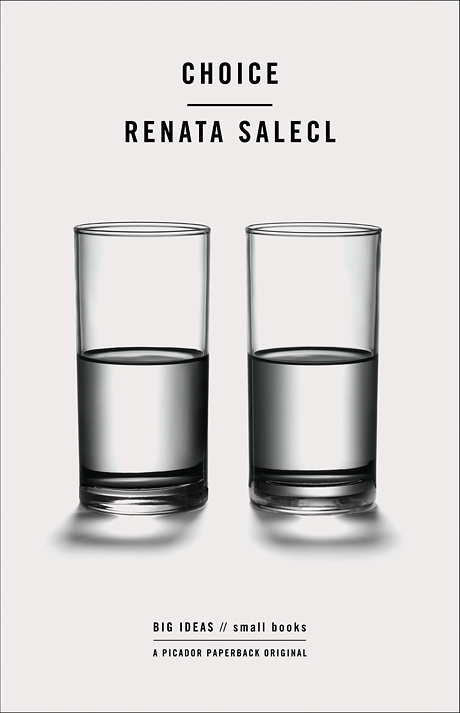
Two stunningly beautiful, and sadly unused, designs by Henry Sene Yene with photographs by Jon Shireman for Picador’s BIG IDEAS // small books series. Picador decided not to publish the book. You can see Henry’s other designs for the series here.

A Meaningful Publisher — Forbes profiles the fantastic NYRB Classics (via Sarah Weinman):

While the series hasn’t published a bestseller, and is unlikely to do so, readers care about NYRB Classics and are loyal to it. This is a monumental accomplishment at a moment when cultural loyalty is extremely fickle. Frank and Kramer did it using a frills-free, deceptively simple editorial strategy: give readers good books consistently, respect them, engage them, and they’ll stick with you.

Rough Healer — Jamie Byng, publisher at Canongate, on musician, poet, and author Gil Scott-Heron in The Guardian.

The Ultimate Online Bookclub — A little late to the party, but Viv Groskop discovers Twitter is the place to share book opinions and gossip (and stalk authors apparently) in The Telegraph (via Source Books publisher Dominique Raccah on Twitter of course!):

Twitter allows you to discuss books and authors with other fans online without having to set up a blog or invent some dodgy chat room identity. If you “follow” the right people… you soon discover that Twitter brings you compelling snippets from publicists, book fanatics, bloggers and authors themselves. With reading recommendations galore, it is the book addict’s paradise.

The New Narrative — Creative Nonfiction magazine is seeking interesting stand-alone narrative nonfiction blog posts (2000 words or less) to reprint in their next issue. Nominate something from your own blog, or from a friend’s. Closing date is this Monday (April 26, 2010).

And finally…

A Fan of the Form — Author and publisher Dave Eggers talks to On The Media about the McSweeney’s newspaper Panorama:

I like the curatorial, the calmness, the authority of a daily paper. But I do think that it’s a time to make the paper form more robust and more surprising and beautiful and expansive. People still want to read long form literary journals and nonfiction, etc., and so why can’t the print medium do that and be that home and leave the Internet to do the more quick thinking and quick reacting things?

Comments closed

Midweek Miscellany

In the Land of Punctuation published by Tara Books (seen at DesignWorkLife):

Written in 1905 by the German poet Christian Morgenstern, In the Land of Punctuation is a darkly comic linguistic caprice that holds a resonant mirror to our times. Situated at the crossroads of language, design, and politics, this illustrated edition is a unique picture book for adults. Translated faithfully by Sirish Rao, with typographic illustrations by Rathna Ramanathan, this is a brilliantly inventive dance of text and image.

More on the illustrations at Rathna Ramanathan’s blog.

Quality. Interest. Significance — Robert McCrum profiles literary agent Andrew ‘The Jackal’ Wylie in The Observer:

The more he talks, the more Wylie’s innate puritan zeal comes to life within the clerical black of his undertaker’s suit and tie. “I’m a books person. Yes, I have a Kindle. I used it for an hour and a half and put it in the closet. I’m not interested in mass culture. When I started out I saw nine out of 10 people heading for the door marked Money, Commerce, Trash. So I chose the door marked Quality. Interest. Significance…”

Battle Royale — In a much linked to article, Ken Auletta, author of Googled: The End of the World as We Know It, discusses the iPad, the Kindle, and, yes, Google, in The New Yorker:

Publishing exists in a continual state of forecasting its own demise; at one major house, there is a running joke that the second book published on the Gutenberg press was about the death of the publishing business.

There’s not much (if anything) new in the article and more than a few of the usual suspects (and clichés) appear, but it does cover a lot of ground and provides a decent summary of where things currently stand in the publisher-Apple-Amazon-Google pissing match.

Revolution Betrayed — Christopher Hitchens on George Orwell’s Animal Farm for The Guardian:

It is affecting to imagine battle-hardened ex-soldiers and prisoners of war, having survived all the privations of the eastern front, becoming stirred by the image of British farm animals singing their own version of the discarded “Internationale”, but this was an early instance of the hold the book was to take on its readership. The emotions of the American military authorities in Europe were not so easily touched: they rounded up all the copies of Animal Farm that they could find and turned them over to the Red Army to be burnt. The alliance between the farmers and the pigs, so hauntingly described in the final pages of the novel, was still in force.

And finally…

[space]

Massimo Vignelli says we use too many fonts.  I Love Typography has a smart response. The full 36-minute interview with Vignelli is available from Big Think.

2 Comments

Something for the Weekend

John Squire‘s 1980’s covers for the Penguin Decades Series at The Creative Review. The art direction was by Penguin’s Jim Stoddart, but yes, it is THAT John Squire (i.e. awesome).

Fine Independent Publishing — An interesting interview with Barbara Epler, Editor-in-Chief at literary publisher New Directions, at KCRW’s Bookworm (although I could do without the decline of literature being blamed squarely on sales and marketing people. Again):

Permanent Crisis — A post by Rebecca Smart, Managing Director of military history publisher Osprey Publishing, at Digital Book World:

If you perceive that your only environment is that encompassed by your current supply chain then you’re only going to adapt to changes in that environment – so the response to the digital challenge viewed in this way would be to create and sell e-books. If you put the consumer at the heart of your thinking you can consider instead each group of customers you serve and what they might want on top of what you already provide, how they might want you to serve them differently in the future. More to the point, you can ASK them, listen and respond.

Proletarian Erotica — Lorin Stein, former senior editor at Farrar, Straus and Giroux and new editor of the Paris Review, interviewed at The Economist‘s ‘More Intelligent Life’ blog. The National Post also ran a nice interview with Stern last month.

Going Deutsch — Tom McCarthy, whose new book “C” I’m reading right now,  interviewed at the New York Times ‘Paper Cuts’ blog:

One critic described “Remainder” as a French novel written in English; well, by that token, “C” is my German novel. What the next one will be is anyone’s guess. Swedish, maybe…

More from Tom on The Casual Optimist soon (if I can twist his arm)…

Print Junkies — An interview at The Second Pass with the publisher and editor of Stop Smiling magazine J. C. Gabel on the launch if the Stop Smiling book imprint:

We’re still operating with the same mentality… but have adopted a Less Is More mindset — and a production schedule to match. It does feel nice to know that what we spend months or years working on is now being released in a permanent format. We’re really trying to reinvent the DIY aesthetic of the magazine to apply it to editing, publishing, and promoting books. The book-making process itself, of course, is much slower and drawn out, which is refreshing as we all get older.

And finally, I give you Oliver Jeffers’ moustache (via Tragic Right Hip)…

3 Comments

Midweek Miscellany

McGraw-Hill paperbacks designed by Rudolph De Harak — A nice Flickr set of vintage covers from Joe Kral, who apparently has an amazing book collection (via Words & Eggs).

Free Libraries Are Full of Books That No One Reads — Author Paul Theroux talks to The Atlantic about e-books (via The Second Pass):

I don’t think people will read more fiction than they have in the past… but something certainly is lost—the physicality of a book, how one makes a book one’s own by reading it (scribbling in it, dog-earing pages, spilling coffee on it) and living with it as an object… I can’t predict how reading habits will change. But I will say that the greatest loss is the paper archive—no more a great stack of manuscripts, letters, and notebooks from a writer’s life, but only a tiny pile of disks, little plastic cookies where once were calligraphic marvels.

Not Dead Yet — An interesting post at Personanondata on what the resilience of the CD format means for books:

Many believe the physical book will disappear within in the next ten years yet the example of the music CD suggests the future of the book may be more nuanced. The availability of electronic versions of trade content will approach 100% in less than ten years… Despite the availability however, electronic content is likely to represent only one of a number of ways consumers will engage with book content…  Rather than disappear, the lowly print book may retain a position of wide distribution… and become the focal point of a facilitated interaction with numerous content acquisition options for consumers.

The information on CD sales in the post comes from a recent report in The Economist, which also ran an interesting article about the future of copyright on the same day:

The lawmakers intended… to balance the incentive to create with the interest that society has in free access to knowledge and art… Over the past 50 years, however, that balance has shifted. Largely thanks to the entertainment industry’s lawyers and lobbyists, copyright’s scope and duration have vastly increased… They are now calling for even greater protection, and there have been efforts to introduce similar terms in Europe. Such arguments should be resisted: it is time to tip the balance back.

The New York Times obituary for publishing executive and copywriter Nina Bourne:

The campaign she created for “Catch-22” is now regarded as a classic. Ms. Bourne was the most passionate in-house champion of the book, a darkly comic tale of World War II by a first-time novelist. Pleading for an increase in the initial print run, she turned to her colleagues during a production meeting, tears in her eyes, and asked, “If I can’t get this, why am I here?”

And finally…

Architecture Under Construction — a beautiful set of photographs by Stanley Greenberg from a new book published by the University of Chicago Press. Pictured: Untitled, Toronto, Ontario, 2005 — Royal Ontario Museum, Studio Daniel Libeskind (via PD Smith).

Comments closed

Something for the Weekend

A couple of quick links…

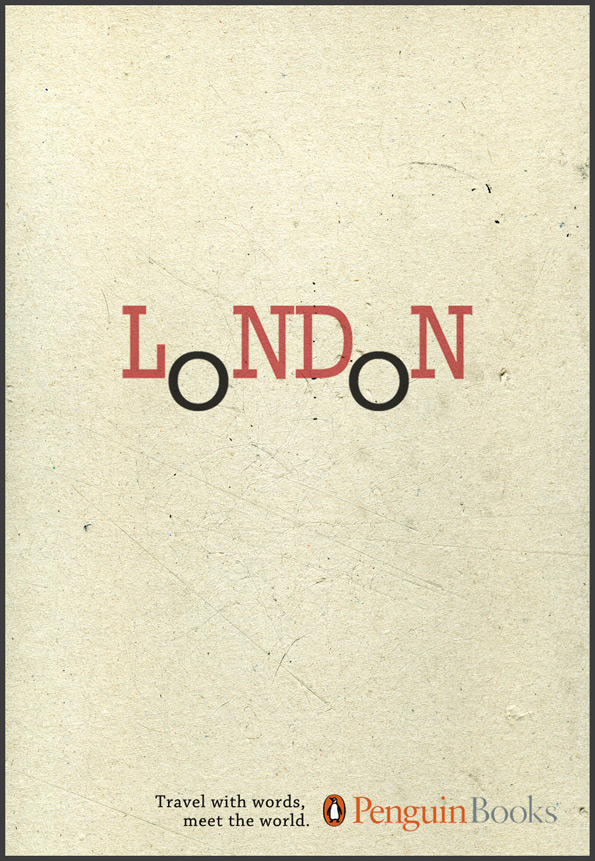
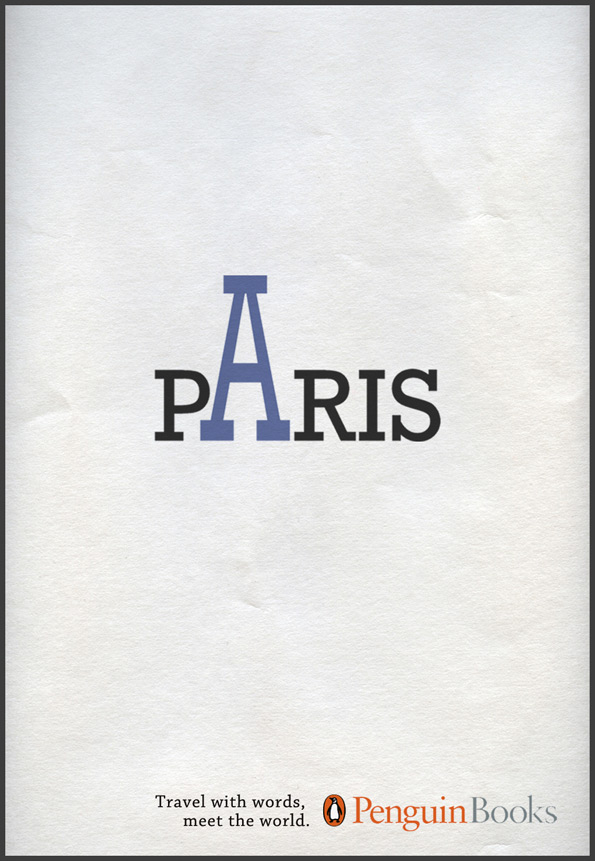
‘Travel with words, meet the world’ — A nice typographic ad campaign from Penguin Books seen at Ads of the World (via This Isn’t Happiness).

No-Fi — Cartoonist James Sturm, founder of the Center for Cartoon Studies, is giving up the internet and documenting for Slate:

Over the last several years, the Internet has evolved from being a distraction to something that feels more sinister. Even when I am away from the computer I am aware that I AM AWAY FROM MY COMPUTER and am scheming about how to GET BACK ON THE COMPUTER. I’ve tried various strategies to limit my time online: leaving my laptop at my studio when I go home, leaving it at home when I go to my studio, a Saturday moratorium on usage. But nothing has worked for long. More and more hours of my life evaporate in front of YouTube. Supposedly addiction isn’t a moral failing, but it feels as if it is.

(For the sake of full disclosure, James Sturm’s new book Market Day is published by D+Q who are distributed in Canada by my employer Raincoast)

Jonathan Turner (AKA Insect54) has posted a few photos of Herbert Spencer’s book Pioneers of Modern Typography on his (amazing) Flickr photostream (via Inspire Me).

2 Comments

Midweek Miscellany

Some nice book design from graphic design student Tom Pollard, spotted at FormFiftyFive

And speaking of FFF…

Some beautiful print design work by FormFiftyFive contributor Daniel Gray (via Cosas Visuales).

The Dramatist — A great profile of David Simon, creator of HBO series The Wire and Treme, in New York Magazine (via Mark Athitakis’ American Fiction Notes):

“Fuck the exposition,” he says gleefully as we go back into the bar. “Just be. The exposition can come later.” He describes a theory of television narrative. “If I can make you curious enough, there’s this thing called Google. If you’re curious about the New Orleans Indians, or ‘second-line’ musicians—you can look it up.” The Internet, he suggests, can provide its own creative freedom, releasing writers from having to overexplain, allowing history to light the characters from within.

Sympathy for the Librarian — A lovely quote from Keith Richards in The Times (via MobyLives):

“When you are growing up there are two institutional places that affect you most powerfully: the church, which belongs to God, and the public library, which belongs to you. The public library is a great equaliser.”

Amen.

And finally…

After posting about the big man earlier this week, I would be remiss if I didn’t mention The Ten Commandments of George Lois t-shirts available from TypographyShop:

“Great ideas can’t be tested. Only mediocre ideas can be tested.” Awesome.

Comments closed