Skip to content

Category: Miscellany

Something for the Weekend

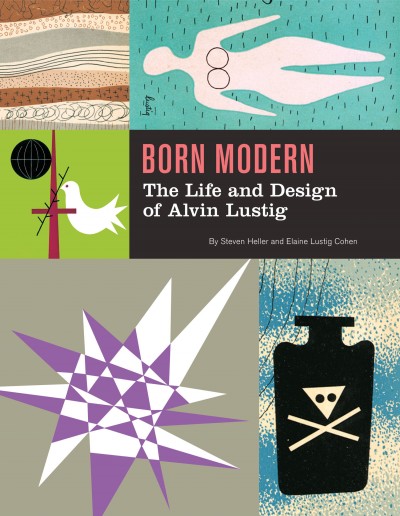
There are two new books about designer Alvin Lustig available this month — Born Modern: The Life and Design of Alvin Lustig by Steven Heller and Elaine Lustig Cohen (Chronicle Books*) and Purity of Aim: The Book Jacket Designs of Alvin Lustig by Ned Drew and Paul Sternberger (RIT Cary Graphic Arts Press).

The Death of the Book has Been Greatly Exaggerated — Tech columnist Christopher Mims on the “irrational exuberance” around e-books (via MobyLives):

Tech pundits recently moved up the date for the death of the book, to sometime around 2015, inspired largely by the rapid adoption of the iPad and the success of Amazon’s Kindle e-reader. But in their rush to christen a new era of media consumption, have the pundits overreached?

I’m calling the peak of inflated expectations now. Get ready for the next phase of the hype cycle – the trough of disillusionment.

The Secret Life of Shepperton — A photo essay on Shepperton, the suburban town south west of London where author J. G. Ballard spent most of his adult life. The photographs are accompanied by text from Ballard’s own novels, autobiography, interviews as well as observations about the town and its history (via 3:AM).

And finally…

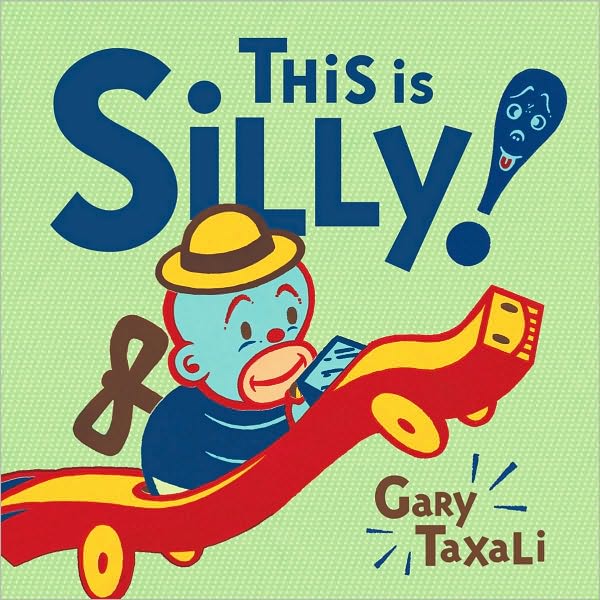
The Wonderful 36 Pages features This is Silly! by Toronto-based artist/illustrator Gary Taxali:

* Chronicle Books is distributed in Canada by my employer Raincoast Books.

Comments closed

Midweek Miscellany

Lost Libraries — With the personal book collection of David Markson ending up at The Strand bookstore in New York, Craig Fehrman examines the fate authors’ libraries for The Boston Globe (via The Second Pass):

Most people might imagine that authors’ libraries matter — that scholars and readers should care what books authors read, what they thought about them, what they scribbled in the margins. But far more libraries get dispersed than saved. In fact, David Markson can now take his place in a long and distinguished line of writers whose personal libraries were quickly, casually broken down. Herman Melville’s books? One bookstore bought an assortment for $120, then scrapped the theological titles for paper. Stephen Crane’s? His widow died a brothel madam, and her estate (and his books) were auctioned off on the steps of a Florida courthouse. Ernest Hemingway’s? To this day, all 9,000 titles remain trapped in his Cuban villa.

Fehrman expands on this article — and the reasons we should not have been surprised that Markson’s books found their way to The Strand — at his blog.

Eating Each Other is Wrong — Evan Scnittman, Managing and Director of Sales and Marketing at Bloomsbury, argues that e-books don’t cannibalize print:

The most important lesson I can convey to book publishing professionals is that they must understand that those of us who have made the transition to ebooks, buy ebooks, not print books. Ebook reading device users don’t shop in bookstores and then decide what edition they want; ebook device readers buy what is available in ebookstores. Search an ebookstore for a title and if it doesn’t come up, it doesn’t exist – no matter how many versions are available in print.

Ebooks aren’t a better value, ebooks aren’t more attractive nor are they a threat to the print version of any immersive reading book. This isn’t the same as paperback versions vs hardcover – where the platform and convenience are the same – the timing and pricing are the key ingredients. Books that aren’t in ebook form are do not exist to ebook reading consumers. There is no cannibalization if in the mind of the buyer if there is no version available to them.

The Forgotten Mimics — In the 11th installment of The National Post’s ‘Ecology of Books’ series, Mark Medley talks to to some of Canada’s foremost literary translators:

“We’re not robots,” says [Lazer] Lederhendler, 59, who won the Governor General’s Literary Award for his translation of Dickner’s last novel, Nikolski. “We have a way of reading a book. We have a way of using the language. We have our own vocabulary, our likes and dislikes in terms of this phrase or that phrase. It’s a kind of balancing act between observing the fact that you’re at the service of someone else’s work, but at the same time it’s an artistic mission.”

Four Decades of Art — A mini-documentary about illustration in The New York Times Op-Ed page, featuring interviews with art directors and illustrators.

And finally…

Type designer Matthew Carter and writer David Simon (creator of The Wire) were recently named MacArthur Fellows. The Fellowship is a $500,000 (US), no-strings-attached grant for people who have shown exceptional creativity in their work and promise to do more (via How Magazine):

Comments closed

Something for the Weekend

Sadly I missed the book launch earlier this week, but Toronto-based artist and illustrator Gary Taxali talked to the Torontoist and The National Post about his new kids book This is Silly!. You can see more of Taxali’s amazing book covers here.

ArtifactsMaximus Clarke has a fascinating conversation with William Gibson about his new novel Zero History :

I reach instinctively for something without knowing why, and place it in the narrative, and if it strikes a resonant chord with me, I’ll leave it there… But I myself have wondered why I do that — why I depict a universe of man-made objects, with people walking among them (laughs). My best answer is that it’s the way I perceive things. And I also suspect that the narratives of objects are more available to us when the objects themselves have become slightly decrepit. So I think my interest in old things, and worn things, isn’t about nostalgia in any conventional sense; it’s about the revelation of the narrative of how that object came to be in the world, and what it once might have meant to someone.

And on a somewhat related note, an interview with J.G. Ballard from the Winter 1984(!) issue of The Paris Review:

I would say that I quite consciously rely on my obsessions in all my work, that I deliberately set up an obsessional frame of mind. In a paradoxical way, this leaves one free of the subject of the obsession. It’s like picking up an ashtray and staring so hard at it that one becomes obsessed by its contours, angles, texture, et cetera, and forgets that it is an ashtray—a glass dish for stubbing out cigarettes.

The Black Arts — Book cover designers discuss their devious techniques for winning a clients approval with Peter Mendelsund and Peter Terzian:

Yes, a good design should speak for itself—but what if the client isn’t listening? Well, that’s when designers employ methods that are not taught in design school. Psychological methods. Machiavellian methods. Used-car-dealer methods. Manipulation. Intimidation. Seduction.

The PDF is here.

And Peter T has clearly been busy. The editor of Heavy Rotation: Twenty Writers on the Albums That Changed Their Lives has an article on books about album cover art at BookForum.

And finally (and on the subject of music)…

Finding Our WayRadiohead bassist Colin Greenwood reflects on the digital “pay what you think it’s worth” release of their album In Rainbows in 2007  and the band’s distribution options for their new songs:

I buy hardly any CDs now and get my music from many different sources: Spotify, iTunes, blog playlists, podcasts, online streaming – reviewing this makes me realise that my appetite for music now is just as strong as when I was 13, and how dependent I am upon digital delivery. At the same time, I find a lot of the technology very frustrating and counter-intuitive. I spend a lot of time using music production software, but iTunes feels clunky. I wish it was as simple and elegant as Apple’s hardware. I understand that we have become our own broadcasters and distributors, but I miss the editorialisation of music, the curatorial influences of people like John Peel or a good record label. I liked being on a record label that had us on it, along with Blur, the Beastie Boys and the Beatles.

(via Subtraction)

Comments closed

Midweek Miscellany

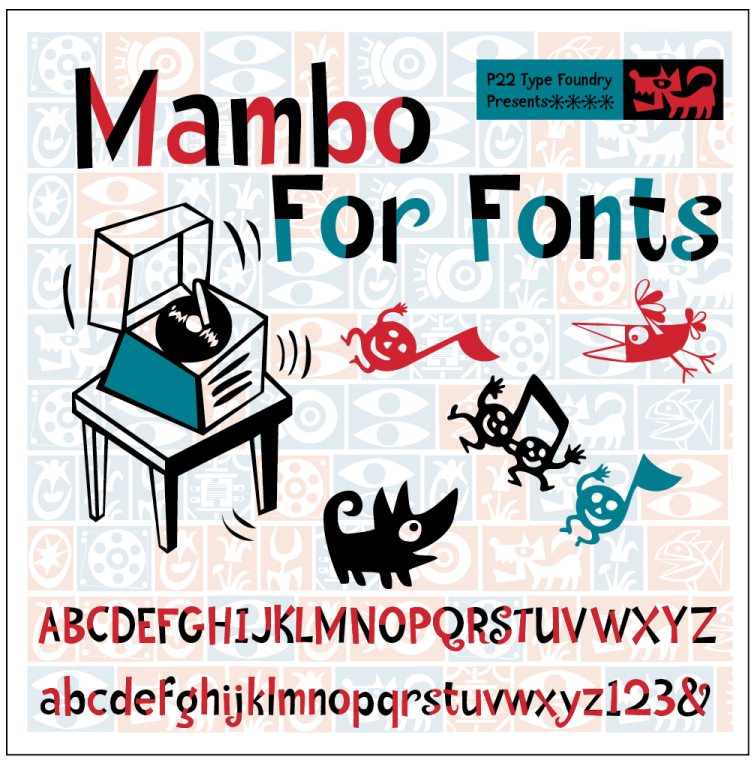
Mambo for Fonts — Flora Mambo is a new font from the P22 Type Foundry based on Jim Flora’s hand-lettering for the 1955 Mambo For Cats RCA Victor album cover.

Character — Type designer Matthew Carter profiled in The Boston Globe:

Around 1994, he started developing Verdana, a revolutionary font for having prevailed over technical constraints of that time, like coarse computer screen resolution. To hear Carter recall it, it was a pivotal moment: People were on the brink of reading as much — or more — on screen than on paper. And that transition has had a profound effect on the design process.

Carter also talks about his work in this short video for the Globe (via Eightface):


The Paris Review has made it’s entire interview archive — from the 1950’s to the present — available online (via The NY Observer).

An Education — James Bridle of BookTwo and Bookkake interviewed at Publishing Perspectives:

“There’s still a reluctance in the industry to give [e-books] their own space. They are still subsidiary to the traditional book forms… There still an incredible lack of understanding about them and the people who are doing the educating are Apple and Amazon, which means they are taking the market very quickly and we’re kind of letting them do that.”

The Likely Lads — Authors Lee Rourke (Canal) and Tom McCarthy (Remainder, C) in conversation at The Guardian.

And finally…

Writers from The Guardian and Observer newspapers talk about the books that sparked their passion for literature:

Comments closed

This Must Be the Place

BYUN is the first film in a series called This Must Be the Place by Lost & Found. The series explores the idea of home — what makes them, how they represent us, and why we need them.  I can’t wait to see the rest of the series…

(via Coudal)

1 Comment

Something for the Weekend

Thanks for the CBC Books blog for including The Casual Optimist in their list of 10 ‘Book Blogs We Appreciate’ earlier this week. It is always nice to be appreciated — I only hope I can live up to the billing… :-)

The Story of Eames Furniture — Written and designed by Marilyn Neuhart together with her husband John, who both worked with the Eames Office from the 1950’s until 1978, the year Charles Eames’s died. Published later this month by Gestalten, the book comes in two full-colour volumes with a slipcase.

The Future of the Future — William Gibson interviewed in The Atlantic:

I think that our future has lost that capital F we used to spell it with. The science fiction future of my childhood has had a capital F—it was assumed to be an American Future because America was the future. The Future was assumed to be inherently heroic, and a lot of other things, as well… I’m not going all Sex Pistols, shouting No Future!—I’m suggesting that we’re becoming more like Europeans, who have always retrofitted their ruins, who’ve always known that everyone lives in someone else’s future and someone else’s past.

Respect for the UsersJay Rosen‘s inaugural lecture to incoming students at Sciences Po école du journalisme in Paris earlier this month:

The Web effortlessly records what people do with it. Therefore it is easy to measure user behavior: what people are interested in, what they are searching for, clicking on, turning to… right now. What should a smart journalists do with this “live” information?… [Y]ou should listen to demand, but also give people what they have no way to demand because they don’t know about it yet. In fact, there is a relationship between these things.  The better you are at listening to demand, the more likely it is that the users will listen to you when you say to them: you may not think this is important or interesting, but trust me… it matters. Or: “this is good.” Ignoring what the users want is dumb in one way; editing by click rate is dumb in a different way. Respect for the users lies in between these two.

And finally…

Graphic designer James Patrick Gibson talks to Babelgum about his photoblog New Type York , an archive of images of typographic artifacts — signs, directions and building inscriptions — around New York City (via DesignRelated):

Comments closed

Midweek Miscellany

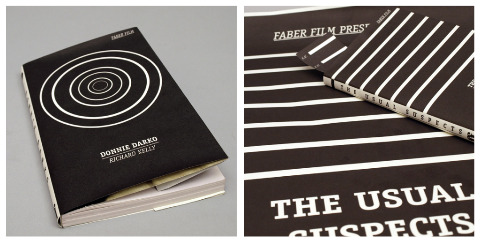
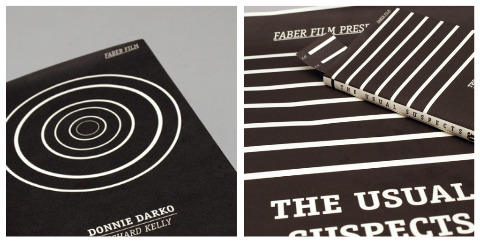
Another great set of designs for the 2009 D&AD student award brief for typography sponsored by Faber and Faber, this time by Rinse Design (via Cosa Visuales). See also: Ed Cornish’s designs for the brief.

Phaidon have relaunched their website and it is really rather nice (via FormFiftyFive).

The Imaginary PresentMike Doherty interviews William Gibson about his new novel Zero History for The National Post:

In his earlier books, Gibson says, he aimed to devise “futures that felt as though they were filled with designed artifacts, as indeed they would be. I can’t think of too many science fiction writers who’d bother trying to do that.” In the [new] series, his devotion to design has gone into overdrive, reflecting the idea that “everything is ‘designer,’ ” even though “with most things, you’ll never know the name of a designer.”

PopMatters also spoke to the author about the new book.

Code — Jennifer Egan, author of A Visit From the Goon Squad, reviews Tom McCarthy’s C for The New York Times:

[McCarthy] aligns disparate things into larger patterns full of recurring images: analogies between the human body and earth, and machinery; hums and whirs; film screens; bowels and tunnels; electric circuits; cauls and other silken membranes. These repetitions come to feel like the articulation of a larger code — as if, were readers to plot their exact positions throughout the novel, they would discover a hidden message.

What Ever Happened to Reading Properly? — ReadySteadyBlog’s Mark Thwaite on critics misreading of  Gabriel Josipovici’s What Ever Happened to Modernism?:

It’s interesting that Josipovici’s book which, in many ways, is both a call to read more carefully and an enquiry into why reading carefully is beyond so many cultural gatekeepers, has been read so sloppily by so many of its critics… Josipovici doesn’t invoke marginal or avant-garde writers, nor praise typographical or narrative playfulness over stale traditionalism, but rather brings us back to canonical writers (a good part of his essay is taken up with Wordsworth) and allows us to see what was at stake for those artists in their work, and what is at stake for us as readers.

And finally… It’s Vignelli week at Design Observer:

Debbie Millman’s 2007 interview with Massimo Vignelli (excerpted from her book How To Think Like a Graphic Designer):

I’m interested in “essence” — my major aim is really to get to the essence of the problem. And just throw away everything that’s not pertinent to it. At the end of a project, my work should be the projection of that experience, the essence of effect. It’s a habit that you get into… The essence is what is left when there’s nothing else that you can throw away.

Michel Bierut profiles Lella Vignelli:

Massimo has often defined their working relationship like this: “I’m the engine, and Lella is the brakes.” The first time I heard this as a young designer, it was clear to me which was more important. If you were a designer, wouldn’t you want to be the engine, powerful, propulsive, driving forward? It was only years later that I remembered something my high school driving instructor once said: “You don’t get killed in a car accident because the car won’t start. You get killed because the breaks fail.”

And, there is an interesting, beautifully shot, video interview with Massimo Vignelli by photographer John Madere here.

There will surely be more good stuff as the week progresses…

Comments closed

Bread and Surfing

I posted this documentary short about baker Chad Robertson, co-founder of Tartine Bakery & Café in San Francisco and author of Tartine Bread, on the Raincoast Books blog yesterday. I wanted to share it here as well because there is definitely something inspiring about Chad’s process, enthusiasm, and dedication to his craft. And he’s a surfer…

(Disclosure: Tartine Bread is published by Chronicle Books, who are distributed in Canada by my employer Raincoast Books)

4 Comments

Something for the Weekend

A series of book cover design concepts for The Infamous Press by Norwegian graphic designer Morten Iveland (via IS050).

Paid by the Joke — The enduring appeal of Keith Waterhouse’s Billy Liar in The Guardian:

Billy Liar’s longevity is not an example of a tale that is told and told again with a dulling faithfulness; rather, the long life of Billy Liar is a story of reincarnation, of each new generation seizing upon the tale afresh and making the story its own. Its influence may be felt in half a century of creative endeavour, in drama and literature and film, and, perhaps most keenly, in popular music: referenced, for instance, in the video for the Oasis single The Importance of Being Idle, and in a song by the Decemberists, and popping up, too, in many of Morrissey’s lyrics, including the Smiths’ 1984 hit William, It Was Really Nothing.

And if anyone at Penguin is reading, please, please reissue Billy Liar with the Tony Meeuwissen Woodbine cover from the 1970’s (come on, you know you want to):

(image via David The Designer)

If Covers Could Talk — A nice satirical book cover blog, kind of like Unhappy Hipsters for books.

And finally…

W. W. Norton, who have done great job with their Flickr — particularly their book design archive where the above stunner by Gray318 comes from — now have a Tumblr as well. The latest post, at the time of writing, is an animated scene from Stitches, the graphic memoir by David Small. Nice work.

5 Comments

Midweek Miscellany

Killing Her Softly — Joseph O’Neil reviews Martin Stannard’s biography of Muriel Spark for The Atlantic (thx Ben):

In one of her memoirs, [Doris] Lessing suggests: “Writers, and particularly female writers, have to fight for the conditions they need to work.” This sounds like an understatement, particularly in relation to the last pre-feminist generation, to which she belonged. Dipping into it, we see that Penelope Fitzgerald, a mother of three, did not publish until the age of 58, that Iris Murdoch and Flannery O’Connor and Patricia Highsmith were childless. Spark may not have been alone in associating motherhood with artistic and personal annihilation. (Other patterns emerge. Highsmith, Lessing, and Spark all loved cats, and in fact Spark received a cat from Highsmith, with whom she also shared itinerancy and a gleefully vicious imagination. If you took scoops of the temperaments of Doris Lessing and Patricia Highsmith and added a dollop of Flannery O’Connor—for the cold Catholicism—the resulting gelato would taste a lot like Muriel Spark.)

Sensory Deprivation — The ubiquitous Jonathan Franzen, author of Freedom,  interviewed at the A.V. Club:

Where does this stuff come from? It comes from sensory deprivation. It comes from turning down all the volume knobs to the one setting—or somewhere between zero and one—on everything, so I can actually hear myself think and I can actually poke around inside myself. We’re all so used to cultural noise being played at full volume. It can come as a surprise, even to myself, how much you can know about what’s going on by listening to almost nothing. It’s important, because if you have it up at full volume, you can’t hear yourself think, and all you want to do is chase after the stuff that’s going on.

And if you think Mr Franzen might have got a little too big for his boots, then following Emperor Franzen on Twitter might be for you (“I was on the cover of TIME. That’s TIME magazine, bitches…”).

Fighting the Last War — John Le Carré talks to the BBC Radio 4 Today Programme about his new novel Our Kind of Traitor (released next month):

“I was laughed at, in a way, when the Cold War ended and the wall came down… ‘Poor old Le Carre, what will become of him? Nobody’s spying anymore.’ The reality is, the budgets have never been bigger, the recruitment has never been more wholesale.”

Boredom — Lee Rourke, author of The Canal, interviewed for 100th issue Bookslut:

We’re in constant thrall, either waiting to be used by technology or desperately trying to catch up with it. Boredom is the realization of an acute emptiness caused by this widening void… There’s nowhere for us to go now. We are stranded. We have been marooned. My novel, The Canal, is a summation of this sense of dread: this slow realization that things, everything, is speeding up and moving away from us. We have been left with the inability to deal with what this distance creates within us…

And finally…

Living in Conservative Times — Tom McCarthy reviews What Ever Happened to Modernism? by Gabriel Josipovici for The Guardian:

In cultural terms, we live in deeply conservative times… We shouldn’t imagine, though, that things were that different in the golden age of modernism. Ulysses was printed, in 1922, on a small, private press in Paris, in a run of 1,000; Kafka’s Metamorphosis, on its small-press publication in 1915, sold 11 copies – of which 10 were bought by Kafka. Yet can anyone, now, name the successful middlebrow writers of 1922 or 1915? Of course not.

(And, as this is a blog for people who like to live under rocks, Tom’s novel C was shortlisted for the 2010 Man Booker Prize yesterday.)

3 Comments

Something for the Weekend

What Do You Do With These Things? — Andrew Pettegree, author of The Book in the Renaissance, interviewed at the Boston Globe (via The Second Pass):

What you’ve got to do once you’ve got 300 identical copies of a book is you’ve got to sell it to people who don’t even yet know they want it. And that’s a very, very different way of selling…

It’s this classic example of how you get technological innovation without people really being aware of the commercial implications, of how you can make money from it. There’s quite a little similarity in the first generation of print with the dot-com boom and bust of the ’90s, where people have this fantastic new innovation, a lot of creative energy is put into it, a lot of development capital is put into it, and then people say, “Well, yeah, but how are we going to make money…?”

Your Brain on Gadgets — NPR looks at digital overload:

The average person today consumes almost three times as much information as what the typical person consumed in 1960, according to research at the University of California, San Diego.

And The New York Times reports that the average computer user checks 40 websites a day and can switch programs 36 times an hour.

“It’s an onslaught of information coming in today,” says Times technology journalist Matt Richtel.

Digital Horde — Fast Company on the launch of The Mongoliad, Neal Stephenson’s experiment with digital storytelling and social media:

The innovation in The Mongoliad… [is] in the entire concept of a serialized, dynamic, digital “book” that includes video, imagery, music, and background articles among the text of the storyline and comes with a social media companion, with which fans/readers can comment and interact. The social aspect even goes so far as including badges, the new digital “reward” phenomenon, which readers can earn for taking part in particular activities. The book will be available online via a browser, and also through dedicated apps for Apple iDevices and Android phones.

There’s more about the venture at The New York Times. At what point, however, does this stop being a novel and start being a game? Can we tell anymore…?

This Is Our Niche — Steven Heller talks to Sonic Youth’s Thurston Moore and editor Eva Prinz about Ecstatic Peace Library for the The New York Times:

Moore and Prinz believe that the analog and digital are more distinct in books than in other media. “To say that an art book can be an e-book is ignorant of the tradition and art of color separations, printing and binding,” Prinz said. “Likewise, to suspect that a digital storytelling experience is simply a pdf downloaded on your iPad or Kindle platform is disrespectful to the interactive arts and artists.” She has been experimenting with video game technology to create their first e-book. “In similar processes to those employed by the 1960s experimental subcommittee of the College de Pataphysique, a group of French writers and poets who called themselves OuLiPo (Ouvroir de litterature potentielle),” Prinz continued, “Ecstatic Peace Library is creating new ways to ‘escape’ into literature and art.”

The Wolf Hall EffectIntelligent Life looks at the growing respectability of  historical fiction in the wake of Hilary Mantel’s Booker Prize winning novel.

And finally…

Little Acts of Civil Disobedience — A profile of book designer Peter Mendelsund by Stefan Kamph from 2009 that I hadn’t seen previously (thx Jacob):

Moments of humor and surprise in a cover are a designer’s “little acts of civil disobedience,” says Mendelsund, and he “would like to think that if you’re a good reader there are little exegetical clues you can sneak in.” The court artist hides his private mark in the appointed painting.

Peter also recently posted his beautiful designs for the Steig Larsson deluxe boxed set at his blog JACKET MECHANICAL.
Comments closed

Midweek Miscellany

The mighty George Lois at home in New York City at The Selby.

Start the Press — Robert Pinsky reviews The Book in the Renaissance by Andrew Pettegree for the New York Times:

The story begins with money. Johannes Gutenberg did not find a way to profit from his technical achievements. The Gutenberg Bible, a gigantic project, required large amounts of capital that needed replenishing over time, long before there was any hope of profit. The finished product inspired awe, but the print run was 180 copies. Gutenberg “died bankrupt and disappointed.”

Nor was he alone. Apparently, it took decades before some people figured out how to make money from this remarkable invention. For decades after Gutenberg, it was not even clear that print would become a success. How do you market books? How many should you run off at one time? Piracy was a problem, as were texts changed, mutilated or combined in unauthorized editions. Many printers were ruined, trying to exploit the new medium.

And at the other end of the spectrum (or, at least, the other side of the Atlantic)…

Seeing Things Flat — Jenny Turner reviews Tom McCarthy’s C for the London Review of Books:

Remainder works as an allegory of a certain flâneurish model of artistic production, in which a gentleman’s independence of income and education loom pretty big. That, we might say, is Remainder’s material remainder; and it is that of C also, though C moves the argument on a little, investigating the conditions, as it were, of its own existence: family inheritance, war, imperialism, technology; spreading information, spreading death. It’s this core of historical and philosophical seriousness that separates McCarthy’s work completely from the current fashion for baroque narratological cleverness in fiction… There are differences between cleverness and intellect. McCarthy has many things he’s trying to do in his novels, none of which have much to do with pleasing producers or publishers or even an audience, unless by pleasing one means leaving purged.

The Googleable Future — Author William Gibson, whose new novel Zero History is published next week, on Google for the New York Times (via MDash):

We never imagined that artificial intelligence would be like this. We imagined discrete entities. Genies. We also seldom imagined (in spite of ample evidence) that emergent technologies would leave legislation in the dust, yet they do. In a world characterized by technologically driven change, we necessarily legislate after the fact, perpetually scrambling to catch up, while the core architectures of the future, increasingly, are erected by entities like Google.

Cyberspace, not so long ago, was a specific elsewhere, one we visited periodically, peering into it from the familiar physical world. Now cyberspace has everted. Turned itself inside out. Colonized the physical. Making Google a central and evolving structural unit not only of the architecture of cyberspace, but of the world.

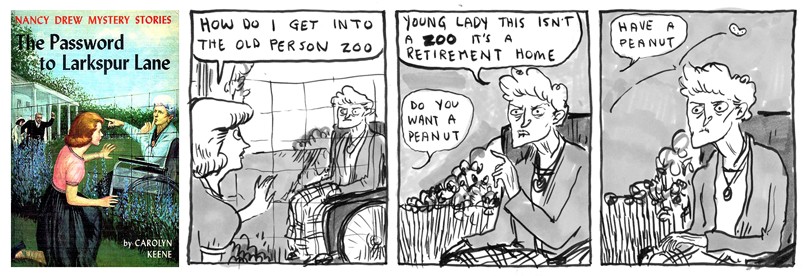
Kate Beaton interprets Nancy Drew book covers in her own unique way at Hark! A Vagrant.

And finally…

Kevin Huizenga has posted his head-spinning Glenn Ganges comic ‘Time Travelling’ at What Things Do.

1 Comment