Skip to content

Category: Miscellany

Something for the Weekend

Hornby Cover Versions — Some rather beautiful student work by Barcelona-based graphic designer Lucía Castro (although my inner-bookseller gets very twitchy at the thought of those soft off-white covers!). (via Cosa Visuales)

Full of Refusals — Tom McCarthy interviewed for More Intelligent Life:

[C]ontemporary literature has to deal with the challenges laid down by modernism. The most exhilarating and unsettling upheavals took place in the early 20th century, and to ignore them and go back to writing some kitsch version of the 19th-century novel is ostrich-like… I’m suspicious of the term ‘avant-garde’. I think it should be restricted to its strict historical designation: Futurists, Dadaists, Surrealists etc. “Tristram Shandy” and “Motherless Brooklyn” aren’t avant-garde novels; they’re novels.

C by Tom McCarthy will finally available in the US and Canada on September 7th.

A stunningly simple Malevich-like book cover design by Jason Booher and Helen Yentus for the paperback edition Inside the Stalin Archives by Jonathan Brent. First seen at the Book Cover Archive who have just posted a slew of Jason’s covers.

On the subject of the BCA, co-curator Ben Pieratt has recently updated his own design portfolio.

Agile Content — Marny Smith interviews Brian O’Leary of publishing consultants Magellan Media Partners:

[P]ublishers are competing against both established players and new entrants at the same time.  The newer players often have much lower costs than we’re used to, making them potentially tough competitors… I’ve been thinking lately that publishers need to work more aggressively on creating agile content that can be discovered and easily reused or recombined.  Creating content that is sold in one format just won’t be cost-effective in the future.

And finally…

The cute book trailer for OH NO! Or How My Science Project Destroyed the World written by Mac Barnett illustrated by Dan Santat:

You can find more of Dan’s awesome illustrations on his Flickr:

(via The Ward-O-Matic)

Comments closed

Midweek Miscellany

Jardin de la Connaissance —  Berlin-based landscape architect Thilo Folkerts and artist Rodney Latourelle used 40,000 reclaimed books to create a ‘Garden of Knowledge’ for the 11th International Garden Festival in Grand-Métis, Quebec (via Kitsune Noir).

A History of Print Culture — Assistant Professor of Media Culture,  C.W. Anderson,  provides his annotated syllabus for a print history course at CUNY in The Atlantic (thx Jamie):

The primary goal of this class is to teach students about the culture of “print media” in an era when that culture is being joined (and in some cases, overtaken) by a culture that we might variously call digital culture, online culture, or the culture of the web. What does “print” mean in our digital age? And what does “culture,” mean, for that matter? By culture I mean something that is not reducible to “economics,” “technology,” “politics,” or “organizations” — although culture emerges out of the nexus of these different factors, and others.  In other words, I want to disabuse my students of the notion that new technologies or new economic arrangements can create digital or print culture in the same way that a cue ball hits a billiard ball on a pool table.

Also in The Atlantic10 Reading Revolutions Before E-Books by Timothy Carmody.

Knowledgeable Criticism — An interesting interview with Fred Brooks, computer scientist and author of The Mythical Man-Month, for Wired magazine:

Great design does not come from great processes; it comes from great designers… The critical thing about the design process is to identify your scarcest resource. Despite what you may think, that very often is not money.

And finally…

When You Don’t Know You Are Breaking the Rules… Eli Horowitz, managing editor of McSweeney’s, interviewed for Scotland on Sunday (via the indefatigable  Largehearted Boy):

At the heart of McSweeney’s success is the huge amount of care and attention which goes into producing each book, ensuring that the jacket design and layout complement the words inside the covers. Though Horowitz believes there is a McSweeney’s aesthetic he is struggling to put into words what it is. “There’s a notion of old-fashioned story-telling and a compelling plot combined with an innovative literary impulse – when we’ve had those ingredients that’s when we’ve done our best works.”

Comments closed

Something for the Weekend

Psycho Cover — Penguin art director Paul Buckley discusses his new book Penguin 75 with Imprint:

I am very aware of how much product gets put out there that is completely unnecessary, be it music, movies, books, whatever—it seems that for every good piece of culture we experience, we are bombarded with 99 pieces of redundant crap. I’ve been in the industry for awhile, and of course want to show off the great work we do here, but was not going to put out yet another design book and take your money—you can get that in any annual. To me, often more interesting than the covers are the stories, the psychology that created all the variables that led to this cover over the 20 other proposed covers.

Paul has recently updated his Flickr with new covers from the Penguin Ink series, which utilizes art by tattoo artists, as well as the latest additions to the excellent Penguin Graphic Classics series, which have art by contemporary cartoonists.

My interview with Paul and Penguin 75 designer Christopher Brand is here.

Also at Imprint Thurston Moore of Sonic Youth and book editor Eva Prinz (formerly of Abrams and Rizzoli)  talk about their new publishing venture Ecstatic Peace Library.

Writing on the Wall — Andrew Franklin, publisher and managing director of Profile Books,  offers an overview of the current state of the book business in the UK (via Dan Mogford):

Bookshops enliven high streets, create communities of readers and stage author events, while good booksellers encourage reading and shape taste. For most readers, browsing is a key part of deciding what to read, and publishers put huge effort into packaging and presenting their books. Of course many of these activities can migrate online with Facebook groups, online forums, feeds and websites helping to steer readers to the books they will most enjoy. For some online shoppers bookshops are part of this process: they browse in bookshops, write shopping lists and then buy (perhaps more cheaply) online. But no bookshop can be in business as a shop window for other retailers. You don’t have to be hopelessly nostalgic or sentimental to believe something very precious is lost with every bookshop that closes.

And at the other of the spectrum…

Another Reading Revolution — Historian Andrew Pettegree talks about his new book The Book in the Renaissance with The Atlantic (via Shelf Awareness):

The situation really is that the first generation of printers, encouraged by scholars, naturally produced the sort of books these people wanted. But it’s hard to apply this sort of commercial model—this small, bespoke model used for manuscripts—to a new process that produces 300 or more identical items. The irony is that there were plenty of other readers out there. The first printers ignored the groups that we might call pragmatic readers. Literacy was already widely-disseminated in the fifteenth century. There were lots of people who could read but did not habitually buy books, so the trick was to discover how to reach them.

Comments closed

Midweek Miscellany

The Eyes Have It — An interview with gentleman book cover designer and advertising copywriter David Gee about his design for Jim Hanas’s e-book short story collection Why They Cried. You can find my interview with David here.

Writers on Process — Writers of every stripe talking about how they write (via Largehearted Boy).

In Their Own Words — A BBC archive of television and radio interviews with modern British novelists including Virginia Woolf, Daphne du Maurier, Anthony Burgess, J.G. Ballard,  and Muriel Spark. One could quibble about about selection of some of  contemporary novelists, but otherwise this is pretty amazing collection.

And speaking of archives…

Design is History is an expanding reference for graphic design history created by designer Dominic Flask.

And finally…

The only page of Jason’s silent and sadly aborted adaptation of Edgar Allan Poe’s The Black Cat.

e-book short story collection, Why They Cried

3 Comments

Something for the Weekend

Illustrator and designer Dale Edwin Murray’s proposed cover for the Reservoir Dogs Original Screenplay. Is it just me, or is there something of artist and erstwhile Penguin designer Alan Aldridge about this?

You can see more of Dale Edwin Murray’s work on his blog and his Flickr (via Cosas Visuales).

The Library Project — A photographic installation by Swiss artist Nicolas Grospierre inspired by the infinite library in Jorge Luis Borges’ novel short story The Library of Babel (via This Isn’t Happiness).

And finally…

Author David Mitchell talks to Michael Silverblatt about his new novel The Thousand Autumns of Jacob de Zoet on this week’s KCRW’s Bookworm.

I have a truly bad track record with David Mitchell novels, but I should probably give him another go  (although that title isn’t doing a lot to encourage me).

The BBC World Service also interviewed David Mitchell recently about his earlier novel Cloud Atlas.

2 Comments

Midweek Miscellany


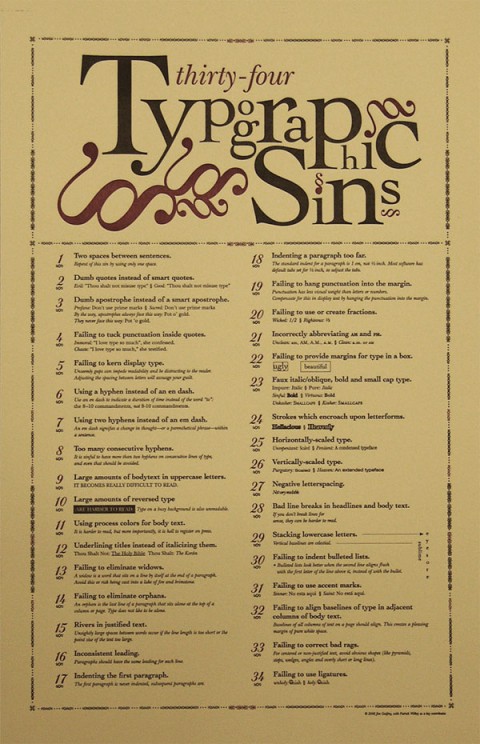
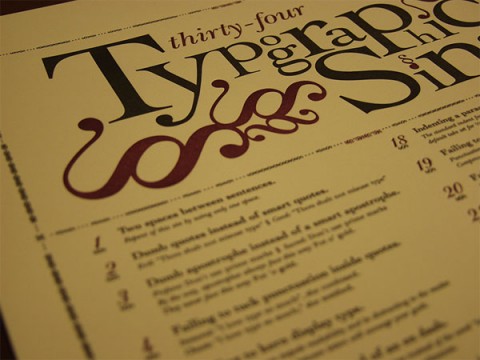
Typographic Sins Poster designed by Jim Godfrey (seen at For Print Only).

And on the subject of graphic design crimes…

Angry Paul Rand on Twitter (via @thebookdesigner):

My advice for designers & design students: fuck the rules, if your work is good enough to get away with it.

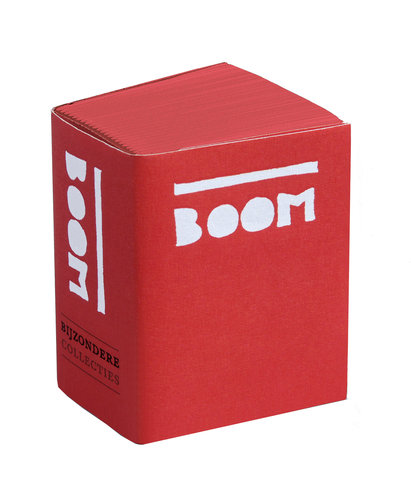
Boom — Alice Rawsthorn profiles Dutch book designer Irma Boom for the New York Times:

Ms. Boom, 49, has designed most of her books just as she has wanted. Typically, a book designer works with the text and images selected by the editor and art director, but Ms. Boom prefers to combine all three roles by deciding on the book’s structure and choosing the themes and visual material herself. She then obsesses over every element — not just how the book will look, but how it will feel and smell — and invents ingenious ways of achieving the desired effects.

One of her books was printed on coffee filter paper. Another was scented to smell of soup. A monograph of the work of the Dutch artist Steven Aalders was made in the exact dimensions of one of his paintings. The page edges of a book on the American textile designer Sheila Hicks were hacked with a circular saw to evoke the fraying edges of her work. The title on the white linen cover of a history of the Dutch company SHV only becomes visible after frequent use. There are 2,136 pages in that book, but no page numbers, to encourage readers to dip in and out.

An exhibition of Boom’s work, ‘Irma Boom: Biography in Books’ runs until Oct. 3 at the University of Amsterdam Library. The book accompanying the exhibition, designed by Boom and pictured above, is only 2 inches high, 1.5 inches wide and 1 inch thick.

And finally…

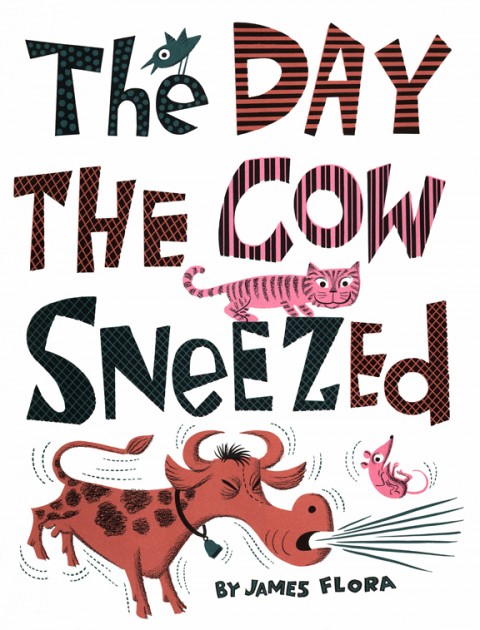
Enchanted Lion are reprinting Jim Flora’s kids books starting with The Day The Cow Sneezed in Fall 2010. Flora was best known his incredible jazz and classical album covers for Columbia Records and RCA Victor, and is officially awesome.

Comments closed

Words

Latest WYNC RadioLab podcast is all about words, and filmmakers Will Hoffman and Daniel Mercadante have made a beautiful video about wordplay and visual connections to accompany the episode:

2 Comments

Something for the Weekend

Patrick Cramsie, author of The Story of Graphic Design, chooses his top 10 graphic design books for The Guardian. The list includes Notes on Book Design by Derek Birdsall.

Type Education — FontShop have released a handful of free typography primers designed for downloading and printing, including ‘Seven Rules for Better Typography’ by Erik Spiekermann.

Frost — Sifting through the Penguin archive in Bristol, writer Gaby Wood profiles the late Eunice Frost, who became an editor at Penguin in the 1930’s and went on to become its first female director, for The Telegraph:

Frost was sharp and, for all her youth and inexperience, in many ways more culturally engaged than the Lane brothers… It was to a large extent thanks to her that Penguin began to publish original work – not just reprinted fiction but the Pelican series of new non-fiction, and the Penguin ‘Specials’ series – quickly produced tracts on various subjects of urgent import. Three weeks after war was declared, for instance, Harold Nicolson was commissioned to write a 50,000-word book entitled Why Britain Is at War, which he delivered two weeks later and which was published a fortnight after that.

Secrets of Life and Death — Artist Jaime Hernandez, co-creator of Love & Rockets, and comics scholar Todd Hignite discuss their new book The Art of Jaime Hernandez with Eric J. Lawrence on KCRW.

Comments closed

Midweek Miscellany

The typographical cover for Oscar Guardiola-Rivera’s What If Latin America Ruled the World designed by Sarah Greeno at Bloomsbury UK.

The Gall — The inimitable  John Gall, VP and Art Director of Vintage / Anchor Books, interviewed for a rather super looking new magazine called Design Bureau:

[O]nce you have a nice solid concept, the rest of the process can almost seem effortless; enjoyable, even. And these, of course, are usually the best ones.” Gall describes his creative process as threefold: research, concept and execute. “Read the books, come up with some ideas, flesh them out, see what is sticking,” he says. However, it’s the process of getting a book’s cover approved that poses the greatest challenge for Gall and his team. “If the publisher comes back and says, well, ‘This needs really big type with a chicken on it’, that obviously means they think this is kind of important,” he says. “The re-working, dealing with all the feedback (some warranted, some moronic) ‘make this bigger’, ‘make this smaller’, ‘my psychic thinks it should be blue’—that is what separates the men from the boys,” he says.

John Gall by Noah Kalina

The article is accompanied by photographs by Noah Kalina, and includes John’s tips for lunch in New York. What more could you ask for? An interview with designer Abbott Miller you say? Well, Design Bureau have one of those as well.

Exit Interview — Former New York Times Design Director Khoi Vinh on designing the newspaper’s paywall, and his decision to walk away, in the New York Observer:

One way of trying to make logical design decisions is through research. Mr. Vinh’s team has been studying traffic patterns on the site and watching test subjects, real readers, in a lab to see how their eyes move across the page when they are reading The Times online.

“I take it all with a grain of salt,” he said. “Everything is so measurable now, theoretically. But the truth of the matter is, there’s never enough data to substitute for raw decision-making abilities. At the end of the day, you still need to make the decision.”

Designing Madison Avenue The New York Review of Books blog on the look of TV show Mad Men:

Among many things that make Mad Men so intriguing is its broad definition of what constitutes design. For example, its cunningly detailed, not-quite-couture female costuming—the B.H. Wragge-style coat-and-dress ensembles, the Koret handbags, the Coro costume jewelry—makes the female characters … seem as if they have stepped straight out of the Sunday New York Times during the twilight of Lester Markel… Equally fanatical attention is paid to interior design. The offices of Sterling Cooper were done up in the spacious, late International Style corporate mode epitomized by the boxy glass-and-steel skyscrapers that rose along Park Avenue after World War II.

And on a somwhat related note, Eleanor Wachtel interviews legendary designer Milton Glaser for CBC Radio. Good stuff.

1 Comment

The Wave Pictures, Sweetheart

The official video for The Wave Pictures EP Sweetheart, directed by Ben Reed and made entirely out of second hand books:

2 Comments

Something for the Weekend

Today is Penguin’s 75th Birthday! Happy Birthday Penguin.

Tony Lacey, Publishing Director of Penguin, discusses the Penguin Decades series:

And The Guardian interviews Penguin Chief Executive John Makinson, who sounds pretty pleased with himself (Penguin just announced record-breaking half year results):

“[E-books] redefine what we do as publishers and I feel, compared with most of my counterparts, more optimistic about what this means for us,” he says. “Of course there are issues around copyright protection and there are worries around pricing and around piracy, royalty rates and so on, but there is also this huge opportunity to do more as publishers.” Publishing, he says, must embrace innovation: “I am keen on the idea that every book that we put on to an iPad has an author interview, a video interview, at the beginning. I have no idea whether this is a good idea or not. There has to be a culture of experimentation, which doesn’t come naturally to book publishers.

In other news…

Copy Writer from the Dark Side — Author Will Self (Liver) discusses advertising with Gordon Comstock for an interview the Creative Review:

I straighten my dog collar and point out some of the things we might have in common, the novelist and the adman. The love of epigrams, the twisting of cliché, the use of animals behaving uncannily – all Self tropes, all things that a copywriter might well have in his book.

It’s a notion I can imagine certain writers would bridle at, but Self only nods philosophically, “Well, maybe I am a copywriter that’s gone to the dark side, I don’t know.”

Wonder Woman Returns — Kate Beaton goes all superhero and shit at Hark! A Vagrant. Kate is now also selling prints directly from her site and from TopatoCo.

And finally, on a related note and because it’s Friday,…

Lady Gaga Kidnaps Commissioner Gordon:

Supervillain Lady Gaga brazenly abducted Commissioner James Gordon from a charity fundraiser Tuesday, leaving police baffled and the citizens of Gotham fearing for their safety. Known for her outlandish costumes and geometric polygon hair, the criminal madwoman made a daring escape from Arkham Asylum last week and has been taunting authorities by interrupting television broadcasts ever since… While the kidnapping occurred at stately Wayne Manor, home of playboy jet-setter Bruce Wayne, the eccentric billionaire was not available for comment.

Comments closed

Midweek Miscellany

The elegant new cover design for The Secret of Contentment by William B. Barclay, designed by Christopher Tobias.

Melancholy Technology — Tom McCarthy, whose novel C is on the long-list for the Man Booker Prize, on technology and the novel:

Technology and melancholia: an odd coupling, you might think. Yet it’s one that has deep conceptual roots. For Freud, all technology is a prosthesis: the telephone (originally conceived as a hearing aid) an artificial ear, the camera an artificial eye, and so on. Strapping his prosthetic organs on, as Freud writes in Civilisation and its Discontents, man becomes magnificent, “a kind of god with artificial limbs” – “but” (he continues) “those organs have not grown on to him and they still give him much trouble at times”. To put it another way: each technological appendage, to a large degree, embodies an absence, a loss.

There Might Be Typos On The Internet — Lori Fradkin on life as a copy editor for The Awl :

Once you train yourself to spot errors, you can’t not spot them. You can’t simply shut off the careful reading when you leave the office. You notice typos in novels, missing words in other magazines, incorrect punctuation on billboards… Another downside of the job is that only your mistakes are apparent. The catches are basically invisible. No one will look at an edited article and think, I am certain that, once upon a time, there was a double quote where there should have been a single, and a wise person fixed the issue for my benefit. But if you let a “their” slip through in the place of a “there,” you are a complete moron. And if you are working online, commenters will let you know so.

For Sur — The folks at We Made This on their contribution to the Penguin Great Ideas V series:

We did a bit of research into Borges’ writings, and learnt that he’d been one of the founding contributors to the Argentine literary journal Sur, which was published regularly from 1931 until around 1966… he magazine has a very distinctive (and typographically bonkers) masthead, and fortunately the name ‘Sur’ isn’t a million miles from the name ‘Borges’, so basing our design on it felt like a rather tasty solution.

Design Space — Design consultant Theo Rosendorf, author of  The Typographic Desk Reference, talks about his work and his office space with Herman Miller:

Typography plays a major role in the practice beyond simply picking a font or knowing a particular brand’s guidelines. Every typeface has unique requirements in that it has to be set just so. It’s up to the graphic designer to understand what a particular typeface wants. We work within those bounds to let type communicate as it was intended. Everything else follows.

And speaking of typography…

Brockmann in Motion —  Vít Zemčík animates a print design masterpiece. Zemčík made this beautiful 12 second short during the International Typography Workshop in Czieszyn.

Comments closed