Skip to content

Category: Miscellany

Midweek Miscellany

A little late on this, but 50 Watts has posted the winners of  Polish Book Cover contest. Will Schofield’s co-judges were Aleksandra and Daniel Mizieliński, editors of 1000 Polish Book Covers, and Peter Mendelsund. All the amazing entries are here. Pictured above: A Clockwork Orange by Chris Taylor.

Fragments of Experience The Guardian reviews Modernist America by Richard Pells:

Film editing, he tells us, owes debts to cubism, futurism and surrealism. Cutting from one shot to another enables the cinema to “create a feeling of movement as well as a sometimes fractured sense of time and reality. The fragments of experience, captured in a single shot and then juxtaposed with other shots to produce a multiplicity of perspectives, are the cornerstones of the cinema, and they are also central to the modernist view of the world.”

Music from Nowhere — Rob Young, author of Electric Eden, interviewed in the LA Times:

[P]art of my argument is that the British folk revival did actually begin much earlier than… the 1950s — you have to look back at the late 19th century and the Victorian folk collectors… [William] Morris is important because what you find in the 1880s and ’90s is a surge of conservation and preservation projects starting up, mainly by people who were horrified at the destructive effects of industrial progress on the landscape, the environment and the labor conditions of the working class. Morris was at the forefront of this, and his time-travel novel “News from Nowhere” sets out the utopian conditions of a better world in which the future is actually like a medieval golden age.

Gestalt-Ingenieur — Dieter Rams on design, Jonathan Ives and Apple for The Daily Telegraph:

I am troubled by the devaluing of the word ‘design’. I find myself now being somewhat embarrassed to be called a designer. In fact I prefer the German term, Gestalt-Ingenieur. Apple and Vitsoe are relatively lone voices treating the discipline of design seriously in all corners of their businesses. They understand that design is not simply an adjective to place in front of a product’s name to somehow artificially enhance its value. Ever fewer people appear to understand that design is a serious profession; and for our future welfare we need more companies to take that profession seriously.

And finally…

Music for Dieter Rams — a mini-album by Jon Brooks (via The Donut Project):

“Every sound on this record, from the melodic sounds to the percussion, the atmospheric effects to the bass lines originates from the Braun AB-30 alarm clock.”

Awesome.

Comments closed

Something for the Weekend

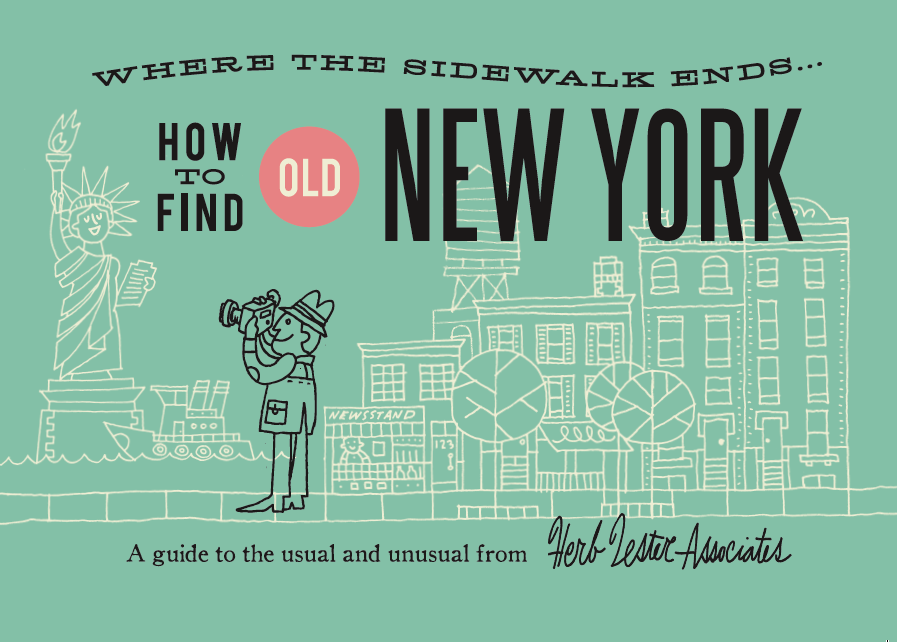
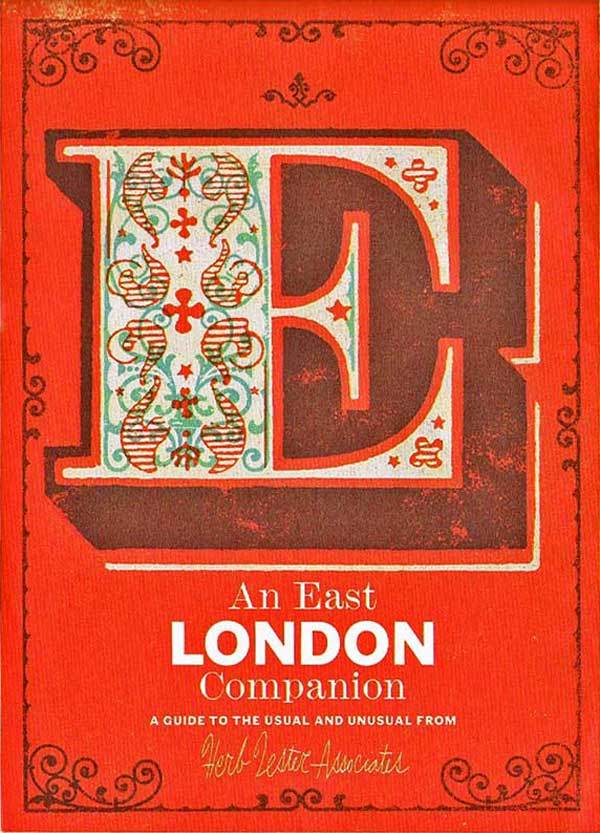
Old Fashioned, Foldy, Inky Things — Daniel Gray (fellow member of the fictional League of Daniels) interviews Ben Olins and Jane Smillie about creating the wonderful Herb Lester city maps:

Old fashioned, foldy, inky things have personality, something which Google maps and web guides lack. But the limitations of the format also force you to be selective, to only recommend things you genuinely believe to be good. It’s a fallacy that comprehensive listings are useful, when really they’re just confusing – it’s so much easier when someone makes a decision for you.

Collecting / Organizing / Cataloging — Steven Heller interviews Greg D’Onofrio and Patricia Belen of Kind Company about DISPLAY, their wonderful a collection of mid-century modern graphic design books and journals:

For us, one of the primary responsibilities of owning a collection is conducting research about the objects we acquire and finding out how they can far exceed their role as inspirational “eye candy”. The combination of collecting / organizing / cataloging has helped us see new, unique perspectives and discover a greater understanding of many of the principles, ideas and theories we so often admire.

See also: Steven Heller (who is apparently waging a one man occupation of the internet) on graphic designers and hoarding:

Design stuff finds refuge in drawers, on shelves, in boxes; we store it in offices, apartments, dens, living rooms, garages and attics (basements are too easily flooded). Along with lint balls, design stuff is often hiding under the bed. Design stuff is mostly paper, but can also be packaging or points-of-purchase displays—it may be small, medium or large. We hang it on walls and pay considerable amounts to have it framed. Uncontrollably, we hunger and devour it in stores, markets, shows and eBay (damn you, eBay!!). Ravenously, we hunger for and devour bargains, but when they don’t materialize, we pay sizable sums to own the more rare and costly stuff (sometimes realizing we owned it when we were children). In fact, knowing that years ago Mom might have thrown out some potential treasure, we are even more conditioned to hoard anything that could be construed as potentially valuable in the future.

Dead End — Cartoonist Joe Sacco on his most recent book, Footnotes in Gaza, in The Believer:

I think, for me, the book ends up being—this is going to sound strange—a dead end. Because I don’t know where to go from here, except to delve into human psychology. I think I understand how history works. I understand why one people are battling another people. I understand that they both want land. But ultimately there’s a level that I haven’t really got to yet. I’m touching on motive in places, like what makes someone pull a trigger? What makes one person beat another one to death? I know we can dehumanize people. Obviously, that’s the main thing. And I know we can fear them enough that we’d kill them before we think they’re going to kill us. There’s all that going on. But I think I need to go in another direction after this book. What am I going to do after this? Keep detailing massacres? For me, personally, I think I’m not going to get anything out of it anymore. I’ve come to the end of that.

And finally…

Simon Reynolds on his new book Retromania: Pop Culture’s Addiction to its Own Past in The Guardian:

The deeper you venture into the underground, the more music involves pilfering from the past. This is one of the central mysteries that propelled me through the writing of Retromania: how come the very kind of people who would have once been in the vanguard of creating new music (bohemian early adopter types) have switched roles to become antiquarians and curators? In the underground, creativity has become recreativity. The techniques involved are salvage and citation; the sensibility mixes hyper-referential irony with reverent nostalgia.

2 Comments

Midweek Miscellany

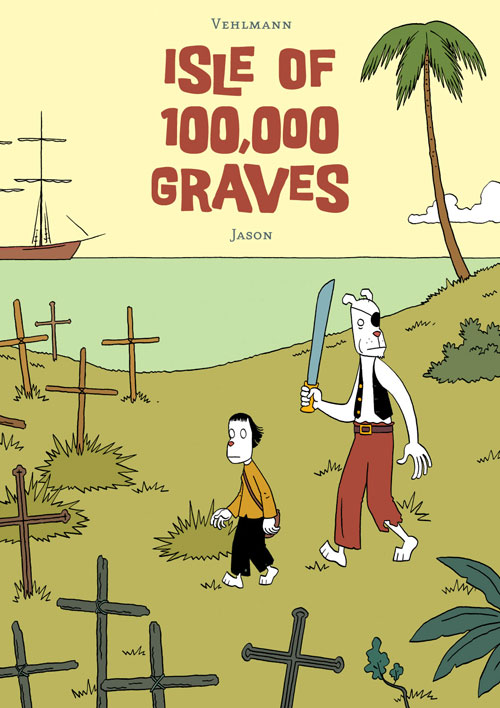
An introductory reading guide to the work of Norwegian cartoonist Jason from Robot 6:

Since his U.S. debut in 2001, Jason has produced 15 books, with nary a drop in quality. More to the point, he’s been able to use and play with a lot of familiar genre cliches — movie monsters, the big heist, the man accused of a crime he didn’t commit — and make them seem fresh and inviting.

That’s largely because his characters are usually grounded in a strong emotional reality. What often drives them are not simplistic ideals about right and wrong but love, longing, guilt and anxiety, the same stuff that drives most of us. What’s especially fascinating about his work, though, is how he’s able to convey all these roiling emotions with such a… minimalist style… Anyone interested in learning about timing and tempo… should be studying Jason’s comics.

Jason’s latest book Isle of 100,000 Graves is released this month.

Let’s Put It This Way — Cartoonist Ivan Brunetti profiled in The Chicago Tribune:

When people talk about Brunetti, they often couch it with a “Let’s put it this way.” Francoise Mouly, the longtime art director of the New Yorker, said, “Let’s put it this way — Ivan will never be comforted in life.” She said it in her native French lilt, with the breeziness of tone and the bluntness of meaning we associate with the French. But without malice or sarcasm, only lament and concern. There is no comforting Ivan Brunetti.

(I am still slightly traumatized by Brunetti’s Misery Loves Comedy)

The Poverty of Abundance — Sukhdev Sandhu, author of London Calling: How Black and Asian Writers Imagined a City, reviews Retromania: Pop Culture’s Addiction to its Own Past by Simon Reynolds for The Observer:

Retromania is a book about the poverty of abundance. At malls, on mobile-phone ads, in the background as we work at our computers: pop, usually in the form of anorexically thin MP3 sound, is everywhere these days. Perhaps that ubiquity puts a brake on its ability to astound or shape-shift. Perhaps the process of circulating and accessing music has become more exciting than the practice of listening to it.

Future Classics — Agent Andrew Wylie in The WSJ:

[T]he business we’re in is to identify and capture and anticipate the value of books that are inherently classics, future classics… Sure, writers these days can go directly to readers, without publishers or agents. But there needs to be a chain of people who have authority and can help convey what is essential. We spend most of our time strongly supporting work that we believe is significant.

And finally…

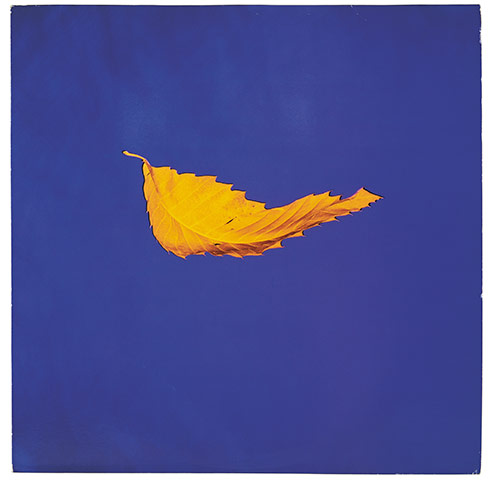
Peter Saville discusses his favourite designs for Joy Division and New Order with The Guardian.

Comments closed

Midweek Miscellany

An incredible Flickr set of 20th Century avant-garde book covers (via Quipsologies).

The Lottery — Ruth Franklin, author of A Thousand Darknesses, on the history of the American bestseller for Book Forum:

Trends come and go, but the best seller remains essentially serendipitous. An editor can be no more certain of finding the next one than a writer can be assured of writing it. “As a rule of thumb,” writes John Sutherland, an English scholar who has studied the phenomenon, “what defines the bestseller is bestselling. Nothing else.”

Dystopia — Malcolm McDowell, Jan Harlan and Christiane Kubrick discuss the remastered 40th anniversary edition of Stanley Kubrick’s adaptation of A Clockwork Orange with Guardian film critic Xan Brooks (video).

Multitasking — Wyndham Wallace on the demands currently placed on musicians for The Quietus (via BookTwo):

“When you’re in Hollywood and you’re a comedian,” another tragically deceased stand-up, Mitch Hedberg, joked, perhaps bitterly, “everybody wants you to do things besides comedy. They say, ‘OK, you’re a stand-up comedian. Can you act? Can you write? Write us a script?’ It’s as though if I were a cook and I worked my ass off to become a good cook, they said, ‘All right, you’re a cook. Can you farm?’” This is the position in which our musicians now find themselves. They’re expected to multitask in order to succeed. Their time is now demanded in so many different realms that music is no longer their business.

And lastly…

Old ‘Boofy’ Halberstam — P. G. Wodehouse’s American Pyscho at McSweeney’s Internet Tendency:

“What, old ‘Boofy’ Halberstam on some kind of psychotic killing spree? That’s hardly the sort of thing that would stand up in court—I mean to say, there was that business with the policeman’s helmet back at Harvard, true enough, but even so—”

“Not to worry, Patrick. You see, yesterday evening I took the further liberty of murdering Mr. Halberstam.”

I stood agog.

AGOG.

Comments closed

Midweek Miscellany

Line o’ Type — John Hendel celebrates 125 years of Linotype at The Atlantic:

A German immigrant named Ottmar Mergenthaler invented [Linotype] in the 1880s and continued to promote and expand its use until dying in Baltimore in 1899. The Linotype’s power involved transferring a line of text (typed with meticulous care by a Linotypist onto a special 90-key keyboard) to a sheet, creating a “line o’ type” that could be rapidly printed onto many subsequent pages, thanks to the genius of matrices and hot metal.

A Good English ButlerDwell Magazine spends 30 minutes with designer Dieter Rams:

Never forget that a good product should be like a good English butler. They’re there for you when you need them, but in the background at all other times. Besides a few millionaires in London, most of us don’t have butlers.

The butlers of today are our products and our furniture.

And on a related note… Erik Spiekermann talks about typography and crowd-sourcing a logo for human rights with Deutsche Welle:

Typography is the famous crystal goblet – you drink the wine, you don’t think about the glass. I can make things a little bit warmer or colder, or squarer or rounder, but I am a servant to the words… I like to say, typography is like air – you only talk about it when it’s bad. It’s taken for granted, but we would certainly miss it if it wasn’t there.

Lying LiarsIan Leslie, author of Born Liars: Why We Can’t Live Without Deceit, on the connection between lying and storytelling:

[T]here is a gushing river of verbal creativity in the normal human mind, from which both artistic invention and lying are drawn. We are born storytellers, spinning narrative out of our experience and imagination, straining against the leash that keeps us tethered to reality. This is a wonderful thing; it is what gives us our ability to conceive of alternative futures and different worlds. And it helps us to understand our own lives through the entertaining stories of others. But it can lead us into trouble, particularly when we try to persuade others that our inventions are real. Most of the time, as our stories bubble up to consciousness, we exercise our cerebral censors, controlling which stories we tell, and to whom. Yet people lie for all sorts of reasons, including the fact that confabulating can be dangerously fun.

See also: Cynthia Crossen on the allure of unreliable narrators for the WSJ:

Today, unreliable narration does seem to be in vogue. Could that be because so many people are chronicling their lives online now, and we can see how unreliable most personal narratives are? As David Fromkin wrote in his history of civilization, “The Way of the World,” “Life is a story that each of us tells to his or her self; and it therefore is a tale told by an unreliable narrator.”

And finally…

Author Umberto Eco on the books we haven’t read for The Guardian:

There are more books in the world than hours in which to read them. We are thus deeply influenced by books we haven’t read, that we haven’t had the time to read… And yet I’ve a fairly accurate notion of what I haven’t read. I have to admit that I only read War and Peace when I was 40. But I knew the basics before then. The Mahabharata – I’ve never read that, despite owning three editions in different languages. Who has actually read the Kama Sutra? And yet everyone talks about it, and some practise it too. So we can see that the world is full of books that we haven’t read, but that we know pretty well.

Comments closed

Something for the Weekend

The New Museum — Steven Heller profiles Will Schofield, the man behind the awesome 50 Watts blog, for The Atlantic:

For want of money, Schofield notes that he always bought cheap used copies and mass-market editions of the books he actually read. “So before I ever thought about design history, I had stacks of books from New Directions, Grove, Calder, Doubleday Anchor, Ace, and the Time Reading Program. Once I learned the names, I realized I had been long been admiring the work of designers like Paul Rand, Alvin Lustig, George Salter, Milton Glaser, Seymour Chwast, George Giusti, and Roy Kuhlman and illustrators like Edward Gorey and the Dillons.”

A Country Without Libraries — A stirring defence of public libraries by poet Charles Simic for the NYRB:

I don’t know of anything more disheartening than the sight of a shut down library. No matter how modest its building or its holdings, in many parts of this country a municipal library is often the only place where books in large number on every imaginable subject can be found, where both grownups and children are welcome to sit and read in peace, free of whatever distractions and aggravations await them outside. Like many other Americans of my generation, I owe much of my knowledge to thousands of books I withdrew from public libraries over a lifetime. I remember the sense of awe I felt as a teenager when I realized I could roam among the shelves, take down any book I wanted, examine it at my leisure at one of the library tables, and if it struck my fancy, bring it home. Not just some thriller or serious novel, but also big art books and recordings of everything from jazz to operas and symphonies.

See also: Why Libraries Still Matter by Laura Miller for Salon.

God Arrived by Train — An interesting article about the philosopher Ludwig Wittgenstein, and an exhibition on his life currently on display at Schwules Museum in Berlin, 60 years after his death:

Wittgenstein may have gained a reputation as a solitary, tormented and alienated philosopher, but the exhibition seeks to show the many social ties he had in England and Austria, which continued after he was no longer active in academia. Among others, he formed connections with prominent figures such as the philosophers of the “Vienna Circle” (whose school of logical positivism was deeply influenced by his thinking ) – architect Adolf Loos, writer and satirist Karl Kraus and economists Piero Sraffa and John Maynard Keynes. When Wittgenstein returned to Cambridge University in 1929, Keynes wrote to one of their friends: “Well, God has arrived. I met him on the 05:15 train.”

And finally…

Slate has an excerpt from The Influencing Machine by Brooke Gladstone and illustrated by Josh Neufeld, mentioned earlier this week.

Comments closed

Midweek Miscellany

Juggling — The multi-tasking Charlotte Strick,  art editor of The Paris Review, art director at Faber & Faber and Farrar, Straus & Giroux, and book designer,  interviewed at From The Desk Of…

Genre — China Miéville, on his new book Embassytown and genre fiction in The Guardian:

“I love genres; I think they are fascinating. My issue with litfic is not that it is a genre but that (a) it doesn’t think it is and (b) it thinks it’s ipso facto better than all the ones that are genres. Literary fiction of that ilk – insular, socially and psychologically hermetic, neurotically backslapping and self-congratulatory about a certain milieu, disaggregated from any estrangement or rubbing of aesthetics against the grain – is in poor shape.”

Invasion by the Virtual — Iain Sinclair discusses London and five novels that capture the spirit and history of city:

When the railways were first put in, there was devastation, because there were so many competing companies who just ripped up houses right, left, and centre. In the name of catching the spirit of the age and indulging in this technological process (and the idea of progress through science), London was savagely remade. It took a long time to absorb, recover and discover itself through that. At the moment, we’re in this sort of management age — an age of the virtual — in which you can change reality by looking at digitised, computer-generated images and projecting a fantastic city of the future, like a science fiction. People have come to believe that this is reality, even though they are contradicted by observation, which shows you devastated fields, radioactive materials buried in the ground that have been ripped up fast, and absolute destruction… So it is a devastating moment for the city, which I don’t think has ever been under such a prolonged form of invasion by the virtual.

Franzen’s Ugly Americans — Tim Parks on reading Jonathan Franzen’s Freedom in Europe (and, incidentally, the work Swiss novelist Peter Stamm, author of Seven Years, which sounds great) (via Bookslut):

Freedom’s failings are interesting in so far as they deepen the mystery of the book’s international success. It’s one thing for the Americans to hype and canonize one of their favorite authors, but why do the Europeans buy into it? Ever anxious that they need to understand America, fascinated by its glamor and power, Europeans are perhaps attracted to those American novels that explain everything: Roth’s American Pastoral, DeLillo’s Underworld. More than a novel by an American they want The Great American Novel. But of course Europeans also resent American world hegemony and feel (still and no doubt wrongly) superior culturally.

And finally…

20 Books Every Graphic Designer Should Read and an interview with Rick Poynor, founding editor of Eye and a co-founder of Design Observer, who compiled the list, at Designers and Books:

Books always point to other books. A bookshop, like a library, is a fantastic, spatially organized, easily navigable source of vast quantities of interconnected information about what exists for you to discover and know. If someone devised an online virtual space that allowed you to do this kind of rapid, effortless, multifocal, visual, and spatial browsing—perhaps someone has, though it certainly isn’t Amazon or the iPad App Store—we’d applaud them for a brilliant new concept. But these marvelous spaces already exist, at least for the time being, right there in your local shopping street.

art editor of The Paris Review and an award-winning designer known for creating the jackets for books by Roberto Bolaño, Lydia Davis, and Jonathan Franzen, among many others. She is also art director of Faber & Faber, Inc. and of the paperback line at Farrar, Straus and Giroux.art editor of The Paris Review, art director of Faber & Faber and at Farrar, Straus & Giroux,
Comments closed

Something for the Weekend

Canadian book designer Bill Douglas annotates one of his favourite covers for the newly launched Toronto weekly The Grid.

Tools of the TradeJonathon Green, author of the three volume Green’s Dictionary of Slang and the somewhat more compact and affordable Chambers Slang Dictionary, on the life of a lexicographer:

What I do is to sit alone in a room with a screen in front of me, a book more than likely to my left, held open by the weight of a discarded piece of chain, and within reach walls full of more books which are not just books but also tools and at the same time both extensions of and bastions for my existence. Some of them I have even made myself. With this screen and books and book-shaped tools I chase down words. And by placing these words in alphabetical order and by naming and defining and providing a word-based background for their existence and more words that illustrate examples of their use I create yet another book which is designated more than any other type to be a tool in its turn.

A Nostalgic Baseline — Harvard English Professor Leah Price, author of The Anthology and the Rise of the Novel and the forthcoming Unpacking My Library: Writers and Their Books, on books as objects:

“In thinking about new media, we measure what we do now against a nostalgic baseline. We compare the way we really do use digital media to the way we imagine we once used printed media, so that we take the reading of printed books to stand for all sorts of values we think we used to have, like sustained attention, linear thinking, noninstrumental appreciation,” Price said. “But if you just count how many pages came off of the printing press at any moment, never in any historical period have books, let alone literary works, been the majority of printed production.”

What Are You? — A wonderful essay by Alexander Chee, author of the novel Edinburgh, on comics, identity and American culture at The Morning News:

At the supermarket when people asked my white mom, “Whose little boy is this?” sometimes I would defiantly insist I was hers, sometimes say nothing, but I’d glare each time as if I had eyebeams that could vaporize them… No one else was like me, except my sister and brother… In the bathroom I sometimes imagined myself as I would have been with either a white face or an Asian one, looking into the hazel part of my eye and seeing the green extend across all the way, or watch it shrink back, covered by brown. The freckles would blanch away or extend until they met and my face turned darker.

It would have been easier to be a mutant, I decided. I sometimes told myself I was one, that it was the only explanation for the reason so many people asked me “What are you?”

The Ludovico Treatment — Steve Rose on Stanley Kubrick’s film adaptation of A Clockwork Orange, released 40 years ago, for The Guardian:

Beyond the UK, the movie has never been out of currency, particularly in the US, and particularly among the young. Its sci-fi stylings have aged remarkably well, and its almost abstract portrayal of out-of-control youth and paternalistic society have made it something of a teenage rite of passage, the movie equivalent of The Catcher in the Rye. Remarkably, it has been a style guide for pretty much every subsequent musical genre… On the big screen, meanwhile, every time you see a gang walking along in slow-motion, a speeded-up party scene, a slow pan out from a closeup of a face, a torture scene set to cheerful music, the chances are it was plundered from Kubrick’s original.

There Are Enough Chairs — A short interview with designer Dieter Rams in the New York Times:

Most of the things are done already — you can’t make it better. Look at chairs: there are enough chairs. There are bad chairs, some good ones, mostly bad ones. But there are, even with a chair, possibilities to make it more comfortable or, from the economic point, you can make it cheaper, save some material or you can try new materials.

And finally…

Because it’s Friday, and because I can, The Velvet Underground Oh! Sweet Nuthin’:

You can thank me later.

Comments closed

Midweek Miscellany

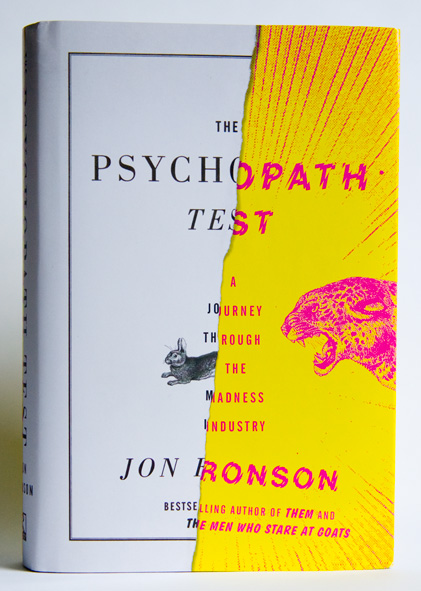
Half Crazy — Matt Dorfman on his great book cover design for The Psychopath Test by Jon Ronson, published by Riverhead Books:

Riverhead did not skimp on the production touches for this one. They sprung for a combination gritty matte finish (which covers the white paper portions of the jacket) and a shiny gloss for the yellow/magenta “crazy” half, thereby giving your sense of touch a noticeable edge if you find yourself blindly scanning your shelf for this book in a dark room (which I have done).

The Intimate Orwell — Simon Leys reviews Diaries by George Orwell, edited by Peter Davison, and George Orwell: A Life in Letters also edited and annotated by Davison, for the NYRB:

From the very start, literature was always Orwell’s first concern. This is constantly reflected in his correspondence: since early childhood “I always knew I wanted to write.” This statement is repeated in various forms, all through the years, till the end. But it took him a long time (and incredibly hard work) to discover what to write and how to write it. (His first literary attempt was a long poem, eventually discarded.) Writing novels became his dominant passion—and an accursed ordeal: “writing a novel is agony.” He finally concluded (some would say accurately), “I am not a real novelist.” And yet shortly before he died he was still excitedly announcing to his friend and publisher Fredric Warburg, “I have a stunning idea for a very short novel.”

Investigative Self-Repair — Author James Lasdun (It’s Beginning to Hurt) reviews Edward St. Aubyn’s latest semi-autobiographical Patrick Melrose novel At Last for The Guardian:

This act of investigative self-repair has all along been the underlying project of these extraordinary novels. It is the source of their urgent emotional intensity, and the determining principle of their construction. Not much gets into these books that doesn’t bear directly on Patrick’s predicament. Exposition is kept to a minimum; there are few descriptive passages, no digressions. For all their brilliant social satire, they are closer to the tight, ritualistic poetic drama of another era than the expansive comic fiction of our own.

And finally…

The General Specialist — Designer, illustrator, and letterer Jessica Hische talks to Method & Craft:

I love learning about new things whether or not they directly connect to how I earn a living and I think that this desire to pay attention to related industries is one of the reasons why I’m a figure in the design community. It’s by learning about many things that you’re able to understand specialization—that design is broken into countless micro-industries. If you don’t understand the differences between them (or acknowledge that they exist), there is no way for you to find your own specialized niche with in it.

Comments closed

Something for the Weekend

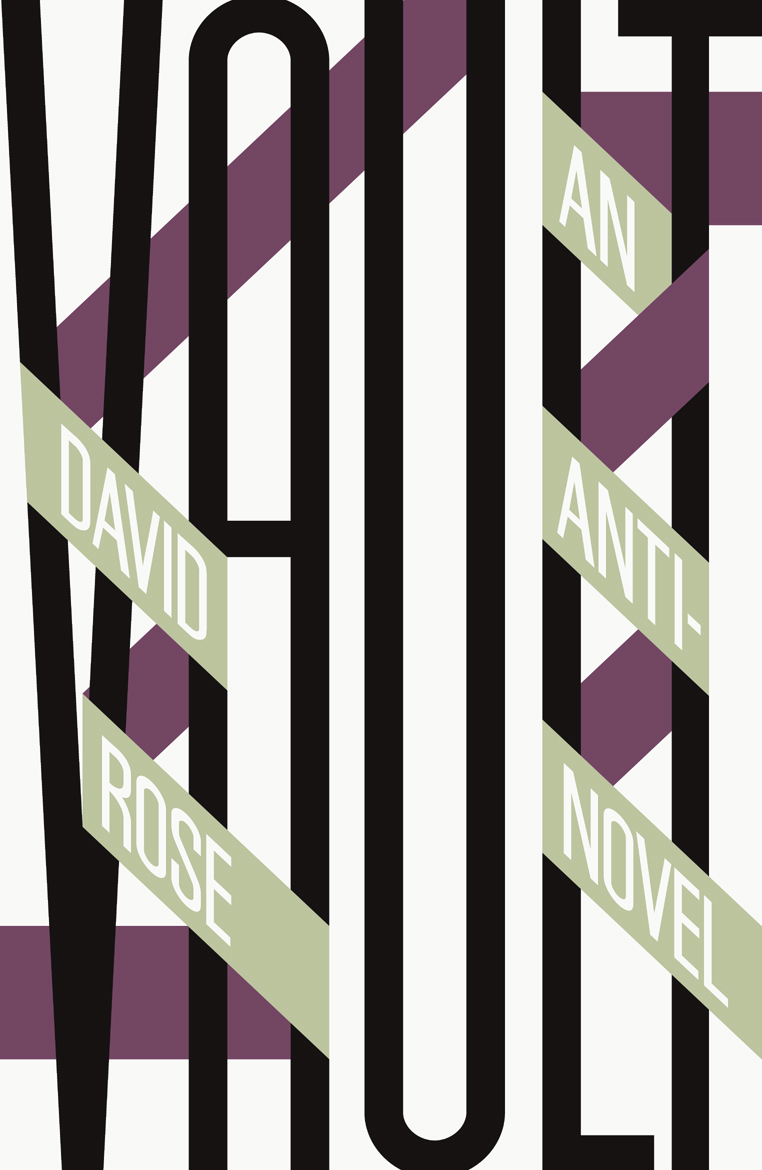
A distinctively typographic cover by David Pearson for Vault by David Rose, new from Salt Publishing.

Giving Up Irony — John Self reviews Edward St. Aubyn’s At Last:

The author’s background, like Patrick’s, is of inherited wealth; perhaps it is this which enables him to treat his characters mockingly and sympathetically at the same time. His brittle, witty prose evokes comparisons with Evelyn Waugh, whose snobbish attraction to the upper classes, looking in on them from without, contrasts with St Aubyn’s cool-eyed appraisal. The phrase “a handful of dust”, quietly slipped into At Last, could be an acknowledgement of the similarities and contrasts.

Patrick is like his creator, not just in his background, but in his stylistic weaknesses:

“It’s the hardest addiction of all. Forget heroin. Just try giving up irony, that deep down need to mean two things at once, to be in two places at once, not to be there for the catastrophe of a fixed meaning.”

The Architecture of the Secret Lair — Mark Lamster for Design Observer:

The Bin Laden compound makes an interesting contrast with the secret modern lairs created for Bond villains by the legendary production designer Ken Adam. These have routinely been described as unrealistic, insofar as they could never be built without drawing attention. It’s curious now, in retrospect, to think that it was fear that kept the local population from Dr. No’s island hideaway (which was just off British and American territory). Though Bond films make us think of visual extravagance, the most visually arresting set from the film was the rather raw interrogation room, with its cross-beam, ocular ceiling. What was in Osama’s basement?

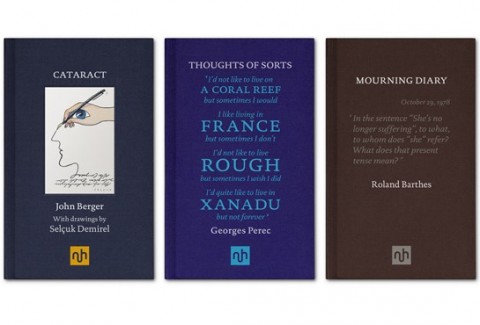
Notting Hill Editions, a new publishing imprint devoted to the essay, launches this month with books by from John Berger, Georges Perec and Roland Barthes among others. The typographic covers were designed by Garvin Hirst at Berlin-based design consultancy Flok.

And finally…

The Burden of Entertainment — Woody Allen discusses five books that still resonate with him:

The Catcher in the Rye has always had special meaning for me because I read it when I was young – eighteen or so. It resonated with my fantasies about Manhattan, the Upper East Side and New York City in general.

It was such a relief from the other books I was reading at the time, which all had a quality of homework to them. For me, reading Middlemarch or Sentimental Education was work, whereas reading The Catcher in the Rye was pure pleasure. The burden of entertainment is on the author. Salinger fulfils that obligation from the first sentence on.

Reading and pleasure didn’t go together for me when I was younger. Reading was something you did for school, something you did for obligation, something you did if you wanted to take out a certain kind of woman. It wasn’t something I did for fun. But Catcher in the Rye was different. It was amusing, it was in my vernacular, and the atmosphere held great emotional resonance for me. I reread it on a few occasions and I always get a kick out of it.

new publishing imprint launching in May, which is dedicated to revitalising and celebrating the essay.
1 Comment

Midweek Miscellany

Scripts: Elegant Lettering from Design’s Golden Age — new from Steven Heller and Louise Fili, published by Thames & Hudson.

50/50 — Designer Andrew Henderson, curator of Lovely Book Covers, is going to spend 50 days designing 50 covers based on the 50 most influential books of the last 50 years.

See also: Matt Roeser’s New Cover project.

Why She Fell — An interesting article by Daniel Mendelsohn on Spider-Man and Julie Taymor’s ill-fated musical Spider-Man: Turn Off the Dark, in the NYRB:

What made Spider-Man unusual among superheroes when he debuted wasn’t so much the arachnid powers he derived from the radioactive spider…, but his very ordinariness. Bullied at school, worried about girls and money, fussing at and fussed at by his foster parents, the kindly Aunt May and Uncle Ben, Peter Parker is a regular lower-middle-class Joe with pretty average teenager problems… It’s not hard to see how all this made Spider-Man popular among teenaged comic book readers in the 1960s, that decade of the teenager. Indeed, the series marked the beginning of what one historian of the genre called a “revolution” — a newfound interest on the part of comic book creators in emphasizing the protagonist’s “everyday problems” rather than the glamour of being a superhero… The emphasis on Spidey’s ordinary humanness explains why this series, as opposed to a number of other superhero comics, is laden with “heavy doses of soap-opera and elements of melodrama.”

Sheep — Philosopher Simon Blackwell reviews How to Write a Sentence: And How to Read One by Stanley Fish for The New Republic:

It is wrong to think that the sentence is a mere slave, whose function is to bear content, which, while being the really important thing, is also something that could equally have been borne by another. Change the shape and ring, and you change everything. The balance, the alliterations, the variation, the melody, the lights glimmering in the words, can work together to transform even an ugly thought into something iridescent, as when Eli Wallach in The Magnificent Seven expressed his character’s indifference to the suffering he brings the peasants in one perfect, albeit perfectly brutal, sentence: “If God didn’t want them sheared, he would not have made them sheep.” As Fish says in his analysis of this example, here the “air of finality and certainty” is clinched by “the parallelism of clauses that also feature the patterned repetition of consonants and vowels” and then, of course the inevitability of that last dismissive word. If the devil has the best tunes, sometimes the bandits have the best sentences.

And finally…

The aforementioned Steven Heller on the paintings of Paul Rand at Design Observer:

[He] proceeded to tell me how he liked working in all media, including photography and painting and how it influences what he does and how rarely these “other things” are seen in print or elsewhere. Actually, he used excellent judgment insofar as the paintings and watercolors were appealing for their humor and craft, but they were paeans to Klee (and even Cezanne). They were not his true métier (pardon my French). They showed his interests and represented his eye, but painting was not his signature work…

What is there to say about these paintings and watercolors? Are they building blocks or respites from the rigors of graphic design? When I said, “Paul, one of the things I like about you, is that you don’t pretend to be a painter” he had a knowing look. I don’t think he wanted to be a painter, but he wanted to integrate art into graphic design, which he did so very well.

Comments closed

Something for the Weekend

Defending the Unusual — Designer Allison Saltzman, art director at Ecco,  interviewed at Caustic Cover Critic:

Everywhere else I’ve worked, the books’ content still informs the cover design, but the overall aesthetic is subject to the publisher’s (and their art director’s) taste. I think the trick to happiness, in this business, is to find yourself a publisher or an art director whose taste you’re comfortable with. And you also need them to trust your instincts as a designer. I am so content at Ecco because the publisher and editors tell me about their books and the audience they’re aimed at, but then they just want me to read them and come up with cover ideas myself. Another good thing about Ecco is that the publisher wants and defends interesting and unusual covers; that’s rare.

Burying the Book — Laura Miller interviews legendary editor and writer Robert Gottlieb for Salon:

[S]ince I’ve been in publishing since the mid-’50s, I’ve lived through all the moments when doom was cried, going right back to “the medium is the message.” The book was dead — I can’t tell you how many times we’ve buried the book in my lifetime. The fact is that we haven’t buried the book, and however all this works out, we’re still not going to be burying the book. People are still going to be reading books, and whether they’re going to be reading them on a Kindle or as a regular physical hardcover book or a paperback or on their phones or listening to audiobooks, what’s the difference? A writer is still sending his or her work to you, and you’re absorbing it, and that’s reading.

Seeing the Pain — Mark Medley talks to Michael Pietsch, editor of the late David Foster Wallace, about constructing the recently released The Pale King:

“This project has been kind of all-consuming,” says Pietsch, whose only other experience editing a posthumous work came in 1985, when he worked on Ernest Hemingway’s bullfighting memoir The Dangerous Summer.

There was no outline, no list of chapters, no clues as to where Wallace planned to take the narrative. The chapters were not in sequence. The names of characters constantly changed. Pietsch thought he’d discovered the novel’s first chapter — the one which begins “Author here” — until he found a footnote explaining precisely why it wasn’t the first chapter. He laughs: “I thought, ‘Oh, I don’t even have a starting point!’ ” Still, the process “was sometimes exhilarating, delightful and joyful because I felt in his presence. And at other times heartbreaking because I saw how hard it was for him. You can’t read this book without seeing pain.”

The War of Independents — Andrew Keen, author of The Cult of the Amateur, on how online piracy is damaging independent filmmakers more than Hollywood:

One of the Internet’s greatest fallacies, its fishiest tale, is the idea of the “Long Tail.” Popularized by Wired magazine editor-in-chief Chris Anderson, first in a 2004 magazine article and then in the bestselling 2006 book, The Long Tail: Why the Future of Business Is Selling Less of More, it argues that the Internet is an ideal distribution platform for independent filmmakers, musicians, and writers struggling to compete against the financial might of mass media conglomerates… But Anderson’s argument has a fatal flaw. He forgets about Internet theft — the online cesspool of illegal peer-to-peer networks and illegal streaming services that has already decimated the music business and is now doing potentially irreparable damage to the motion picture industry. And in the face of piracy, I’m afraid, the belief that all the value in the Internet economy can be located in its tail is, literally, turned on its head. Rather than a long tail, Internet theft’s mass looting of the content industry is transforming the Internet into a fat-headed economy with everything on top — an increasingly unequal medium which discriminates against independent filmmakers and makes it harder, rather than easier, for them to make a living from today’s digital economy.

Before people yell at me, I’m sure that there are counter-arguments to Keen. Constructive ones are welcome in the comments (just leave ad hominem stuff at home).

And finally…

RUR — NPR discusses the origin on the word ‘robot’:

It was the brainchild of a wonderful Czech playwright, novelist and journalist named Karel Capek. He lived from 1880 to 1938. And he introduced it in 1920 in his hit play “RUR,” or “Rossum’s Universal Robots.”… [It] comes from an Old Church Slavonic word, rabota, which means servitude of forced labor. The word also has cognates in German, Russian, Polish and Czech. And it’s really a product of Central European system of serfdom, where a tenants’ rent was paid for in forced labor or service.

And he was writing this play about a company, Rossum’s Universal Robots, that was actually using biotechnology. They were mass-producing workers using the latest biology, chemistry and physiology to produce workers who lack nothing but a soul. They couldn’t love. They couldn’t have feelings. But they could do all the works that humans preferred not to do. And, of course, the company was soon inundated with our orders.

Well, when Capek named these creatures, he first came up with a Latin word labori, for labor. But he worried that it sounded a little bit too bookish, and at the suggestion of his brother, Josef, Capek ultimately opted for roboti, or in English, robots.

 

2 Comments