Yes, it’s a TED Talk (sorry), but this seems apropos after yesterday’s post about Ivan Brunetti — The New Yorker‘s longstanding cartoon editor Bob Mankoff discussing humour and the magazine’s “idea drawings”:
(And if you’re a cynic, it might also help explain why you don’t think a lot of The New Yorker‘s cartoons are funny!)
At the TED Blog Mankoff selects his favourite New Yorker cartoons.
I’m a little late in the game on this (as usual), but teacher and cartoonist Ivan Brunetti has a new book out this month from Yale University Press. An illustrated autobiography of sorts, Aesthetics: A Memoir is a retrospective of Brunetti’s work to date, including previously unpublished drawings, personal photographs, and handmade objects:
So is thisathing now? I don’t know. You folks seem to like these posts, so maybe… (but probably not because a lot of designers I really like just don’t updated their portfolios that often—you know who you are… cold, hard, stare)…
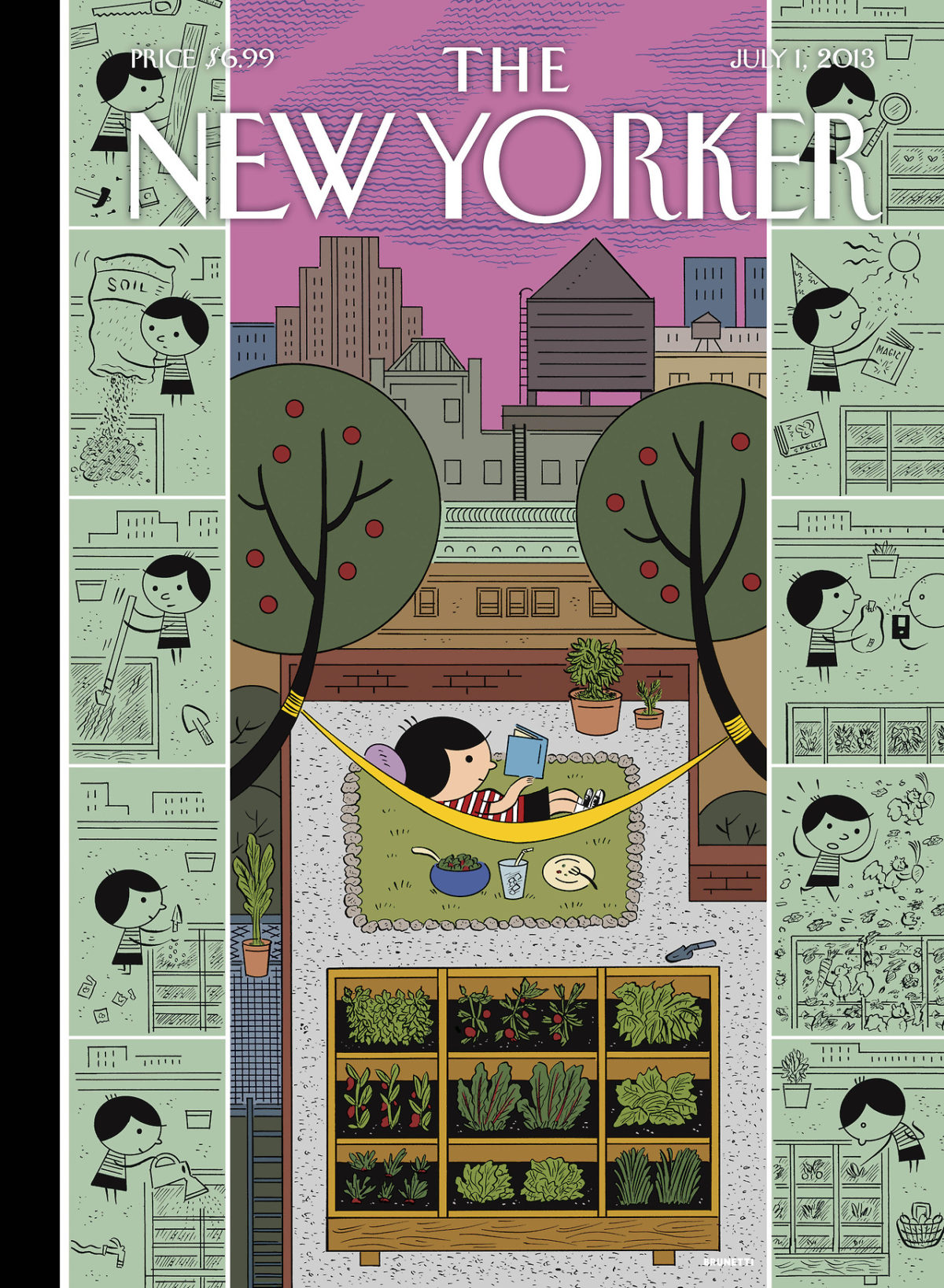
Here are half-a-dozen covers that have caught my eye recently:
I’ll Seize the Day Tomorrow by Jonathan Goldstein; design by Michel Vrana (I think this is actually from last year, but I saw it recently and I really like it. If I’d been paying better attention, it might well have made my 2012 list—maybe next to this!).
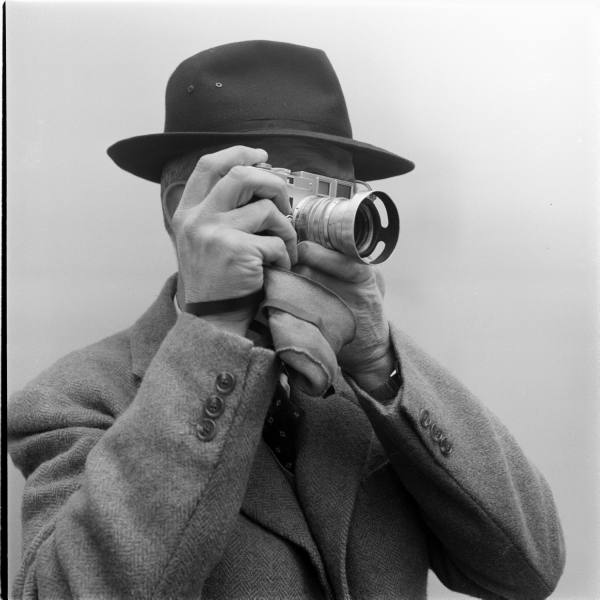
On the New York Times Lens blog today there is first part of an interview with the photographer Henri Cartier-Bresson. Conducted by journalist and filmmaker Sheila Turner-Seed in Cartier-Bresson’s Paris studio in 1971, the interview was apparently for a film-strip series on photographers produced for Scholastic:
I’m not interested in documenting. Documenting is extremely dull and I’m a very bad reporter. When I had an exhibit at the Museum of Modern Art in 1946, my friend, Robert Capa, told me, “Henri, be very careful. You must not have a label of a surrealist photographer. If you do, you won’t have an assignment and you’ll be like a hothouse plant. Do whatever you like, but the label should be ‘photojournalist.’ ”
All my training was surrealism. I still feel very close to the surrealists. But Capa was extremely sound. So I never mentioned surrealism. That’s my private affair. And what I want, what I’m looking for — that’s my business. Otherwise I never would have an assignment. Journalism is a way of noting — well, some journalists are wonderful writers and others are just putting facts one after the other. And facts are not interesting. It’s a point of view on facts which is important, and in photography it is the evocation. Some photographs are like a Chekhov short story or a Maupassant story. They’re quick things and there’s a whole world in them.
By a strange coincidence I recently stumbled across a video of Cartier-Bresson talking about his work (via A Piece of Monologue I think). There appears to be at least some overlap between the film and Turner-Seed’s interview at the Times, so I assume it originated with her? (More knowledgeable people, please feel free to chime in!)
Sheila Turner-Seed’s daughter Rachel Seed (also a photographer) is working on a personal documentary about her mother called A Photographic Memory.You can donate to the project on Kickstarter.
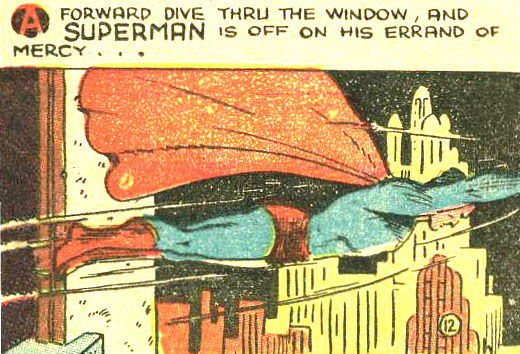
At the Smithsonian Design Decoded blog, Jimmy Stamp provides a brief history of The Daily Planet building in Superman comics:
Whenever disaster strikes Superman’s Metropolis, it seems that the first building damaged in the comic book city is the Daily Planet – home to mild-mannered reporter Clark Kent, his best buddy Jimmy Olsen, and his gal pal and sometimes rival Lois Lane. The enormous globe atop the Daily Planet building is unmistakable on the Metropolis skyline and might as well be a bulls-eye for super villains bent on destroying the city. But pedestrians know that when it falls–and inevitably, it falls–Superman will swoop in at the last minute and save them all (The globe, however, isn’t always so lucky. The sculpture budget for that building must be absolutely astronomical).
In opposition to the constipated naturalism of the art-house consensus—whether the one that prevailed sixty years ago or that of today—crudeness has an intrinsic merit, and it’s easy to detect the same impulse behind [Vulgar Auteurism] and Godard’s decision to dedicate “Breathless” to the B-movie studio Monogram Pictures. Getting rid of prejudices—acknowledging that there’s no such thing as intrinsically good acting or cinematography or direction, but only the evidence of artistic inspiration—is as great a discovery for critics as for filmmakers. From the start, Godard repudiated the false merits of so-called production values, but he invested the film not with the elements of the usual Monogram movie but with a rich and complex collection of high-art references, intellectual divagations, and documentary-based techniques, all held together by an aesthetic philosophy that owed more to Sartre than to Hawks. His praise of cheapness and scruffiness wasn’t in the service of those qualities but of the virtues of the grandest, greatest art and ideas he knew. The hat tip to the gangster genre served to embody his most intimate emotions and personal experiences—and, for that matter, to suggest the way that those very intimacies had become tied up, for better or worse, with the experience of moviegoing.
I’ve already posted a couple of David Pearson‘s cover designs for the new Pushkin Press editions of Ryu Murakami’s novels, so I thought I might as well put them all in one place:
The rather lovely experimental animated short Beauty in Danger is collaboration between MK12 and New York-based artist Brian Alfred, with a score by Ian Williams from Battles. I don’t know what it means, but I’m not sure it matters…
And if liked that (and why wouldn’t you?) now would seem like a good time to remind you about MK12’s short experimental film TELEPHONEME from a couple of years ago.
If you’re not following the National Geographic‘s Tumblr Found, you really should be — it’s terrific. More than a few of the photographs, especially those of 1950’s and 60’s America, have a quietly Ballardian, drinking at the edge-of-darkness, Cold War chill:
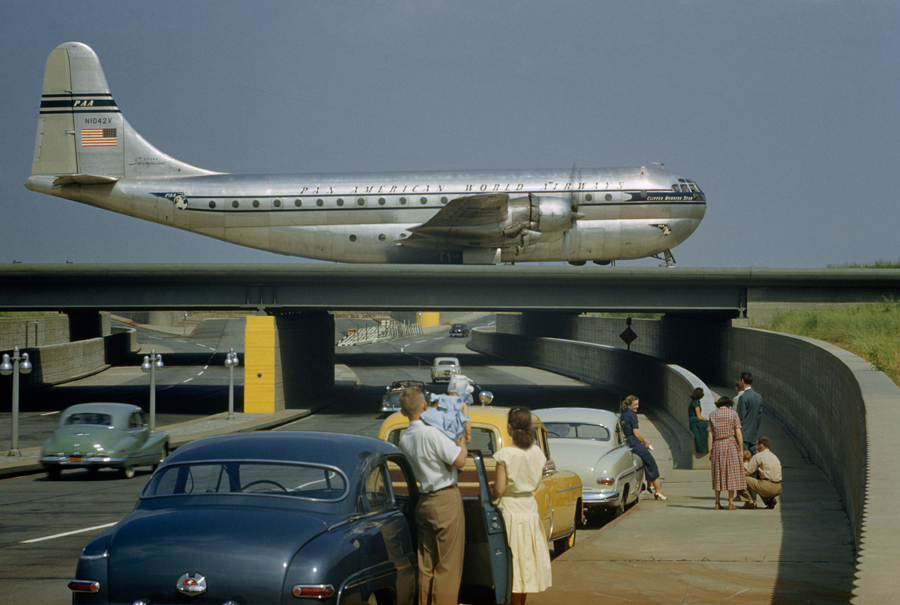
Sightseers park to watch a Stratocruiser taxi across an underpass in Queens, New York, March 1951.
PHOTOGRAPH BY B. ANTHONY STEWART, NATIONAL GEOGRAPHIC
The glow of an atomic bomb test draws Las Vegas casino workers, March 1953.
PHOTOGRAPH BY VOLKMAR K. WENZTEL, NATIONAL GEOGRAPHIC
People on steep slope overlook western headland of Martha’s Vineyard, August 1950.
PHOTOGRAPH BY ROBERT SISSON, NATIONAL GEOGRAPHIC
A couple inspects a beach house destroyed after a storm in March 1962.
PHOTOGRAPH BY B. ANTHONY STEWART, NATIONAL GEOGRAPHIC
Fifty-two stories high, city noises fade and vistas expand. Chicago, June 1967.
PHOTOGRAPH BY JAMES L. STANFIELD, NATIONAL GEOGRAPHIC
Following a group of aspiring indie cartoonists struggling through two gruelling years at the Center for Cartoon Studies in White River Junction, Vermont, and featuring candid interviews with the likes Chris Ware, Scott McCloud, Lynda Barry, Charles Burns, Françoise Mouly, Art Spiegelman and Jules Feiffer, Cartoon Collegelooks like a fascinating documentary about “one of the world’s most tedious artistic disciplines:”
The film was released on iTunes this week, with the DVD available in July.
For me, there’s nothing ordinary or routine about writing novels, though I’ve been doing it for thirty-seven years. When I write, even now, my brain is in a mode that’s different to everyday consciousness. So the words always come; I never find myself unable to write. Perhaps the fact that I consider myself a “cult novelist” helps. Though I’m famous in Japan and have achieved some status as an author, my works are by no means mainstream. They aren’t really accepted by the majority, and I don’t imagine that most people here understand them. And that motivates me to keep on writing.
The rather splendid cover is by David Pearson, I believe.