Skip to content

The Casual Optimist Posts

St Franz of Prague


At the Financial Times, Ian Thomson, author of Primo Levi: A Life, reviews three new books about Franz Kafka:

In 1982, the Italian writer and Nazi concentration camp survivor Primo Levi embarked on a translation of Franz Kafka’s The Trial. At first he was enthusiastic, hoping to improve the German he had learnt so imperfectly at Auschwitz. Instead, Kafka involved him more terribly than he could have imagined. Levi found only bleakness in the hero Josef K, who is arrested and executed for a crime he probably did not commit.

The more Levi became immersed in Kafka, the more he began to see his own life mirrored in that of “St Franz of Prague”, as he called the Czech writer. Born in Prague in 1883 into a German-speaking Jewish family, Kafka lived a life of quite exemplary tedium as an insurance clerk, rarely travelling beyond his home or that of his parents. Levi saw similar constrictions in his own life as an assimilated Jew in bourgeois Turin. Moreover, Kafka’s three sisters had all perished in the Nazi gas chambers – victims of the grotesque bureaucracy foretold by their brother two decades earlier in The Trial. Kafka must have had a seer-like sensibility, Levi thought, to have looked so accurately into the future.

Pictured above: David Zane Mairowitz’s graphic novel adaptation of The Castle illustrated by Jaromír99, published by SelfMadeHero.

Comments closed
50 Canadian Book Cover Designs

Lists are always problematic, but CBC Books longlist of Canada’s Most Iconic Book Covers seems strangely underwhelming somehow. Setting aside what counts as ‘Canadian’ (some of the books on the list were not designed by Canadians for example), ‘iconic’ covers are inevitably those that have stuck around and we are most familiar with, not necessarily those that are well designed or particularly interesting to look at. Needless to say, the list says more about our fondness for certain books and authors than about the current state of Canadian book cover design. Perhaps it isn’t really fair to judge the CBC’s contest this way, but it makes the list less interesting than it might otherwise have been (to me, at least).

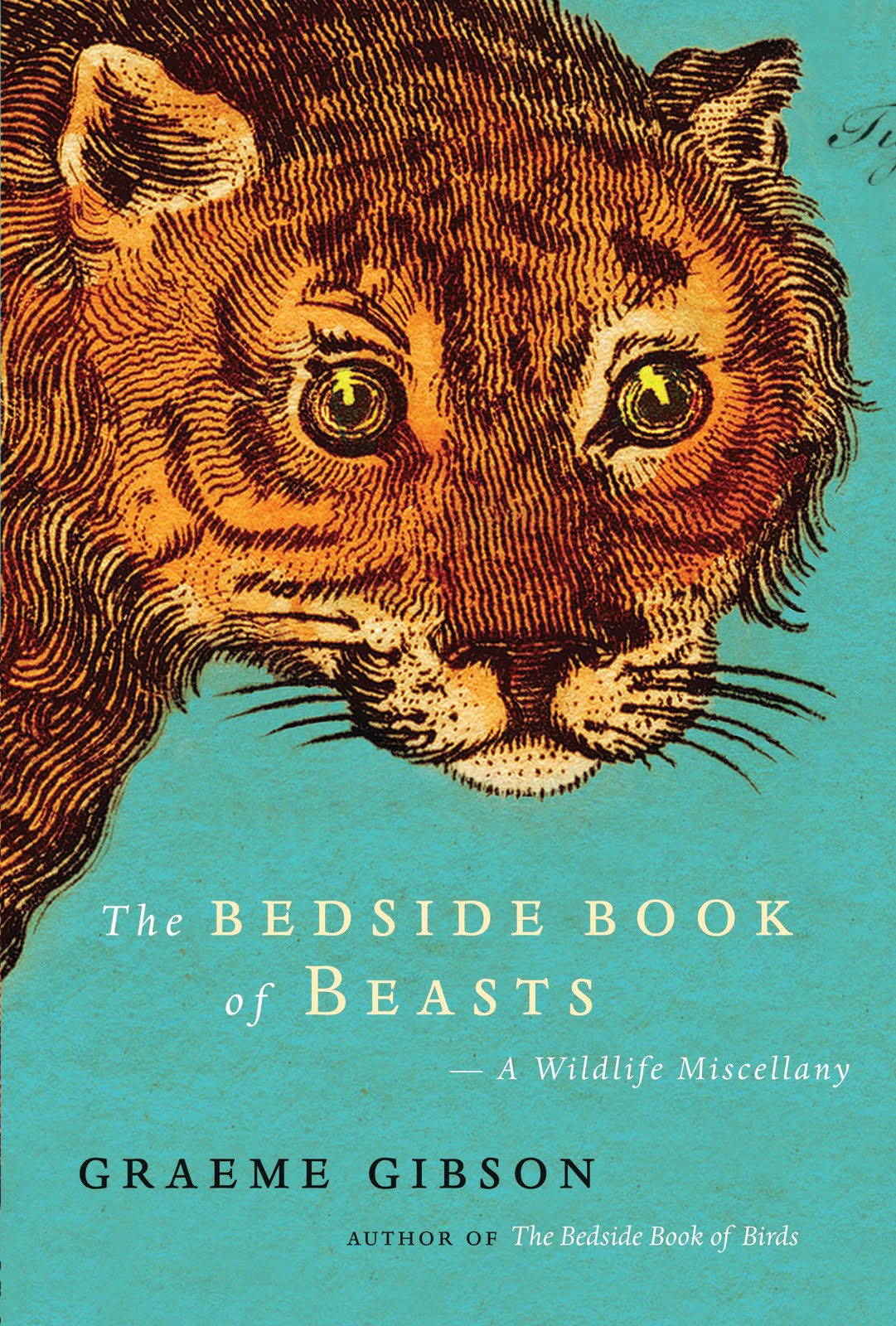
That said, I am terrible, no good Canadian. 10 years and one Canadian passport later, I still feel like the immigrant I am. It’s not that I feel particularly British any more (if I ever did), it’s more like I haven’t finished unpacking yet (which might literally be true come to think of it)! In nearly five years of blogging I haven’t dedicated a single post to Canadian book design. To remedy to that, below are 50 (FIFTY!) recent book covers designed in Canada. Some of them are well-known, some of them are award-winners, some of them were recommended, some I’ve posted before, and some are just personal favourites. I can’t say they’re ‘iconic’ but they are all great covers. Enjoy. (Pictured above: The Bedside Book of Beasts by Graeme Gibson; design by Scott Richardson; published by Doubleday Canada).

15 Comments

Trains, Punks, and Photographs


In 2002, 17-year-old Mike Brodie started hopping trains. Over the next five years he took photographs — first using a found Polaroid camera and then an old 35-mm Nikon — documenting his experiences. In the July/August edition of Book Forum, Geoff Dyer reviews A Period of Juvenile Prosperity, a book collecting Brodie’s photographs:

As with Nan Goldin’s Ballad of Sexual Dependency—and if ever a book of photographs deserved to be termed a ballad it’s this one—Brodie’s pictures are entirely from within the world depicted. Goldin always had a knack, according to Luc Sante, for finding beautiful colors and light in what was otherwise a complete dump. The light for Brodie and his fellow travelers is a given, filling their lives with lyric and radiant purpose. The land that blossomed once for Dutch sailors’ eyes whizzes and blurs past as they ride the rails; the light fades, and the dark fields of the Republic roll on under the night. But the book is less a record of sights and places seen than one of the people doing the seeing. Photographs by Helen Levitt don’t just show children playing in the street; they convey what it’s like to be a child. Same here. We share the optimism, recklessness, and manifest romance of these outlaws’ take on destiny.

Earlier this year, Brodie, who is now working as mechanic, talked about the book with All Things Considered on NPR:

NPR: All Things Considered: Trains, Punks, Pictures mp3

I’ve not seen any sign of the book in Canada, but apparently it is available from the publisher Twin Palms, and I’m sure there will be US independent bookstores who have it.

Comments closed

The Photo Man


Mark Kologi collects  found photos. In this weirdly fascinating short film he discusses buying and selling the personal pictures of complete strangers:

(Does he remind anyone of Steve Buscemi? Is that just me?)

Comments closed

The Story Coaster by Grant Snider


Another gem for the New York Times Book Review by Grant Snider. Love the Unreliable Narrator.

Comments closed

Ersnt Reichl: Wide Awake Typographer


Elizabeth Hawes, Fashion is Spinach (Random House, 1938; AIGA 50 Books 1939)

At Design Observer, design historian Martha Scotford discusses the work of German-American book designer Ernst Reichl:

Midway in his career, Reichl began to reflect on many of the books he designed in written comments; he spent more time on this during the period 1977-1978, shortly before his death in 1980. In the end, there were approximately 550 3 x 5 inch index cards on which he hand-wrote his thoughts about selected books he designed. In lively prose Reichl comments on myriad elements of book design and details of book production, several for each book. He covers typography, binding design and jackets, illustration, publishers, the publishing industry in New York, design colleagues (revered and annoying), production triumphs and problems, how well the book sold, his opinion of the book and his philosophy of book design as applied to that title. He also critiques his own work, sometimes in the moment, sometimes from the perspective of more time and experience. These comments, often sharp and humorous, are highly entertaining and informative. I know of no other book designer who has done this so extensively.

Reichl’s comments about book design have now been transcribed from the cards and accompany a selection of over 100 examples of his work in an exhibition curated by Scotford, ‘Ernst Reichl: Wide Awake Typographer,’ currently on display at Columbia University’s Rare Book and Manuscript Library in New York until September 13, 2013.

On a related note, Scotford has previously written about the US publication of James Joyce’s Ulysses and the role of Ernst Reichl, who designed the typographic cover for Random House.

Comments closed

Remembering the NYRB Mailroom and Edward Gorey’s Keds

At  the New York Review of Books blog, Luc Sante, author of Low Life: Lures and Snares of Old New York, reminisces about his time at the magazine:

The scale of the office was intimate and I sat right in the middle of it, very self-conscious at all times but generally invisible to the great and the good who passed by. I imagined an early scene in some novel, maybe by Dreiser: the young clerk at his desk, his pen suspended in midair as he observes this or that eminence on parade. Isaiah Berlin, Lincoln Kirstein, Joan Didion, the debonair Murray Kempton, V. S. Pritchett who still sometimes turned in holograph manuscripts, Edward Gorey towering in his raccoon coat and white Keds. Not many of the names meant much to me at first; I came from another culture in another part of town.

Has Sante written anything on Gorey? It seems like a perfect match… or is that just me?

Comments closed

Uncovered QOTSA

I’m surely oh-so-late to the party on this, but Nouvelle Vague’s Olivier Libaux has recorded a new album of Queens Of The Stone Age covers performed by female singers.

The Wall Street Journal spoke to Libaux about the album:

“I remember I was already thinking about doing an album like mine back in 2006, when touring with Nouvelle Vague…I was sure some Queens of the Stone Age songs would become wonderful, played softly, sung by female vocalists.”

Rather than make the covers album into a Nouvelle Vague project with French singers, though, he was keen to try something different.

“I wanted the album to be performed by English-speaking artists,” Libaux said. “I know that Nouvelle Vague sometimes sounded funny because of some of our singers’ accents. But my ‘Uncovered QOTSA’ had to be 100-percent accent free. I believe it’s because I wanted the lyrics to be as close to the bone as they could be. I then listed all my favorite female singers of this world and sent tones of e-mails. I was very fortunate since many of these singers answered ‘yes’ without any hesitation.”

Its charm may well wear thin on repeated plays, but you can currently stream the whole album at Soundcloud and decide for yourself:

If nothing else, I’d love to know who did the jazzy Milton Glaser-esque art.

The album is out in the US on July 16.

(via Largehearted Boy)

Comments closed

Alan Moore: The Revolution Will Be Crowd-Funded


photo: Leo Williams

Alan Moore discusses his short films, crowd-funding, the Occupy movement, The Prisoner, and zombies (amongst other things) at Salon:

While the revolution will be certainly televised, it strikes me that there is a strong possibility that the revolution will also be crowd-funded. If Kickstarter and other enterprises are giving projects like Occupy Comics a chance, then it does suggest there are imaginative ideas out there with incredible use and application across the board. Not just in the arts, but in the sciences as well. It’s an exciting concept, and I look forward to seeing what emerges from it.

Moore talks more about his Lynchian short film Jimmy’s End — created with Mitch Jenkins — in this short ‘behind-the-scenes’ documentary for Motherboard TV (worth watching just for the interior of the actual Jimmy’s End Working Men’s Club around the 10 minute mark):

He also discusses crowd-funding and ‘The Jimmy’s End Cycle’ of films — the last of which, Heavy Heart, you can still support on Kickstarter —  in an interview with Bleeding Cool from earlier this month.

Comments closed

Franz Kafka – 130th Birthday

Now this is truly wonderful: Designer Pablo Delcán has created an animation to celebrate Kafka’s 130th birthday based on Peter Mendelsund’s cover designs for Schocken Books:

Schocken have just re-released five of Franz Kafka’s letters as eBooks with new covers by Peter, and, if that wasn’t enough, Peter has written a short post about Kafka and Russian composer Dmitri Shostakovich — whose music accompanies the video — on his blog Jacket Mechanical.

Comments closed

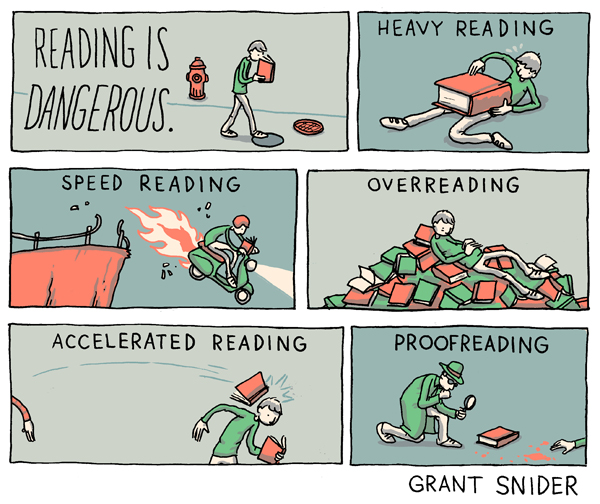
Reading is Dangerous by Grant Snider

Another charming comic by Grant Snider for the New York Times Book Review, ‘Reading is Dangerous’ illustrates ‘Clunkers‘, James McWilliams’ essay about books as weapons:

Comments closed

On Vacation

20130701-125650.jpg
Back soon…

2 Comments