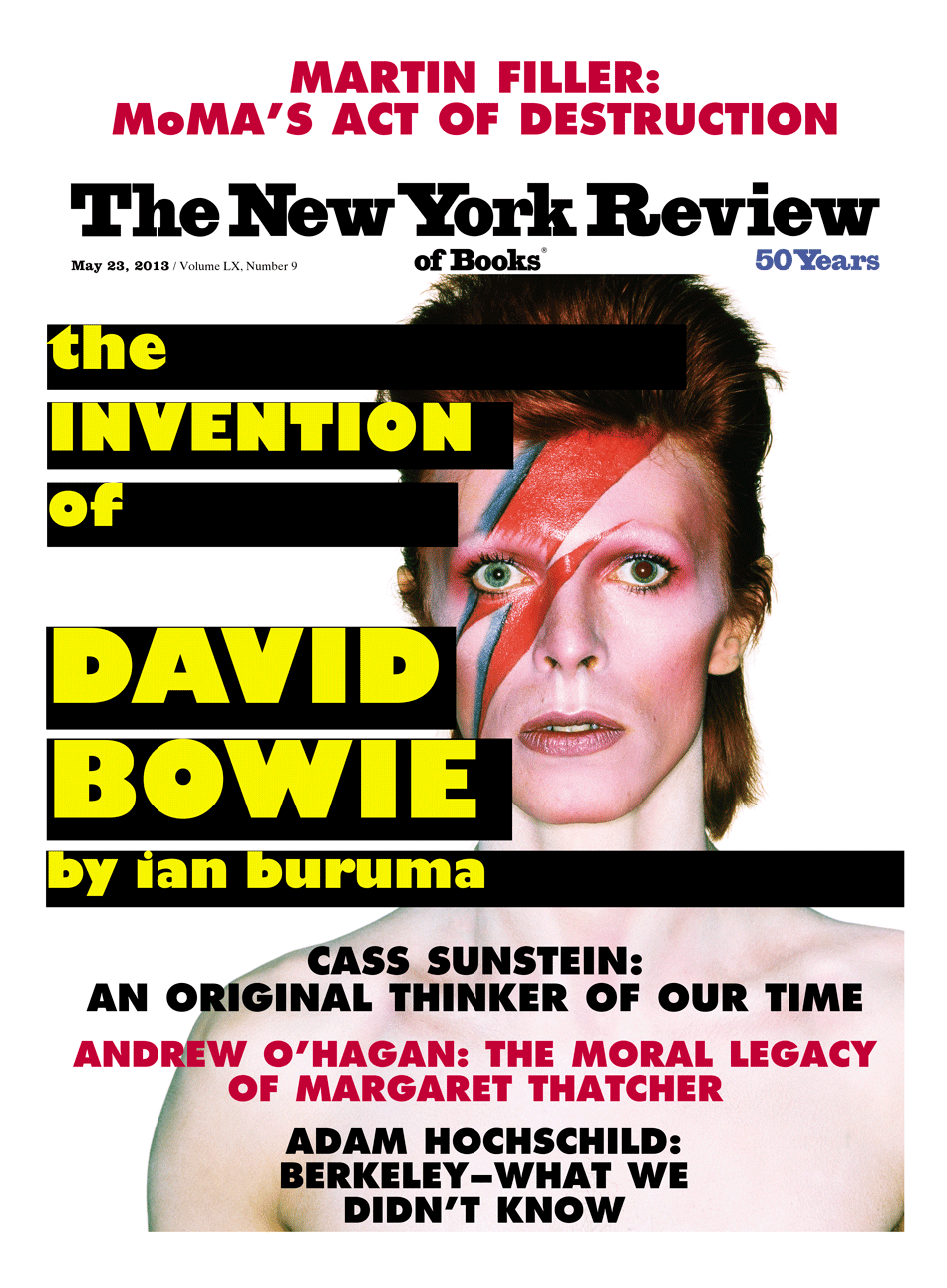
Monday’s edition of CBC Radio show Ideas featured Michael Enright in conversation with the New York Review of Book‘s co-founder Barbara Epstein, caricaturist David Levine, and long-time Vanity Fair editor Graydon Carter:
So could it be—and this is the question I really want to ask—that however much literature may appear to be opposed to bureaucracy and procrastination, it actually partakes of the same aberration? Balzac’s Comedie humaine with his declared ambition to “compete with the civil registry”; Proust’s monstrous, magnificent Recherche, which he likened to a cathedral, tediously extending the analogy to every section of the work; Joyce’s encyclopaedic aspirations in Ulysses, his claim that Finnegans Wake would be a history of the entire world. Or go back to Dante, if you like, and his need to find a pigeonhole in hell for every sinner of every category from every sphere of society. Or fast forward again to Bouvard and Pécuchet, Flaubert’s two incompetents who react to practical failure by becoming obsessive copiers of literary snippets. This without mentioning the contenders for the Great-American-Novel slot, so eager to give the impression that their minds have encompassed and interrelated everything across that enormous continent (one thinks of the interminable lists of contemporary paraphernalia in Franzen’s writing). In each case, however different in tone and content the texts, life is transformed into a series of categories, made more mental, more a matter of words and intellect; we revel in the mind’s ability to possess the world in language, rather than to inhabit it or change it.
(pictured above: Gustave Doré: Canto VII—Hoarders and Wasters, from Dante’s Inferno)
Cartoonist Joe Sacco discusses his new illustration/book The Great War in an interview at Salon:
I think every medium has its strengths. But I think illustrated work puts the reader directly into a picture. You open up, let’s say, a comic book, and I’ve drawn a Palestinian refugee camp — you’re inside it, and with the multiple images, you’ll hopefully get an idea of the atmosphere. As a cartoonist, you’re concentrating on giving visual information — especially in the background — that can be conveyed by multiple images. And things follow the reader around. You know, the architecture will follow the reader from one panel to another, so it becomes part of the atmosphere that the reader is imbibing. With the written word, you can describe the architecture, but you’re not going to keep mentioning it as a figure is walking down the street, you’re not going to keep mentioning what the background is. With comics you can do that.
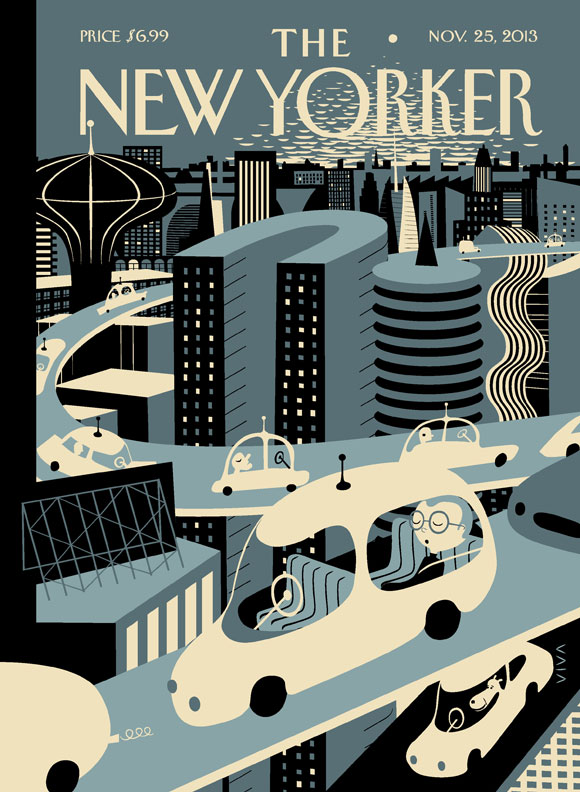
At this point is there any more important editor in periodical illustration than Françoise Mouly? With so many erstwhile venues for illustration being driven online, where any illustration is rendered into spot illustration, The New Yorker could be the big time all by itself. Unless Spiegelman comes into the office with her we have to assume this is an adventure without him. The New Yorker cover of the William Shawn era was essentially wallpaper, the perfect decoration for the better kind of dentist’s office. (Not least because it didn’t matter how old the magazine was.) The New Yorker cover of the Mouly era is not only more topical than it used to be, but is also frequently a one-image narrative. The ultimate Mouly-era narrative cover is Adrian Tomine’s November 8, 2004 cover: A young man and woman spot each other reading the same book in subway trains going in opposite directions, and not only have not encountered but will lose each other in a second’s time. (Though it would have been a hell of an advertisement for Chance Encounters classifieds if they had them.) The effect is to put the cartoonist at the center of the world of illustration.
Teju Cole, author of Open City and a photographer himself, on the late Saul Leiter at The New Yorker:
The content of Saul Leiter’s photographs arrives on a sort of delay: it takes a moment after the first glance to know what the picture is about. You don’t so much see the image as let it dissolve into your consciousness, like a tablet in a glass of water. One of the difficulties of photography is that it is much better at being explicit than at being reticent. Precisely how the hypnotic and dreamlike feeling is achieved in Leiter’s work is a mystery, even to their creator.
Steven Heller and Louise Fili talk about their beautiful new book Shadow Type in a new video for Designers & Books:
The video is part of the Designers & Books Online Book Fair, a wonderful directory of design books that you can browse in all sorts of interesting ways.
(Shadow Type is published by Princeton Architectural Press in the United States, and distributed by my employer Raincoast Books in Canada)
Freud was always a painter of the Great Indoors. Even his horses are painted at home in their stables; and though he curated a great Constable show in Paris in 2003, the greenery he depicted himself lived either in pots or was visible from a studio window. His subject matter was ‘entirely autobiographical’. Verdi once said that ‘to copy the truth can be a good thing, but to invent the truth is better, much better.’ Freud didn’t invent, nor did he do allegory; he was never generalising or generic; he painted the here and now. He thought of himself as a biologist – just as he thought of his grandfather Sigmund as an eminent zoologist, rather than a psychoanalyst. He disliked ‘art that looks too much like art’, paintings which were suave, or which ‘rhymed’, or sought to flatter either the subject or the viewer, or displayed ‘false feeling’. He ‘never wanted beautiful colours’ in his work, and cultivated an ‘aggressive anti-sentimentality’. When there is more than one figure in a picture, each is separate, isolated: whether one is reading Flaubert and the other is breastfeeding, or whether both are naked on a bed together. There is only contiguity, never interaction.
An interesting painter, but not a pleasant man, unfortunately.
At the L.A. Review of Books Sarah Boxer interviews Françoise Mouly, art editor of The New Yorker and the editorial director of Toon Books:
At RAW,I felt I was the advocate for white space. There’s a certain kind of comic esthetic that is chock full, you know, very Mad magazine, with a million different details. Art is more tolerant of this. I can be brought to tears by a few simple lines. There are so many things where we complement each other very well.
To me design and printing are important. For Art these are a means to an end. When I met him, and he was doing production for [his first book] Breakdowns, he was thinking about printing because the cover was about the printing process. For him, this was something he had to master to sell his ideas. I’m a much more limited thinker. I’m not an abstract person. I can only find things when I’m touching them and making them. I’m eager to do paste-up, mechanical, production. I love to learn new programs, techniques to art, I like things that stand in the way… Art makes things because that’s something he has to do in order to express his ideas. I don’t have ideas outside of making things. I can’t do what he does, expounding on the theory of this and that. I’m like, “Can I just show you, and not have to tell?”
I know I’ve been posting a lot of links to interviews with Mouly recently, but I think it’s really interesting that an art director — someone deliberately behind the scenes — is talking so much about her work and her approach to magazines right now.
Earlier this week, someone I know (you know who are!) suggested that people who work in publishing like to pay lip-service libraries while not actually making use of the services they offer. I can’t speak for everyone else in the industry, but this couldn’t be further from the truth as far as I’m concerned. I spent a lot time in libraries as a kid, and I use my local library now more than ever. There are two pretty simple reasons for this: I’m curious about stuff, and I can’t afford all the books I (or my curious kids) want to read!
All of which is to say, I’m very grateful for public libraries and, like many people, I find our politicians attitude to them deeply depressing. My local library is always busy. It is full of people — of all ages — making use of the quiet, uncommercialized space to read, work, or just sit. The computers in particular are in constant demand. It is an important part of our community.
In the face of planned service reductions, advocacy group Our Public Library has commissioned this animated short film on the Toronto Public Library, narrated by author Vincent Lam:
The film was made by James Braithwaite and Josh Raskin, the creative team behind the award-winning animated short, I Met the Walrus:
I was just in Chicago this past weekend, so I was really interested in this short documentary about the battle to preserve the former Prentice Women’s Hospital in the city. Designed by modern architect Bertrand Goldberg, the building — composed of a nine-story concrete cloverleaf tower cantilevered over a rectangular five-story podium — is owned by Northwestern University, which is in the process of demolishing it. The film is directed by journalist and Northwestern alumnus Nathan Eddy:
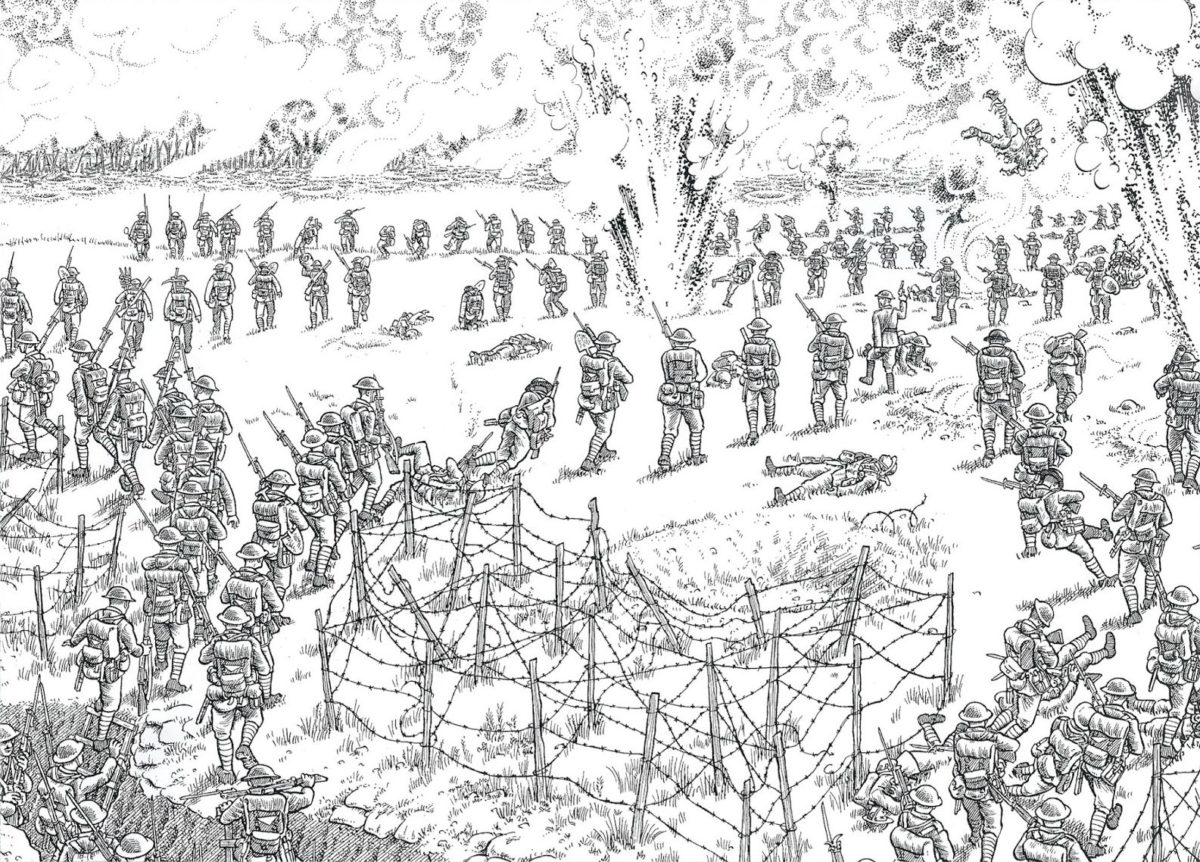
Joe Sacco talks to The New Yorker about his new accordion book The Great War, which folds out to create a twenty-four-foot-long panorama of the Battle of the Somme:
When we first talked about my drawing a panorama of the Western front, the idea seemed static. But immediately I thought of the Bayeux Tapestry… which has a narrative. William the Conqueror in France is getting ready for the invasion; they’re building the boats; they’re crossing the English Channel; then there’s the Battle of Hastings, and you basically read it left to right. It just came to my mind that I could show soldiers marching up to the front, going to the trenches, going over the top, and then returning after they’ve been wounded, back through the lines to the casualty-clearing station behind the front. So it seemed like a very simple idea, and to be honest, I just wanted to draw. On a visceral level, it was just a pleasure to think only in terms of drawing.
It was a relief not to think about words, and to do a different kind of research. I did a lot of image research and I actually had to read a lot of books, because sometimes prose takes you where photography never went. I would read and get images in my head, and it was just a matter of putting them down. I’ve spent a lot of time doing journalism, and I still am interested in it, but I think the artist side of me wants to sort of come out now. And that’s what the Great War was to me, letting myself go in that direction.
Sacco talks more about the work in this video for publisher W. W. Norton: