Skip to content

The Casual Optimist Posts

Tove Jansson: The Hand That Made the Moomins

9781770461345
At The New Yorker, James Guida reviews Tove Jansson: Life, Art, Words: The Authorized Biography by Boel Westin, and Jansson’s memoir of childhood Sculptor’s Daughter (both published by Sort of Books):

Writing the Moomins afforded an escape at war’s end. After a quiet start, the series took off in the fifties, bringing welcome financial stability—but the success also represented a kind of detour. Jansson’s ambitions for painting never left her. Now free time was scarce, thanks to an unceasing flow of fan mail, the minutiae of merchandising, processions of visitors, and, until Lars, one of her brothers, took over, the arduous demands of the comic strip. For a while, there was no pleasure to be found in working. Thankfully, social media didn’t exist yet: “I could vomit over Moomintroll,” she wrote. “I shall never again be able to write about those happy idiots who forgive one another and never realize they’re being fooled.”

As with someone like Kafka, it is hard to know how literally to take Jansson’s obstacles. To some degree, her entrapment was avoidable: to be so involved in the products, to answer every letter, seem Moominish ideas—either that or, for a person who so prized being left free and alone, they’re plain masochistic. Were an analogous scenario to occur in the books, the hassles would be washed away by flood, to be followed by a celebratory picnic. As it was, Jansson believed that her nature didn’t give her a choice.

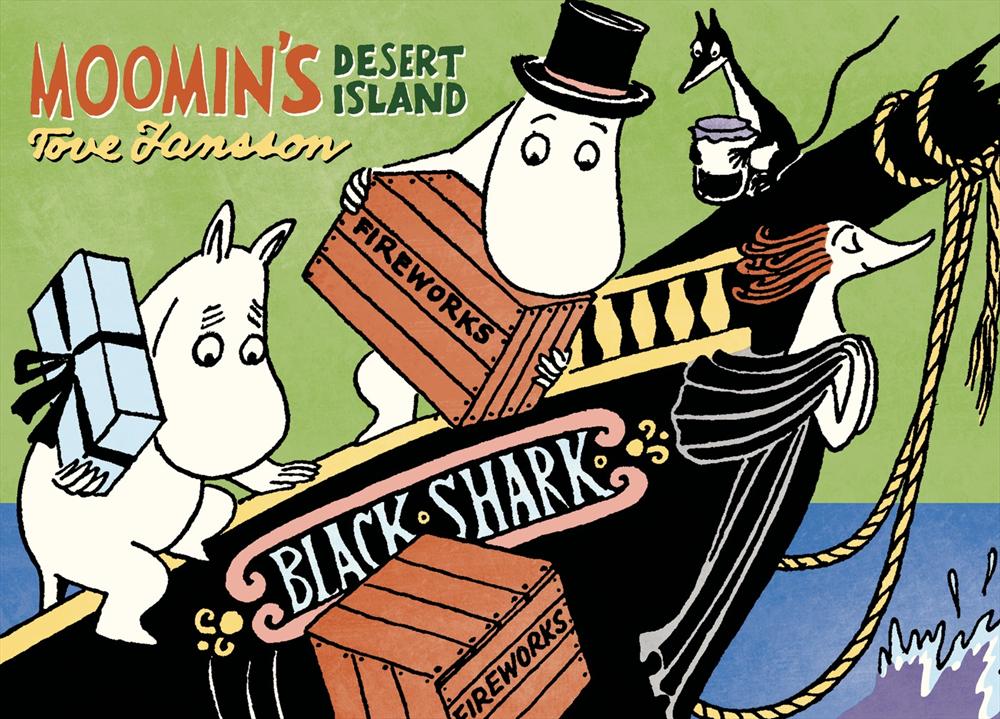
moomins-desert-island
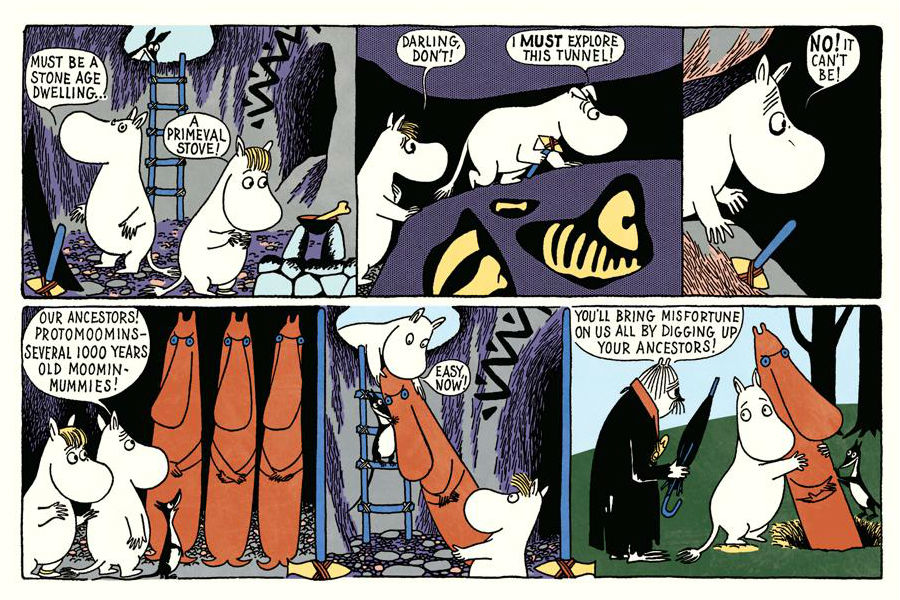
On related note, Montreal’s Drawn Quarterly have just published two new paperback books in their lovely series of classic Moomin comic strips reworked in full colour, Moomin and the Golden Tail and Moomin’s Desert Island (pictured above).

(NB: the Moomin storybooks, published by FSG, and the Moomin comic books, published by D+Q, are distributed by my employer Raincoast Books. Sorry I seem to be doing this so much lately!)

Comments closed

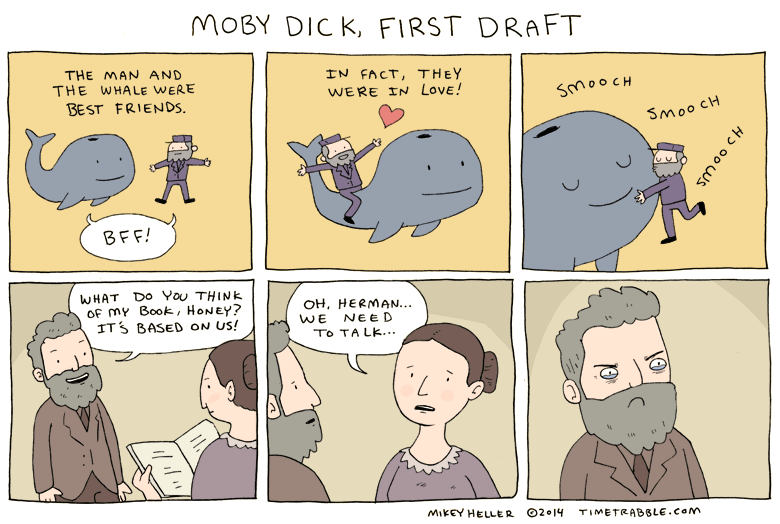
Moby Dick, First Draft

2014-01-20-Moby-Dick,-First-Draft
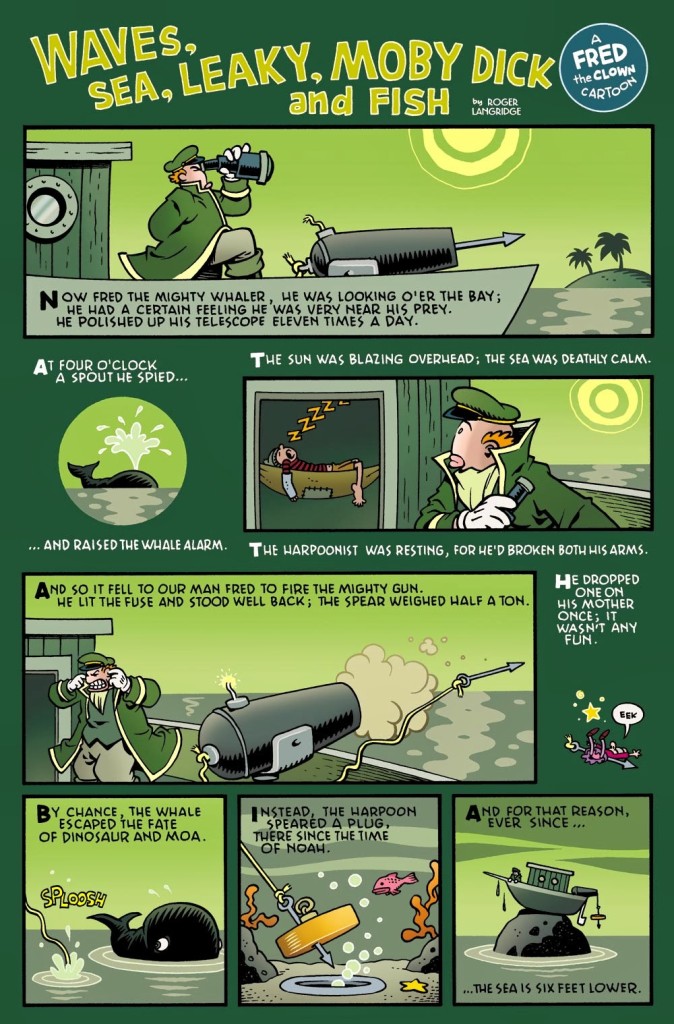
By some strange coincidence, Mikey Heller’s Time Trabble strip is the second comic about Moby Dick I’ve seen recently. Here’s Roger Langridge’s version featuring Fred the Clown:

Waves,_Sea,_Leaky,_Moby_Dick_and_Fish

(Thanks Michel)

Comments closed

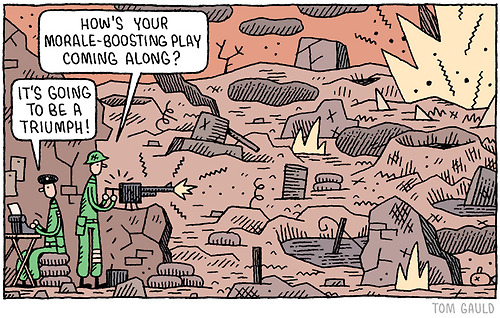
Morale

morale
In light of my previous post about how awful being a writer is, Tom Gauld‘s latest cartoon for The Guardian seems strangely appropriate…

Comments closed

Writing and the Cost of Living

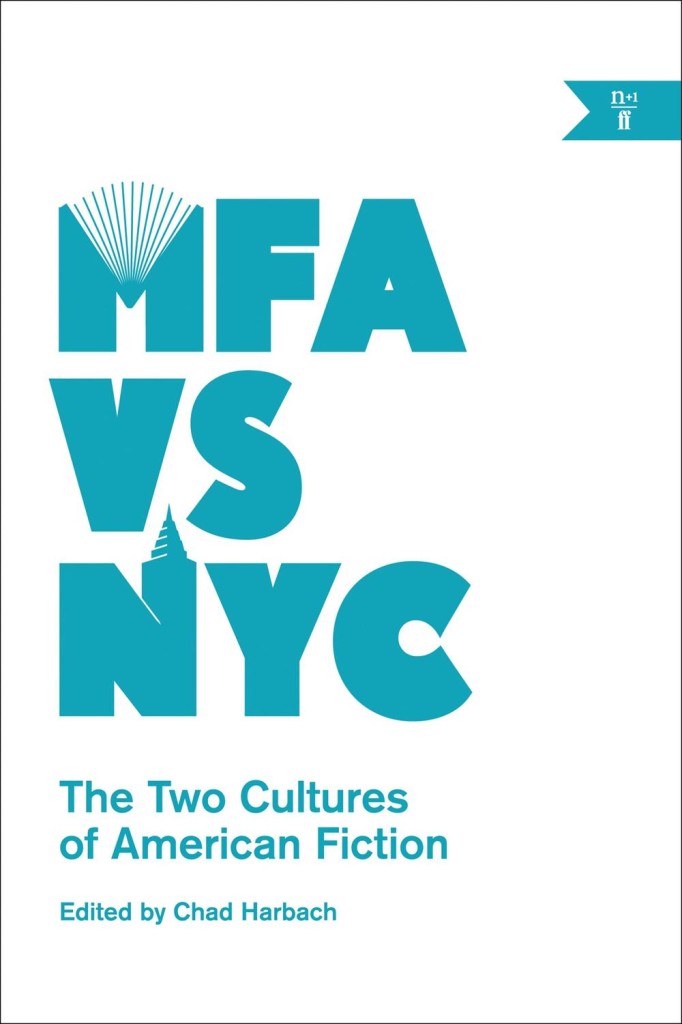
mfc_vs-nyc

I finally just got around to reading Emily Gould‘s spiralling essay on writing and debt ‘How much my novel cost me‘ over the weekend. It’s an excerpt from the new n+1 book MFA vs NYC edited by Chad Harbach (author of The Art of Fielding), which seems like it could be essential reading for idealistic folks wishing to pursue writing as a career:

IT’S HARD TO WRITE ABOUT BEING BROKE because brokeness is so relative; “broke” people run the gamut from the trust-funded jerk whose drinks you buy because she’s “so broke right now” to the people who sleep outside the bar where she’s whining. But by summer 2012 I was broke, and in debt, and it was no one’s fault but mine. Besides a couple of freelance writing assignments, my only source of income for more than a year had come from teaching yoga, for which I got paid $40 a class. In 2011 I made $7,000.

During that $7,000 year I also routinely read from my work in front of crowds of people, spoke on panels and at colleges, and got hit up for advice by young people who were interested in emulating my career path, whose coffee I usually ended up buying after they made a halfhearted feint toward their tote bag–purses. I felt some weird obligation to them and to anyone else who might be paying attention to pretend that I wasn’t poor. Keeping up appearances, of course, only made me poorer. I’m not sure what the point of admitting all this might be, because I know that anyone who experiences a career peak in his mid-twenties will likely make the same mistakes I did, and it’s not even clear to me that they were all mistakes, unless writing a book is always a mistake, which in some sense it must be.

Interestingly, Robert McCrum touches on the financial difficulties of older authors in an article for this weekend’s The Observer

To writers of my generation, who grew up in the age of Penguin books, vinyl records and the BBC, it’s as if a cultural ecology has been wiped out. For as long as most of us can remember, every would-be writer knew the landscape of the printed word. This Georgian square was home to publishing grandees (now retired). On that high street were the booksellers (now out of business). In those twisting back streets, you could expect to find literary agents working the margins with the injured innocence of pickpockets at a synod. It was a mutually dependent ecosystem.

Publishers were toffs, booksellers trade and printers the artisan champions of liberty. Like the class system, we thought, nothing would change. The most urgent deadline was lunch. How wrong we were. The years 2007-2010 are pivotal: first… came the credit crunch. And it occurred at the very moment that the IT revolution was wrecking the livelihoods of those creative classes – film-makers, musicians and writers of all sorts – who had previously lived on their copyrights.

Gould is self-recriminating. McCrum — a former editor-in-chief at Faber and Faber — is nostalgic for a time I don’t remember (things were always better in the ‘old days’ in publishing circles). For Gould the internet is a double-edged sword — a platform and a distraction — for McCrum it has brought nothing but woe. Both seem to agree, however, that nobody is making any money, “marketing types” are awful (aren’t they though?), and being a writer is not all it’s cracked up to be…
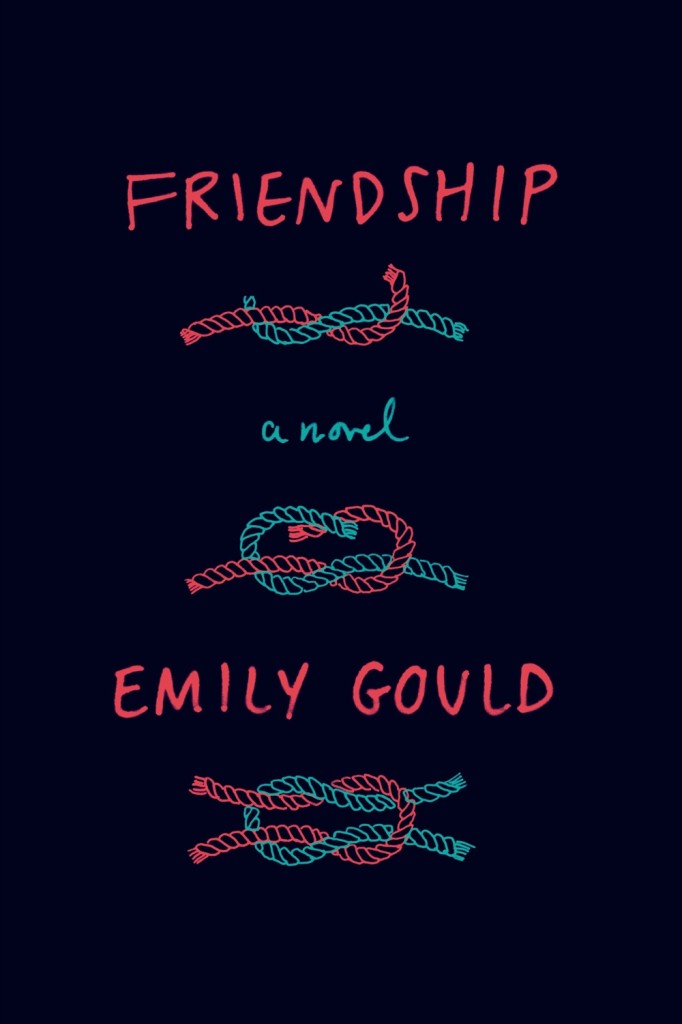
friendship_gould

Coincidently, Emily Gould’s new novel Friendship will be published in the US and Canada by Farrar, Straus & Giroux on July 1 (and a couple of days later in the UK by Virago). I’m not sure who designed the cover, but it is rather nice.

(NB: FSG, and n+1 / Faber & Faber are distributed in Canada by my employer Raincoast Books)

UPDATE: Leslie Jamison, author of the forthcoming essay collection The Empathy Exams (published by Graywolf Press, also distributed in Canada by Raincoast — sorry), reviews MFA vs NYC  for The New Republic:

Writers throughout these essays face the shame of privilege and the specter of poverty: They join magazine mastheads to keep from going broke, or they teach to keep from going broke, or else they actually do go broke—they’re broke in Brooklyn and broke in Los Angeles. Eli Evans evokes his years living in a “warehouse on Pico and Fourth” in one perfect image, one of the most remarkable moments in the entire collection: “I once found a baby rattlesnake strangled with electrical wire and tied to a signpost.” This baby rattlesnake, apparently, is what dreams become…
1 Comment

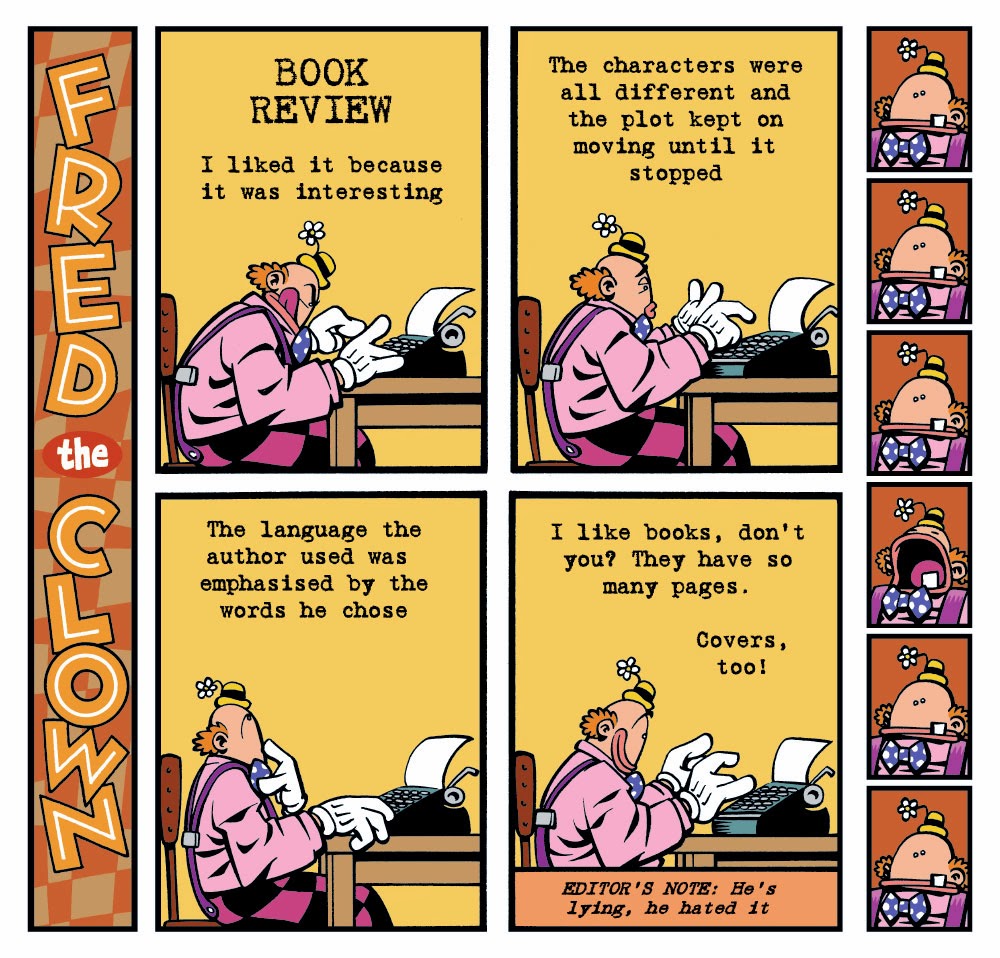
Fred the Clown: Book Review

fred_079-Book-Review
By Roger Langridge. I’ve read reviews like this (except the bit about liking books usually comes at the beginning).

Comments closed

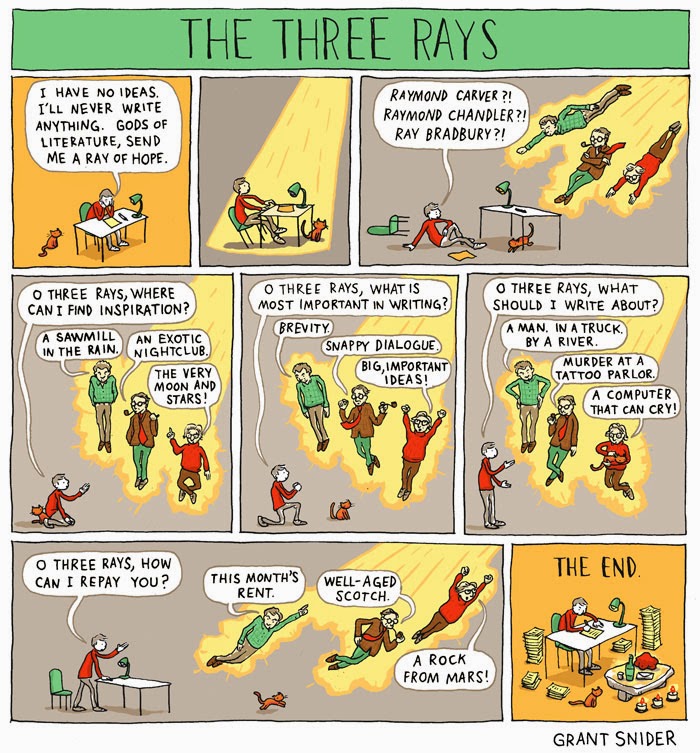
The Three Rays by Grant Snider

threerays-blog

Grant Snider’s latest comic for the New York Times Book Review.

Comments closed

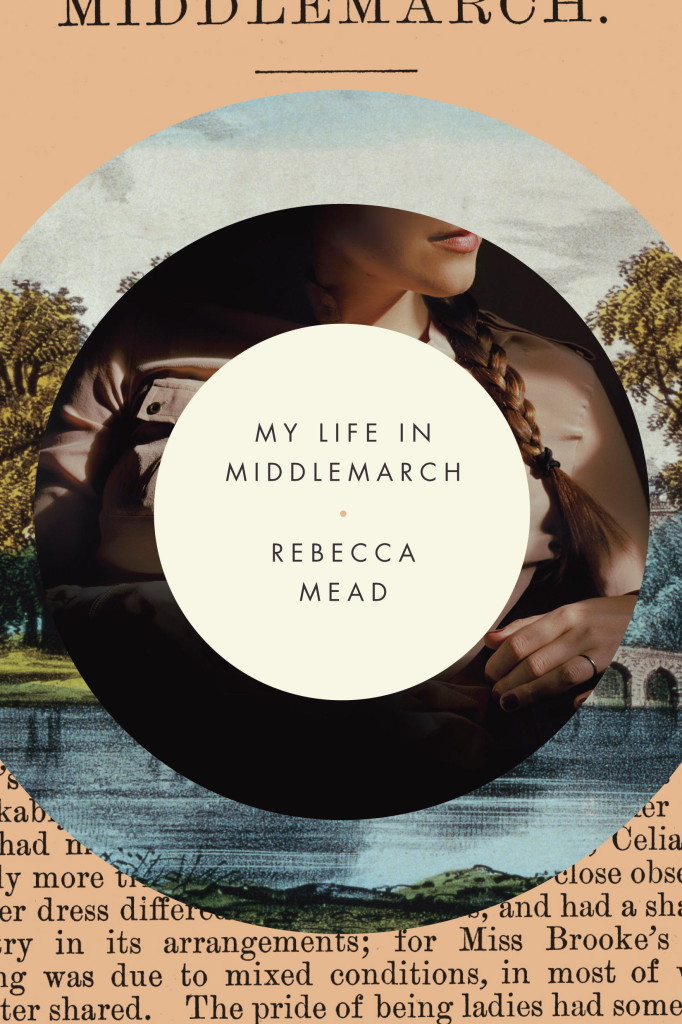
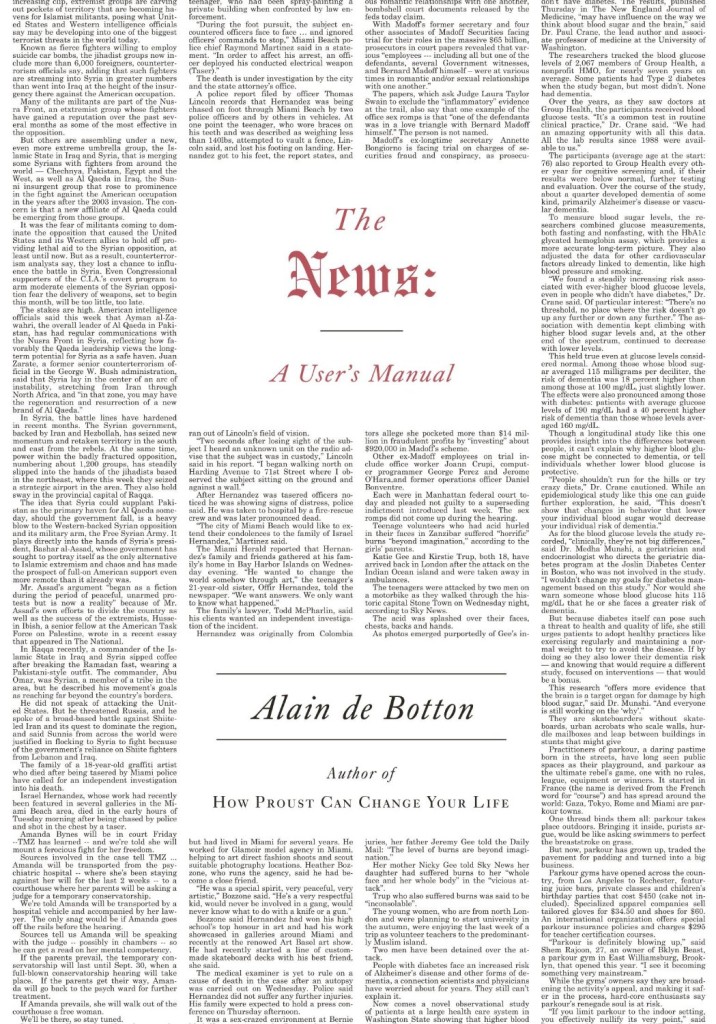
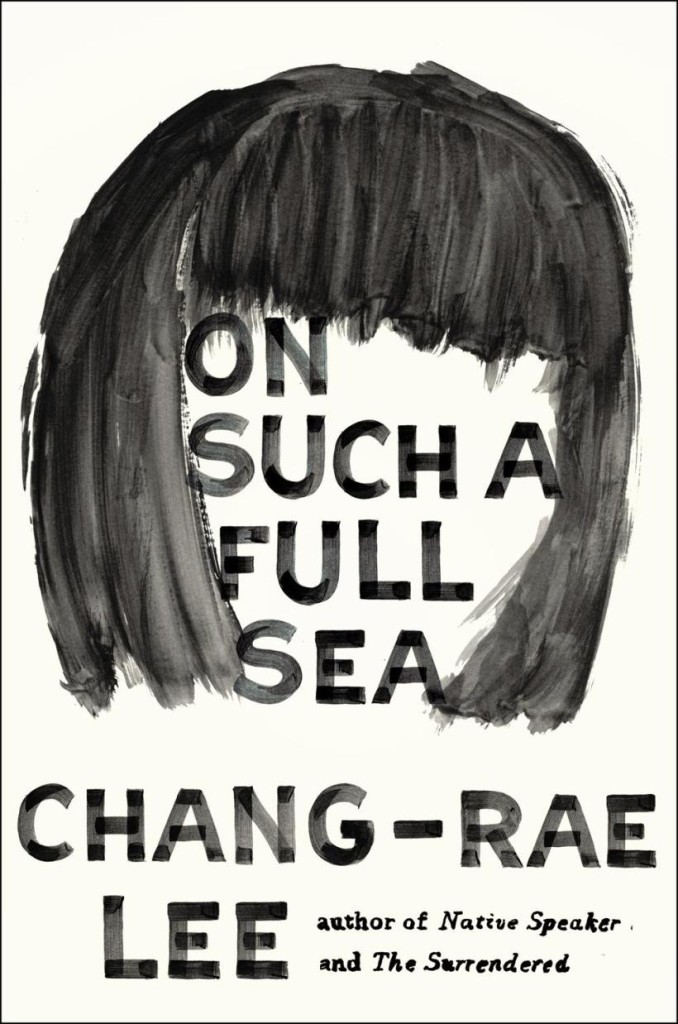
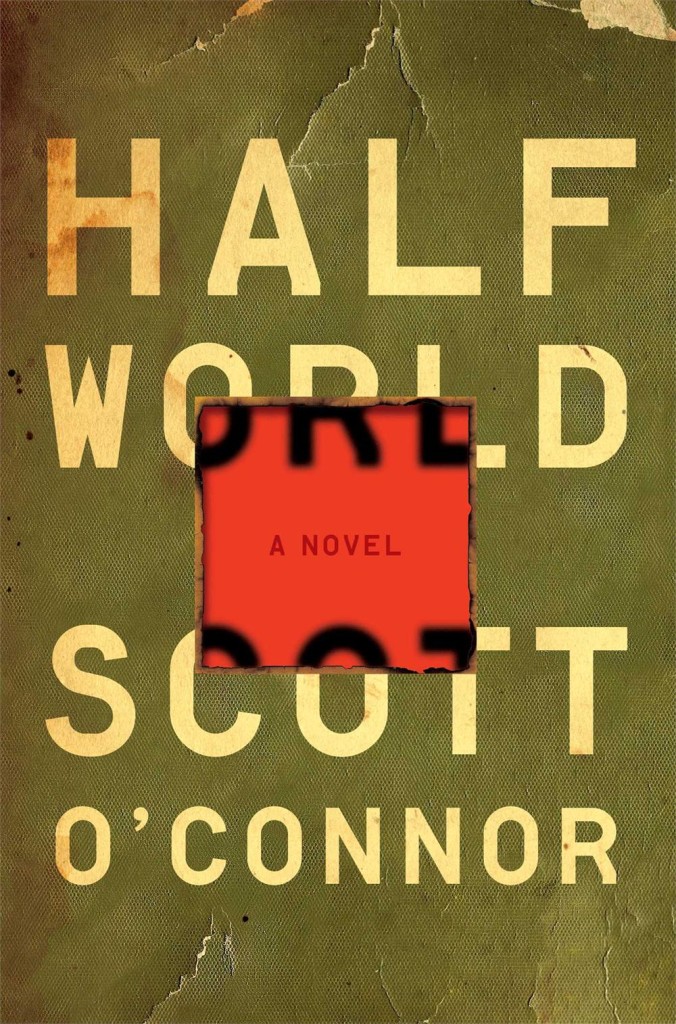
Recent Covers of Note February 2014 Edition

It’s almost March and I’ve just realised that I haven’t posted very many book covers this year. To make up for this lapse, here are ten of my favourite covers from the last few months:

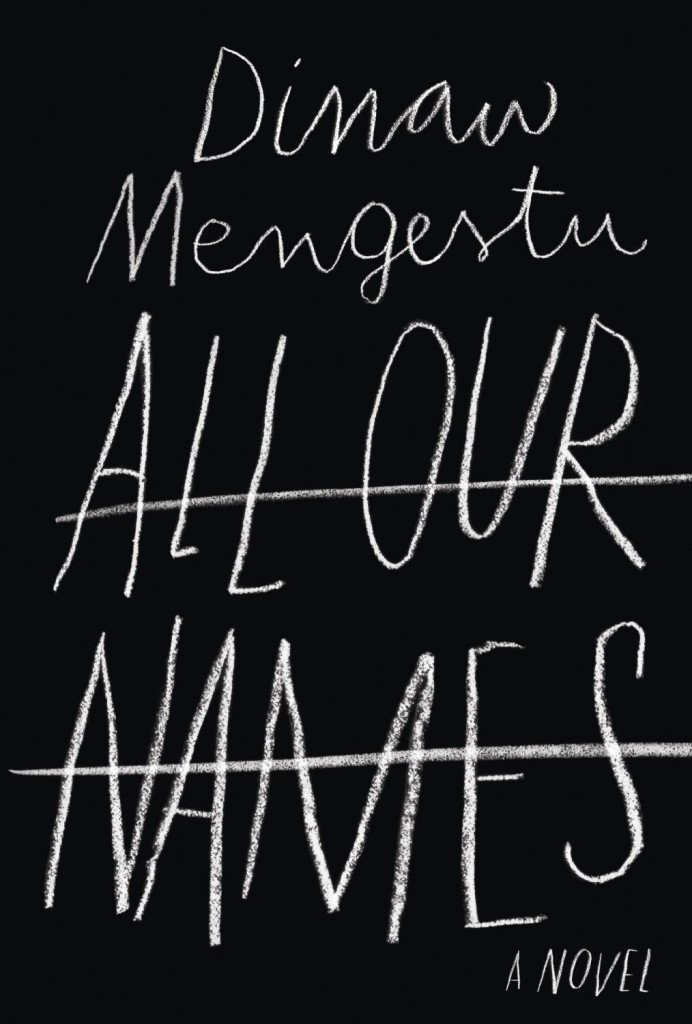
all-our-names
All Our Names by Dinaw Mengestu; design by Isabel Urbina Peña

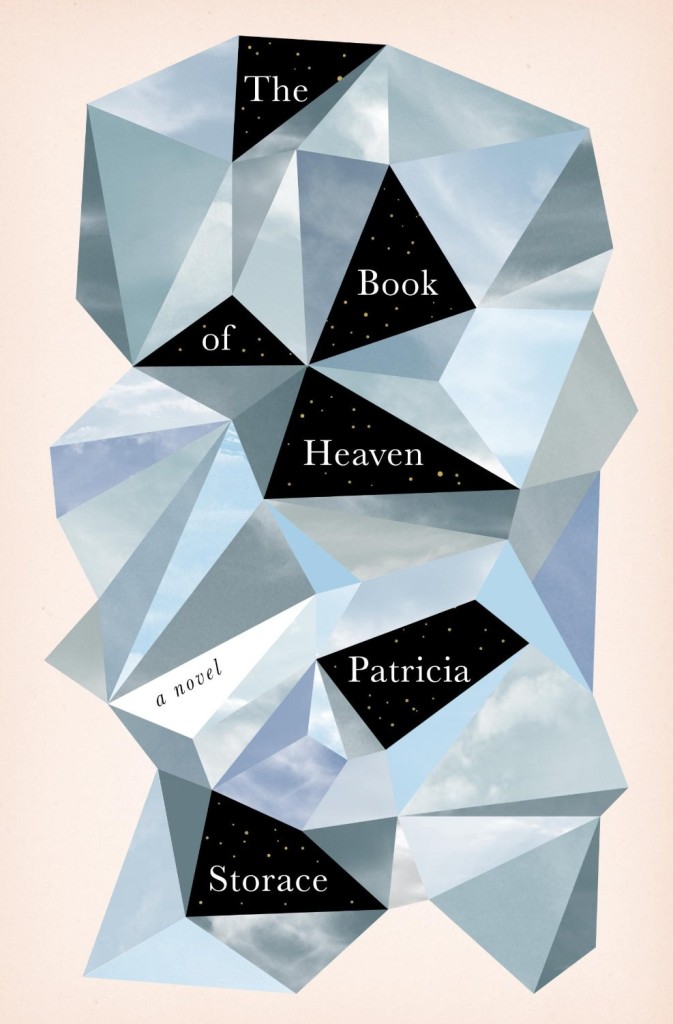
book-of-heaven
The Book of Heaven by Patricia Storace; design by Linda Huang

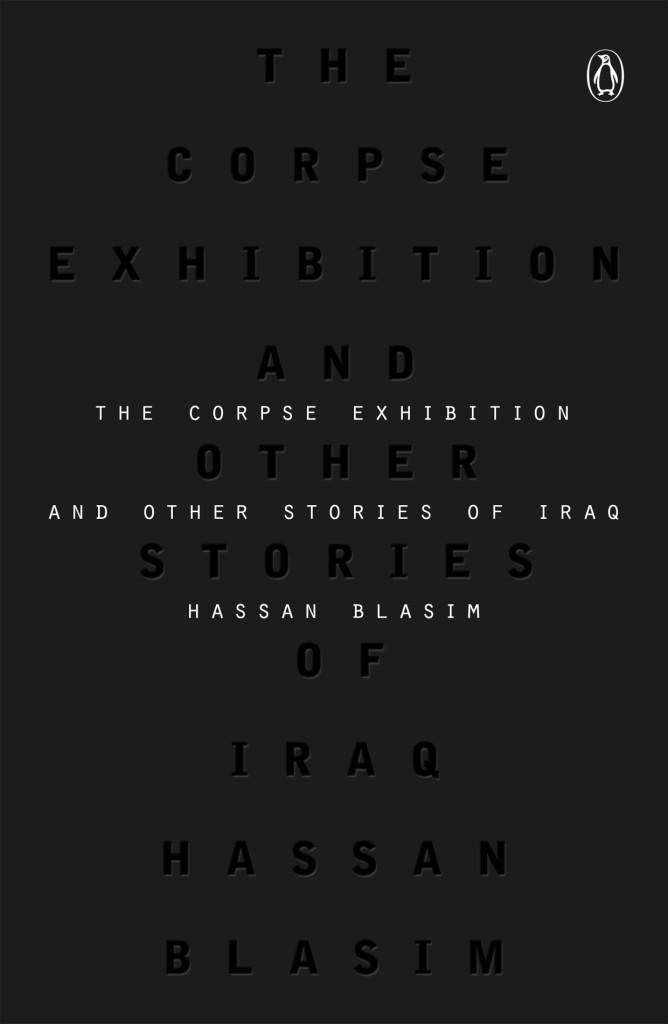
corpse-exhibition
The Corpse Exhibition by Hassan Blasim; design by Jason Ramirez

the-erl-king
The Erl King by Michel Tournier; design by Leo Nickolls

my-life-middlemarch
My Life in Middlemarch by Rebecca Mead; design by Elena Giavaldi

the-news
The News: A User’s Manual by Alain de Botton; design by Matt Dorfman

such-a-full-sea
On Such a Full Sea by Chang-Rae Lee; design by Helen Yentus, lettering Jason Booher

half-world
Half World by Scott O’Connor; design by Christopher Lin

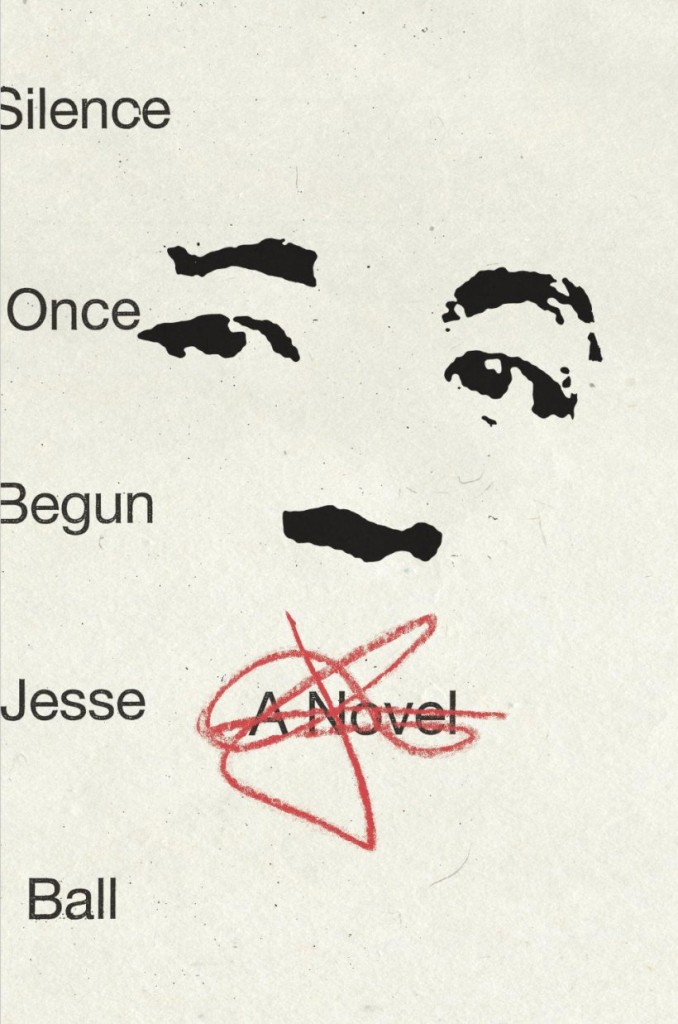
silence-once-begun
Silence Once Begun by Jesse Ball; design by Peter Mendelsund

visionist
The Visionist by Rachel Urquhart; design by Keith Hayes

If you’d like to see more book covers, you can follow my Pinterest board or check out the ‘Book Design’ category at The Accidental Optimist.

3 Comments

Eve Babitz: Muse and Writer

Lili Anolik on the stranger-than-fiction life of Eve Babitz, “an irresistible hybrid of boho intellectual and L.A. party girl”, for Vanity Fair:

Eve Babitz’s claims to fame rest, in large measure, on her claims on the famous. She’s the goddaughter, of course, of one of the most influential composers of the 20th century. Then there’s that photograph of the chess match with Marcel Duchamp, Eve contemplating her next move without so much as a fig leaf for cover. And what about the series of Adams, better known than the original, some of them, to whom she offered her forbidden fruit? Jim Morrison, Steve Martin, Ed Ruscha, J. D. Souther, Stephen Stills, Glenn Frey, Harrison Ford, Warren Zevon, Ahmet Ertegun all took a bite at one time or another.

If that were her whole story, however, Eve wouldn’t be a whole story. She’d be a footnote. A minor figure of glamour in America’s cultural history. A groupie with a provocative pedigree. She’d be Edie Sedgwick, basically: so relentless a companion to celebrity that she became a bit of one herself, the spotlight just naturally spilling over onto her, making her luminous, too. But she’s not. Eve is Edie cut with Gertrude Stein and a little Louise Brooks thrown in.

Why?… Eve could write.

(pictured above: Eve Babitz, chessboard, and Marcel Duchamp, photograph by Julian Wasser, 1963)

Comments closed

Worse than Wal-Mart?

In an excerpt from his new book, Mindless: Why Smarter Machines Are Making Dumber Humans, Simon Head compares the labour practices of Amazon and Walmart:

Amazon equals Walmart in the use of monitoring technologies to track the minute-by-minute movements and performance of employees and in settings that go beyond the assembly line to include their movement between loading and unloading docks, between packing and unpacking stations, and to and from the miles of shelving at what Amazon calls its “fulfillment centers”—gigantic warehouses where goods ordered by Amazon’s online customers are sent by manufacturers and wholesalers, there to be shelved, packaged, and sent out again to the Amazon customer…

…With Walmart’s and Amazon’s business model, the workplace practices that raise employee productivity to very high levels also keep employees off balance and thus ill placed to secure wage increases that match their increased output. The “cult of the customer” preached by both corporations is a scented smoke screen thrown up to hide this fact. Apart from the model’s intensive use of IT, there is not much to distinguish its methods from those of the primitive American and European capitalism of the late nineteenth and early twentieth centuries.

UPDATE: George Packer, continuing his series about Amazon, touches upon a similar topic in a new post for The New Yorker:

[T]hese companies are everywhere and nowhere, ubiquitous in our lives but with no physical presence or human face. They are regarded by many users as public resources, not private corporations—there for us—and their own rhetoric furthers this misperception: Facebook’s quest for a “more open and connected world”; Google’s motto, “Don’t be evil,” and its stated mission to “organize the world’s information and make it universally accessible and useful”; Amazon’s ambition to become “Earth’s most customer-centric company.” Because these endeavors seem to involve no human beings, no workers, other than ourselves—the supposed recipients of all the benefits—it takes an effort to realize that the tech economy is man-made, and that, as with the economies that preceded it, human beings have the capacity to shape and reform it for the public good. It would be easier to remember this if every time you clicked “BUY,” searched for an article, or texted a friend your screen flashed the face of a worker who once held a job that made way for your seamless online experience.

Comments closed

Jasper Johns: Regrets

regrets-jasper-johns

At the Financial TimesJulie L. Belcove talks to 83-year-old painter Jasper Johns about ‘Regrets’, a new series of paintings to be exhibited at MOMA next month:

Johns began “Regrets” after he came across an old photograph in a 2012 auction catalogue from Christie’s, London – though he seems little concerned with the image’s context or provenance. “It was a sale of – who’s the other artist? Francis Bacon.” On the block was Bacon’s “Study for Self-Portrait” (1964) and the catalogue had published the source material, a portfolio of photo­graphs found in Bacon’s studio after his death in 1992. Taken by the photographer John Deakin, the pictures were of Bacon’s friend and fellow artist Lucian Freud. Bacon had married Freud’s body with his own face in “Self-Portrait”. “This is the one that struck me,” Johns says, pointing to the image of Freud perched on the quilt-covered bed and hiding his face in his hand, newspapers at his feet. The photograph was paint-splattered and torn, with a large chunk of the lower left side missing ­altogether, and the creases and voids – the photograph as object – were as interesting to Johns as the image itself. “Bacon mistreated the photographs ­physically, is what it looks like,” Johns says. “I just saw that and it caught my eye.”

‘Jasper Johns, Regrets’ opens at the Museum of Modern Art, New York, on March 15, 2014.

Comments closed

Tate Shots: William Eggleston

eggleston-tate

“William Eggleston never takes multiple shots of the same image, just the right picture at just the right moment.”

Curator Simon Baker discusses the work of photographer William Eggleston, currently on display at the Tate Modern in London:

Comments closed

In Thrall to Machines: Italian Futurism, 1909–1944

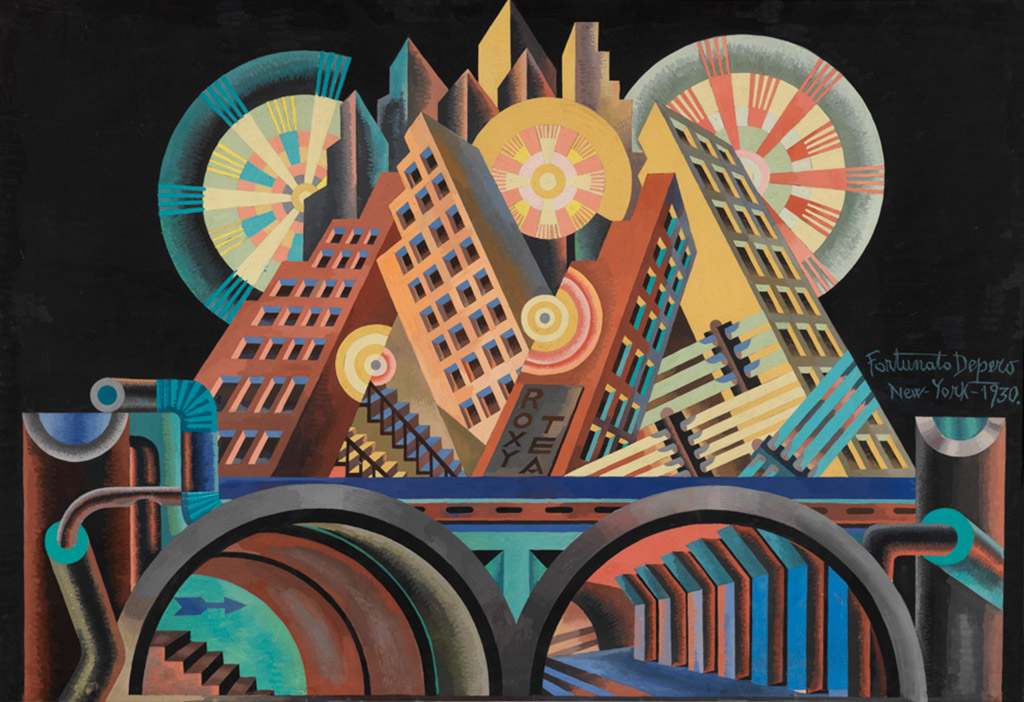
ex_depero_Skyscrapers-and-Tunnels

The New York Times reviews Italian Futurism, 1909–1944: Reconstructing the Universe, a new exhibition at the Guggenheim:

Was any avowedly modern art movement as obnoxious and noisily contradictory as Italian Futurism? By turn aesthetically revolutionary and politically reactionary, farsighted and visually challenged, not to mention officially misogynist, it is both a stain on the Modernist brand and a point of pride. It needs all the help it can get and it receives a large dose from “Italian Futurism, 1909-1944: Reconstructing the Universe,” an epic exhibition at the Guggenheim Museum.

Cool Hunting talks to curator Vivien Greene about the exhibition:

The show has a lot of didactics. Some of the artwork addresses that directly, so it’s easy enough to see their ideas, but we walk people through it as well. They celebrated war as this kind of cleansing medium, and a part of it was because Italy was seen as being so staid and so bourgeois, and after Italian unification in 1860, all those ideals of the Risorgimento really never come to fruition. So this idea of burn down the past and start fresh, be super modern—there were a lot of ideas of regeneration. But they also were very pro war because they wanted to enter World War One to get back the lands that were still under the rule of the Austro-Hungarian empire that were part of the Italian peninsula. So that’s a really practical historical reason that goes beyond you know, Sorelian ideas of the mob and violence—although Georges Sorel does inform them too, but sort of at different levels… [They] also were very aggressive: they start off as a left-wing revolutionary movement and then—how it often happens when you’re at one extreme of something totalitarian—you shift to the other and end up being on the right. They disagreed with the anarchists because the anarchists, although they were running around throwing bombs, had a more pacifist goal in mind.

Italian Futurism, 1909–1944: Reconstructing the Universe opens 21 February 2014 and runs through 1 September 2014.

(pictured above: Fortunato Depero, Skyscrapers and Tunnels (Gratticieli e tunnel), 1930.)

Comments closed