Skip to content

The Casual Optimist Posts

Mise En Scène & The Visual Themes of Wes Anderson

Way Too Indie explores the visual themes of American film director Wes Anderson:

for all his towering success as an American auteur, the look and feeling behind each Anderson film finds its influences more rooted in foreign cinema. The tracking camera, moving from room to room, examining the bourgeoisie and upper class in the films of Luis Buñuel (e.g. El Angel Exterminador) laid the groundwork for the dolly and tracking shots in Anderson’s Rushmore, The Royal Tenenbaums and early sections of The Life Aquatic with Steve Zissou. The frenetic energy and overall zeal found in François Truffaut’s Jules et Jim serves also as the celluloid backbone of most of Anderson’s works, specifically Bottle Rocket, The Royal Tenenbaums, and Fantastic Mr. Fox. The melancholic swoons of the silver screen’s longing romantics permeate Moonrise Kingdom, Hotel Chevalier/The Darjeeling Limited and in the romance subplot of Bottle Rocket.  These films share the same sort of beautiful yet honest moments found in Jean-Luc Godard’s Pierrot Le Fou.

(via Coudal)

Comments closed

The New US and UK Murakami Covers

murakami-us
It’s just been announced that Haruki Murakami’s next novel, Colorless Tsukuru Tazaki and His Years of Pilgrimage, will be published on August 12th in the UK and US by Harvill Secker and A. A. Knopf respectively.  The cover of the US edition is above, the UK edition below.
murakami-uk-2


I would assume that the US cover is designed by Chip Kidd (correct me if I’m wrong); please let me know if you know who Suzanne Dean designed the UK cover (thank you @BookCovrs).

Comments closed

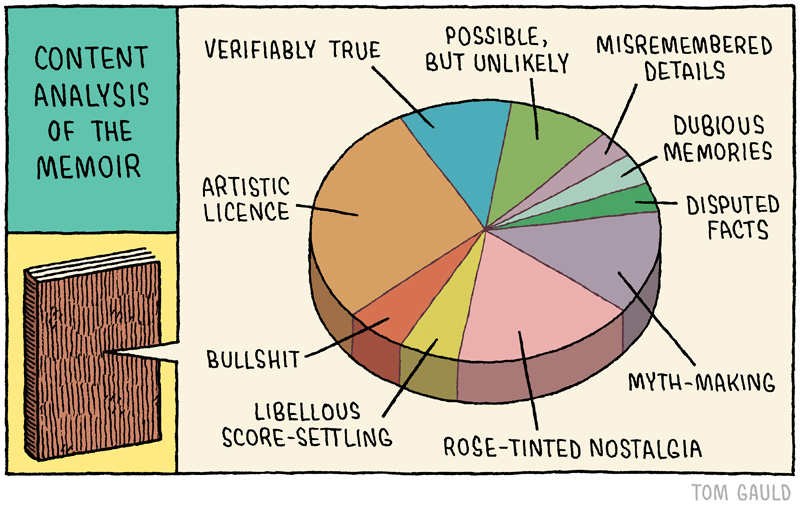
Content Analysis of the Memoir by Tom Gauld

memoir-tom-gauld
Tom Gauld

(My memoir will be largely myth-making, dubious memories, and bullshit. Maybe some artistic license too… )

Comments closed

James Wood On Not Going Home

Norfolk

In an essay for the London Review of Books, critic James Wood considers what is to be an immigrant and the desire to return home even though one can’t:

When I left this country 18 years ago, I didn’t know how strangely departure would obliterate return: how could I have done? It’s one of time’s lessons, and can only be learned temporally. What is peculiar, even a little bitter, about living for so many years away from the country of my birth, is the slow revelation that I made a large choice a long time ago that did not resemble a large choice at the time; that it has taken years for me to see this; and that this process of retrospective comprehension in fact constitutes a life – is indeed how life is lived. Freud has a wonderful word, ‘afterwardness’, which I need to borrow, even at the cost of kidnapping it from its very different context. To think about home and the departure from home, about not going home and no longer feeling able to go home, is to be filled with a remarkable sense of ‘afterwardness’: it is too late to do anything about it now, and too late to know what should have been done. And that may be all right.

I’ve lived in Canada for over 10 years now and I don’t have a ‘home’ to return to either. My parents no longer live where I grew up. My friends are scattered across the UK. Yet I still get pangs of homesickness at surprising moments — walking in a Toronto park on a rare foggy morning, or the smell of urban wood smoke — and it is a strange experience to feel nostalgic about a place that no longer exists and never really quite did. I know the England (and Scotland) that I miss is a fictional place — one that exists at least in part in books, film, and music as well as my memories — even as I miss it.  It doesn’t mean my feelings aren’t real, it just means that I know I can’t go home again. And it’s all right.

Comments closed

Cheap Words: George Packer on Amazon

The book folks have surely seen this already, but at The New Yorker George Packer takes a long hard look at Amazon:

Before Google, and long before Facebook, Bezos had realized that the greatest value of an online company lay in the consumer data it collected. Two decades later, Amazon sells a bewildering array of products: lawnmowers, iPods, art work, toys, diapers, dildos, shoes, bike racks, gun safes, 3-D printers. Amazon’s code of corporate secrecy is extreme—it won’t confirm how many Seattle employees it has, or how many Kindle e-readers have been sold—so it’s impossible to know for sure, but, according to one publisher’s estimate, book sales in the U.S. now make up no more than seven per cent of the company’s roughly seventy-five billion dollars in annual revenue.

Origins, though, leave lasting marks, and Amazon remains intimately tangled up in books. Few notice if Amazon prices an electronics store out of business (except its staff); but, in the influential, self-conscious world of people who care about reading, Amazon’s unparalleled power generates endless discussion, along with paranoia, resentment, confusion, and yearning. For its part, Amazon continues to expend considerable effort both to dominate this small, fragile market and to win the hearts and minds of readers. To many book professionals, Amazon is a ruthless predator. The company claims to want a more literate world—and it came along when the book world was in distress, offering a vital new source of sales. But then it started asking a lot of personal questions, and it created dependency and harshly exploited its leverage; eventually, the book world realized that Amazon had its house keys and its bank-account number, and wondered if that had been the intention all along.

It’s very comprehensive piece and well worth taking the time to read all the way through. At the LA Times Jacket Copy blog, Carolyn Kellog spoke to Packer about how the article came about:

Packer… included a suggestion from super-agent Andrew Wylie that publishers stop selling their books to Amazon altogether. Does Packer think that’s viable? “It’s a pretty radical solution, if you think about what it would do to their sales” he said. “I don’t know enough to agree or disagree.”

But in terms of telling the story, it was helpful. “It seemed like a way to jolt the picture productively. When you’re been an industry for a long time, you can’t imagine things differently. Maybe publishers need to think disruptively and not be victims.”

UPDATE: Packer has posted a short, but interesting, follow-up essay, ‘Amazon and the Perils of Non-Disclosure, at The New Yorker:

To Amazon, any piece of information could give its competitors an advantage. But what if those competitors’ main advantage is the walled-off, impenetrable nature of the company? If Amazon were just selling clothes, this might not be a potentially fatal flaw. But, as I wrote, the company has become a book publisher and a production company, and its owner has bought a major newspaper. Amazon is up to its neck in the world of culture, where nothing good can be done without a little light and air. The fact that Bezos visited his newspaper last month with more stealth than George W. Bush flying into Baghdad—a visit that was so well hidden even from people at the famously wide-open Post that I managed to break the story in these pages—struck me as particularly bizarre. Why not just show up? Because secrecy is in Amazon’s marrow. I’m certain that, sooner or later, this is going to create problems for Bezos’s newspaper, and I’m fairly sure that one reason for the failure of Amazon’s trade-publishing arm has to do with its isolation from the larger publishing world. If editors can’t gossip, speak to reporters, and pick up intel, they’re less likely to spot new talent and incubate ideas. They’re also less likely to be trusted by writers. Book culture and non-disclosure agreements are inimical.


1 Comment

Paranoid celluloid: conspiracy on film

the-conversation-lobby-card
Writing at The Guardian, Michael Newton looks at paranoid fiction and conspiracy on film:

The conspiracy film is not quite a genre. And if conspiracy is simply two or more people engaging in criminal or nefarious plots, the more you think about it, the more any film can start to seem to a conspiracy film – from Double Indemnity (1944) to The Wings of the Dove (1997). No movie is to be trusted.

Yet there is a discernible kind of conspiracy fiction out there, both criminal or political, fantastic or close to documentary. It would embrace Edge of Darkness (1985), as well as Rosemary’s Baby (1968), The 39 Steps (1935) and Capricorn One (1978), The Manchurian Candidate (1962) as much as Francis Ford Coppola’s The Conversation (1974). Such works might be better termed “paranoid fictions”, characterised by uncertainty, suspicion, a mood of disquiet, the sense that nothing is as we perceive it. The camera intensifies the unease with shots that reveal someone else is watching, as we share for a moment their malign, inquisitive gaze. Suspicion and curiosity are the motivating forces. In All the President’s Men, the journalists’ great mantra is the phrase, “We know that”, always spoken when pushing further into what they do not yet know.

Comments closed

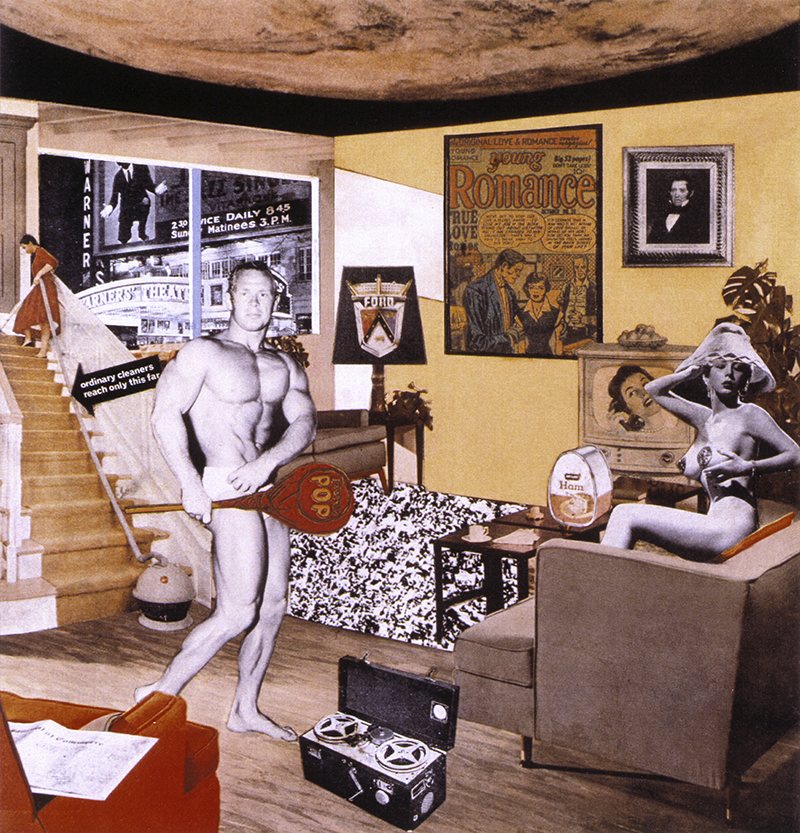
Richard Hamilton, Pop Art and Braun

Also writing at The Guardian, Fiona MacCarthy on British pop artist Richard Hamilton:

Among the design cognoscenti of the period, Braun products were the creme de la creme, the must-have objects. I remember a time when no trendy living room would seem complete without its Braun stereo player. All image-conscious offices had Braun electric desk fans… The elegance and rigour of Braun products were drawn on by Hamilton in several of his most peculiarly disconcerting works. The Braun catalogues were plundered not only for the pop-up toaster but also the portable combination grill and even the immaculate typography.

His own admiration for Dieter Rams, Braun’s chief designer, verged on the ecstatic. Hamilton said: “I have for many years been uniquely attracted towards his design sensibility; so much so that his consumer products have come to occupy a place in my heart and consciousness that Mont Sainte-Victoire did in Cézanne’s.” All the same – and typically – this attitude of reverence did not prevent him from affixing to the top of his own Braun electric toothbrush the giant set of sugar-pink confectionery teeth his young son had bought him as a present from Brighton. The assemblage was later made into a multiple, The Critic Laughs(1968), complete with its own Braun-style packaging.

A retrospective of Hamilton’s work opens at the Tate Modern in London later this week.

Comments closed

Sounds from a Concrete Island

I’m sure there are some of you who’ve already heard of UK sound artist Janek Schaefer. He has, after all, been recording and creating sound installations for past 20 years, and he even won the British Composer of the Year award in Sonic Art a few years ago. But, personally, I hadn’t heard of Schaefer until I heard a track from his new album on Tom Ravenscroft’s BBC 6Music radio show this evening.

Lay-by Lullaby, released this week on the 12K music label, uses “location recordings made in the middle of the night above the M3 motorway, right at the end of the road where JG Ballard lived, a couple of miles from Schaefer’s studio on the far west edge of London.”

Now, admittedly, the M3 has a special place in my psyche — I drove up and down it rather a lot in my late teens, often late at night — but more significantly Ballard also wrote his “seminal works on car culture” — Crash (1973) and Concrete Island (1974) — as the motorway was being built past the front of his house.

Schaefer’s 73 minute album was created last year as an installation for his show ’Collecting Connections’ at the Agency gallery in London. Apparently the sounds were played on infinite loop through a car radio installed in a little leather travel case and amplified by a pair of reclining traffic cones.

In other Ballard news, director Ben Wheatley announced earlier this week that he would start shooting his adaptation of High-Rise in June with Tom Hiddleston in the lead role.
High-Rise
The teaser poster for the film was created by artist Jay Shaw. You can read more about Shaw’s work, including his poster for Wheatley’s current film, A Field in England, which opened in New York this week, in Adrian Curry’s column for MUBI this week.

Comments closed

The Bee’s Knees


Sara Wood kindly let me know that fellow designer Steve Attardo has not only started his own freelance studio NinetyNorth Design, but also delivered this rather fine jacket design for Laline Paull’s forthcoming novel The Bees.

The book’s publisher Ecco has put together a rather nice trailer based on Steve’s cover design. It was conceptualized by Ecco’s art director Allison Saltzman and animated by Justin Cassano:

Comments closed

Truth. Beauty. Bailey.

david-bailey

“Are you filming, or am I wasting my fucking time?”

A short film by Jamie Roberts about British fashion photographer David Bailey, who I will forever associate with David Hemmings propeller-purchasing photographer in Michelangelo Antonioni’s 1966 film Blow-Up:

The film was commissioned by Dazed & Confused.

1 Comment

Rachel Kushner on Images

Author Rachel Kushner discusses her novel The Flamethrowers (now out in paperback), and the importance of images to her work, with The Quietus:

I’m inspired by visual art and film… Whether or not I’m writing about those mediums directly, as I sometimes do in Flamethrowers, I’m always thinking about images… I always wanted to have images in a book, and with [The Flamethrowers], after I got to have my choice of the image on the North American cover, I got a little bold, and asked about putting images inside. My editor said yes, so I quickly put together a short list of ideal visual passages. I didn’t want anything that would illustrate the narrative. I wanted, instead, images as kind of pauses, or counterpoints, but that would complicate, function in a relation, but not an obvious one. There’s a Richard Prince image, and he’s a shadow presence over the course of the book (one of the characters is also the name of Prince’s alter-ego, John Dogg). There’s a photograph by Aldo Bonasia, of a riot and police tear-gassing the rioters, in Italy. There’s a still from the movie Wanda, which figures in the book…

Funnily enough, I have feeling that Scribner have actually stuck closer to the hardcover for the front of the US paperback edition and slapped needless award stickers all over it, but I prefer the restraint of the version above left. The cover on the right is the UK paperback — a vast improvement on that mystifying hardcover).

Comments closed

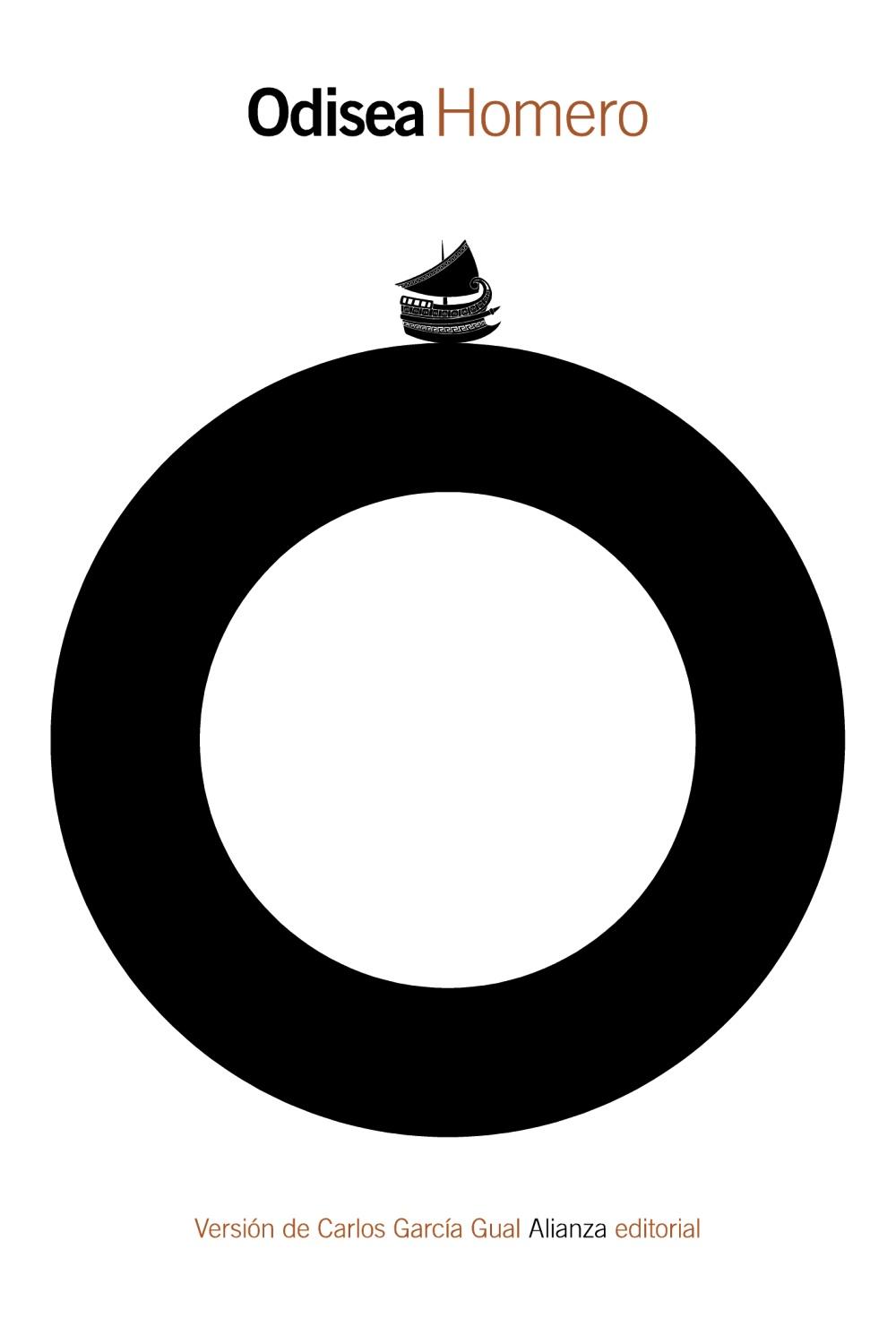
The 10 Best Spanish Book Covers 2013

Odisea

Ferran López and friends asked journalists, publishers and other designers for their favourite book covers of 2013. You can see the full list on Ferran’s Tumblr. (Pictured top: Design: Odisea; design by Manuel Estrada)

1 Comment