Skip to content

The Casual Optimist Posts

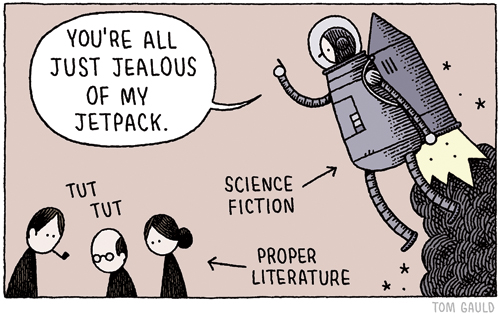
Jetpack

jetpack

Tom Gauld of course…

Comments closed

Something for Weekend, May 29th, 2009

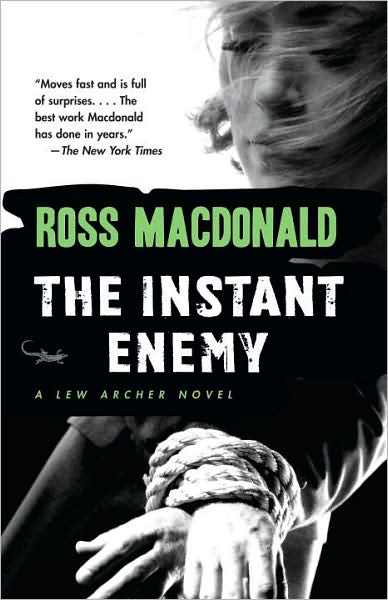
Hard-boiled — New designs for Ross MacDonald’s Lew Archer books by Joe Montgomery seen at FaceOut Books. I know I link to FaceOut just about every other week, but it’s an awesome site and the juxaposition of images in this series are great (as are some of the unused comps).

The Concierge and the BouncerPublishers Weekly report on Richard Nash (formerly of Soft Skull) and Dedi Felmen (formerly of Simon & Schuster) and their plans to “push back against the outmoded idea of publisher as cultural gatekeeper” with their new venture Round Table (announced at BEA this week):

The key is a shift from a caretaker mentality to a service mentality, from a linear supply-chain model to the idea of a free-floating, non-hierarchical “ecosystem” of readers, writers and authors… Nash and Felman’s idea of Publishing 2.0 could make a semi-professional reader, writer, editor and critic out of anyone with the desire.

Reading in a Digital World — A killer line in an otherwise blah article for Wired by Clive Thompson:

“We need to stop thinking about the future of publishing and think instead about the future of reading.”

Book Distribution in Canada — A Canadian Heritage study on book distribution in English Language Canada produced by Turner-Riggs dropped this week.

Can Editors Change Their Spots — David Hepworth’s thoughts on Robert G. Picard’s CS Monitor article ‘why journalists deserve low pay’,  and what “the new dispensation” means for  editors:

Magazine editors spend most of their time deciding what they’re *not* going to do and trying to arrive at a mix that the majority of people will like. They then find that whatever they’ve arrived at is too much for some people and not enough for others. This is made more difficult by the fact that their readers, being the most engaged in their particular area, are the people most likely to tap into other sources themselves. The people who value your mix most are also the people who would feel most qualified to mix it themselves.

The italics are mine.

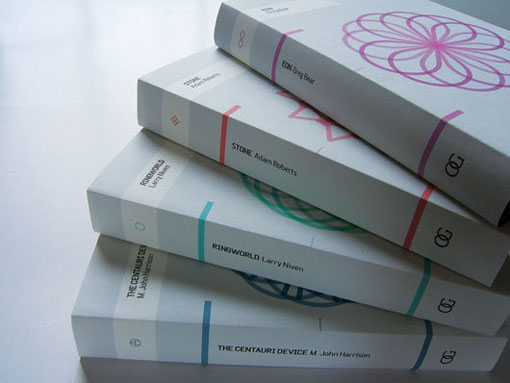
Cover to Cover —  Steven Heller reviews newly released  ‘visual books’ in the New York Times with a nice accompanying  slide-show. (See image above, but hey NYT, when are you going to let people embed your slide-shows? When?).

Comments closed

Turning Towards Our Shelves

Ellen Lupton, author of Thinking With Type (interviewed by me here), interviews graphic designer David Barringer about his new collection of essays There’s Nothing Funny About Design over at Design Observer today.

It’s a wide ranging interview — mostly about design unsurprisingly — but a couple of paragraphs about books caught my eye:

I do think that ebooks are a step backwards, however. It’s like the fax. It’s not flexible or useful enough. Handheld computers should have greater power, and the Kindle instead has less. You should be able to access encyclopedias, dictionaries, and other searchable resources, just like we can on the computer or the iPhone. That’s where the real benefit of portable handheld units are. Who cares about downloading Twilight? I care about having access to entire online libraries of reference works, maps, and encyclopedias.

I’ve sort of come to the same conclusion. If e-readers are less convenient than cell phones, less useful than laptops, and less durable than books, what’s the point?

Anyway, David Barringer goes on to discuss our enduring emotional connection with book-books:

I’ve seen many friends who are avid readers turn toward their shelves of books and regard them as they would a photo album of their own lives. We take the contents of books into our imaginations, and our personalities are influenced by them. Looking at the books on my shelves, I feel memories bloom, my own life come back to me. Books are triggers for remembering where we have been, and who we are. A book is like a body part, and when you die and your connection to the book is broken, the book dies a little, too.

I thought that was rather touching…

Link

(NB Full Disclosure: Thinking With Type and There’s Nothing Funny About Design are published by Princeton Architectural Press, who are distributed in Canada by my employer, Raincoast Books)

Comments closed

What’s Next For Publishers?

An unforeseen consequence of the “New Think for Old Publishers” debacle at SXSW in earlier this year is that I will be a participant in a session on the role of the publishers in the digital age at Book Camp Toronto on June 6th.

140 Character Assassination

The now infamous SXSW panel was supposed to discuss “what’s going right and what’s going wrong in publishing, assess success of recent forays into marketing digitally, digital publishing, and what books and blogs have to gain from one another.”

As has been well documented elsewhere, things did not go according to plan.

Despite the presence of heavyweight panelists (including the venerable Clay Shirky), new ideas were in short supply. Audience frustration overflowed on to Twitter and an array of 140 character bullets (identified by a #sxswbp hashtag) ripped into the panel, with what was perhaps the kill-shot fired by a writer in the audience:

“If, as an author, I can design it myself, write it myself, publish it myself, why would I bother going to a publisher at all? What purpose do you serve?”*

Existential Crisis

The old answer to this question was that publishers offered technical expertise and mass distribution.

But, nowadays, digital technology has made it easy for writers to publish, distribute and market their own books independently. And whilst professional editing, design, production, distribution, and marketing may still be valuable and sought-after services, it’s become very apparent that the perceived gap between self-publishing and traditional publishing is narrowing.

The battering that the SXSW panel took inadvertently revealed what we have long-suspected — publishers need to change the way they think about themselves, the decisions they make, and the services they offer, or cease to exist.

Fine Filtering

One idea that gained some currency in the aftermath of SXSW was that publishers are — or could be — ‘cultural curators’, a role made only more important by the explosion of content created and distributed by digital technology.

In a world where it is impossible to read everything that is emailed, texted, tweeted, posted, uploaded, or printed, there is an opportunity for publishers to become trusted advisers who sift through the vast digital slush-pile and present only the best, most interesting work. Or so the argument goes.

Unfortunately, the truth of the matter is that publishers haven’t proved to be very effective at curating in the past, and it’s precisely this kind of pretension that gets them in trouble at events like SXSW.

A rap sheet of opportunistic publishing, self-indulgence, costly blunders, and generally too much poor product means that publishers (not to mention the mainstream media) have squandered any cultural authority they may once have had, and have been superseded by an informal network of curators connected online.

Furthermore, curation doesn’t really explain what publishers actually do for authors. If it’s just filtering (by set a of cultural criteria I may or may not agree with), why bother going to a publisher at all?

Strengthening the Signal

Not long after after SXSW I sat down in Toronto with Book Camp TO organizer Hugh McGuire to discuss these crumbling cultural hierarchies and the implications for publishers.

Expressing my dissatisfaction with the idea of publishers as curators  — and trying to take into account Hugh’s reader-centric approach — I suggested that perhaps we’d stand ourselves in better stead if we thought of ourselves more as ‘advocates’.

More proactive than curation, advocacy takes into account that publishers do more than find completed works of art and present them to the public. And it goes at least part way towards explaining what publishers do for authors, whilst offering a model for how they can interact meaningfully (and honestly) with readers.

Perhaps, just as crucially, it also means being able to effectively publish and promote books that we believe in, without making any of the claims of cultural authority or superiority that are attached to curating — the framework of advocacy works whether you are publishing literary fiction or genre, poetry or humour.

Admittedly, there are probably minimal and maximal versions of what ‘publisher as advocate’ means. On the minimal side, publishers promote (and defend if necessary) their books in the public forum. A more maximal version — which is probably where my thinking lies — would not simply limit advocacy to marketing a finished product. It would begin with the commissioning editor championing the work in-house, and continue through the production of the book to the publicist who is pitching it to reviewers, and beyond. It would also mean publishing less and publishing better.

So…

These ideas are not definitive. In fact they’re a rather hurried formation (at the prompting of Sean Cranbury) of a jumble of ideas that I’ve had kicking around my head that need more time, but also more air and more discussion.

The Book Camp Toronto session about the role of publishers is on Saturday June 6th at the University of Toronto’s iSchool. Please come along and share your ideas. If you can’t make it, please feel free to leave your feedback, ideas, and links in the comments section or send me an email or a DM.

Over and Out.

* For the record, this quotation is from panelist Peter Miller‘s account of #sxswbp

1 Comment

Meanwhile, Elsewhere…

As is probably obvious, I spend a lot of time online clicking on stuff.

The things I bookmark, tag, and mentally store away that are (vaguely) about books end up here in one form or another.

But because I have eclectic interests, I bookmark a lot of photographs, illustrations, videos, and other things that just don’t have place on The Casual Optimist.

I’ve been mostly collecting these together in a digital scrapbook at Image Spark.

Image Spark has a really useful bookmarking plugin for Firefox so it’s easy to use and I really like it — despite it’s occasional  slowness.

But whilst Image Spark is great for me, I don’t think it’s so good for sharing.

I tried Tumblr and discovered I didn’t particularly like it (no offensive Tumblr — it’s not you, it’s me… Well, it’s a little bit you…), and so I have switched (at Ehren‘s suggestion) to Posterous which has a neat bookmarklet that makes it incredibly easy to post things when you see them.

So The Accidental Optimist is up and running. It’s just images and videos that I’ve stumbled upon. There’s links and tags but no commentary.

Inevitably there is some overlap with my Image Spark stuff but I don’t post everything to both, and I think the new blog will take on a personality of its own.

Anyway, like The Casual Optimist, it’s a work in progress, only it’s not about books (or anything really — which breaks about a bazillion rules of blogging).

Recent posts include a photograph of World War II airplanes in Texas, a bonkers animated music video by Mcbess and an Eric Gill quotation, so — as I say – eclectic. But maybe you’re interested? OK, maybe not…

(You can also find me — grumpy and misanthropic — on the Twitter if you care to)

Comments closed

Monday Miscellany, May 25th, 2009

Health Insurance and ShostakovichCaustic Cover Critic interviews über-book designer Peter Mendelsund:

Book jackets, mind you — which are already needless, redundant, frivolous items in life’s already cluttered inventory — themselves need designing. This arcane little tidbit came as something of a shock to me. “Someone gets paid for that?”

The Ampersand — a blog about ampersands. Really.

Hard Decisionsthe National Post interview Andrew Steeves, co-founder and co-publisher of Gaspereau Press, about their recently announced cutbacks:

I think it’s important to stress that I don’t think this is directly related to the more general economic downturn. Honestly, when you start a business from scratch you gradually try and figure out what size works for what you’re doing. I mean, you go through so many years where there isn’t a normal; the year previous can tell you nothing about what to expect.

And more good stuff from the National Post — In this month’s installment of their Ecology of Books series, Mark Medley talks to Evan Munday of Coach House Books, and looks at the thankless task of being a book publicist.

The Wankers Shelf — Nicholas Royle on the ethical dilemma presented by authors who are wankers (via 3:Am Magazine):

Do you have a Wankers shelf? I do. It’s for books by Wankers. Books that are so bad – or books by authors who are Wankers, whose books might actually be OK, from time to time, but they themselves are such unbearable Wankers – that you wonder if the best thing to do, rather than giving these books to charity, is to keep them out of circulation.

I fear the nuance is lost here for North American readers — but anyone associated with McSweeney’s is probably a Class A wanker if that helps. Martin Amis, he’s a definitive wanker. Who would be on your wanker shelf?

And lastly…, I may have rather unfairly dismissed the new volume of The League of Extraordinary Gentlemen Century: 1910 as “mildly disappointing”, but — like most of Moore’s work — it is undisputedly clever and even if I read 1910 another half-a-dozen times, I’ll still miss half the allusions, references, and knowing winks… Fortunately Jess Nevins has posted some very helpful annotations for the amateur nerd (via LinkMachineGo).

Comments closed

Something for the Weekend

Das Boot — David Drummond’s cover for Canadian Water Politics Edited by Mark Sproule-Jones, Carolyn Johns, and B. Timothy Heinmiller has been selected for the AIGA 50 Books/50 Covers this year. The book is published by McGill-Queens University Press who clearly take pride in the look of their books and have some other rather nice cover designs on their site.

The Long Goodbye — Another long, hard — and somewhat cynical look — at the state of the book industry. This time it’s the turn of Elisabeth Sifton, senior vice president of Farrar, Straus & Giroux, in The Nation.

W. W. Norton Book Design Archive — Publisher W. W. Norton have started posting their book cover designs to designated Flickr set (Crime by Irvine Welsh, designed by Darren Haggar pictured above) . I’d love to see more publishers do this (via The Book Cover Archive Blog).

Bird Brained or Brilliant — The contentious issue live-tweeting conferences. I only mention this because it tallies with my own recent experience of live-tweeting Raincoast’s Fall 09 Sales Conference. And because I’m a nerd (via Kate Trgovac on Twitter).

Gigantic Robot — the awesome Tom Gauld is publishing a new 32-page comic called The Gigantic Robot this summer. According to the Creative Review blog it’s “a fable concerning the production of a secret weapon whose promise apparently goes unfulfilled”. Can’t wait.

And finally (on a completely un-book related note)…

Redux — Muxtape is dead! Long live Muxtape! Whereas the late, lamented Muxtape was a place to upload mp3 ‘mixtapes’ (that fell foul of the music industry lawyers), Justin Ouellette’s new site is a platform for bands to share their music. Nice (via ISO50).

Comments closed

Midweek Miscellany, May 20th, 2009

Cut It Out — Dioramas made from the covers of pulp novels by Thomas Allen, seen at We Made This (via Ingrid Paulson on Twitter).

You Can’t Be SeriousThe Guardian takes a gloomy look at fate of  non-fiction and bookselling in the UK, managing to summon up  some half-hearted optimism towards the end:

Despite decades of predictions to the contrary, the appetite for demanding non-fiction has survived the advent of newspapers, radio and television – and, in Britain, a popular culture with a particular ability to absorb talent and themes that in other countries would be channelled into grand state-of-the-nation volumes. In fact, many publishers think the noise and immediacy of the web will make slow, quiet immersion in a book seem more, not less, appealing. And books, unlike most digital media, are not directly dependent on recession-affected advertising revenues.

Boy’s Own Misadventure3:AM Magazine’s Mat Colgate gets to the heart of why volume 3 of The League of Extraordinary Gentleman Century: 1910 (published by Top Shelf)  is mildly disappointing (by Alan Moore standards). Could it really be that Moore writes better when subverting restrictions of form and genre than when he has free reign?

It’s Not Just Your Type — Priya Ganapati talks to designers, including Henry Sene Yee, about the problems of  e-book design at Gadget Lab.  (And Joshua Tallent’s commentary at TeleRead about the problems of formatting for ePub is also worth reading).

Restraint — I mentioned Marian Bantjes’ gorgeous new typeface at the weekend, and now you can download a rather lovely Restraint desktop from the folks at Typenuts (via I Love Typography on Twitter).

1 Comment

Something for the Weekend, May 15th, 2009

The Story of Goddesigner Arthur Cherry discusses his elegant design (which uses Marian Bantjes’ typeface Restraint to such brilliant effect) for the new edition of Michael Lodahlr’s book at FaceOut Books.

A Manifesto — Ted Genoways, the editor of Virginia Quarterly Review, on the future of university presses and journals:

University presidents need to see what articulate ambassadors they have in their journals and presses, what tangible, enduring records they present of the variety and vigor of their sponsoring institutions…[G]reat universities extend well beyond the edges of their campuses. They reach out to the larger world, they challenge and engage the public, and the most effective and enduring way of doing so remains the written word.

HarperCollins Wants to Be Your Friend — Leon Neyfakh looks at publishers and social media in the New York Observer. Ostensibly it’s about the ever so anodyne HarperStudio, but more interesting stuff comes from the other people interviewed:

“I don’t know if it’s a direct response to the fact that publishing is in a very uncertain period right now, or if it’s just an idea whose time has finally arrived, but people right now are really interested in experimenting,” said Ami Greko, a 29-year-old digital marketing manager at Macmillan. “There seems to be a real sense of, ‘Let’s get creative—nothing is set in stone yet, so let’s just try a whole bunch of stuff.’”

Das Buch vom Jazz — The German-language version of The Book of Jazz, illustrated by Cliff Roberts ,  found in a used-bookstore by Today’s Inspiration’s Leif Peng. The black and white illustrations are wonderful.

Moaning Eton-boys & Middle-Aged Hackettes — A great defense of blogging by Nina Power at Infinite Thøught  (via PD Smith on Twitter):

Print media suffers from a lack of space; certainly it is selective, but it is also exclusive — all the stories that don’t get told, the injustices that get covered-up. We may feel we can ‘trust’ print journalists more than bloggers… but the sheer quantity and variety of information online allows for the exposure and discussion of things that might otherwise get ignored.

And finally…

The Tyranny of Data — The New York Times on Douglas Bowman‘s decision to leave his position as top visual designer at Google, and the  limitations of crowd-sourcing design:

“Getting virtually real-time feedback from users is incredibly powerful,” said Debra Dunn, an associate professor at the Stanford Institute of Design. “But the feedback is not very rich in terms of the flavor, the texture and the nuance, which I think is a legitimate gripe among many designers.”

Adhering too rigidly to a design philosophy guided by “Web analytics,” Ms. Dunn said, “makes it very difficult to take bold leaps.”

1 Comment

Paul Auster Granta Interview

“A lot of hesitation, stopping and starting, and re-thinking” — Author Paul Auster talks about his new book Invisible and his writing process with  Granta magazine’s US Editor John Freeman.

Comments closed

Midweek Miscellany, May 13th, 2009

Any colour, so long as it’s grey” — New typographic covers for the Faber editions of Samuel Beckett,  designed by London-based studio A2/SW/HK. You can see more from the series at Faber’s Flickr photostream.

The Publishers’ Dilemma — Tobias Schirmer on publishing’s digital future:

[D]igitalization is not about a product moving from its analogue to a digital form. It is a revolution that changes everything. The old business models don’t work the way they used to. Inevitably, publishing needs to think about how it can still inject value somewhere in between the creation of content and its distribution. Not transition but change management is needed.  Acknowledging this is the first step in getting out of the publishers dilemma.

Now is the Winter of our Discontent — Peter Olson, the former chairman and CEO of Random House, is feeling gloomy in Publishers Weekly. I wonder how much of this only applies to bloated multinationals?:

With the recession accelerating changes that are already taking place in the market, the world after 2009 will likely begin to look very different for book publishers, and a likely return to the relative security of the last decade may be wishful thinking.

Tintin and the Broken Records600 lots associated with the cartoonist Hergé were sold at auction at the weekend:

The sale in Namur, southern Belgium, dominated by five large hand-drawn pages of original cartoon strips, raised 1,172,000 euros (1.57 million dollars), including charges, — a world record for Herge-associated items and a cartoon strip book record in Belgium, said Thibaut Van Houtte, an expert on hand for the Rops auction house sale.

Titles Designed by Saul Bass — A collection of Bass’ incredible film credit sequences at Not Coming To A Theater Near You (via Grain Edit on Twitter):

One is pressed to cite an example of an active, self-contained, and characteristic credits sequence in film prior to the work of Saul Bass. And…  in regard to innovation, renown, and influence, Bass’ impact in credits design remains virtually unparalleled, even to this day.

Comments closed

Parker

Darwyn Cooke (author of one of my favourite superhero comics of recent years, the award-winning The New Frontier) talks about his comic book adaptation of The Hunter by Richard Stark (AKA Donald E. Westlake) — also the inspiration for John Boorman’s film Point Blank starring Lee Marvin — with Tom Spurgeon and writer Ed Brubaker at The Comics Reporter:

The first chapter of that book is so well written it makes me want to puke, but it was like there’s nothing visual left if you put the prose down. It’s all there. It’s an external description, people’s reaction to the guy. So it’s like, “You know what? Let’s take a good chunk of space here and see if we can achieve the feeling of that chapter purely through the visuals that he’s directing. Right down to the holes in his shoe.

Publisher IDW has a preview of the first chapter here.

Am I excited? Yes. Yes, I am.

Link

Comments closed