Skip to content

The Casual Optimist Posts

Heads Will Roll

Steve Osgoode, Director of Digital Marketing and Business Development at HarperCollins Canada, pointed me (and everyone else on Twitter) to an interesting post on e-books at An American Editor by Rich Adin. It’s a nice coda to the Guy LeCharles Gonzalez post I mentioned yesterday:

No industry changes overnight, so it is certain that publishers aren’t going to change their business model tomorrow just because a handful of people demand it… But the anger of the devotees, as few as they may be in number, continues and becomes increasingly strident, with neither side willing to “hear” the other.

Adin goes on to raise some interesting points. I do, however, have problems with his argument that the internet has fostered a sense of entitlement:

The Age of the Internet has birthed a belief among some consumers that they are entitled to everything they want when they want it at a price they want to pay…  Entitlement says I have rights that are more valuable than your rights (or that you have no rights)…

There is certainly some grain of truth to this and, to be fair, Adin’s argument is more nuanced than the quotation suggests. But it is also a dangerously seductive argument for publishers who don’t want to take full responsibility for their actions.

On a basic level, blaming the consumer and/or accusing them of being uppity (or worse, criminals) is not a good business strategy. Figuring out what they will pay for is a much better idea.

Customers don’t necessarily want cheap — they want value. Sure, everyone likes cheap stuff in the short term — free is even better — and yet most people know that in the end you get what you pay for. Quality costs.

Consumers will pay for things when they believe they are worth it, and as publishers, we need to recognise we aren’t always providing real value for money. We publish too many books and (shh… whisper it) a lot of them aren’t very good. We can do better. How many books really do need to be released in hardcover a full year before they’re available as paperbacks (or e-books) for example?

I also don’t think you can ignore that consumer attitudes are being led by businesses — that publishers have been all too willing to oblige — who have an interests in devaluing creative content as much as possible. Cheap content gets people in to stores and sells devices and publishers have benefited from this in the short-term. But we need to realise that cheapening our own content is like pissing in the pool. Not cool and not a good idea — even if it feels good at the time…

That all said, I think Adin recognises that it is not a one way street. He argues that publishers and consumers need to compromise:

The ebookers have thrown down the gauntlet, the publishers need to pick it up and accept the challenge. Simply because some ebookers have decided that publishers have no role to play in the future ebook world doesn’t make it so. Publishers need to redefine themselves in 21st century terms, not rehash 20th century concepts.

This, at least, seems spot on to me…

Read the whole article.

7 Comments

“E” is for Experiment (Not E-books)

Guy LeCharles Gonzalez, Audience Development Director at F+W Media, had an interesting op-ed at Publishing Perspectives last week about e-books and e-readers:

[T]here is a lot of R&D money being poured into [e-readers] — that’s how technology companies work — and one or more of them may eventually click with consumers, but right now it’s a fledgling market and the hype surrounding it has reached irrational levels in publishing circles… There are many fundamental business issues that need to be addressed related to e-books — rights, royalties, pricing, distribution, marketing — and it’s up to publishers, agents and authors to figure them out together and not be distracted by every new shiny object the technology companies come up with.

Although clearly not a big advocate for e-readers, Guy raises a lot of the question marks that I think still hang over the devices in a fairly balanced way, and the article as a whole expresses a lot of the doubts I hear from other quietly skeptical people in publishing.

Needless to say, the whole thing is worth reading and Guy has more to say on the subject at his blog loudpoet.

1 Comment

Something for the Weekend

Salu, Bonjour! — The Caustic Cover Critic features the awesome work of designer Michael Salu. The typography is great.

And speaking of typography…

KnockoutThe New York Times profile type jedis Hoefler & Frere-Jones:

Sitting in their New York studio in the charmingly ramshackle Cable Building, designed in 1892 by the flamboyant Beaux-Arts architect Stanford White, Mr. Hoefler and Mr. Frere-Jones are engaging advocates for their craft. They met in 1989, when they were working independently and found themselves hunting for the same antique typography books. “We’ve given up now because the prices have gone crazy,” said Mr. Frere-Jones. “Between us we own so many that if there’s something we don’t have, it’s either an uninteresting variation or there’s only one in the world and it costs $20,000.”

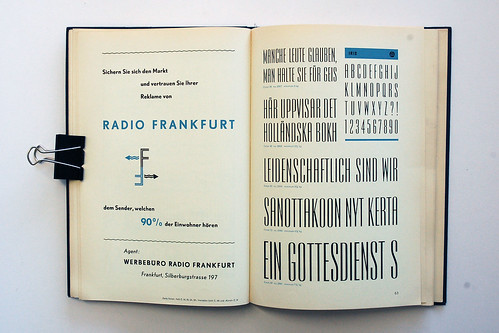
Schriftenkatalog — Beautiful pages from a 1960’s Dutch type catalogue on Flickr (via Inspire Me)

And… The history of the ampersand at the Webdesigner Depot (thanks Nic).

A Guide to Online Publicity (For Dummies) — Freelance writer, editor and blogger Lindsay Robertson’s common sense — but on the money — “do’s and don’ts” for flacks like me approaching bloggers like er… me (via Kottke).

And finally…

Two lovely posts at The Silver Lining featuring the work of Elaine Lustig Cohen: Part 1 and Part 2. There are more Elaine Lustig Cohen book covers at ephemera assemblyman and there is an amazing Flickr pool devoted to the design work of Alvin and Elaine Lustig here.

1 Comment

The Third & The Seventh

I’m fairly certain that every architect and designer on the planet has seen Alex Roman’s artful short film The Third & The Seventh already. But I haven’t seen it mentioned on any book blogs as yet, and so for the benefit of other architecturally-inclined book nerds who may not have caught it, I thought I would share it here (although you really should go and watch it in full-screen HD at Vimeo).

Even though it is apparently a full-CG animated piece, the film beautifully captures the light and elegance of the architectural space, and yes, there are even a few books in it…

There is an interview with the filmmaker about the film at Motionographer.

1 Comment

Goodbye BDR

Just like every other book blogger (and their mum),  I was sadden to read that Joseph Sullivan has decided to put his blog The Book Design Review on an “indefinite hiatus.”

The BDR has consistently been one of my favourite book blogs and was one of the first I added to my RSS reader.

It was a revelation to discover a blog that was about books and design. But more importantly The BDR made me realise that book blogs could be about the people who made books as well those that wrote them, and that enthusiasm might just be more interesting than snarkasm.

Nevertheless, I understand why Joe is taking a break (and I hope it is just a break, even though I don’t really think it is). Taking blogging seriously — taking the time to curate material and write about it well — can wear you down. There is (self-imposed) pressure to deliver, and when it doesn’t pay (and it doesn’t) it is hard to justify — especially if other creative projects fall by the wayside…

But, to be honest, I also feel kind of responsible. In the 5 years since Joe started The BDR a lot of other book design blogs like mine (even though I tell myself this isn’t really a book design blog) and sites like FaceOut Books and Pieratt‘s The Book Cover Archive have cropped up. Imitation may be the sincerest form of flattery, but it’s also fucking irritating. Even though he’s always been very kind to me, I’m sure Joe must have thought WTF? on more than one occasion. Perhaps the Amazon poll for the best book cover of 2009 was the final straw?

All I really know though is that I will miss The BDR terribly, and that will try not to disappoint Joe’s regular readers who chose to haunt The Casual Optimist in its (hopefully temporary) absence.

Thanks again Joe. (And sorry).

(Pictured: The Great Perhaps, designed by Jamie Keenan, one The BDR‘s Favourite Book Covers of 2009)

5 Comments

The Silver Lining

The Silver Lining blog is so good right now it’s giving me a headache: Art, books, ephemera, photography… All the good stuff, all in one place…

That is all. Carry on…

(pictured: De Sainte in New York, book cover by Dick Bruna seen at The Silver Lining)

2 Comments

Ben Wiseman | Chekhov

I really like these Chekov covers for W.W. Norton by Rodrigo Corral Design’s Ben Wiseman:


But I think the alternates are pretty special too:

There is a very short interview with Ben at idsgn.

(via FormFiftyFive and Cosas Visuales)

Update:

The good folks at W.W. Norton have just added Ben’s Chekhov covers to their Flickr design archive (thank you!).

These new editions are available in July 2010.

4 Comments

Something for the Weekend

Megan Wilson‘s new cover design for An Education by Lynn Barber.

Of a Certain Blockheadedness — Scott McLemee on the internet’s “gigantic plot” to get him to write for free:

The idea that new media has somehow abolished the old hierarchical structuring of the field (making everything level and equal and rhizomatic and whatnot) is only half right, at best. The hierarchies aren’t as well-marked as they used to be but they aren’t gone. Talk of an “army of amateurs” is at this point persuasive only to people who enlist without paying any attention to the fine print.

The Art of Fontana Modern Masters — Much linked to elsewhere, James Pardey (of the The Art of Penguin Science-Fiction site mentioned here) has new project on the Op-Art inspired Fontana Modern Masters book cover designs. He’s also written about the series for Eye (via Ace Jet 170 and Daily Discoveries on Design).

The New SleeknessAmi Greko and Pablo Defendini (and other “bookish types”) try to fill a hole in publishing punditry. Having tried that myself and failed horribly, I can only wish them good luck.

Around The World with the Bodoni Family — A beautiful new 60-page book by graphic designer Teresa Monachino seen at The Creative Review. Each letter of the alphabet is printed in Bodoni to illustrate a place beginning with that letter.

Wave of Mutilation — Tom McCarthy, author of Remainder, on the films of David Lynch in the New Statesman. Yes, it is as weird and unlikely as it sounds (via 3:AM):

Try to count the instances of deformity in Lynch’s work, or of people being deformed on camera, and you’ll lose count pretty quickly…  Deformity, for Lynch, is not simply thematic: it is instrumental. In his films, what the continual, almost systematic replacement of body parts and faculties by instruments – crutches, wheelchairs, hearing aids and ever weirder apparatuses sometimes as large as rooms – produces is a whole prosthetic order, a world of which prosthesis is not just a feature, but a fundamental term, an ontological condition.

Information Wants to be Valued — Ian Grant, Managing Director of Encyclopaedia Britannica, at BookBrunch:

The new online world has given book publishers good reason to review everything that they do, from what to publish to how to run their businesses. It is a noisy call to new action and fresh efforts, but publishers are well-placed to respond. The core skills we have had for generations – imagining our users, creating shapely products that meet their needs, and identifying the transfer of value that results in a sale, are precisely the skills that make good publishing online successful and satisfying. Information does not “want to be free”; customers want to be inspired and satisfied.

And finally: It seems I’m not the only one who doesn’t take predictions about the book industry entirely serious… Laurence Hughes over at the Huffington Post:

Some time in the next decade, someone will download both The Bible and The Satanic Bible to their e-reader, triggering the Final Conflict and ushering in Armageddon and the End of Days. Expect a slight dip in book sales during the thousand-year reign of the Antichrist.

2 Comments

Predictions

I really don’t know why smart people make predictions.

Surely one of the lessons of the last couple of years is that experts are actually very, very bad at making predictions — or rather, they are good at making predictions, just not very good at making accurate ones, which is, perhaps, even worse.

And didn’t we learn that experience doesn’t necessarily tell us much about the future?

In fact, someone even wrote a bestselling (if very irritating) book about it.

Nevertheless, it seems the smart book people — like moths to a flame — are undeterred. Here are some predictions from people in and around the industry:

Book Business Faces ‘Tectonic’ Shift: 2010 and Beyond (Part One) — Gail Roebuck (Random House), Peter Field (Penguin) and Victoria Barnsley (HarperCollins) in The Bookseller. Victoria Barnsley:

I think 50% of books will be read online by 2020. There will be far more variety for consumers across different formats with enhanced e-books for example. The business model will become much more complicated. The day when we sold only hardbacks and paperbacks will be looked backed at with wonder.

‘Decade of the people’: 2010 and Beyond (Part Two) — Tim Godfray (Booksellers Association), Michael Neil (Bertrams), Tim Coates (library campaigner), Roy Clare (Museums, Libraries and Archives Council), George Walkley (Hachette) in The Bookseller. Tim Godfray:

The big booksellers will develop online presence and independent booksellers will get increased offers of support from publishers, but as ever it will be consumer led and the winners will be the ones that please the consumer…

$64,000 question—where will the book be purchased and on which platform will it lie?

Predictions 2010: Cloudy with a Chance of Alarm — Michael Cairns, Information Media Partners and Personanondata:

[T]here have been few bright spots… during 2009, and after having taken the pulse of views on the near-term future in publishing by speaking to a number of senior publishing executives, my belief is we will not see any appreciable improvements during 2010. While some of their collective views can be attributed to ‘hedging,’ external trends support the lack of optimism whether they be reductions in education funding and library budgets or the increasing reliance on “blockbuster” authors or pricing issues.

It Was the Best of Times, It Was the Worst of Times — Bob Miller, president and publisher of HarperStudio:

[F]or every trend there will be a counter trend

Book Publishing 10 Years in the FutureRichard Nash, former publisher, at GalleyCat:

In 2020 we will look back on the last days of publishing and realize that it was not a surfeit of capitalism that killed it, but rather an addiction to a mishmash of Industrial Revolution practices that killed it, including a Fordist any color so long as it is black attitude to packaging the product, a Sloanist hierarchical management approach to decision making, and a GM-esque continual rearranging of divisions like deck chairs on the Titanic based on internal management preferences rather than consumer preferences.

A baker’s dozen predictions for 2010 — Mike Shatzkin, The Idea Logical Company:

By the end of 2010, the experiment with “windowing” ebooks — withholding them from release when the hardcover comes out — will end as increasing evidence persuades publishers and agents that ebook sales (at any price) spur print book sales (at any price), not cannibalize or discourage them and, furthermore, that this withholding effort does nothing to restrain Amazon’s proclivity for discounting.

2010 Predictions — Joe Wikert, general manager and publisher at O’Reilly Media:

Let’s face it. The e-future of this industry is not quick-and-dirty p-to-e conversions.  Pricing pressures and  value propositions mean these will be nothing more than revenue rounding errors for the foreseeable future.  2010 will be the year where we’ll see more investment in richer e-content products.

Ten Things You Can Comfortably Ignore in 2010 — David Worlock, publishing analyst and advisor, Thoughts from the bottom of my garden…:

Anyone who proclaims the arrival of a new age and names it web 3.0 , 4.2 or X marks the spot.  We are working within a new continuum, every technology we will use in the next 15 years has already been invented and patented, and what remains to be seen is only the way in which consumers react to which combinations of hardware/software/content to solve which problems in what contexts. And nothing is lost by experimentation.

OK, for the record, I do genuinely believe these are all smart people who should have some idea what they’re talking about. But I do think it’s important to ask the following questions:

  • Who is writing the prediction?
  • Why are they making predictions about the book industry?
  • What do they have to gain (or lose) from their predictions coming to pass?

And, remember kids, while predictions are fun, they’re really no more reliable than tea leaves…

Book business faces ‘tectonic’ shift: 2010 and beyond, part oneBook business faces ‘tectonic’ shift: 2010 and beyond, (part one)

4 Comments

More than…

In a recent op-ed for The NY Times, ‘There’s More to Publishing Than Meets the Screen’, Jonathan Galassi, president of Farrar, Straus & Giroux, asked:

Are e-books a new frontier in publishing, a fresh version of the author’s work? Or are they simply the latest editions of the books produced by publishers like Random House?

This is essentially a more articulate framing of a question I asked here a couple of weeks ago. But unsurprisingly Galassi offers a far more compelling defence of Random House than I could manage:

[S]hould another company be able to issue e-book versions of Random House’s editions without its involvement? An e-book version of Mr. Styron’s “The Confessions of Nat Turner” will contain more than the author’s original words. It will also comprise Mr. Loomis’s editing, as well as all the labor of copy editing, designing and producing, not to mention marketing and sales, that went into making it a desirable candidate for e-book distribution. Mr. Styron’s books took the form they have, are what they are today, not only because of his remarkable genius but also, as he himself acknowledged, because of the dedicated work of those at Random House.

I think the point here is that books are often a collaboration between author and publisher, and in this sense publishers add value — or, at least, they did in the past. Galassi’s example is Styron, but we now know that Raymond Carver’s editor Gordon Lish was instrumental in defining the author’s trademark style. No doubt there are other high profile examples…

As Peter Ginna, director of Bloomsbury Press, points out in this post, and in a comment on my post here, there are definitely some issues around royalty payments that Random House need to address. But while e-books are little more than converting the file format of a work, I do have some sympathy for Random House’s argument about rights.

2 Comments

Daily Discoveries on Design

Karen Horton is co-founder of the design community site design:related and Art Director at Little, Brown and Company. Her Tumblr blog Daily Discoveries on Design is currently one of my favourite RSS Feeds. It’s full of great design, art, books, photography and inspiration — so much so, that it makes feel like a total sloth for my inability to post here daily. If you’re not subscribing already, you really should be.

You can find Karen own work (also great) on design:related (where else?).

(pictured: I Never Loved a Man the Way I Love You, cover design by Karen Horton for St. Martin’s Press).

1 Comment

Books of the Decade

Back in November, the chaps at The National Post asked me and a selection of eminently more qualified Canadian book types what we thought the most important publishing story of the past 10 years was. They ran the results at the weekend and the smart answers ranged from decline of literary magazines to the rise of Google.

I have to admit, I was at a bit of loss as to how answer the question. Decades are such arbitrary periods of time. I read somewhere that the 19th Century didn’t really end until 1914, and in a way I feel like the 21st Century didn’t really start until the day after 9/11 2001. And who is to say that epoch is over? So many things still look the same…

Of course I really have no idea what any of the last 10 years meant for books. I don’t have enough perspective. All I knew is that I wanted to say something positive (nobody likes a whiner) and avoid saying anything too obvious, boring or bullshitty (i.e. definitely no talk about either the “death of publishing” or “teh internetz”).

In the end I equivocated and then gushed about something close to my heart — comics:

“J.K. Rowling’s Harry Potter and online retailer Amazon dominated the decade, but they have their roots in the previous century (Amazon was founded in 1994, Harry Potter and the Philosopher’s Stone was published in 1997). George W. Bush surely has a claim — his crimes and misdemeanours created an industry within an industry and produced many fine books including The Dark Side by Jane Mayer and The Forever War by Dexter Filkins — but the very thought of the 43rd President of U.S. being the publishing story of the decade is simply too horrifying to contemplate seriously. Many people will no doubt say e-books, but I think they will be the story of the next decade. So I’m going to go with the popular success and the critical acceptance of long-form comics (the “graphic novel” if you must) as the big story. With the likes of Asterios Polyp, Black Hole, Bone, Epileptic, Fun Home, George Sprott, The Hunter, Jimmy Corrigan, Louis Riel, Paul Moves Out, Persepolis, Safe Area Gorazde, Scott Pilgrim, Skim and Shortcomings (not to mention the beautiful reprints of Peanuts and translations of Tezuka and Tatsumi) to name just a few, we really have had a wonderful decade.”

Perhaps, not the wisest thing I’ve ever written, but hey…

The Post also asked us to nominate our best books of the decade.

As I’ve said before, I’m really not terribly qualified (at least compared to some) to make a call on “best” (especially when it comes to Canadian literature), but I did strive to be more objective than I was with my personal list of the books of 2009, which meant leaving out eclectic favourites ranging from Stet and How To Be Alone at one end of the spectrum to Hellboy: Conqueror Worm and Hard Revolution at the other, with the likes of I’ll Go To Bed At Noon, Lush Life, Mother’s Milk and The Dark Room stuck somewhere in the middle. And that’s not to mention all the art and design books I chose to leave out: 79 Short Essays on Design, Penguin By Design, The Curiously Sinister Art of Jim Flora, Charley Harper, to name just a few of the top of my head…

But with all those caveats firmly in place, here is my annotated and abridged list of the best books of the decade compiled for The Post:

Remainder by Tom McCarthy (Metronome 2005, subsequently published by Alma and Vintage)

Tom McCarthy’s Remainder was the first book I worked on at Raincoast Books — We briefly distributed the Alma Books hardcover before Vintage published their own paperback edition (pictured above, cover design by John Gall of course,with the most unlikely of blurbs from Jonathan Lethem) in the US and Canada — so it has a special place on my shelf. Oh and it’s really good.

Here’s what I wrote for The National Post:

“If only for a fleeting moment Remainder, a dark and spare novel about personal authenticity and murderous re-enactment, seemed to offer a creative alternative to the cul-de-sac of overwrought and twee novels emanating from Brooklyn (and creative writing classes everywhere). Sadly the bloated and banal seem to have made a decided comeback (if they ever went away), but even so, the unashamedly intellectual Remainder stands out, perfectly capturing the fears and anxieties of the decade.”

The Amazing Adventures of Kavalier and Clay by Michael Chabon (Random House 2000)

Possibly the polar opposite of Remainder, Chabon’s literary Boy’s Own adventure hit a lot of my buttons: Golden Age Comics, Eisner, Steranko, European folklore, New York, and WWII. Really, what’s not to like? But my affection for this book ebbs with every new effort — including Chabon’s own — to repeat the formula and turn pulp into something politely literary. (And NB the Picador paperback cover design above is by Henry Sene Yee — you can see his sketches here).

Jimmy Corrigan: The Smartest Kid on Earth by Chris Ware (Pantheon 2000)

Perhaps not my favourite graphic novel favourite of the decade (that slightly dubious honour would probably go to Tekkon Kinkreet — and although the English edition I own was published in 2007, the series itself is actually from the mid-90’s, so I didn’t think it qualified for this list), but Ware’s breakthrough graphic novel began the decade and went on to creatively define it for graphic novels. No Jimmy Corrigan, no McSweeney’s Issue 13.

Never Let Me Go by Kazuo Ishiguro (Knopf 2005)

Like Kavalier and Clay, Ishiguro’s quietly evocative SF novel justifiably appeared on a lot of other Best of the Decade lists. It’s just beautifully, beautifully written and has a silver sliver of ice at its heart.

The Dark Side by Jane Mayer (Doubleday 2008)

It’s almost impossible to think about books that are representative of the decade without including at least one on the Bush Presidency, 9/11 and the awful ‘war on terror’. The Dark Side could easily have been the aforementioned Forever War by Dexter Filkins, or Ghost Wars by Steve Coll, or Imperial Life in the Emerald City by Rajiv Chandrasekaran, or one of the many other excellent books on these topics. But Mayer’s exposé of state-sanctioned torture chillingly underlines the bureaucratic banality of evil and the horror lived long in the mind after I finished reading it.

And, you know what? The Dark Side reminded me that books are important. They can and should be more than vehicles of self-promotion. Research — real research — requires more than Wikipedia. And — fuck it — we need to keep paying writers to write.

Louis Riel: A Comic Strip Biography by Chester Brown (D+Q 2003)

I suspect Louis Riel is now a creative and stylistic albatross for poor ol’ Chester Brown, but it was my joint first choice for the Canadian book the decade. This is what I wrote for The National Post:

“Not only is Louis Riel a uniquely Canadian story, it was published by Drawn + Quarterly (surely the most interesting Canadian publisher of the decade) and it epitomizes their success at unearthing and supporting creative talent. It isn’t a coincidence that Daniel Clowes—author of Ghost World and one the cartoonists of his generation—has decided to publish his new book with them.”

Pattern Recognition by William Gibson (GP Putnam And Sons 2003)

Although Pattern Recognition did not receive good reviews when it was first published and I bought the hardcover out of a reminder bin, it was my other pick for Canadian book of the decade. The book’s obsession with the fringes of pop culture and the dislocation and horror of the globalized world seemed to me (in some small way) to make it the first novel genuinely about the 21st Century. Even if it dates horribly (which many critics seemed to think it would), I think it’s a something of a cult classic. This is what I said to The National Post:

“A prescient post-September 11th novel about viral media, [Pattern Recognition is] the antithesis of the clunking, insular, parochial Canadian novel so beloved of literary prizes. The book is not without its flaws – it was not well received by the critics when it was published in 2003 – but it just fizzes with ideas, oddness, and energy. I can’t think of another Canadian novel that I refer to quite as often in everyday conversation. Give me flawed and brilliant over dull and worthy any decade of the century.”

OK — I love Pattern Recognition and I do talk about it a lot — but I was being a bit of a shit disturber here (which is probably why The Post ignored it). That said, Pattern Recognition is better than several other books (that shall remain nameless) that did make the cut that’s for sure.

So, that’s my list. You can read the Post’s selections here. What did we miss out?

5 Comments