Skip to content

The Casual Optimist Posts

Grand Openings: Fight Club

In a 5 part series of video essays for Moving Image Source called ‘Grand Openings’, critics Aaron Aradillas and Matt Zoller Seitz analyze the credit sequences of David Fincher’s films.

Part 3 in the series looks at Fincher’s adaptation of Chuck Palahniuks Fight Club:

(vis @mdash)

Comments closed

Something for the Weekend

More Than Words — Yves Peters takes a typographical look at the winners of British Book Design and Production Awards 2010 for FontFeed. The winners all look wonderful, but, as Peters notes, it is a shame that only the publishers are credited, not the designers of the books.

An Archaeology of Business Cards — Penguin book designer Coralie Bickford-Smith discusses her workspace and her work with From the Desk Of…:

Right now I’m in the middle of designing a 20-book series, as well as sundry standalone titles, and my desk is usually a mess of ideas and scribbles on innumerable scraps of paper. There’s a whole archaeology of business cards, post-it notes and other treasures under there. I like to be surrounded by the current proofs to make sure the designs are working and that any tweaks are made in time for the final print. I like my desk – it’s my own tiny world in a big office.

My Q & A with Coralie is here.

Reading the ProcessThe New Yorker’s Book Bench interviews book designer Rodrigo Corral:

Reading is always part of the process when we’re working on a book jacket or cover for fiction. I read, I take notes, I take breaks. I’ll stop on the title, re-read it, and think about how it plays into the book and its overall message and intent. It’s rare to be able to illustrate the tone of the entire story by only depicting one moment from the book, so I prefer using a new image or design that I feel represents the story accurately.

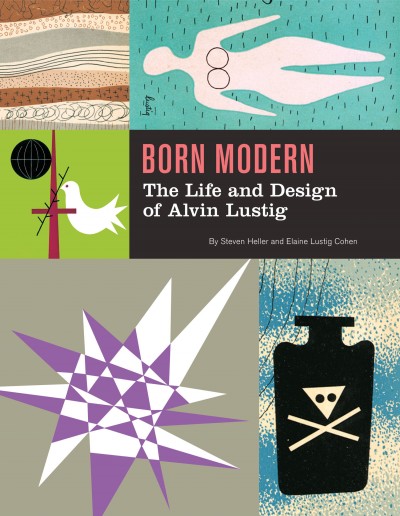
The Rejection of Literalism — Steven Heller talks about his biography of designer Alvin Lustig Born Modern* with Imprint:

I did not get the impression that Lustig went into the book jacket biz with a literary bent. He did, however, have the temerity to try just about anything. And since, as a kid, he was interested in designing his way, he just, well, designed his way. So, I guess “confidence” is the right word. It was ballsiness. He had a vision—wherever it came from—and he pursued it. He was largely self-taught.
And, also via Imprint

Design Dossier: Graphic Design for Kids by Pamela Pease published by Paintbox Press, seen at The Daily Heller.

12 Reasons to be Excited About Publishing’s Future — Following up an earlier post about the love of books, Digital Book World‘s Guy LeCharles Gonzalez asks book industry folks why they’re excited about publishing.

And finally…

Help Me Destroy Public Radio” — Alec Baldwin channels Jack Donaghy for his “Do Not Pledge To Public Radio” pledge drive promo for NPR.

* Born Modern is published by Chronicle Books, who are distributed in Canada by my employer Raincoast Books.

1 Comment

Bruce Mau and the Problems of Success

“Most of the problems we are facing are the problems of success, not failure.”

Canadian designer Bruce Mau, author of Massive Change, talks about sustainability and framing the issue positively with Jeanne Park of the PBS show Need to Know.

When asked which approach — carrot or stick — is more the effective way to change people’s habits,  Mau replies, “I think you have to paint the stick orange”:

(via Bookslut)

Comments closed

Midweek Miscellany

The Man With the Getaway Face — Cartoonist Darwyn Cooke talks The LA Times’ Hero Complex blog about his latest Richard Stark (AKA Donald Westlake) adaptation, The Outfit, released this month:

With the first book, I was really trying to get Don Westlake’s worldview across to people. The story had already been told several times in films… and what-have-you, but it had never been told down the line, so it was really important for me to do that. With “The Outfit,”  I was able to sort of step back and say, ‘OK, the plan is we’re doing four books here; are there ways I can make this one stronger in terms of how it relates to the three other books?’ We don’t have, say, 20 books to get our readers acquainted with this entire world, so are there things that I can do here to help in that regard? So I changed a few things. And to be honest, I fixed a couple  of tiny problems with the story that I think Donald would have giggled about if I had brought them up. ‘Oh, geez, good point…

And on the subject of Richard Stark, David Drummond recently posted the final 3 covers (there are 18 in total) for the University of Chicago Press’ Parker reissues  (mentioned previously here):

Where the Wind Blows — Stephen Page, CEO of Faber & Faber, outlines the challenges facing existing book publishers at The Guardian:

Publishers perform roles that writers need. The question now is whether writers will continue to turn to existing publishers to perform these tasks, and whether they believe they offer value. Some authors will bypass publishers (some always have) but among most authors and agents I deal with, there is no appetite to do so, because publishers continue to perform essential roles for writers in both the physical and digital worlds (editorial, marketing, distribution, and so on). However, urgent questions are rising about how a successful 21st-century publisher ought to look and function, and whether existing publishers can adapt quickly enough…

A Hipster Never Teaches  a Square Anything — Over at Good, Lexicographer Mark Peters looks at the origins of the word “hipster” and why, these days, nobody admits to being one:

“Hipster” first popped up in 1940, and The Historical Dictionary of American Slang’s first use includes the statement that “A hipster never teaches a square anything.” The OED’s early examples include semi-definitions such as “know-it-all” (1941) and “man who’s in the know, grasps everything, is alert” (1946). Those descriptions sound groovy, but in the HDAS’s definition of “hipster,” we can find the seed that grew into today’s widespread hipster-phobia: “A person who is or attempts to be hip, esp. a fan of swing or bebop music.” It’s that attempting—especially in clumsy, transparent ways—that make the hipster horrible.

And finally…

What Batman Taught Me About Being a Good Dad — The headline tells you just about all you need to know about Adam Rogers post for The Atlantic (what dad doesn’t secretly believes that Batman is full of very important life lessons?), but hey…

I am trying to build a good human being here, someone who will make the world better for his presence. Because I don’t know any other way to do it, that means I’m building a little geek… I want him to think that these stories have weight, that they mean something; they are our myths. I give my son comics and cartoons and episodes of Thunderbirds because I want him to understand right and wrong, and why it’s important to fight the dark side of the Force. The mantras spoken in this corner of pop culture are immature, but they have power: With great power comes great responsibility. Truth, justice, and the American Way. The weed of crime bears bitter fruit. No evil shall escape my sight.

secretly
Comments closed

Chris Ware, The New Yorker

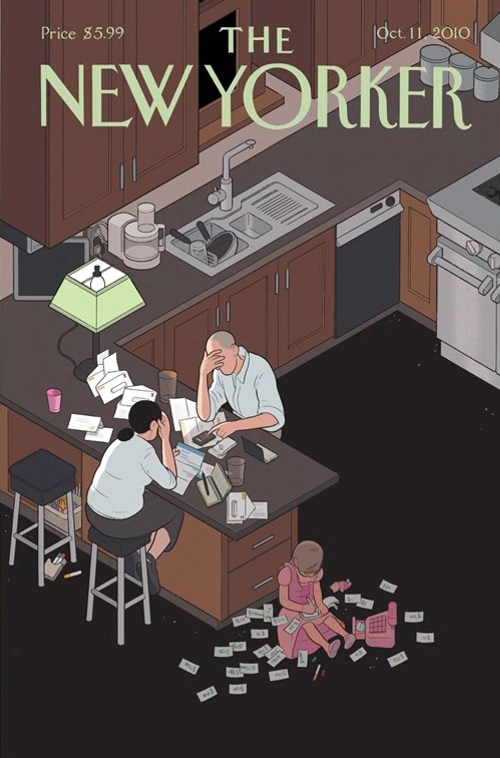
Another heart-rending, all too relatable, illustration by Chris Ware for the October 11th issue of The New Yorker:

After last year’s killer Halloween cover, Ware is fast becoming one of the most incisive commentators on modern parenting.

Acme Novelty Library #20 by Chris Ware is available from Drawn & Quarterly next month. (Full disclosure: D+Q are distributed in Canada by Raincoast Books)

(via The Ephemerist)

5 Comments

Something for the Weekend

There are two new books about designer Alvin Lustig available this month — Born Modern: The Life and Design of Alvin Lustig by Steven Heller and Elaine Lustig Cohen (Chronicle Books*) and Purity of Aim: The Book Jacket Designs of Alvin Lustig by Ned Drew and Paul Sternberger (RIT Cary Graphic Arts Press).

The Death of the Book has Been Greatly Exaggerated — Tech columnist Christopher Mims on the “irrational exuberance” around e-books (via MobyLives):

Tech pundits recently moved up the date for the death of the book, to sometime around 2015, inspired largely by the rapid adoption of the iPad and the success of Amazon’s Kindle e-reader. But in their rush to christen a new era of media consumption, have the pundits overreached?

I’m calling the peak of inflated expectations now. Get ready for the next phase of the hype cycle – the trough of disillusionment.

The Secret Life of Shepperton — A photo essay on Shepperton, the suburban town south west of London where author J. G. Ballard spent most of his adult life. The photographs are accompanied by text from Ballard’s own novels, autobiography, interviews as well as observations about the town and its history (via 3:AM).

And finally…

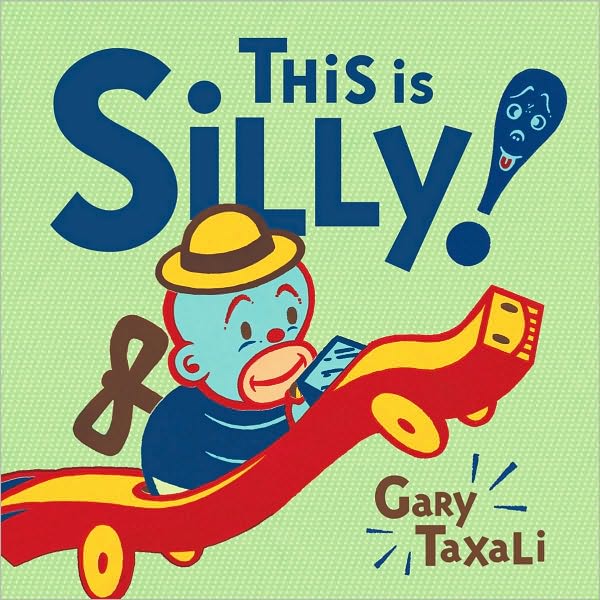
The Wonderful 36 Pages features This is Silly! by Toronto-based artist/illustrator Gary Taxali:

* Chronicle Books is distributed in Canada by my employer Raincoast Books.

Comments closed

Midweek Miscellany

Lost Libraries — With the personal book collection of David Markson ending up at The Strand bookstore in New York, Craig Fehrman examines the fate authors’ libraries for The Boston Globe (via The Second Pass):

Most people might imagine that authors’ libraries matter — that scholars and readers should care what books authors read, what they thought about them, what they scribbled in the margins. But far more libraries get dispersed than saved. In fact, David Markson can now take his place in a long and distinguished line of writers whose personal libraries were quickly, casually broken down. Herman Melville’s books? One bookstore bought an assortment for $120, then scrapped the theological titles for paper. Stephen Crane’s? His widow died a brothel madam, and her estate (and his books) were auctioned off on the steps of a Florida courthouse. Ernest Hemingway’s? To this day, all 9,000 titles remain trapped in his Cuban villa.

Fehrman expands on this article — and the reasons we should not have been surprised that Markson’s books found their way to The Strand — at his blog.

Eating Each Other is Wrong — Evan Scnittman, Managing and Director of Sales and Marketing at Bloomsbury, argues that e-books don’t cannibalize print:

The most important lesson I can convey to book publishing professionals is that they must understand that those of us who have made the transition to ebooks, buy ebooks, not print books. Ebook reading device users don’t shop in bookstores and then decide what edition they want; ebook device readers buy what is available in ebookstores. Search an ebookstore for a title and if it doesn’t come up, it doesn’t exist – no matter how many versions are available in print.

Ebooks aren’t a better value, ebooks aren’t more attractive nor are they a threat to the print version of any immersive reading book. This isn’t the same as paperback versions vs hardcover – where the platform and convenience are the same – the timing and pricing are the key ingredients. Books that aren’t in ebook form are do not exist to ebook reading consumers. There is no cannibalization if in the mind of the buyer if there is no version available to them.

The Forgotten Mimics — In the 11th installment of The National Post’s ‘Ecology of Books’ series, Mark Medley talks to to some of Canada’s foremost literary translators:

“We’re not robots,” says [Lazer] Lederhendler, 59, who won the Governor General’s Literary Award for his translation of Dickner’s last novel, Nikolski. “We have a way of reading a book. We have a way of using the language. We have our own vocabulary, our likes and dislikes in terms of this phrase or that phrase. It’s a kind of balancing act between observing the fact that you’re at the service of someone else’s work, but at the same time it’s an artistic mission.”

Four Decades of Art — A mini-documentary about illustration in The New York Times Op-Ed page, featuring interviews with art directors and illustrators.

And finally…

Type designer Matthew Carter and writer David Simon (creator of The Wire) were recently named MacArthur Fellows. The Fellowship is a $500,000 (US), no-strings-attached grant for people who have shown exceptional creativity in their work and promise to do more (via How Magazine):

Comments closed

Journalism in the Age of Data

A fascinating 54-minute documentary about news and data visualization by Geoff McGhee:

(via Information Aesthetics)

Comments closed

The Revolution Will Not Be Tweeted

Author Malcolm Gladwell on Twitter, Facebook, and social activism in the New Yorker:

[Social media] is simply a form of organizing which favors the weak-tie connections that give us access to information over the strong-tie connections that help us persevere in the face of danger. It shifts our energies from organizations that promote strategic and disciplined activity and toward those which promote resilience and adaptability. It makes it easier for activists to express themselves, and harder for that expression to have any impact. The instruments of social media are well suited to making the existing social order more efficient. They are not a natural enemy of the status quo. If you are of the opinion that all the world needs is a little buffing around the edges, this should not trouble you. But if you think that there are still lunch counters out there that need integrating it ought to give you pause.
Comments closed

Something for the Weekend

Sadly I missed the book launch earlier this week, but Toronto-based artist and illustrator Gary Taxali talked to the Torontoist and The National Post about his new kids book This is Silly!. You can see more of Taxali’s amazing book covers here.

ArtifactsMaximus Clarke has a fascinating conversation with William Gibson about his new novel Zero History :

I reach instinctively for something without knowing why, and place it in the narrative, and if it strikes a resonant chord with me, I’ll leave it there… But I myself have wondered why I do that — why I depict a universe of man-made objects, with people walking among them (laughs). My best answer is that it’s the way I perceive things. And I also suspect that the narratives of objects are more available to us when the objects themselves have become slightly decrepit. So I think my interest in old things, and worn things, isn’t about nostalgia in any conventional sense; it’s about the revelation of the narrative of how that object came to be in the world, and what it once might have meant to someone.

And on a somewhat related note, an interview with J.G. Ballard from the Winter 1984(!) issue of The Paris Review:

I would say that I quite consciously rely on my obsessions in all my work, that I deliberately set up an obsessional frame of mind. In a paradoxical way, this leaves one free of the subject of the obsession. It’s like picking up an ashtray and staring so hard at it that one becomes obsessed by its contours, angles, texture, et cetera, and forgets that it is an ashtray—a glass dish for stubbing out cigarettes.

The Black Arts — Book cover designers discuss their devious techniques for winning a clients approval with Peter Mendelsund and Peter Terzian:

Yes, a good design should speak for itself—but what if the client isn’t listening? Well, that’s when designers employ methods that are not taught in design school. Psychological methods. Machiavellian methods. Used-car-dealer methods. Manipulation. Intimidation. Seduction.

The PDF is here.

And Peter T has clearly been busy. The editor of Heavy Rotation: Twenty Writers on the Albums That Changed Their Lives has an article on books about album cover art at BookForum.

And finally (and on the subject of music)…

Finding Our WayRadiohead bassist Colin Greenwood reflects on the digital “pay what you think it’s worth” release of their album In Rainbows in 2007  and the band’s distribution options for their new songs:

I buy hardly any CDs now and get my music from many different sources: Spotify, iTunes, blog playlists, podcasts, online streaming – reviewing this makes me realise that my appetite for music now is just as strong as when I was 13, and how dependent I am upon digital delivery. At the same time, I find a lot of the technology very frustrating and counter-intuitive. I spend a lot of time using music production software, but iTunes feels clunky. I wish it was as simple and elegant as Apple’s hardware. I understand that we have become our own broadcasters and distributors, but I miss the editorialisation of music, the curatorial influences of people like John Peel or a good record label. I liked being on a record label that had us on it, along with Blur, the Beastie Boys and the Beatles.

(via Subtraction)

Comments closed

Chance Favours the Connected Mind

A clever book trailer for Steven Johnson’s new book Where Good Ideas Come From :

(via Kottke)

2 Comments

IDEO’s Future of the Book

Design consultancy IDEO present three visions for the “future of the book” (none of which include print of course):

Any thoughts?

7 Comments