As a follow up to Monday’s post Is This A Good Time?, here’s designer Michael Wolff discussing curiousity, appreciation and imagination as part of Intel’s Visual Life series:
(via Quipsologies)
Comments closedBooks, Design and Culture
As a follow up to Monday’s post Is This A Good Time?, here’s designer Michael Wolff discussing curiousity, appreciation and imagination as part of Intel’s Visual Life series:
(via Quipsologies)
Comments closed
In a recent interview for CBC Radio show Spark, Jason Fried, the founder of 37signals, talked with Nora Young about his book Rework:
CBC RADIO SPARK: JASON FRIED | REWORK
Also doing the rounds is Fried’s article ‘How to Get Good at Making Money’:
People are happy to pay for things that work well. Never be afraid to put a price on something. If you pour your heart into something and make it great, sell it. For real money. Even if there are free options, even if the market is flooded with free. People will pay for things they love.
This lesson is at the core of 37signals. There are plenty of free project management tools. There are plenty of free contact managers and customer relationship management tools. There are plenty of free chat tools and organization tools. There are plenty of free conferences and workshops. Free is everywhere. But we charge for our products. And our customers are happy to pay for them… Charging for something makes you want to make it better. I’ve found this to be really important. It’s a great lesson if you want to learn how to make money.
What I didn’t know, but learnt today, was that Jeff Bezos is the sole investor in 37Signals. Make of that what you will.
Comments closed
Picador have just posted all their Spring 2011 covers to Facebook. There’s some lovely work. Here are a few favourites:
 The Fever: Cover design by LeeAnn Falciani
 Watching the World Change: Cover design by Henry Sene Yee • Cover photograph by Patrick Witty
 Winterland: Cover design by Keith Hayes • Cover photograph by eyespy/GettyImages
(Thanks Henry).
6 Comments
Pharmaceutical Sincerity — Michael Bourne on Fear and Loathing in Las Vegas 40 years on for The Millions:
I can still remember sitting in the basement of my parents’ house in Northern California, practically whizzing myself with delight at that dizzying list of pharmaceuticals. I was fourteen and I’d read Catcher in the Rye and A Separate Peace and all the other books about and for nice, well-heeled boys whose lives have gone a little off the rails, but Fear and Loathing in Las Vegas was different. It wasn’t just the mind-blowing drug use or the lusty middle finger Thompson seemed to be giving straight America; no, what was so startling, so riveting to my fourteen-year-old’s mind was how sincere the whole thing seemed.
Base Camp — Levi Stahl compares J.G. Ballard to Joseph Conrad (via The Second Pass):
Ballard’s scientists, marooned on far-flung outposts throughout the galaxy, are merely Conrad’s company agents and traders thrown into the future.
Like Conrad’s characters, Ballard’s have been nominally put in charge of places that are only barely understood back home–and whose history, culture, traditions, and dangers are almost entirely a secret. Their knowledge is limited where it isn’t totally useless; their true dominion extends no farther than the walls of their base camp; and the culture they represent is utterly unwanted, even insignificant when set against against the inescapable age of the universe around them.
Disrupting Molecules — Apple designer Jonathan Ive profiled in the Daily Mail (of all places):
Ive is not like other product designers, who too often trade in slick superficialities and press releases. Ive prefers to be engrossed in fundamentals and has very little interest in personal publicity. To him, the way a thing is made is fundamental to its character: his mind occupies a workshop, not an artist’s atelier.
With an Ive product, it is impossible to say where the engineering ends and the ‘design’ begins. It’s a continuum. He thinks and thinks about what a product should be and then worries it into existence. It’s what Ive calls ‘effort and care beyond the usual’. He has very few distractions…
…With the MacBook Air, he told me it’s, metallurgically speaking, about as far as you can actually go with aluminium before you start disrupting molecules. A calm and engaging personal manner becomes almost excitable when he describes the outer limits of transforming stainless steel. This Zen-like obsession with materials, with getting to what he calls the ‘local maximum’, is what gives Apple products their extreme appearance.
Semantic Slippage — The Information by James Gleick reviewed in The New York Times:
[In] its ordinary usage, “information” is a hard word to get a handle on (even after a recent revision, the Oxford English Dictionary still makes a hash of its history). It’s one of those words, like “objectivity” and “literacy,” that enable us to slip from one meaning to the next without letting on, even to ourselves, that we’ve changed the subject.
That elusiveness is epitomized in the phrase “information age,” which caught on in the 1970s, about the same time we started to refer to computers and the like as “information technology.” Computers clearly are that, if you think of information in terms of bits and bandwidth. But the phrases give us license to assume that the stuff sitting on our hard drives is the same as the stuff that we feel overwhelmed by, that everybody ought to have access to, and that wants to be free.
Kick Out the Jams — Wired Magazine profiles everyone’s favourite funding platform Kickstarter (via Waxy):
While plenty of people are willing to extol Kickstarter’s earth-shattering potential, its founders are not among them. “We never had change-the-world aspirations,” says cofounder Yancey Strickler, who insists he just wanted to help artists get stuff made. (Strickler’s team approves every project before it’s posted, and Strickler has personally funded 340 of them, making him the site’s greatest patron.) But the world may have other plans for the site. The Kickstarter guys may have kick-started something bigger than they ever intended…[J]ust as Twitter outgrew its beginnings as a humble messaging system, Kickstarter may not be able to maintain its low profile much longer. “The most interesting companies demonstrate emergent behavior,” says Fred Wilson, a venture capitalist at Union Square Ventures, which invested in Kickstarter. “People’s use of the service is never what the creators intended.”
And finally… Just in case you’ve been in a dark room with the lights off for the last 24 hours (and who could blame you?), a US federal judge has rejected Google’s legal settlement with authors and publishers reached in 2008. Read about at The Guardian, The New York Times, or the media outlet of your choice. MobyLives stops just short of dancing on it’s grave, and Jacket Copy looks at what might come next.
Comments closedScreening at MoMA next month, How To Make A Book With Steidl is an award-winning documentary by Jörg Adolph and Gereon Wetzel about book publisher Gerhard Steidl:
(via Coudal. Of course.)
Comments closedIs This A Good Time? is a series of interesting video interviews on topics as varied sustainable design, social anthropology, formal semantics, collaborations, and intersections. I’ve just started working my way through them, but I very much enjoyed designer Michael Wolff’s thoughts on creativity:
When you’re speaking you can’t be thinking and when you’re thinking you can’t be speaking.
If anyone has any further information on the series (the website is a bit cryptic), please let me know.
(via Eightface)
Comments closedA short profile of Benedikt Taschen from CBS Sunday Morning:
Comments closedPushing Paper — Ben Kafka asks why is there no Norton Anthology of Paperwork?:
My Norton Anthology of Paperwork would include some of the finest historical examples of boilerplate, alongside selections of letterhead, fill-in-the-blank forms, fine print, and the history of that wonderfully poetic instruction, “last name, first.” Indeed, the boilerplate metaphor could itself be a metaphor for a larger transformation, two centuries in the making, that has taken many of us away from extracting coal and forging iron and assembling boilers toward waiting for an inspector to come sign off on a certificate that needs to be filed with the local Department of Buildings. Paperwork occupies us and preoccupies us, whether we are maritime lawyers or nail-salon owners, congressional aides or human-resource managers, college professors or freelance web designers.
Hard Times — Sam Jordison on the EU investigation into the agency model of e-book pricing and what it means for publishers in The Guardian:
The customer may be unpleasant, but he or she is always right. It’s clear that publishers do need to up their game to accommodate the new demands. There’s also the fact that they’ve been pretty dreadful at digitising the backlists of their living authors, while those of dead authors are widely — and often freely — available. Publishers have to do something to win over…pretty much everyone.
The trouble is that… digital editions still cost money to produce (and indeed that the physical costs of a printed book are only a small percentage of their price), that rights are hellishly complicated, and that authors fear losing out hugely if publishers start putting up their backlist digitally (since they would never go out of print and so never be able to escape their contracts).
And on a related note…
Tearing Their Hair Out — Margaret Atwood discusses e-books with Rosalind Porter in The Globe & Mail:
[P]eople sit there putting words on the page, and some of them make a lot of money for their publishers and others create huge losses because the publishers placed their bets wrong. When people say publishing is a business – actually it’s not quite a business. It’s part gambling and part arts and crafts, with a business component. It’s not like any other business, and that’s why when standard businessmen go into publishing and think, “Right, I’m going to clean this up, rationalize it and make it work like a real business,” two years later you find they’re bald because they’ve torn out all their hair. And then you say to them, “It’s not like selling beer. It’s not like selling a case of this and a case of that and doing a campaign that works for all of the beer.” You’re selling one book – not even one author any more. Those days are gone, when you sold, let’s say, “Graham Greene” almost like a brand. You’re selling one book, and each copy of that book has to be bought by one reader and each reading of that book is by one unique individual. It’s very specific.
See also: Margaret Atwood’s keynote speech at TOC.
Comments closed Literary editor Lev Grossman (author of The Magicians) discusses why Time put Jonathan Franzen on the front cover the magazine of with Ramona Koval on ABC Radio National’s The Book Show:
ABC RADIO NATIONAL THE BOOK SHOW: LEV GROSSMAN
Comments closedIn this short interview, Alex Ross, music critic of The New Yorker and author of The Rest is Noise and Listen to This, discusses music and music criticism:
Thanks to the chaps at We Made This for directing me to The School Life of video series.
Comments closedYale University Press recently posted a neat animated trailer for Ivan Brunetti’s new book Cartooning: Philosophy and Practice:
(via Fantagraphics)
Comments closed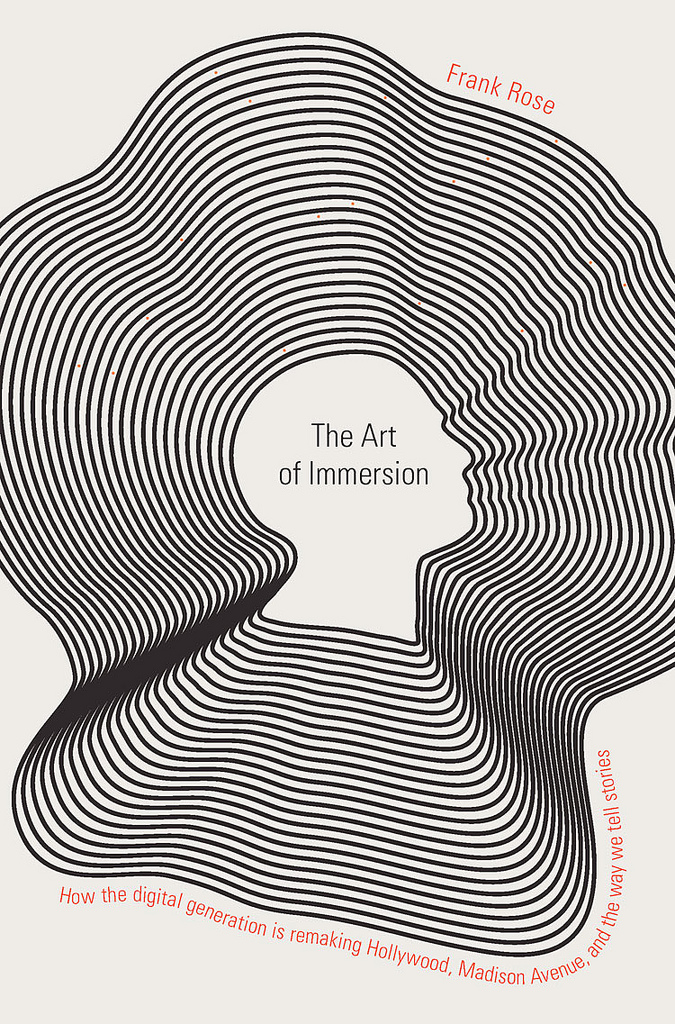
The nice folks at W.W. Norton were kind enough to give me a heads up about this beautiful new cover design by Jason Booher for The Art of Immersion by Frank Rose. Stunning stuff.
Be sure to check out W. W. Norton’s Book Design Archive on Flickr if you haven’t already.
Comments closed