Skip to content

The Casual Optimist Posts

Midweek Miscellany

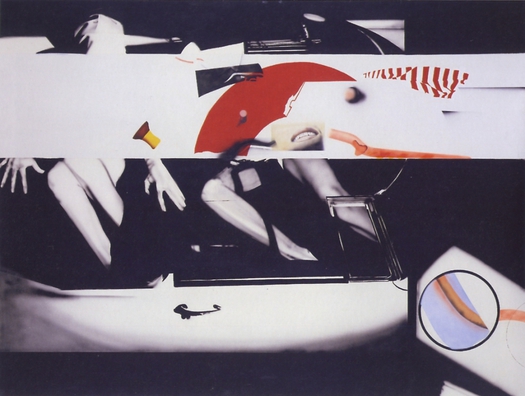
The Analytical Eye — Rick Poyner’s second essay for Design Observer on the visual interpretation of J.G. Ballard examines the work of French artist Peter Klasen:

What both Ballard and Klasen share… is a cold, appraising, analytical eye. It’s impossible to tell how they feel about what they show, or to know what they want us to feel, if anything at all. Their findings are disturbing and perhaps even repellent from a humanist perspective, yet the new aesthetic forms they use to embody them are, even today, exciting, provocative and tantalizingly difficult to resolve.

Any Colour — So Long As It Is Black — The WSJ profiles Massimo Vignelli:

“The greatest design has to provide a little pleasure,” he explained, producing the straightforward black bag he carries; Mr. Vignelli wears nothing but black. Proudly reporting that he’d bought the bag from a local street vendor, he pulled out a black Leica camera…, a pair of black Ray Bans and a tape measure—alas, bright yellow, not black.

“This is my dictionary,” Mr. Vignelli said of the tape measure. He explained that even as a child he had such fascination with the dimensions of things that he would challenge his friends to guess their size. He believes that subtleties of shape conjure emotion. “Is that three centimeters or four centimeters?”

All Forest, No Trees — David L. Ulin reviews The Information by James Gleick for The LA Times:

Over the course of human culture, there have been a number of significant transformations, beginning with the alphabet, which Gleick calls “a founding technology of information. The telephone, the fax machine, the calculator, and, ultimately, the computer are only the latest innovations devised for saving, manipulating, and communicating knowledge.” It is his idea that all these technologies exist as part of a continuum, with each developing from the last.

The key to such an argument is perspective, which is often in short supply when it comes to the information culture, with its tendency to inspire either paeans or jeremiads. Gleick, however, is too smart for that; he’s all about the forest, not the trees.

And finally…

Breaking Machines — Richard Conniff, author of The Species Seekers, on what the Luddites really fought against:

Despite their modern reputation, the original Luddites were neither opposed to technology nor inept at using it. Many were highly skilled machine operators in the textile industry. Nor was the technology they attacked particularly new. Moreover, the idea of smashing machines as a form of industrial protest did not begin or end with them. In truth, the secret of their enduring reputation depends less on what they did than on the name under which they did it. You could say they were good at branding.

Comments closed

Charlotte Strick | The Atlantic


Charlotte Strick, art director at Faber & Faber, Farrar, Straus and Giroux and The Paris Review, writes about the book design process for The Atlantic:

Even though I frequently have designs for titles from the previous season still on my plate, and just when I think I can’t possibly come up with another original idea for a cover, the creative sparks begin to fly. At the launch meetings, editors take turns presenting recent acquisitions… As the books are introduced, each of us begins to wonder: Will I solve the problem with illustration or photography? If the title is brilliant and descriptive, maybe an all-type treatment that’s bold and clever is the best solution. (These are always my favorites.) Is there even any budget for art after the copy-editing fees, production costs, and author’s advances have been tallied? No? Never mind! We’ll get out our paintbrushes and dust off our cameras and get to work.

She is also interviewed by The Atlantic’s Daniel Fromson:

Everyone has an opinion on whether or not the book publishing world as we know it is doomed. Just as the design of websites was becoming more interesting and thoughtful by the late ’90s, it’s clear that the look and feel of e-books will transform over the next decade. As a designer who makes her living creating covers for actual books, I hope to take part in this. I don’t want our work to be reproduced exclusively in black and white or viewed only at postage stamp size.

(Pictured above: sketches by Chris Silas Neal for the cover of Poser: My Life in Twenty-Three Yoga Poses, by Claire Dederer, published by FSG)

Comments closed

A Brief History of Title Design

Ian Albinson of the excellent The Art of the Title Sequence put together this short collection of film titles for the SXSW “Excellence in Title Design” competition screening:

(via Coudal)

Comments closed

Rousseau Deep, Montaigne High

Anthony Gottlieb writes on the renewed interest in 16th Century French essayist Michel de Montaigne for The New York Times:

Like Socrates, Montaigne claims that what he knows best is the fact that he does not know anything much. To undermine common beliefs and attitudes, Montaigne draws on tales of other times and places, on his own observations and on a barrage of arguments in the ancient Pyrrhonian skeptical tradition, which encouraged the suspension of judgment as a middle way between dogmatic assertion and equally dogmatic denial. Montaigne does often state his considered view, but rarely without suggesting, explicitly or otherwise, that maybe he is wrong. In this regard, his writing is far removed from that of the most popular bloggers and columnists, who are usually sure that they are right.

And, funnily enough, Sarah Bakewell author of How To Live: Or, A Life of Montaigne in One Question and Twenty Attempts at an Answer — one of the books mentioned by Gottlieb — recently spoke to Eleanor Wachtel about Montaigne for CBC  Radio’s Writers & Company:

CBC RADIO WRITERS & Co. WITH SARAH BAKEWELL

The cover of the US edition of How To Live, published by Other Press, is by Mr. John Gall (pictured above). But you knew that already of course….

Comments closed

Learning to Love the (Shallow, Divisive, Unreliable) New Media

James Fallows, veteran journalist and author of Breaking the News, has a lengthy article in The Atlantic on Gawker and the effect of digital media on journalism:

One by one, the buffers between what people want and what the media can afford to deliver have been stripped away. Broadcast TV was deregulated, and cable and satellite TV arose in a wholly post-regulation era. As newspapers fell during the rise of the Internet, and fell faster because of the 2008 recession, the regional papers fell hardest. The survivors, from The New York Times to the National Enquirer, will be what British newspapers have long been: nationwide in distribution, and differentiated by politics and class. The destruction of the “bundled” business model for newspapers, which allowed ads in the Auto section to underwrite a bureau in Baghdad; the rise of increasingly targeted and niche-ified information sources and advertising vehicles; and the consequent pressure on almost any mass offering except for sports—all of these are steps toward a perfected market for information of all sorts, including news. With each passing month, people can get more of what they want and less of what someone else thinks they should have.

Every news organization recognizes this shift… The Atlantic is now profitable in part because traffic on our Web site is so strong. Everyone involved in the site understands the tricks and trade-offs that can increase clicks and raise the chances of a breakout “viral” Web success. Kittens, slide shows, videos, Sarah Palin—these are a few. For us and for other publications, they are complications. For Gawker, they’re all that is.

According to Fallows, however, the disruption is also creating new, positive opportunities:

Economic history is working against “legacy” news organizations like the BBC, The New York Times, NPR, and most magazines you could name. But historical forces don’t play out on a set schedule, and can be delayed for a very long time. Economic history is also working against museums, small private colleges, and the farm-dappled French countryside, but none of them has to disappear next week. Even as it necessarily evolves, our news system will be better the longer it includes institutions whose culture and ambitions reach back to the pre-Gawker era, and it would be harder and costlier to try to re-create them after they have failed than to keep them on life support until their owners find a way to fit their values and standards into the imperatives of the new systems.

But the new culture also creates positive opportunities—as, it’s worth saying again, every previous disruption has… At no stage in the evolution of our press could anyone be sure which approaches would support life, and which would flicker out. Through my own career I have seen enough publications and programs start—and succeed, and fail—to know how hard it is to foresee their course in advance. Therefore I am biased in favor of almost any new project, since it might prove to be the next New York Review of Books, Rolling Stone, NPR, or Wired that helps us understand our world.

If you are interested in journalism and news media, the whole article is definitely worth your time.

Comments closed

Aaron Renier’s Mathilda

Based on Roald Dahl’s Matilda and Quentin Blake’s illustrations, cartoonist Aaron Renier has created a wonderful comic about the joy of books and libraries. Read the whole strip at Unshelved.

(via Drawn | The Ephemerist)

Comments closed

Amazing Things Will Happen

“Please do not be cynical. I hate cynicism. For the record, it’s my least favorite quality, it doesn’t lead anywhere. Nobody in life gets exactly what they thought they were going to get. But if you work really hard and you’re kind, amazing things will happen. I’m telling you, amazing things will happen. I’m telling you, it’s just true!”

Jacob Gilbreath, a graphic design student at Oklahoma State University, created this great kinetic typography project — inspired by Lou Dorfsman’s Gastrotypographicalassemblage — from the dialogue of Conan O’Brien’s farewell on The Tonight Show on NBC:

1 Comment

Something for the Weekend

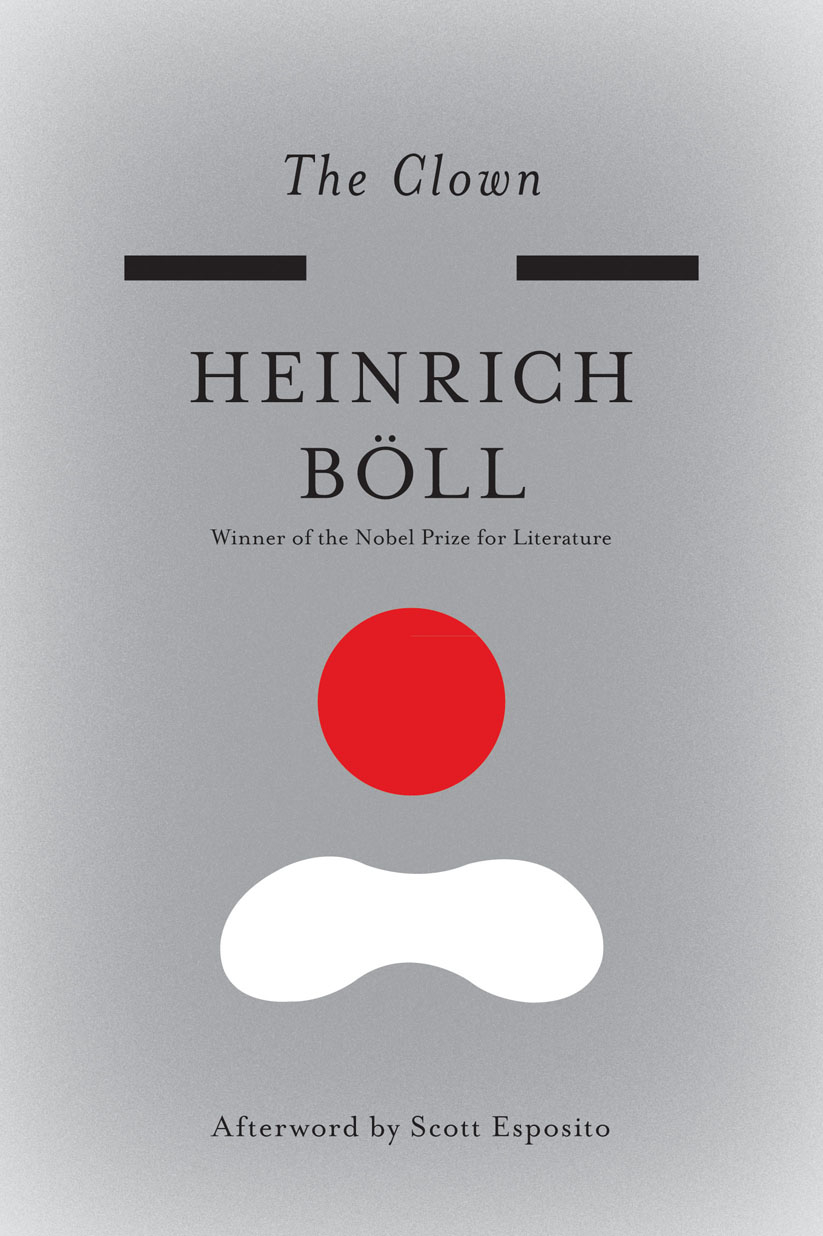
The Book Bench interviews designer Kelly Blair about her work and her Heinrich Böll redesigns for Melville House:

There are so many amazing and striking book covers out there, yet I am most often drawn to the simplest thing on the shelf. Perhaps it’s because I am so immersed in book design day-to-day, but sometimes going into the bookstore can feel visually overwhelming, like the cereal aisle at the grocery store. To that end, David Knopka’s series design for the Melville House novellas still stands as one of my favorites. For the same reason, walking into the Persephone book shop in London feels like a breath of fresh air.

And on the subject of book covers, I’ve been loving designer Andrew Henderson‘s Lovely Book Covers Tumblr.

You can find The Casual Optimist Tumblr here.

Cabaret — Author Hanif Kureishi on the art of writing for The Independent:

There’s no connection between being able to write and being able to explain your work in a rain-swept tent to an audience staring at you like hungry animals contemplating a suspect steak. Listening and reading are different experiences. Reading, writing for a reader, and being read, are intimate acts, and there’s something about trying to articulate what you’ve done that can flatten and reduce it, horrifyingly so.

Some writers choose the written word because they find it difficult to speak directly; many writers are in love with solitude. Whichever it is, good writing should resist interpretation, summary and the need for applause.

The Information — Michael Dirda reviews Too Much To Know: Managing Scholarly Information Before the Modern Age by Ann M. Blair for The Washington Post:

Just how to present information for easy use was a constant vexation. In late antiquity, one might simply find a list of authorities cited. Gradually, though, compilers began to employ categorical headings or to arrange entries alphabetically or according to elaborate branching diagrams of knowledge. “One historian has counted nineteen different systematic orders present in early modern encyclopedic works, including the order of creation, of the Decalogue, of the biblical narrative,” and various “chronological and geographical orders,” as well as others that follow “the chain of being.”

While people during the Middle Ages and later drew much of their learning from dictionaries and digests, the more ambitious also took extensive notes from whatever classics came their way. By the Renaissance one could even purchase the equivalent of “Reading for Dummies”: Francesco Sacchini’s 1614 “De ratione libros cum profectu legendi libellus,” i.e.,”A Little Book on How to Read With Profit.”

The Science of Making Decisions — Sharon Begley on how too much information impairs our ability to make decisions:

The problem has been creeping up on us for a long time. In the 17th century Leibniz bemoaned the “horrible mass of books which keeps on growing,” and in 1729 Alexander Pope warned of “a deluge of authors cover[ing] the land,” as James Gleick describes in his new book, The Information. But the consequences were thought to be emotional and psychological, chiefly anxiety about being unable to absorb even a small fraction of what’s out there. Indeed, the Oxford English Dictionary added “information fatigue” in 2009. But as information finds more ways to reach us, more often, more insistently than ever before, another consequence is becoming alarmingly clear: trying to drink from a firehose of information has harmful cognitive effects. And nowhere are those effects clearer, and more worrying, than in our ability to make smart, creative, successful decisions.

And related… Jonah Lehrer, contributing editor at Wired and the author of How We Decide and Proust Was a Neuroscientist, on why easy decisions seem so hard:

The problem, of course, is that the modern marketplace is a conspiracy to confuse, to trick the mind into believing that our most banal choices are actually extremely significant. Companies spend a fortune trying to convince us that only their toothpaste will clean our teeth, or that only their detergent will remove the stains from our clothes, or that every other cereal tastes like cardboard. And then there is the surreal abundance of the store shelf… While all these products are designed to cater to particular consumer niches, they end up duping the brain into believing that picking a floss is a high-stakes game, since it’s so damn hard. And so we get mired in decision-making quicksand.

Comments closed

Chip Kidd: A Drinker and a Crier

Chip Kidd, book designer and associate art director at A.A. Knopf, profiled at Stodgy is Sexy:

Comments closed

Bookbinders, 1961

Earlier this week I posted the 1947 documentary Making Books. As follow up, here’s the 1961 documentary Bookbinders from the AFL-CIO  series  “Americans at Work”:

1 Comment

50 Watts

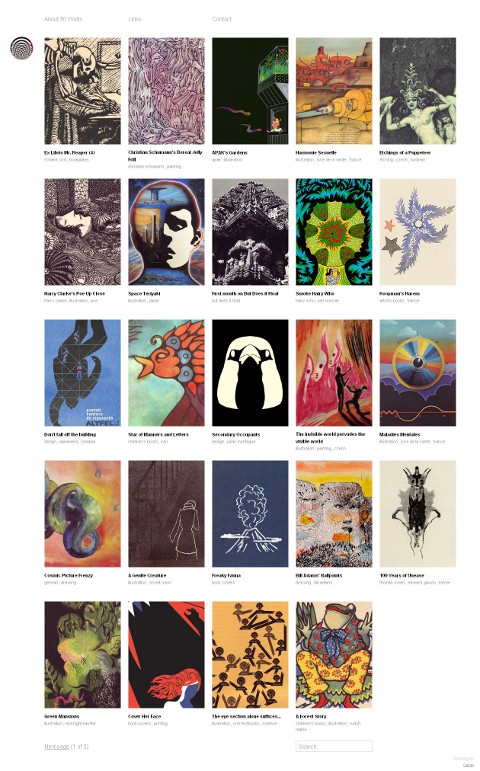
Will Schofield’s wonderful blog A Journal Round My Skull has been relaunched as 50 Watts using the Cargo platform:

The new name has something to do with Charlie Watts, Beckett’s Watt, Charles Wright & the Watts 103rd Street Rhythm Band, dim light bulbs, riots, cheap amps, chaos theory, and the friend who threatened violence if I didn’t drop my old moniker.

I didn’t threaten violence, but I certainly got the name wrong more times than I care to mention. 50 Watts looks great and I should be able to remember the name this time.

Make sure you update your bookmarks and RSS reader.

Comments closed

Midweek Miscellany

Two stunningly minimal designs by Rodrigo Corral for New Directions.

Faceout Books is back after a hiatus. First up, an interview with Jennifer Heuer about her design for Down and Delirious in Mexico City by Daniel Hernandez.

Haystacks of Needles — Nicholas Carr, author of The Shallows, on situational overload versus ambient overload:

Situational overload is not the problem. When we complain about information overload, what we’re usually complaining about is ambient overload. This is an altogether different beast. Ambient overload doesn’t involve needles in haystacks. It involves haystack-sized piles of needles. We experience ambient overload when we’re surrounded by so much information that is of immediate interest to us that we feel overwhelmed by the neverending pressure of trying to keep up with it all. We keep clicking links, keep hitting the refresh key, keep opening new tabs, keep checking email in-boxes and RSS feeds, keep scanning Amazon and Netflix recommendations – and yet the pile of interesting information never shrinks.

The cause of situational overload is too much noise. The cause of ambient overload is too much signal.

The Case for the NovellaThe New York Times Magazine has an excerpt from “The Three-Day Weekend Plan,” an essay by John Brandon from the new book The Late American Novel: Writers on the Future of Books (Soft Skull):

Bluntly, the novella is in its Golden Age as a form right now because no one is beating it with a stick until nickels fall out. So my plan for the novella is — drum roll: Do nothing. Or do whatever little is required to steward the status quo. Let’s agree, shall we, to keep throwing around the inane term Great American Novel, and to never, ever utter the phrase Great American Novella.

And on the subject of The New York Times Magazine…

The Speed of Change — Former Design Director for NYTimes.com Khoi Vinh on the new design of the New York Times Magazine:

Digital publishing is supposed to be much quicker than print publishing, but this… suggests that more important than the speed of medium is the nimbleness of the business behind it. The print side of The New York Times takes a lot of good natured ribbing for being slow to publish news, but it’s still very, very good at what it does. Which is to say that few organizations can publish on a weekly basis and still effect the kind of major change that this redesign represents.

In some ways, the digital side of the business is not as nimble as that. To be sure, few companies can execute digital publishing as well as The New York Times… But partly because the medium is much younger and constantly changing, partly because best practices are less well-defined, and partly because the mission is more diffuse, execution is a more intricate, protracted and, often, inefficient affair on the digital side.

Comments closed