Skip to content

The Casual Optimist Posts

Something for the Weekend

Potential for Infection — A lovely essay by Alan Bennett on books, libraries, and bookcases, in the LRB:

‘Books Do Furnish a Room’, wrote Anthony Powell, but my mother never thought so and she’d always put them out of the way in the sideboard when you weren’t looking. Books untidy, books upset, more her view. Though once a keen reader herself, particularly when she was younger, she always thought of library books as grubby and with a potential for infection – not intellectual infection either. Lurking among the municipally owned pages might be the germs of TB or scarlet fever, so one must never be seen to peer at a library book too closely or lick your finger before turning over still less read such a book in bed.

Not A Sexy Trend Story — Dennis Johnson’s scathing must-read post on the Borders bankruptcy (and the way it is being reported) at MobyLives:

[T]his is a story that has become about some desired and sometimes advertiser-driven trend, and not the more complex reality — which is that what’s happened is not good for either print or digital books.

If there’s anything to take away from the Borders story, it’s this: It doesn’t at all represent that fewer people want to buy print books. It represents that fewer big corporations want to sell them.

19th Nervous Breakdown — Jonathan Ross reviews Supergods: Our World in the Age of the Superhero by Grant Morrison for The Guardian:

Shaving your head before dragging up in full fetish gear and wolfing down a magic mushroom omelette may well open the door to another realm, or give you access to demons and guardian angels. I have never tried it so I can’t say with absolute certainty. But I am pretty sure that what Morrison was experiencing and is describing is a cross between a nervous breakdown and a common-or-garden trip.

See also: David Itzkoff reviews the book (less sympathetically) for The New York Times.

And on a related note… Joe Carducci reviews Absolute Dark Knight by Frank Miller for the LA Review of Books.

And finally…

Typographical reference guide FontBook is now available on the  iPad:

Comments closed

The Helmet of Horror | Angus Hyland

As a follow up to yesterday’s Design Matters post, I just wanted to share Angus Hyland’s extraordinary design for The Helmet of Horror by Victor  Pelevin, published as part Canongate’s Myths series a few years ago:

The illustration is by Sara Fanelli.

2 Comments

The Ultimate Hitchcock Cookbook

Hitch is an animated homage to Alfred Hitchcock by Felix Meyer, Pascal Monaco, and Torsten Strer, students at the University of Applied Sciences and Arts in Hannover:

(via Quipsologies)

Comments closed

Midweek Miscellany


Furious — Writer and herstorian Trina Robbins talks to Imprint about her new book on pioneering female cartoonist Tarpé Mills and her newspaper strip Miss Fury:

I’ve always been a lover of noir and of good adventure strips in the noir mode, as typified by Milton Caniff’s Terry and the Pirates. They are adventures that are good, fun escapist reading. As you know, there were a number of cartoonists during the 1940s who worked in that genre, but only Tarpé Mills was a woman. That alone would have been enough to attract her to me. But add to that: good art, solid storytelling, memorable characters… including three of the strongest female characters in comics…

Mills’s characters also wore great fashions… at a time when many of the male cartoonists dressed their female characters in featureless red strapless evening gowns or equally featureless short red V-necked dresses. Of course there are exceptions – Caniff was very up on women’s styles. But I think in general one sign that a comic is by a woman is that attention is paid to the clothing – Miss Fury, Brenda Starr, Mopsy, I could go on and on – and that men tend not to show much awareness of what real women are wearing, even today… especially today!

And on the subject of comics…

Word as Pictures — Designer Rob Harrigan has launched a new series of interviews about design and comics. First off is designer Rian Hughes:

Comics, in a broader sense, are simply words and pictures – and words AS pictures, which as a designer, and especially as a font designer, is what fascinates me the most. The formal aspects of communication – this is the very language designers manipulate for their own ends, the medium culture uses to spread memes.

Still Great, Still in Production — Alexander Lange reviews Dieter Rams: As Little Design as Possible by Sophie Lovell for The Architect’s Newspaper:

Open Dieter Rams: As Little Design as Possible. Turn to page 64. There you will find the Braun product line circa 1963. I would buy any one of those products today, save the cameras, were they sold in stores. Which is to say, you will get no argument from me about Rams’ greatness as an industrial designer and the superiority of his achievement as head of Braun’s product design department from 1961 to 1995, where he designed or co-designed 500 products, lighters, door handles, coffee grinders, hi-fis and televisions, hair dryers, and cameras. Plus those Vitsoe 606 shelves, still great, still in production.

And finally…

Steven Heller on designer, art director and inventor of the album cover Alex Steinweiss, who died on Sunday aged 94, for The New York Times:

Mr. Steinweiss preferred metaphor to literalism, and his covers often used collages of musical and cultural symbols. For a Bartok piano concerto, he rejected a portrait of Bartok, using instead the hammers, keys and strings of a piano placed against a stylized backdrop. For a recording of Gershwin’s “Rhapsody in Blue,” he used an illustration of a piano on a dark blue field illuminated only by an abstract street lamp, with a stylized silhouetted skyline in the background…

Mr. Steinweiss said he was destined to be a commercial artist. In high school he marveled at his classmates who “could take a brush, dip it in some paint and make letters,” he recalled. “So I said to myself, if some day I could become a good sign painter, that would be terrific!”

Comments closed

Design Matters with Angus Hyland

Pentagram partner Angus Hyland has designed book covers for CanongatePenguin and others. On the latest Design Matters podcast, Hyland discusses childhood brand recognition, Tintin, music, dyslexia, book design and his new book Symbol, co-authored with Steven Bateman, with host Debbie Millman:

DESIGN MATTERS: Angus Hyland

Disclosure: Symbol is published by Laurence King and distributed in Canada by my employer Raincoast Books. 

Comments closed

Richard Price Paperbacks | Henry Sene Yee

Columbine and A Wall in Palestine: cover designs by Henry Sene Yee

Henry Sene Yee is a designer and art director at Picador USA. The very of his best work (and all of it is good) — his cover designs for Columbine by Dave Cullen and A Wall in Palestine by René Backmann to pick two recent examples — combine judiciously selected and smartly cropped photographs with bold typographic choices.

Given the poignancy of the images he chooses and the respect he gives to them within his compositions — the room he gives them to breath —  it isn’t surprising that Henry is a photographer himself, regularly capturing scenes of daily life in his beloved New York through a lens.

Photo by Henry Sene Yee

The author Richard Price, who has also written for the HBO series The Wire, was born in and raised in the Bronx. Several of his novels, including Clockers and Freedomland (both adapted to movies), are set in the in fictional town of Dempsy, New Jersey.

Photo by Henry Sene Yee

Over the last couple of years Henry, who also happened to grow up in New Jersey, has designed covers for Picador’s recent reissues of Price’s novels.

Bringing his understanding of photography and type to the designs Henry has, like Price himself, avoided the expected crime fiction clichés.

As fan of Price’s work as well as Henry’s, I thought I would take to the opportunity to ask the designer how he approached the covers.

Here is his reply:

Lush Life: cover design by Aaron Artessa

It started when Picador published the paperback edition of Richard Price’s bestseller Lush Life. Because of its success, the FSG cover was reproduced in ads and displayed prominently in bookstores. Repackaging the cover for paperback would not take advantage of the public familiarity with it so it was decided to keep the original jacket design [by Aaron Artessa].

Clockers final cover by Henry Sene Yee

Clockers: unused designs by Henry Sene Yee

Clockers, probably Price’s most well known backlist was also acquired by us and was reprinted to coincide. It was designed as a stand alone. I couldn’t see how I would or need to relate it to Lush Life.

Bloodbrothers final cover by Henry Sene Yee

It was followed by his next backlist title Bloodbrothers, which was also designed as a stand alone. That book’s themes reminded me of photographer Bruce Davidson’s beautiful 1970s NYC Subway photos. I found this great Davidson photograph from his gang series and kept the colors simple.

The Breaks final cover by Henry Sene Yee

We later acquired The Breaks and Ladies’ Man and I had no intention to follow any previous Price’s look since there was none. Photo research found some great images similar in look to the Davidsons. My two favorite photos happen to both be horizontal and the initial layouts looked similar to Bloodbrothers. I tried to distinguish them by using different colors in the background, type. But in the end, it was just distracting from the great photos. So I decided to have them match Bloodbrothers, keeping the type and same palette of black, warm gray duotones, cream and warm red.

Ladies man final cover by Henry Sene Yee

The Breaks and Ladies Man: unused designs by Henry Sene Yee

Thanks Henry!

Disclosure: As of Fall 2011, book published by Picador will be distributed to independent bookstores and libraries in Canada by my employer Raincoast Books as part of a new distribution arrangement with Macmillan US. For the record, Henry and I discussed featuring his work on The Casual Optimist several times well before details of this deal was known to either of us.

1 Comment

Something From the Weekend

Paint It Black — Alan Moore talks to Pádraig Ó Méalóid about the latest instalment of League of Extraordinary Gentlemen, Century: 1969 (available next month) for the Forbidden Planet blog:

What we’ve got in 1969, in keeping with the League’s usual practice, is that we’ve got a world entirely composed of references to the culture of that period, or around that period. So we’re taking bits from various films, television series, books, comics, any culture of that time we’re working into the fabric of our story… I hope that people will have as much fun digging out the various references as we had putting them in there…

See also: Pádraig Ó Méalóid’s recent interview with Alan Moore for 3AM Magazine.

Gonzo Graphic Novels — Six leading cartoonists discuss their own favourite cartoonists for The Guardian. Here’s political cartoonist Martin Rowson on Joe Sacco:

Although Art Spiegelman’s Maus is a work of incredible importance, I think it gave the entire genre a bum steer. It then got into this terrible kind of introspective, personal, adolescent angstiness. All this “you have to be serious about this because it’s a serious art form”: well, it is and it isn’t. Therefore, discovering Joe Sacco was a liberation. Here is somebody who is using the medium as journalism and reportage. It’s taking the best bits of the underground comics of the 60s – the radicalism – with the personal immersion you got with Spiegelman. It’s an extraordinarily powerful way of telling a story – a true one in this case. The fact that he places himself in the heart of it makes it gonzo journalism turned into a graphic novel, although it’s not really a graphic novel, it’s a sort of visual journalism.

Also in The Guardian… Lee Rourke, author of The Canal, on The Book Barge, a bookstore in a travelling canal barge:

It is the brainchild of Sarah Henshaw. “By setting up on a canal boat,” she explained, “we hope to promote a less hurried and harried lifestyle of idle pleasures, cups of tea, conversation, culture and, of course, curling up with an incomparably good Book Barge purchase.” I was immediately sold. But why a canal boat? “I hoped that by creating a unique retail space, customers would realise how independent bookshops can offer a far more pleasurable shopping experience than they’re likely to find online or on the discount shelves at supermarkets.”

Wonderful.

And finally…

Recording the Disjunction — Errol Morris talks to the A.V. Club about truth, self-deception, and his new documentary Tabloid:

People sort of imagine that they go to a documentary—and this is also true [when] you read an article, a work of journalism—that they’re [experiencing] a work of non-fiction. We know that what we’re reading is not the absolute truth. If we’re reading a first-person account, we know that each and every one of us, myself included, have a great desire to be seen in a certain way, or to be perceived in a certain way. It’s unavoidable. What a movie can do—and this is what really does interest me, it’s at the heart of documentary—is not so much delivering the so-called truth. Yes, pursuing the truth, trying to investigate what really happened, trying to uncover some underlying reality, but recording that disjunction, that distance between how people see the world and the way the world might really be—that’s at the heart of the enterprise.

Comments closed

Le Carré | Matt Taylor

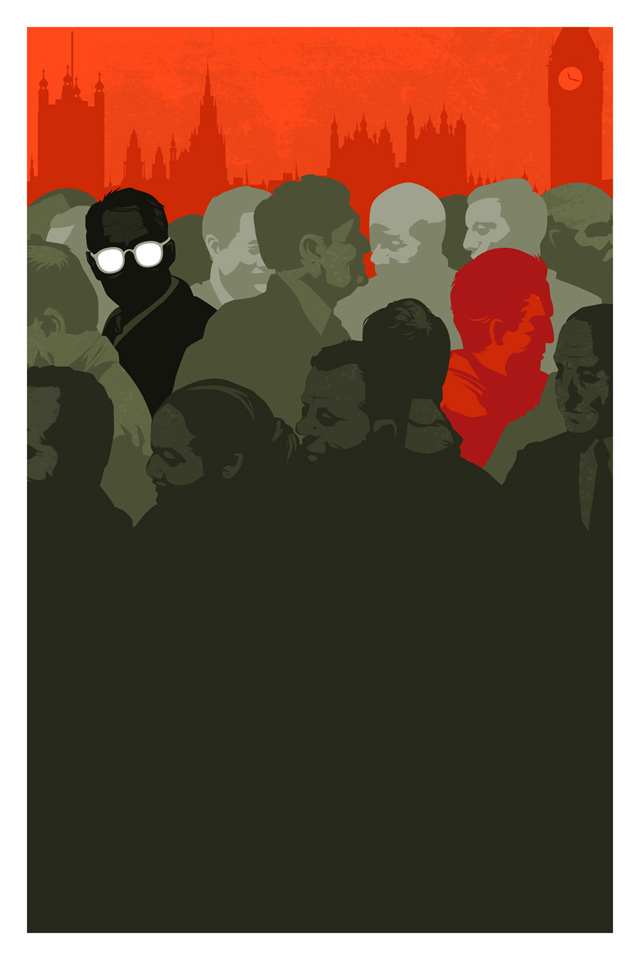
Not long ago, I posted Stuart Bache’s wonderfully cinematic John le Carré covers for Sceptre in the UK. Now (as mentioned earlier today) John le Carré’s American publisher Penguin have reissued new editions of his books with amazing illustrations by Brighton-based illustrator Matt Taylor and design by Gregg Kulick and Paul Buckley. Mr Buckley art directed series.

Special thanks to Paul Buckley and Andrew Lau at Penguin US for providing the cover images, and to James at Caustic Cover Critic for bringing them to my attention.

7 Comments

Midweek Miscellany

Comic Unease — Cartoonist Emily Carroll talks about comics, fairy tales, dreams, and her story His Face All Red with The Comics Journal:

I think a lot of fairy tales have that sort of unease built into them, just because they introduce so many elements that they never explain, and use fairy tale logic—the kind that isn’t really logic at all, but has that matter-of-fact feel to it anyway—and the reader just has to roll with it.

Dark Matter — Author Lev Grossman on fan fiction for Time Magazine:

Fan fiction is what literature might look like if it were reinvented from scratch after a nuclear apocalypse by a band of brilliant pop-culture junkies trapped in a sealed bunker. They don’t do it for money. That’s not what it’s about. The writers write it and put it up online just for the satisfaction. They’re fans, but they’re not silent, couchbound consumers of media. The culture talks to them, and they talk back to the culture in its own language. Right now fan fiction is still the cultural equivalent of dark matter: it’s largely invisible to the mainstream, but at the same time, it’s unbelievably massive.

Grossman’s new novel The Magician King (the sequel to his 2009 novel The Magicians) is published next month.

Dysfunctional Spies — Author John Le Carré reflects on his time in MI6:

The creation of George Smiley, the retired spy recalled to hunt for… a high-ranking mole in Tinker, Tailor, was extremely personal. I borrowed elements of people I admired and invested them in this mythical character. I’m such a fluent, specious person now, but I was an extremely awkward fellow in those days. I also gave Smiley my social ineptitude, my lack of self-respect and my fumblings in love.

Because I came from a dysfunctional background, I made home the most dangerous place for Smiley. Home is where he lets himself in cautiously. Home is where he sees the shadow of his adulterous wife in the window and wonders who she’s with.

Pictured above is Matt Taylor’s incredible illustration for a new Penguin US edition of Le Carré’s novel Tinker, Tailor, Soldier, Spy — more of that wonderful stuff to come — and a new film adaptation of the book, starring Gary Oldman as Smiley, is being released later this year:

Comments closed

There’s No Place Like Here

Here’s a wonderful Etsy video about Brazenhead Books, a secret secondhand bookstore located in Michael Seidenberg’s apartment on the Upper East Side, New York:

(Thanks Kate!)

Comments closed

Les Diaboliques | A. O. Scott

New York Times film critic A.O. Scott turns his attention to the 1955 French thriller Les Diaboliques directed by Henri-Georges Clouzot:

Les Diaboliques was based on the novel Celle qui n’était plus (She Who Was No More) by Pierre Boileau and Thomas Narcejac and before Clouzot bought the rights to the screenplay, Alfred Hitchcock was apparently about to do so. Coincidently, Robert Bloch, author of Pyscho, was a fan of Clouzot’s movie.

Comments closed

David Lodge | Writers & Company

In another great archive interview for Writers & Company, author David Lodge talks to Eleanor Wachtel about artificial intelligence, consciousness and his 2002 novel Thinks:

CBC RADIO WRITERS & COMPANY: David Lodge, Think

Comments closed