Skip to content

The Casual Optimist Posts

Something for the Weekend

Nicholas Carr, author of The Shallows, reviews Retromania by Simon Reynolds for The New Republic:

Who wants yesterday’s papers?” sang Mick Jagger in 1967. “Who wants yesterday’s girl?” The answer, in the Swinging 60s, was obvious: “Nobody in the world.” That was then. Now we seem to want nothing more than to read yesterday’s papers and carry on with yesterday’s girl. Popular culture has become obsessed with the past—with recycling it, rehashing it, replaying it. Though we live in a fast-forward age, we cannot take our finger off the rewind button.

And Mr. Reynolds has been a busy man. Not only is his book also reviewed at the A.V. Club, he is interviewed about it at Pitchfork, The Quietus and The Second Pass.

Shiny and New — Designer Matt Roeser talks about his New Cover project with Ian Shimkoviak at Covered Up:

I love physical books. I have more books than I have space for in my house, but there’s just something about a physical book that is so appealing to me that an e-book will never be able to replicate. Now, whether the rest of the world feels that same way is yet to be seen. I definitely think there is a large population that doesn’t care how they’re experiencing the book; they just want to be able to read it.

And finally…

Drinking, Gambling and Grandma — Lorrie Moore, author of A Gate at the Stairs, on the TV show Friday Night Lights for the NYRB:

The series wants Dillon [Texas] to function as a microcosm of larger working- and middle-class America: it takes its fifty or so hours and opens a window on American family, education, community race relations, athletics, social class and its various brokennesses. But lest you go away, it keeps you involved with the drama of high school—its romantic student soap operas, its tense and dire administrative politics, plus the multigenerational home life that has dads in prison, dads in Iraq, dads gambling and drinking and roaming around the country while Grandma sits in the front room.


Comments closed

Kenneth Grange | Crane.tv

82-year old British industrial designer Kenneth Grange has designed some of the most iconic products and appliances of modern British life — Kodak cameras, the Intercity 125 train, Kenwood food mixers, Parker pens, and the 1997 London black cab.

Crane.tv spoke with Grange at the opening of Making Britain Modern, a retrospective exhibition of his work at the Design Museum in London:

Making Britain Modern runs until October 30th 2011:

Comments closed

Type | PBS Arts Off Book

In this short documentary for a new online series for PBS called Off Book, Jonathan Hoefler and Tobias Frere-Jones, Paula Scher, Eddie Opara, Julia Vakser and Deroy Peraza discuss typography, design, texture, and infographics:

(via The Donut Project)

Comments closed

Midweek Miscellany

FPO: For Print Only features the fun cover for John Durak’s collection of poetry Condiments and Entrails designed by Bunch

The Oracle of Redirection — James Gleick, author of The Information, reviews four books about Google for the NYRB:

Google defines its mission as “to organize the world’s information,” not to possess it or accumulate it. Then again, a substantial portion of the world’s printed books have now been copied onto the company’s servers, where they share space with millions of hours of video and detailed multilevel imagery of the entire globe, from satellites and from its squadrons of roving street-level cameras. Not to mention the great and growing trove of information Google possesses regarding the interests and behavior of, approximately, everyone.

Glittering Delights  — Simon Schama talks to The Guardian about his recent book of essays Scribble, Scribble, Scribble:

I have this magpie instinct for the next glittering object. There are one or two things I know I can’t write about though: DIY, cricket, automobile repair. I could study it for a lifetime and not produce a word on the carburettor.

And finally…

Power, Corruption and Lies New Yorker critic Alex Ross, author of  The Rest is Noise and Listen To This, on Oscar Wilde, homosexuality, and a new “uncensored” edition of The Picture of Dorian Gray published by Harvard University Press:

[N]o work of mainstream English-language fiction had come so close to spelling out homosexual desire. The opening pages leave little doubt that Basil Hallward, the painter of Dorian’s portrait, is in love with his subject. Once Dorian discovers his godlike powers, he carries out various heinous acts, including murder; but to the Victorian sensibility his most unspeakable deed would have been his corruption of a series of young men… At the Wilde trials of 1895, the opposing attorneys read aloud from “Dorian Gray,” calling it a “sodomitical book.” Wilde went to prison not because he loved young men but because he flaunted that love, and “Dorian Gray” became the chief exhibit of his shamelessness.

Comments closed

Whither the Library?

Going to the library is one of my earliest memories. I don’t remember much about the books, but I remember the building — its steps and its smell — and I remember the funny pinkish orange library tickets for children. I think I could take out three books at once.

I also remember that the library was not that close to where we first lived. We must have gone on the bus. It was surely an adventure for me, but a pain for my parents.

We’re more fortunate now. My family and I can walk to the library. It takes about 5 minutes — longer if we are distracted by a friendly dog or the need to jump off a wall.

I borrow picture books and music for their kids; books, comics, DVD and CDs for me. I request most of things from the library website. I can do it whenever something comes to mind or I read about it online. The books (and it is mostly books if I am honest) come from libraries across the city and I get a call at home when they arrive at my branch. I don’t know how many books I can borrow at once — I’ve never hit my limit (not for lack of trying, however) — but I must have at least 7 or 8 things out at the moment. It is an amazing service.

Our library is always busy — no matter the time of day — with people of all ages and from all walks of life. Some, like me, are borrowing books, movies or music. Others are reading newspapers and magazines. Some are making use of the programs that the library runs. Some are using the only computers they probably have any access to.

But here in Toronto, as in many towns and cities in the UK and US, library cuts are now being seriously discussed by politicians who do not appreciate their value to neighbourhoods and who apparently wouldn’t recognise Margaret Atwood on the street. It is hard to imagine they have visited to a library recently, let alone made use of its services.

On yesterday’s CBC news show The Current there was a lengthy and interesting discussion of libraries and their future. Contributors included librarian Ken Roberts, local councillor Sarah Doucette, and Julia Donaldson, the UK’s Children’s Laureate and author of The Gruffalo:

CBC RADIO THE CURRENT: Whither the Library?

If you live in Toronto, you can sign an online petition in support of the public library system here.

Comments closed

Humiliation | Henry Sene Yee

Just too good not to share, here’s an unused comp for Humiliation by Wayne Koestenbaum  designed by Henry Sene Yee for Picador’s Big Ideas // Small Books series. The photograph is by Jon Shireman.

You can see the final cover and read details the design process on his Henry’s blog.

And for the sake of full disclosure, Picador are distributed in Canada by my employer Raincoast Books. 

1 Comment

George Pelecanos

Author George Pelecanos talks to NPR’s Morning Edition about race, class and setting all his novels in Washington, DC:

NPR MORNING EDITION: Taking On Crime In A Racially Divided D.C.

George Pelecanos’ new novel The Cut is released later this month.

(via Largehearted Boy)

Comments closed

Muriel Spark | Writers & Company

The late Dame Muriel Spark, author of Memento MoriThe Prime of Miss Jean Brodie and The Ballad of Peckham Rye among others, talks to Eleanor Wachtel about her life and work in this archive interview for Writers & Company from 1999:

CBC RADIO WRITERS AND CO: Muriel Spark

Muriel Spark died in 2006 at the age of 88. The cover art in the image above is by Terence Greer.

Comments closed

Something for the Weekend

A Period of Digestion — Music journalist and author Simon Reyolds talks about his new book Retromania: Pop Culture’s Addiction To Its Own Past with the A.V. Club:

[S]o much happened in the 20th century and things moved so fast, and you had this enormous capitalist engine generating all these toys and gadgets and things that became rapidly obsolescent. It’s all piled up, hasn’t it? And you think of the sheer amount of recording that went on. It always blows my mind whenever I go record shopping how many records I’ve never seen before. I’ve been in record stores forever, decades I’ve been looking through them, and I still see things I’ve never seen, artists I’ve never heard of. The sheer amount of recording that was done, it is almost like this universe of music. Daniel Lopatin in the book actually says it’s a period of digestion, we’re digesting and processing all this stuff that happened musically and in other senses in this really runaway, fast period of time of production. And perhaps that’s fine. Perhaps that’s what we need.

And on a not unrelated note…

A wide-ranging interview with Alan Moore about his new book, Extraordinary Gentlemen: Century 1969, comics and popular culture, for Wired:

[T]he overall legacy of the first decade of the 21st century has been one wherein culture mirrors what was going on in our politics during those years. We had a form of politics that was concerned with spin and surface at the expense of any kind of moral or even rational content. In keeping with our well-spun political landscape, I think a lot of contemporary art, if it has a concept it is a concept in the advertising sense. It’s a little mental pun, something that you can use to sell cars or burgers. But in terms of art, once you’ve got the idea of joke, if you like, there is absolutely no need to ever look at those works again.

And sticking with comics…

From Superheroes to Superbrands — Paul Gravett on Grant Morrison’s new book Supergods: Our World in the Age of the Superhero and the poor treatment of the original creators of the comic book superheroes (thx Ed):

How easy is it for fans and pros today, so hypnotised since childhood by these ubiquitous, constantly repromoted properties, to ignore their tarnished histories? I’ve talked recently to some fan readers who are troubled when I mention this horrific, disfigured portrait lurking beneath the polished profiles, masks and capes, hidden in the attic, but who can’t seem to help themselves from still wanting to follow these perfect-looking, super-powered Dorian Grays, no matter what. Morrison prefers to elevate the superhero as an indestructible concept, almost an independent, self-actualising entity, acknowledging only slightly its murkier commercial side, but glossing over the exploitation rife in this business, then and now. Unlike earlier ‘public domain’ gods and goddesses from antiquity and religious faiths, Superheroes are as much Superbrands, properties that must make profits for DC, part of Time-Warner-AOL, and Marvel, bought by Disney. While Morrison and his ilk earn tidy sums from endless, spiralling makeovers of these franchises, both publishers are aggressively fighting lawsuits over ownership against the estates of Siegel and of Jack Kirby, joint architect of the Marvel Universe.

And finally…

A fascinating article by Adrian Hon on ‘cargo cults’ and Unbound, a crowdfunding site for books, in The Telegraph (via Waxy):

Unbound isn’t some fly-by-night operation; it was heavily promoted at the Hay Festival, it’s received gushing praise across the media – yet it may end up with a one in six success rate.

So, why was Unbound set up in the first place? It’s because they constructed a cargo cult, believing that if they mimicked the superficial elements of successful crowdfunding, they could enjoy the same success as others – but perhaps even more, thanks to their relationships with publishers, agents, authors, and the media.

It is perhaps a little unfair to single out Unbound. Traditional publishers who jump on the latest genre bandwagon without truly understanding what made the original popular are just as guilty.

Comments closed

A History of Protest Songs | The Book Show

Author and journalist Dorian Lynskey talks about his book 33 Revolutions per Minute: A History of Protest Songs with Ramona Koval on The Book Show:

THE BOOK SHOW: Dorian Lynskey — The History of the Protest Song 

Comments closed

Midweek Miscellany

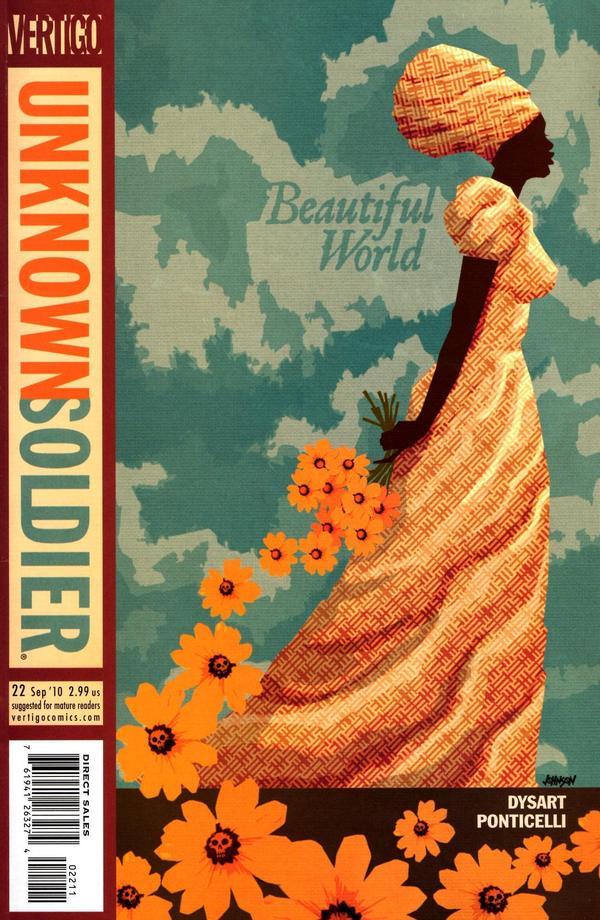
Kelly Thompson chooses her favourite 52 comic book covers from the past year on her blog 1979 Semifinalist. The cover above is by Dave Johnson for Unknown Soldier #22. Other personal favourites of mine on the list include the very retro Deadpool Pulp #4 by Jae Lee, and Hellboy: The Fury # 1 by Mike Mignola (you just can’t go wrong with a big axe really…)

And if you don’t read Kelly’s regular three sentence or less drunken demolitions of Marvel and DC covers you really are missing out. “Motherfucking gangbusters.”

Comics Dwindling Gene Pool — Alan Moore talks about the latest instalment of The League of Extraordinary Gentlemen, Century: 1969, and more with The Guardian:

These days, the majority of the comic book audience is 40-somethings who are not necessarily interested in comic books as a medium or panel progression or sequential narrative. They are probably interested in Wolverine. There is a large nostalgic component in there and there’s nothing wrong with it. But if those people then begin to influence the books themselves or increasingly the movies or the television series then they will want their story to refer to stories that they remember. It becomes very incestuous and over a few decades you get a very limited dwindling gene pool. And you get stories that have become weak through inbreeding.

And sticking with comics for a moment… Eric Reynolds talks about comics and Fantagraphics’ Mome Anthology in a four-part interview The Daily Cross Hatch:

Putting comics online is definitely of interest to myself and all of us at Fantagraphics, for sure. We know that that’s only going to continue to grow. It has certain advantages and disadvantages. But I don’t know if I necessarily want to edit an online anthology, per se. I don’t know why… I know if it’s just that I enjoy the tactile pleasures of print, or what, but—and this is my own personal preference—it doesn’t seem to quite exist when it’s on the Internet, which is quite paradoxical. The Internet has the potential to reach a lot more people that print, in this day and age, and yet, you don’t have that physical object to hold as proof that you did what you did.

Meanwhile, if you are looking for some ‘serious’ books for your vacation, the indefatigable Largehearted Boy is doggedly aggregating online summer reading lists for the year.

While at Slate Robert Pinsky explains  how not to write a book review (whether you’ve read the book in question or not).

And finally (in the likely instance you haven’t seen these yet)…

Cardon Webb’s clever designs for a new series of Oliver Sacks paperbacks from Vintage (via John Gall).


Comments closed

A History of the Title Sequence

A History of the Title Sequence is a short film by Jurjen Versteeg. It charts the development of film title sequences by displaying the names of influential title designers in the style of their own work. In other words, it is a film about title sequences that looks like a title sequence. How great is that?

The film references the following designers and their titles:

Georges Méliès, Un Voyage Dans La Lune; Saul Bass, Psycho; Maurice Binder, Dr. No; Stephen Frankfurt, To Kill A Mockingbird; Pablo Ferro, Dr. Strangelove; Richard Greenberg, Alien; Kyle Cooper, Seven; Danny Yount, Kiss Kiss Bang Bang and Sherlock Holmes.

Comments closed