Skip to content

The Casual Optimist Posts

Something for the Weekend

Issue #56 — Jessica Abel and Matt Madden discuss the latest volume of The Best American Comics at Comic Book Resources:

The problem with superheroes is it’s not a personal taste so much as it just requires so much insider knowledge to read these things. They don’t stand on their own. There have been about three superhero comics, maybe two, in the past five years that stand on their own. That you can just read and not have to know what happened in issue #56 and ever since. It’s a real problem, I think, and it’s a problem for the industry. How do you get into this stuff if you’re not into it already?

The Highs and Lows — Steven Heller, author of bazillion books on design, profiled in the Village Voice:

“The worst design writer is one who doesn’t tell a story,” Heller tells his students. “Facts are nice, but it’d be better to have the facts telling you some tale of highs, lows, and woes.”

Remaining Solvent — Bert Archer interviews Brooke Gladstone, author of The Influencing Machine, for the Toronto Standard:

“I see new structures already emerging, we are in the midst of a big, big change; it’s so obvious it’s pathetic to even say. We have to form new business models, modulate the ones that are already there; we need to acknowledge the role of the news consumer in the creation of news now, and acknowledge… that the precepts and principles that dominated during the time of television and mass media are beginning to disintegrate and fall back to the precepts and principles that guided journalism back when it was not a mass medium, back when you didn’t need to amass audiences at unprecedented size in order to remain solvent.”

Antisocial Behaviour — Gary Shteyngart on his novel Super Sad True Love Story and the effects of social media:

I know professors who can’t read an entire book–professors of English literature, mind you. So everyone’s attention span has been shot. We’re no longer used to processing long strings of information. When a book is no longer a book but yet another text file, it’s very hard to say, “OK, I’m gonna devote myself to the 300 pages of text on my screen” when I have all this other stuff that I need to do.

That’s why channels like HBO and Showtime have taken over to a big extent. The kind of stuff that used to appear in novel form now appears in “The Wire” or “Breaking Bad.” They deliver the narrative thrust that we need. They teach us about different worlds and different ways of living. But at the same time, they don’t require textual immersion. You just passively sit there and let these things happen on the screen.

And finally…

PJ Harvey on writing her award-winning album Let England Shake at GQ Magazine:

As I was doing my research to write this record I realized quite quickly I needed to gather a lot of historical information in order to understand more about our current-day wars, in Afghanistan and Iraq, for example. So I started going through my history books and became so interested in the Gallipoli campaign. It really resonated in me. I felt like I could relate it in a way to some of our contemporary wars and I learned a lot by looking at it, but also just the sheer scale of the mismanagement of that campaign and the scale of the loss of life affected me very deeply. And I really wanted to write about it.

I have played Let England Shake a lot this fall.

Comments closed

John Hodgman, The Deranged Millionaire

I don’t post book trailers here very often, but the video for John Hodgman’s new book That Is All is too funny to pass up:

Comments closed

Q & A with Jason

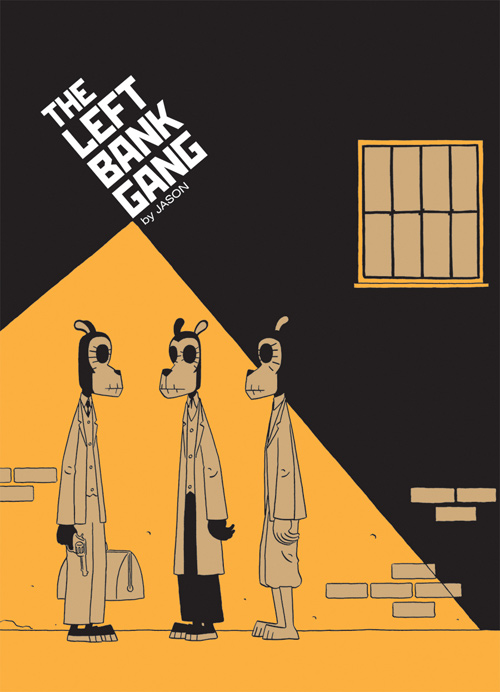
I’ve written about Norwegian cartoonist Jason for The Casual Optimist before and his work appears here with unerring regularity — if you are a frequent reader you are no doubt already familiar with it.

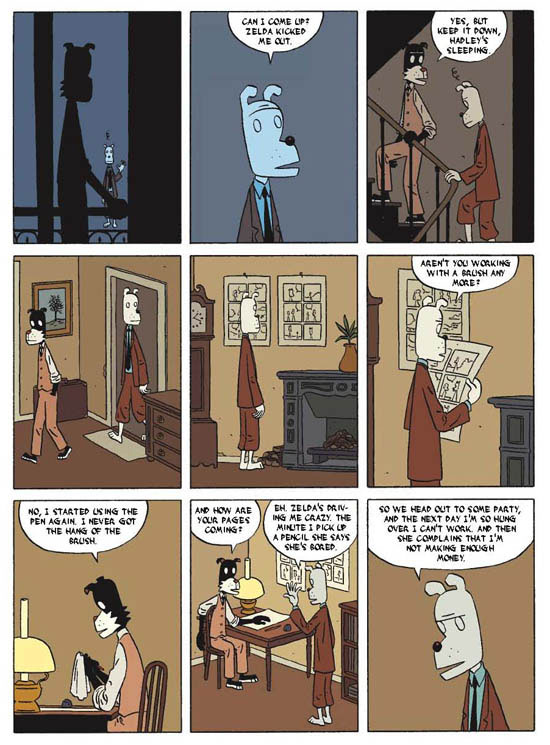
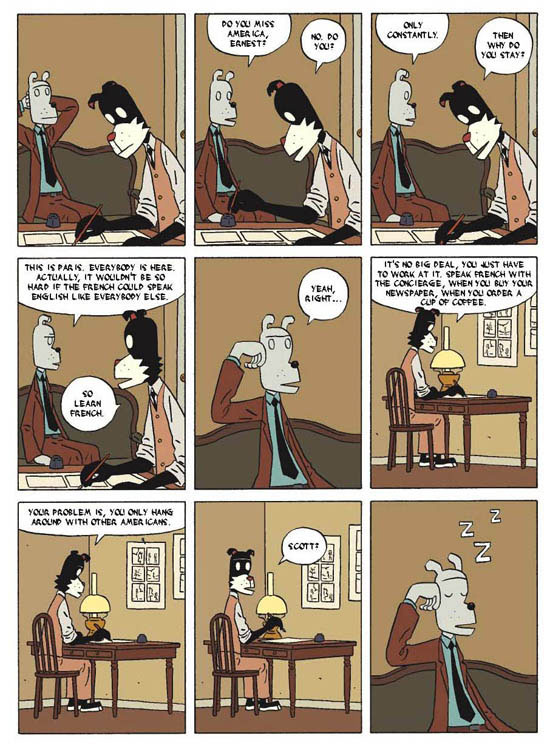
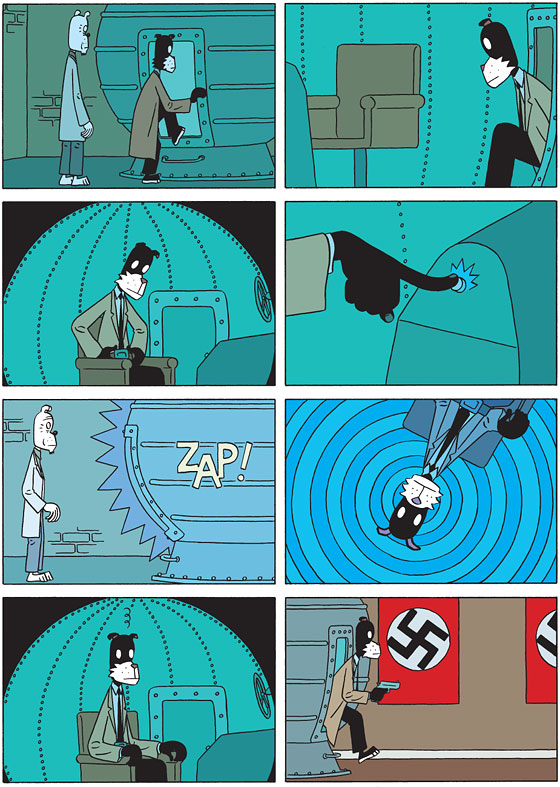
Like British cartoonist Tom Gauld who I interviewed early this year, Jason’s comics are immediately identifiable. You cannot mistake them for the work of someone else. And again, like Tom, Jason’s work references both the pop and the high-brow: zombies and werewolves on the one hand; Hemingway and the Beats on the other. The result is both original and off-beat. His protagonists are like renegades from a Max Fleischer cartoon who’ve inadvertently wandered into a Jim Jarmusch movie… Anthropomorphic animals smoking cigarettes, drinking coffee, talking about French actresses. Action and slapstick wrestle with ennui and loneliness.
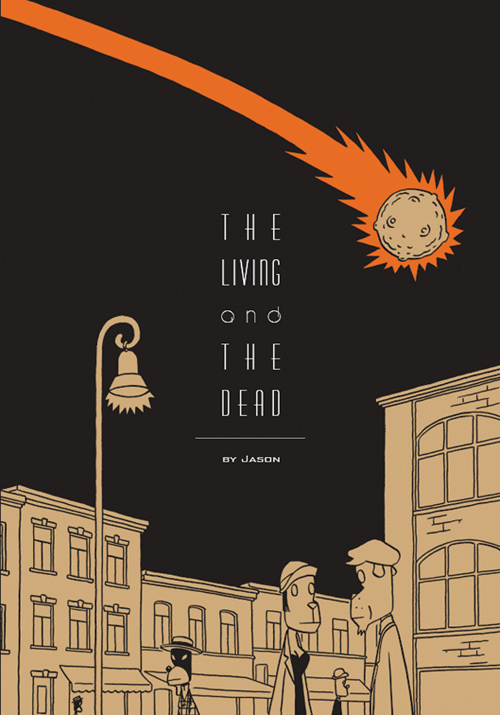
Jason, whose work has been translated into Swedish, Spanish, German, Italian and French, currently lives in Montpellier, France. He was kind enough to talk to me in English. His new short story collection Athos in America will be published in December by Fantagraphics.
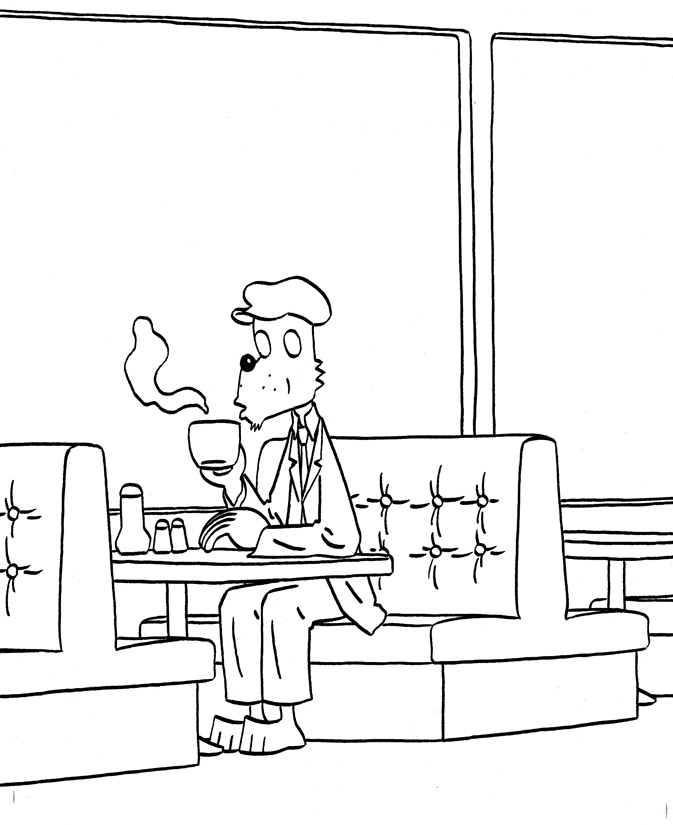
 

When did you first start drawing cartoons?

Around age 13, I guess. And then at age 16 I started selling cartoons and one page strips to a Norwegian humour magazine. I did that through high school.

Did you always want to be a professional cartoonist?

No, it was a hobby. To become a cartoonist in Norway was not much of an option. I went to art school to become an illustrator, but my career never took off, so I kept doing comics. I met other cartoonists in Oslo, there was sort of a little scene. And then I moved to France to be closer to the French comic book industry. I did books that were translated into English, French plus some other languages, and the last seven or eight years I’ve been able to have an income almost exclusively from doing comics.
How did you become involved with your US publisher Fantagraphics?

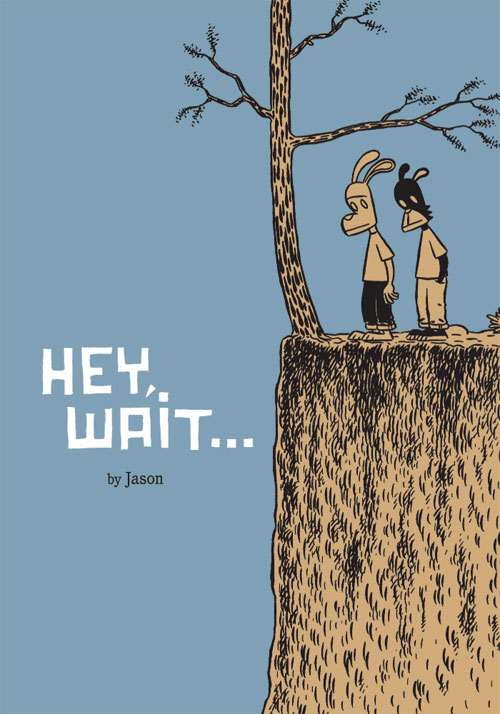
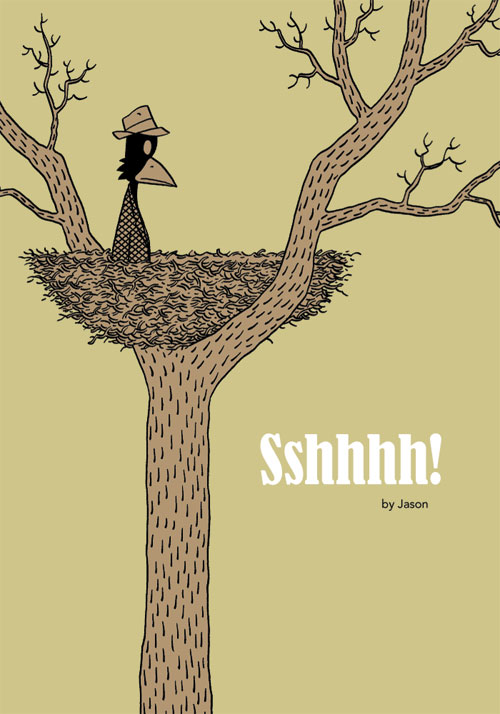
We sent — that is me and my Norwegian publisher, Jippi — we sent Hey, Wait… to Fantagraphics. I’m still not quite sure if Kim Thompson read our submission or if he had already read the French version, but anyhow, they decided to publish the book, and then later Shhh! And The Iron Wagon. And for some strange reason, the books seem to sell okay, so I’m still published by them. [Hey, Wait…, Shhh! and The Iron Wagon are collected in the book What I Did]
Briefly, could you describe your working process?

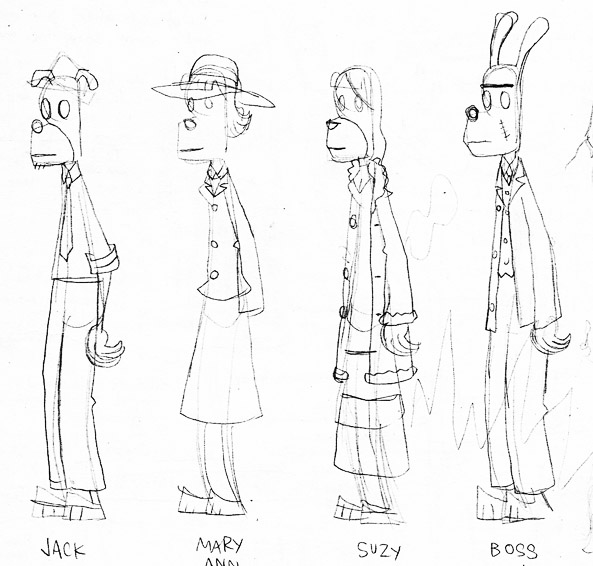
I have ideas in my brain, just lying there, that I sometimes think about. This can last years. Then suddenly I can get ideas for dialogues. I write this down. It’s maybe four or five pages. I can start working on those, and at the same time think about what’s going to happen next. I don’t write a full script. It’s based on improvisation. I write pieces of dialogue. Or sometimes I sketch out the pages first, the images, and write the dialogue after. I usually work on nine or ten pages at the same time, pencil a bit here , then ink it, and then pencil a bit there and ink that. It’s the completely wrong way of doing it, by the way, but it seems to be the only way I can work.
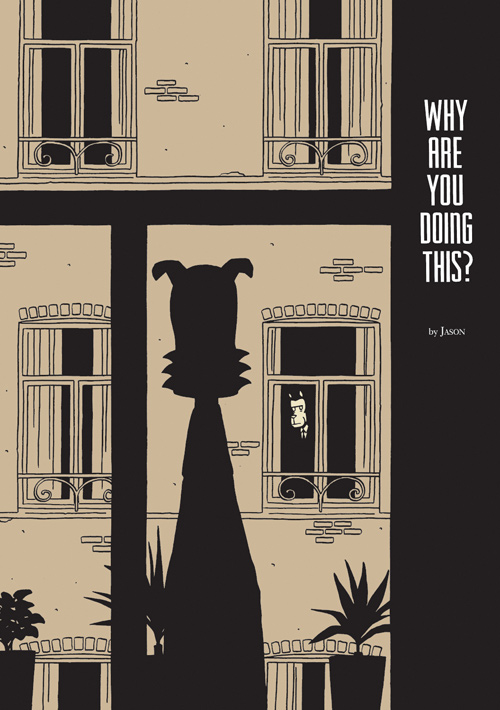
Your work often references classic movies. What are some of your favourite films?

How much room do you have? I like Fred Astaire and Ginger Rogers films, film noir, Brian De Palma, John Ford, especially The Searchers and Howard Hawks, especially Rio Bravo, Buster Keaton, Laurel and Hardy. Paris, Texas, Down by Law, Animal House, Blues Brothers, Fanny and Alexander, Five Easy Pieces, The Last Picture Show, Miller’s Crossing, Roman Holiday, On The Waterfront, Life of Brian. Days of Heaven by Terrence Malick is probably my favourite film.
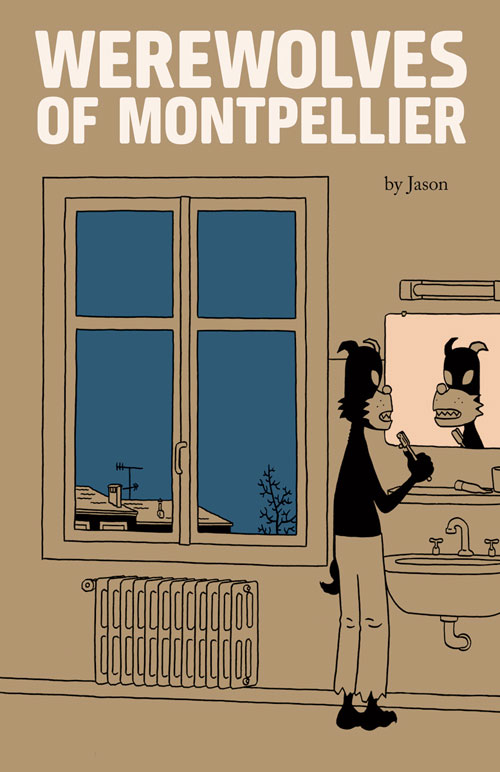
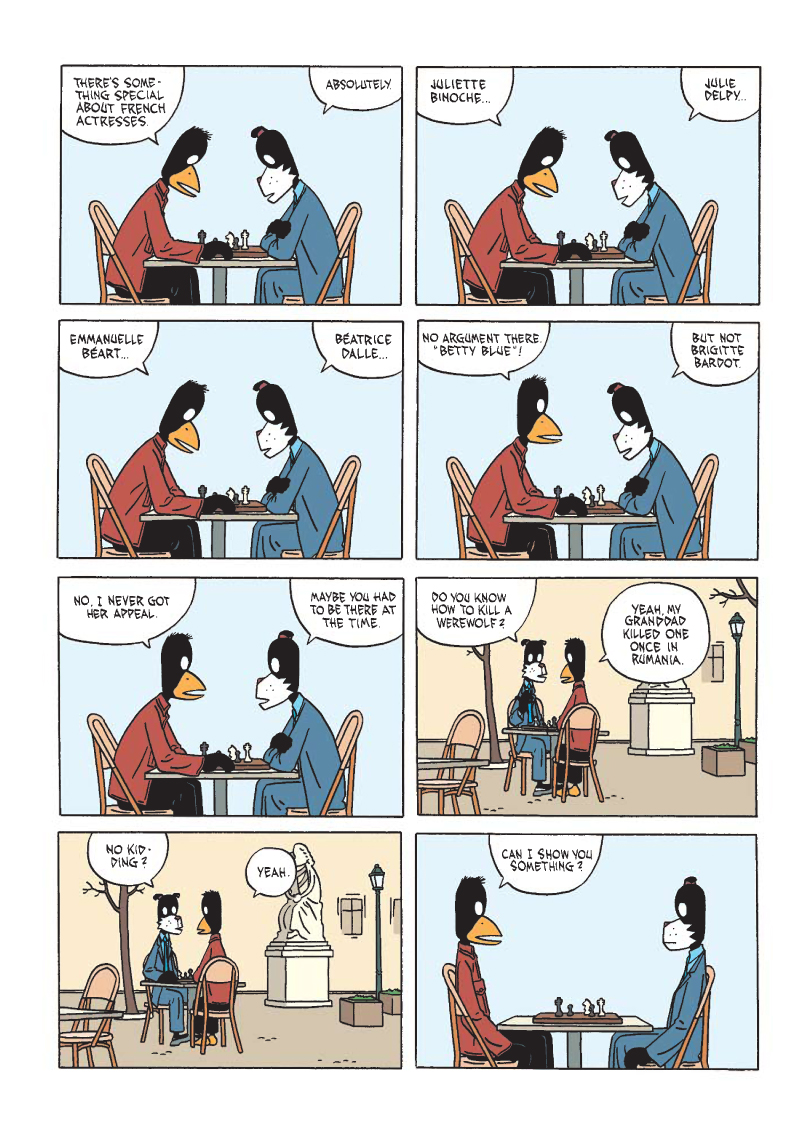
In your recent book Werewolves of Montpellier, one of the characters says they don’t understand the appeal of Brigitte Bardot. Really?

Yes, really! What, you like her? She just looked a little stupid to me. I find Catherine Deneuve a lot more appealing, or Emmanuelle Beart and Julie Delpy to stick with French actresses.
You recently post a list of your 5 favourite Tintin books. Has Hergé been an influence on your work?

Yes, very much so. It was one of the first cartoonists that appealed to me. I borrowed his albums at the library as a kid. I started drawing my own cartoons. And I think you can have a much worse teacher than Hergé. It’s not really the clear line that is the most important thing, even if that is part of what I like with him, it’s more the very clear storytelling that you find in his books. On page three you’re hooked. I think you can read his books in a foreign language, in Russian, and still understand the story and enjoy it. I don’t re-read the books that often, but I often take them out, my favourite albums like The Broken Ear and The Shooting Star, and just look at the drawings.

What do think about the new Steven Spielberg adaptation?

I’ve only seen the trailer. It doesn’t look that bad. I don’t want to just completely rule it out, like its a sacrilege and that Spielberg has no right to adapt Hergé. Not sure about the computer animation, but the original plan was apparently live action with a computer animated Terry [Milou/Snowy], and I think I really would have hated that. And the European animation films, based on each album, are just terrible. Everything that is exciting and funny in the albums are completely lost in the animation films. So I don’t think the Spielberg film can be any worse.
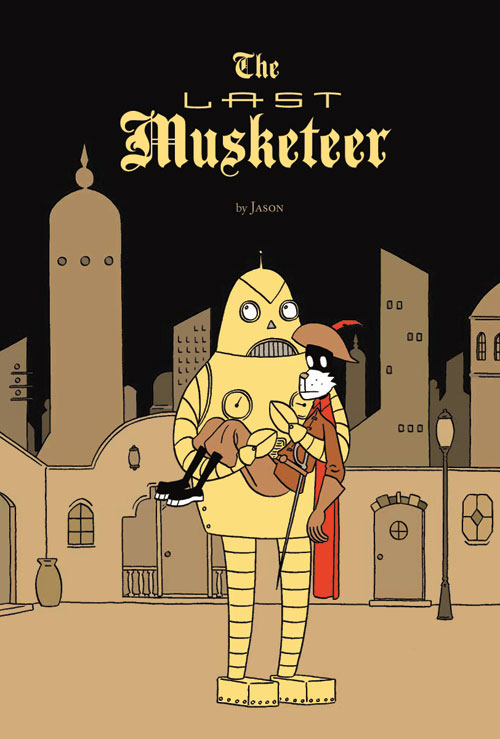
Who are some of your other creative heroes?

Jim Jarmusch, Hal Hartley, Wes Anderson, Aki Kaurismäki. Jaime Hernandez, Jim Woodring, Daniel Clowes, Chester Brown.

Who else do you think is doing interesting work right now?

There are two Argentinian cartoonists I like, Liniers and Pablo Holmberg. The French cartoonist Christophe Blain. Calef Brown’s children books. I like the Mutts books by Patrick McDonnell. I’m not sure if it’s necessarily «interesting», but I find them appealing. It’s like the last, good newspaper strip. I like the old newspaper strip collections: Captain Easy, Prince Valiant, Little Orphan Annie, Gasoline Alley.
What books have you read recently?

This summer I read The Selected Letters by Jack Kerouac, Off The Road by Carolyn Cassady. I tried to read The Subterraneans by Kerouac, but gave up. I read Chronicles by Bob Dylan, Positively 4th Street by David Hadju and A Freewheelin’ Time by Suze Rotolo. I also read Dave Van Ronk’s memoirs, The Mayor of MacDougal Street, so I look forward to the new film by the Coen brothers, based on his life. What else? Blood Meridian by Cormac McCarthy, Last Night in Twisted River by John Irving and Freedom by Jonathan Franzen. I’m currently reading Volume 1 in The Letters of Ernest Hemingway.
What are a few of your favourites books?

Well, Hemingway. The Sun Also Rises and A Farewell to Arms, his short stories. Bukowski, mostly his novels, but I’ve also started reading his poetry. Raymond Carver and Tobias Wolff. Lorrie Moore, her short stories. Kelly Link. There’s a British writer I like, Rupert Thomson. John Fante, especially Ask The Dust, John Steinbeck, especially East of Eden and Grapes of Wrath, Cormac McCarthy, especially The Road and No Country for Old Men. Raymond Chandler and other old pulp writers like Charles Willeford and David Goodis. I like Elmore Leonard. Paul Auster. John Irving. Every four or five years I re-read Cider House Rules, Garp and Hotel New Hampshire.

Are there any stories you would like to illustrate?

Yes, there are one or two books I’d like to adapt to comics. But I’ll probably wait until I’ve run out of ideas myself.
Do you worry about the future of books and print?

No. I don’t know. The bike didn’t disappear when the car came. There are hopefully room for both books and electronic media. Personally I’ll stick with paper. I’ve no interest in reading on a screen. And I’ll be dead in 40 years anyhow. How much can they screw it up by then?

Thanks Jason!
 

6 Comments

Midweek Miscellany

An Expressionist Newsreel of a Bad Dream — Guardian film critic Peter Bradshaw on the classic Martin Scorsese movie Raging Bull:

The effect is to combine stunning scenes of brutality and self-destruction with a lethal, even outrageous sentimentalism and self-pity. It’s all captured in dreamlike, pin-sharp monochrome cinematography, stark images reproduced like a Weegee crime scene. The result is operatic and mad and compelling.

The fight sequences themselves, with the camera swirling and swooping around the ring, and the soundtrack sometimes gulping out into silence and sometimes moaning with weird half-heard animal noises, are unforgettable: an inspired reportage recreation in the manner of a Life magazine shoot, which also looks like expressionist newsreel footage of a bad dream.

Also at The Guardian, Justin McGuirk reviews Gary Hustwit’s new documentary Urbanized:

Urbanized is a brave and timely movie that manages to strike almost exactly the right tone. For a sense of the scale of the urban problem, simply look at Mumbai, a city of 12 million people that is set to be the world’s biggest by 2050. Already, 60% of its population lives in slums with such poor sanitation that there is only one toilet seat for every 600 people. The municipality is reluctant to build toilets for fear that it will encourage more migrants to come. “As if people come to shit,” retorts the activist Sheela Patel in the movie. Quite.

The 10% — CNN looks at the business of women in comics and Womanthology, a comics anthology funded by Kickstarter:

“Think about it from the publisher’s point of view,” [former DC associate editor] Asselin said. “Say you sell 90% of your comics to men between 18 and 35, and 10% of your comics to women in the same age group.  Are you going to a) try to grow that 90% of your audience because you feel you already have the hook they want and you just need to get word out about it, or b) are you going to try to figure out what women want in their comics and do that to grow your line?”

(My advice: go with “b”)

And on the subject of comics… Art Spiegelman talks about MetaMaus (what else?) with The Observer:

In his ramshackle SoHo studio – a sort of comics library with a membership of just one, it consists of a dingy bathroom, a kitchenette, a drawing board, the odd dusty plant and about eight million quietly groaning books – Spiegelman lights yet another cigarette… He then gives himself over to crowing delightedly. “I’ve met a number of editors over the years,” he says, eyes rolling. “And all of them claim to have discovered Maus, when all they really have the right to claim is that they rejected it.”

And finally… While Toronto is busy drawing Tintin, Simon Kuper looks back at the life and work of Hergé for the Financial Times:

The war seems to have forced Hergé inward into his own imagination, and Haddock is one of the best things he found there. The captain’s alcoholism and swearing would be staple jokes of all subsequent Tintin books. Pretty much all writers on Tintin note that the main character is a cipher, a humourless two-dimensional boy scout. “A blank domino,” Hergé’s friend, the philosopher Michel Serres, called him. Tintin therefore requires company. Prewar, he only had his dog, Snowy. Haddock… was much more interesting. Even Hergé seems to have come to prefer him to Tintin.

Comments closed

C. S. Richardson | Quill and Quire

In the first of a new podcast series from Quill and Quire, web editor Sue Carter Flinn talks with C. S. Richardson, vice-president and creative director at Random House Canada, about his 30-year career in book design:

Quillcast: C. S. Richardson mp3

Comments closed

Gerhard Richter at Tate Modern

With a major retrospective currently in London, artist Gerhard Richter talks about his life and work with Nicholas Serota, Director of Tate, on the eve of the show opening:

Comments closed

Something for the Weekend

Words and Pictures — An interview with cartoonist Tom Gauld at The Rumpus:

Format, words and pictures all work together to make a good comic. I started at college doing pure illustration and only gradually got into making stories and using words. I’m still more comfortable with pictures than words: I’m happy doodling away on drawings for hours, but putting words together is always more of a struggle. I  usually like to keep things as simple as I can so it’s interesting seeing what I can remove and still keep the story: you don’t want to say something in words which is better said in the pictures (and vice versa).

There is also a preview of Tom’s new book, Goliath, on the D+Q blog and you can read my interview with Tom here.*

A General Contempt for Small Talk — Edward Docx, author most recently of The Devil’s Garden, on Tolstoy, Russia, and literary prizes. So much good stuff here:

[I]f there’s one thing that novelists love to talk about, it’s how to make things real when, obviously, they are not. This in turn leads naturally into something novelists like to talk about even more: the terrible struggle of writing itself. (My favourite line about writers: “Writers are people who find writing more difficult than other people.”)… Metaphors rise from the table like disturbed lepidoptera. Writing a novel is like attempting to solve an extremely complicated maths equation, which seeks to represent reality, and through which you are trying to lead the public without them ever getting wind that said equation is, in fact, impossible to solve or that, actually, it might not represent reality at all. We are getting carried away. Deciding to write a novel is like visiting an obscure, half-forgotten and slowly-evaporating planet entirely comprised of swimming pools and deciding that what is needed is… yes, another swimming pool! But, for obscure reasons, a swimming pool that must be built single-handedly from scratch and then filled using only a syringe.

And finally…

Critical Authority — New York Times film critics A. O. Scott and Manohla Dargis discuss Brian Kellow’s new book Pauline Kael: A Life in the Dark and the ongoing legacy of the (in)famous New Yorker film critic. Here’s A.O. Scott:

[T]he idea of critical authority has always struck me as slippery, even chimerical. Authority over whom? Power to do what? The importance of particular critics can’t be quantified in lumens of fame, circulation numbers or box office returns, though by all of these measures Kael, in her heyday, certainly enjoyed unusual prominence. But like every other critic, she was above all a writer, and a writer only really ever has — or cares about — one kind of power, which is the power to engage readers.

I think Kael is remembered not for her particular judgments or ideas, but rather for her voice, for an outsized literary personality that could be enthralling and infuriating, often both. A lot of people read her for the pleasure of disagreement, and the resentment she was able to provoke — in critical targets and rival critics — is surely evidence of power. An awful lot of our colleagues are still, in both senses, mad about her. To reread her is to understand why.

*Just so you know: D+Q are distributed in Canada by my employer Raincoast Books.

Comments closed

Novum 11/11: The Making Of Cover

Yes, yet another “making of” video, but before you roll your eyes and click away, take a moment to watch this one. It shows the cover design for the latest issue of German graphic design magazine Novum. Designed by Paperlux, the tactile cover bends and folds in small triangles. I don’t know how it would work with a book cover (and I’m not sure I want to), but it’s pretty neat all the same:

(via Graphic Exchange)

Comments closed

Chip Kidd on 1Q84

Associate art director Chip Kidd talks about designing the cover and interior artwork for Haruki Murakami’s 1Q84:

5 Comments

Midweek Miscellany

Buzzwords of the Incurious — Evgeny Morozov, author of The Net Delusion: The Dark Side of Internet Freedom, delivers a searing review of Public Parts: How Sharing in the Digital Age Improves the Way We Work and Live by Jeff Jarvis.  A must-read:

The ubiquitous references to Gutenberg are designed to lend some historical gravitas to wildly ahistorical notions. The failure of Internet intellectuals actually to grapple with the intervening centuries of momentous technological, social, and cultural development is glaring. For all their grandiosity about technology as the key to all of life’s riddles, they cannot see further than their iPads. And even their iPad is of interest to them only as a “platform”—another buzzword of the incurious—and not as an artifact that is assembled in dubious conditions somewhere in East Asian workshops so as to produce cultic devotion in its more fortunate owners. This lack of elementary intellectual curiosity is the defining feature of the Internet intellectual. History, after all, is about details, but no Internet intellectual wants to be accused of thinking small. And so they think big—sloppily, ignorantly, pretentiously, and without the slightest appreciation of the difference between critical thought and market propaganda.

Swimming Out of Guilt — David Ulin talks to Art Spiegelman about MetaMaus at the LA Times:

“I didn’t predict this for myself,” Spiegelman admits, firing up another cigarette. “I thought ‘Maus’ was going to take two years and I’d move on with my life. But it’s an ongoing wrestling match. Basically ‘Breakdowns’ ” — the 2008 collection that recontextualized his early work, including the first three-page “Maus” strip, from 1972 — “and ‘MetaMaus’ are the great retrospections, the period of my life I’m still swimming out of. Then I get to find out if there’s any other stuff in my pockets to make bets with.”

The World We Live In — Author William Gibson interviewed at the A.V. Club:

I don’t actually think of science fiction as primarily a predictive form. That’s its cultural reputation and that’s what lots of people believe it is, but my approach has always been that it’s invariably about the day it was written in. Regardless of what the author tells us, it can’t really be anything else. There’s no way it can be about the future, except it pretends to be the future. It’s like reading 1984. What it’s actually about is 1948, the year it was written. You see Orwell responding to various aspects of the world he lived in, which was changing, since the world always is.

See also: Margaret Atwood talks about speculative fiction and her new collection of essays Other Worlds with CBC Radio (audio) and The Globe and Mail.

And finally…

Trash — Nathan Heller on film critic Pauline Kael, a new collection of her work, The Age of Movies: Selected Writings of Pauline Kael, and Brian Kellow’s new biography Pauline Kael: A Life in the Dark:

Kael realized that the pictures had a chance to succeed where classic books, painting, and art music had been shunted from the mainstream; she thought a tolerance for “trash” was key to maintaining this openness and innovation. Still, she was no fugitive from the old arts. Kael once said that she’d rather live in a world without movies than in a world without books, and she resented the decline of public literary dialogue. She saw the movies as American art’s second chance.

Also at The New Yorker, Richard Brody looks back Kael’s book 5001 Nights at the Movies.


Comments closed

The Innovator’s Cookbook

I had seen the book trailer for The Innovator’s Cookbook by Steven Johnson posted elsewhere and hadn’t paid too much attention to it (elsewhere being wildly more popular than here!) until designer Helen Yentus dropped me a line to say that it showed her process for making the cover’s title letters using a MakerBot 3D printer:

“We really wanted to produce the cover in some way that would fit into the content. The MakerBot guys were nice enough to print the letters for us and they’re a really innovative company. They make the only affordable 3D desktop printer and they run a site where people upload their designs. It’s all pretty cool.”

In the video you can see Helen sketch out and design the letters before they are printed and set up for the cover shoot. It really is pretty cool:

The video and cover shoot were done by YDESIGN.

2 Comments

The Realist Novel and the Experimental Novel

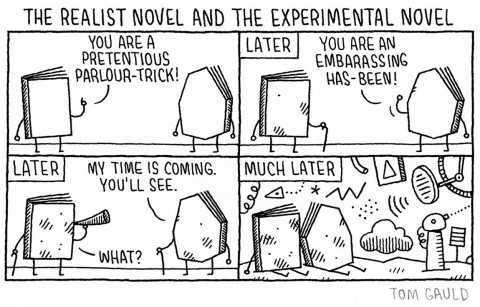
The usual genius for The Guardian from Tom Gauld. You can read my interview with Tom here.

Comments closed