Skip to content

Tag: Writing

Dystopia

Tom Gauld for The Guardian.

Comments closed

The Last London

The London Review of Books has a brilliant, sprawling, melancholy essay by author and psychogeographer Iain Sinclair titled ‘The Last London’. It’s difficult to know what to quote from the essay as it touches on so many interesting, diverse things, but this passage about London in science fiction is perhaps most appropriate for here: 

In 1909 [Ford Madox] Ford published an essay titled ‘The Future in London’, a provocative vision of a planned last city, a London circumscribed by the sixty-mile sweep of a compass point set in Threadneedle Street. He anticipated the urban planner Sir Patrick Abercrombie in reading London as a series of orbital hoops, ring roads and parkland. Brought to life on the edge of the river, this port settlement has always been a magnet for outsiders. It was constructed that way, developed to draw in the scattered tribes, the hut dwellers, to establish the importance of a river crossing. A satellite of Colchester, it was 100 AD before Londinium became a significant entity. And then it was lost, abolished, pulled apart, before it grew again.

Ford Madox Ford’s Edwardian pipedream is ahead of its time. He sees that Oxford and Cambridge and the south coast are all part of the London microclimate. He sees the river coming into its own as an avenue for transport. He envisages escalators and moving pavements, and a population enriched and civilised by incomers. He presents himself as so much the English gentleman that he is doomed to spend most of his career in chaotic exile, in France and the US. Ford is self-condemned, like Wyndham Lewis. His London is as fantastic now as the Magnetic City, protected by river and man-made canals, in Lewis’s The Human Age trilogy: ‘The blank-gated prodigious city was isolated by its riverine moat.’

The compulsion to imagine and describe a final city runs from Richard Jefferies, with his After London; or, Wild England (1885), through Ford and Lewis, to the drowned worlds of J.G. Ballard and Will Self, the dystopian multiverses of Michael Moorcock and China Miéville. Fredric Jameson, considering postmodernism, talks about the ‘hysterical sublime’: a sort of Gothic rapture in contemplation of lastness, the voluntary abdication of power to superior aliens. This was heady stuff for my own compulsive beating of the bounds, an exploration of neural paths and autopilot drifts through the City into Whitechapel and Mile End. One of these haunted dérives brought me to the window of a bookshop in Brushfield Street, alongside Spitalfields Market. The shop, of course, is gone now and the proprietor dead. I zoomed in on an item with a striking riverside skyline on the dust-jacket: Last Men in London by W. Olaf Stapledon, published in 1932. Here was a more intimate coda to the better-known Last and First Men (1930). I had to carry the book home.

Comments closed

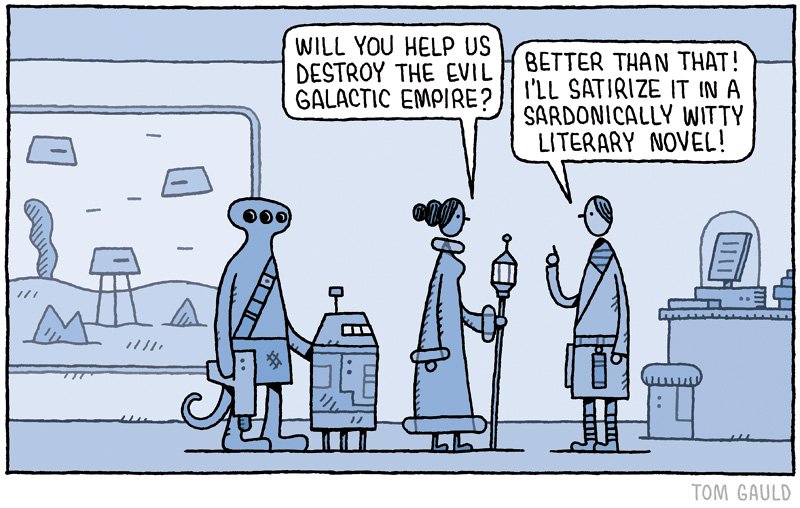
Will You Help Us Destroy the Evil Galactic Empire?

Tom Gauld for The Guardian.

(I’m working on my sardonically witty literary novel as we speak.)

Comments closed

The Rise of Roxane Gay

At Brooklyn magazineMolly McArdle profiles Roxane Gay, author of An Untamed State, Bad Feminist and, most recently, Difficult Women

“What more could I say that I haven’t already said?” Gay asks in an conversation about publishing and diversity we had via email last year. Though the industry-wide dialogue has in many ways gotten stuck (as a lot of things that benefit white people do)—mired by a lack of willingness to do the work, commit the resources—Gay’s own efforts changed the terms of the discussion.

“She’s given us a wonderful model,” Saeed Jones says over the phone. “She could just be a great writer, that would be more than enough, but she’s gone beyond that,” he explains. “She’s showing us how to navigate difficult online spaces. She’s editing and championing people.”

He knows from experience. In 2012 Gay edited Jones’s essay “How Men Fight for Their Lives” for The Rumpus, which became the germ (and the title) for the memoir he’s now working on. “When people read that essay and feel surprised or moved by the candor or the vulnerability, it’s because Roxane made me feel safe,” Jones explains. She went on to invite him to contribute to a special issue of Guernicaa piece that became part of his award-winning debut collection of poetry, Prelude to Bruise. They’ve since shared the stage several times, most recently in front of a sold out audience at the 92nd Street Y this February. “Roxane is the kind of editor who says, ‘You are doing something important. Keep doing it.’ For writers particularly interested in examining gender, the body, power, race, identity—that is an essential and all too rare experience. There are not too many people out there you can trust. With Roxane,” he says, “people feel like themselves.”

Comments closed

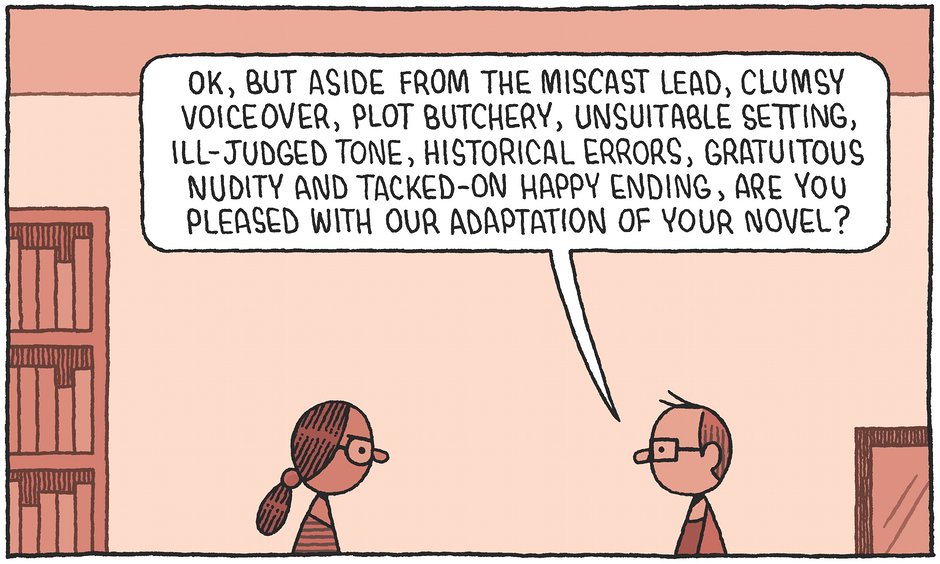
Adaptation

film-adaptation

Tom Gauld for The Guardian

(Tom has touched on this subject before…)

Comments closed

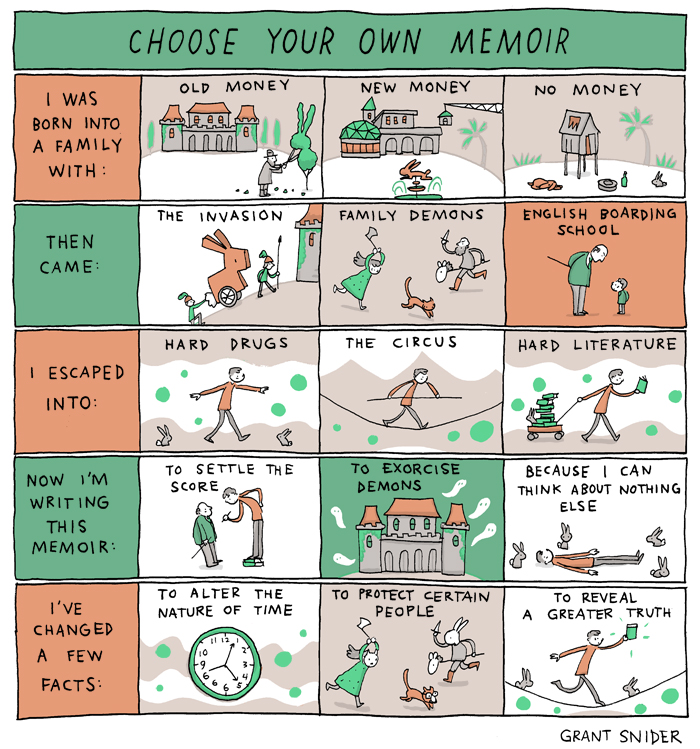
Choose Your Own Memoir

chooseyourownmemoir-web

Grant Snider for the New York Times Book Review.

Comments closed

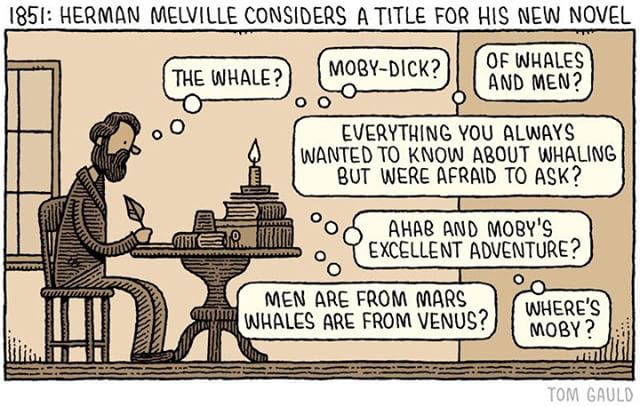
Herman Melville Considers A Title For His New Novel

herman-melville-tom-gauld

Tom Gauld for The Guardian.

Comments closed

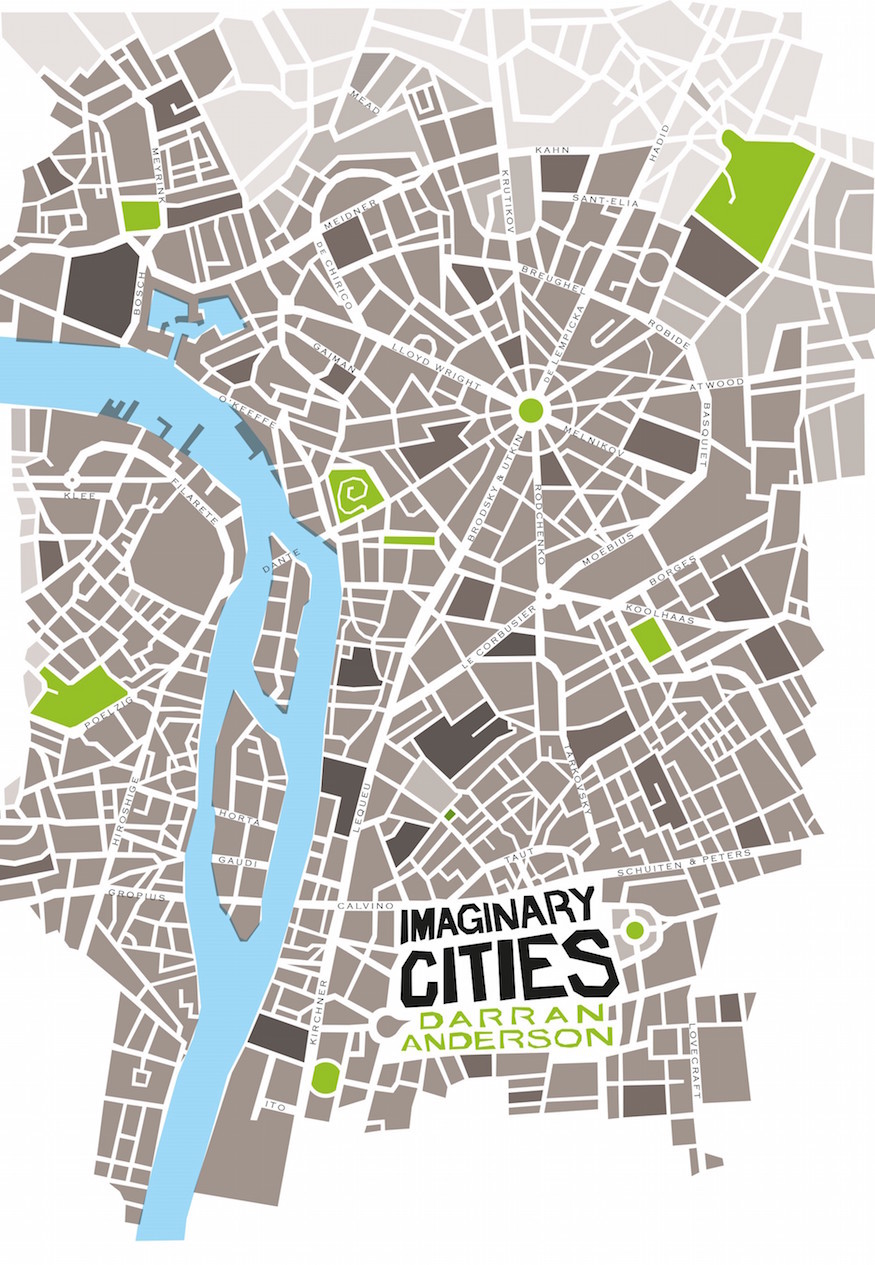
Darran Anderson on Imaginary Cities and Books as Maps

COV_cities_noMarks

Author Darran Anderson discusses his book Imaginary Cities with Rhys Tranter:

[M]y intention was to write something that isn’t self-contained; a book that somehow spills out of its pages and into the world… I wanted to send people out looking for Sant’Elia or Chernikhov or whoever. It would be as much a map as a book…

…We have a tendency to think of books as ends in themselves, which has always seemed somewhat ludicrous, even a bit arrogant to me; the assumption because you’ve read Isherwood’s Berlin novels, you’ve got the Weimar Republic sussed (I don’t mean that detrimentally to Isherwood, whose work I love, incidentally). It’s like that bucket list approach to experience, when you hear someone say they’ve ‘done’ Europe or Thailand. However great a book is, however ‘definitive’ it is on a subject, it strikes me as only a point of beginning or as temporarily conclusive, as time and perspectives are constantly changing. I’ve always had enough self-doubt to be resistant to definitive narratives so I wanted Imaginary Cities to be full of points of departure, contradictions and questions. That’s one of the things I loved about Calvino’s Invisible Cities, which the title is also a nod to. The sense of poetic incompleteness to it. The feeling that the story is continuing on somewhere beyond its pages.

Imaginary Cities, which is already available in the UK, will be published in the US by University of Chicago Press in April 2017.

1 Comment

Proofreader’s Marks

proofreadersmarks-grant-snider

Grant Snider.

Comments closed

The Fantastic Ursula K. Le Guin

illustration Essy May

Julie Phillips long profile of author Ursula K. Le Guin for The New Yorker is wonderful:

Starting in the nineteen-eighties, [Le Guin] published some of her most accomplished work—fiction that was realist, magic realist, postmodernist, and sui generis. She wrote the Borgesian feminist parable “She Unnames Them,” and in 1985 an experimental tour de force of a novel, “Always Coming Home.” She produced “Sur,” the epic tale of an all-female Antarctic exploring party that may be her greatest and funniest feminist statement. Her short stories began appearing in The New Yorker, where her editor, Charles McGrath, saw in her an ability to “transform genre fiction into something higher.”

In fact, it was the mainstream that ended up transformed. By breaking down the walls of genre, Le Guin handed new tools to twenty-first-century writers working in what Chabon calls the “borderlands,” the place where the fantastic enters literature. A group of writers as unlike as Chabon, Molly Gloss, Kelly Link, Karen Joy Fowler, Junot Díaz, Jonathan Lethem, Victor LaValle, Zadie Smith, and David Mitchell began to explore what’s possible when they combine elements of realism and fantasy. The fantasy and science-fiction scholar Brian Attebery has noted that “every writer I know who talks about Ursula talks about a sense of having been invited or empowered to do something.” Given that many of Le Guin’s protagonists have dark skin, the science-fiction writer N. K. Jemisin speaks of the importance to her and others of encountering in fantasy someone who looked like them. Karen Joy Fowler, a friend of Le Guin’s whose novel “We Are All Completely Beside Ourselves” questions the nature of the human-animal bond, says that Le Guin offered her alternatives to realism by bringing the fantastic out of its “underdog position.” For writers, she says, Le Guin “makes you think many things are possible that you maybe didn’t think were possible.”

Comments closed

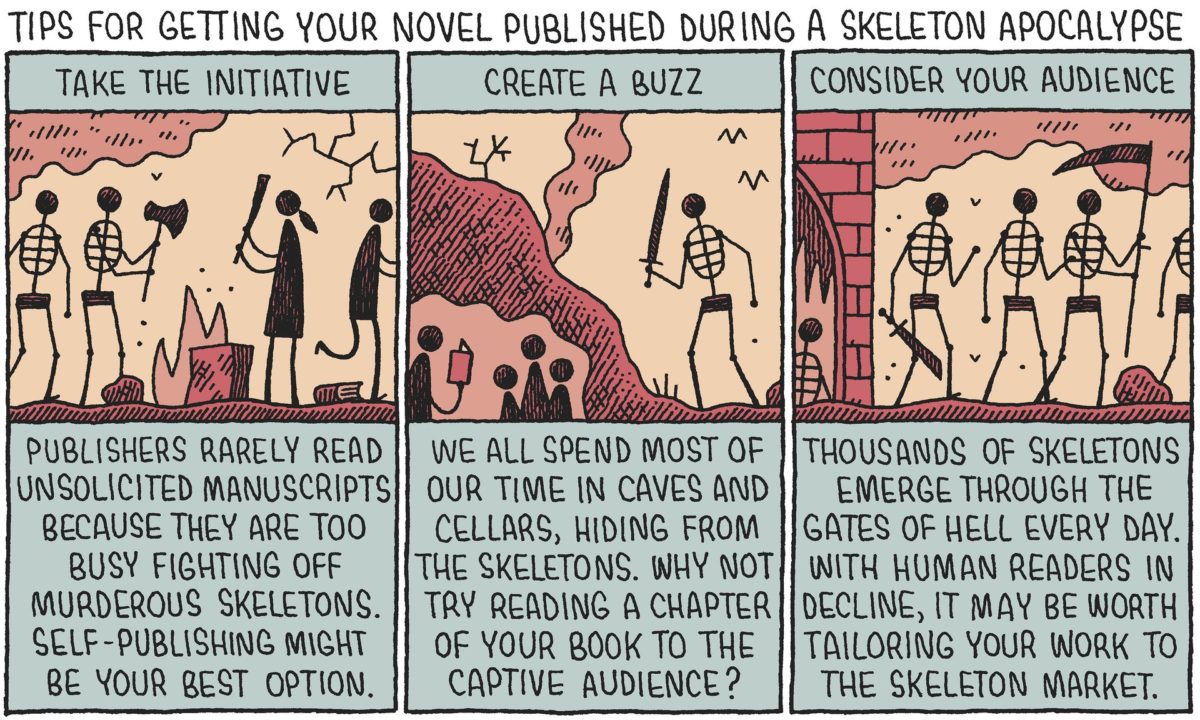
Tips For Getting Your Novel Published

tips-for-getting-your-novel-published

… during a skeleton apocalypse. Tom Gauld for The Guardian.

Comments closed

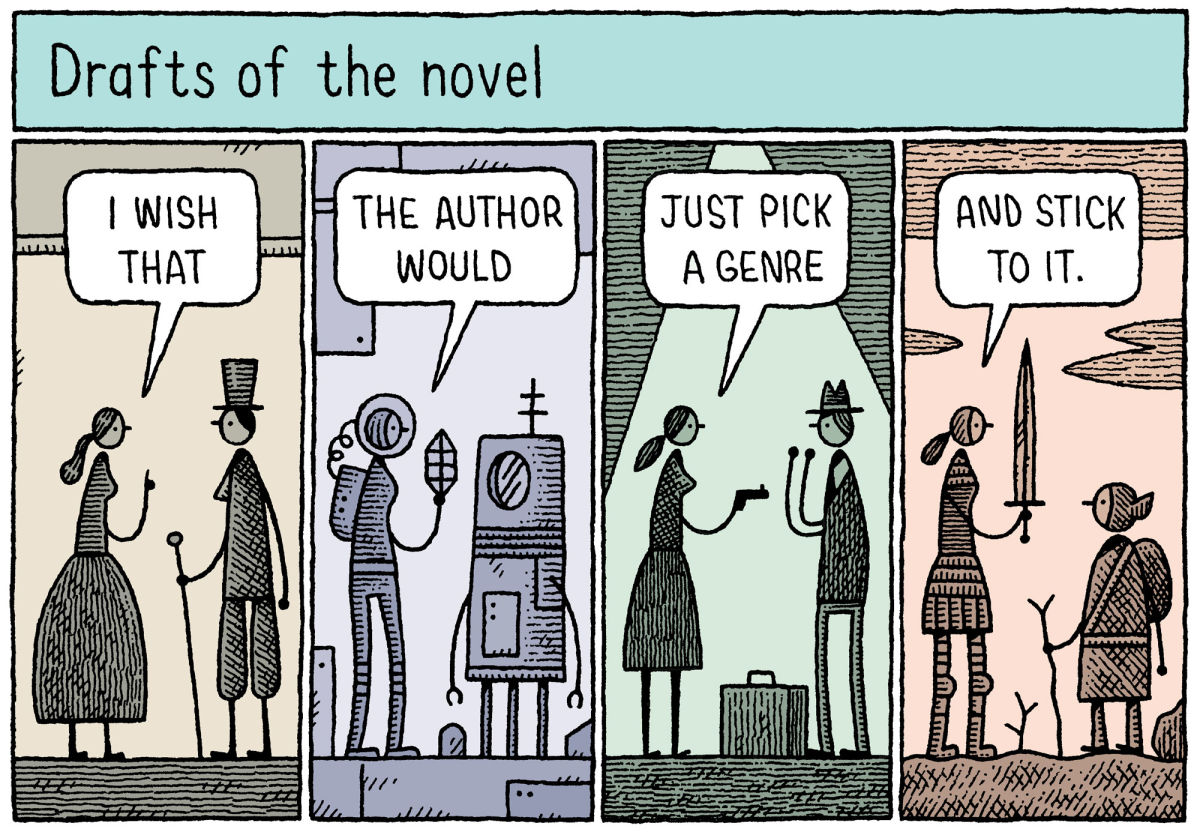
Drafts of the Novel

gauld-tom-genre-090616-1200

Tom Gauld for The New Yorker.

Tom’s new graphic novel Mooncop is out now.

Comments closed