Skip to content

Tag: Reading

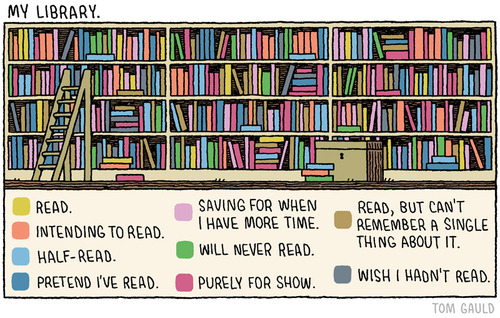
Tom Gauld’s Library

my-library

Tom Gauld.

Comments closed

Have You Seen My Kindle?

have-you-seen

Tom Gauld

Comments closed

The Joy of Reading by Grant Snider

After illustrating the special sex issue of the New York Times Book Review last week, cartoonist Grant Snider has turned his cover illustration and two unused sketches into a series of posters titled The Joy of Reading. The posters are available from Grant’s shop.

Comments closed

Joost Swarte: Tumult in the Book World


This wonderful illustration by Dutch cartoonist Joost Swarte accompanied a discussion on traditional bookstores in the digital marketplace in last Sunday’s New York Times.

4 Comments

Something for the Weekend

Decaying Rabelaisians — An interesting look at the current state of French literature by Florence Uniacke for The Spectator:

Will Hobson, former contributing editor at Granta, says that fiction, philosophy, memoir and non-fiction (amongst other genres) are not clearly defined in France like they are in the UK, and this ‘super-genre’ doesn’t tend to sit well with English readers. The French philosophise, intellectualise, internalise, characterise and analyse; and in the mean time the storyline forgets to materialise. It’s not hard to believe that an English translation of The Roving Shadows by Pascal Guignard, winner of the Prix Goncourt in 2002, which was described as ‘a sequence of beginnings of novels, stories, landscapes and autobiographical fragments’, sold hardly any copies.

Lowered Expectations — Philip Lopate on essays and doubt, for the New York Times:

I like the freedom that comes with lowered expectations. In the area of literary nonfiction, memoirs attract much more attention than essay collections, which are published in a modest, quasi-invisible manner, in keeping with anticipated lower sales. But despite periodic warnings of the essay’s demise, the stuff does continue to be published; if anything, the essay has experienced a slight resurgence of late. I wonder if that may be because it is attuned to the current mood, speaks to the present moment. At bottom, we are deeply unsure and divided, and the essay feasts on doubt.

See also: Adam Kirsch on the ‘new essayists’ for The New Republic (which only reinforces my belief that I am the only person in the known world who was ambivalent about Pulphead and hasn’t the slightest interest in How Should A Person Be)

The Dream Book of Blank Pages — Andrew Gallix on unread (and unreadable) books for The Guardian:

There was a time when a learned fellow (literally, a Renaissance man) could read all the major extant works published in the western world. Information overload soon put paid to that. Since there is “no end” to “making many books” – as the Old Testament book Ecclesiastes prophesied, anticipating our digital age – the realm of the unread has spread like a spilt bottle of correction fluid. The librarian in Robert Musil’s The Man Without Qualities only scans titles and tables of contents: his library symbolises the impossibility of reading everything today. The proliferation of lists of novels that you must, allegedly, have perused in your lifetime, reflects this problem while compounding it. On a recent visit to a high street bookshop, I ogled a well-stacked display table devoted to “great” novels “you always meant to read”. We measure out our lives with unread books, as well as coffee spoons.

And finally…

A wonderful post by Charles Simic on Aperture Magazine, for the NYRB Blog:

In one of the older issues, Minor White had an essay called “What is Meant by ‘Reading’ Photographs” that made a big impression on me. He writes in it about hearing photographers often say that if they could write they would not take pictures. With me, I realized, it was the other way around. If I could take pictures, I would not write poems—or at least, this is what I thought every time I fell in love with some photograph in the office, in many cases with one that I had already seen, but somehow, to my surprise, failed to properly notice before. There is a wonderful moment when we realize that the picture we’ve been looking at for a long time has become a part of us as much as some childhood memory or some dream we once had. The attentive eye makes the world interesting. A good photograph, like a good poem, is a self-contained little universe inexhaustible to scrutiny.

Comments closed

Midweek Miscellany

Ghost Shapes — Writer Warren Ellis talks comics and, very briefly, his new novel Gun Machine at Robot Six:

Gun Machine is as much about the ghost shape of Manhattan’s previous settlements and roadways as it is about its modern architecture, and the invisible channels of wireless communication around which that structure now bends. I see — or at least I look for — the foundations of deep time, and the deals we do with it.

See also: A.V. Club’s review of Gun Machine:

In Ellis’ world, everything is all-caps, all the time, and any character who can ask for a cup of coffee in a way that doesn’t call for at least one exclamation point is a spoilsport. Gun Machine, Ellis’ second prose novel, is in exactly the same style and spirit as his comics; like his first novel, Crooked Little Vein, it gives the impression that Ellis didn’t write it as a comic only because pictures would have slowed down the action.

Sounds about right. The book is also reviewed at The New York Times(That fabulous cover for Gun Machine was designed by Keith Hayes designed by Oliver Munday with art direction by Keith Hayes by the way).

Be Still My Exploding Heart — Stephen Page, head of Faber & Faber, on the Penguin-Random House merger and what it means for the industry at large, at The Guardian:

Authors are talked about as brands in their own right, and this is correct. Publishers rarely achieve the status of becoming consumer brands of scale and significance. Is the next story for publishing going to be one dominated by global and local author and publisher brands, especially in niches? Authors and readers are at the centre of the world of books, and finding new ways to serve them will create further different structures. This merger may be seen as a starting pistol or perhaps an explosion in the heart of the old order dominated by the book trade.

Disposable by Design — Nicholas Carr on e-books and the apparent resilience of print books, at the Wall Street Journal:

From the start, e-book purchases have skewed disproportionately toward fiction, with novels representing close to two-thirds of sales. Digital best-seller lists are dominated in particular by genre novels, like thrillers and romances. Screen reading seems particularly well-suited to the kind of light entertainments that have traditionally been sold in supermarkets and airports as mass-market paperbacks… Readers of weightier fare, including literary fiction and narrative nonfiction, have been less inclined to go digital. They seem to prefer the heft and durability, the tactile pleasures, of what we still call “real books”—the kind you can set on a shelf. E-books, in other words, may turn out to be just another format—an even lighter-weight, more disposable paperback. That would fit with the discovery that once people start buying digital books, they don’t necessarily stop buying printed ones.

An alternative, more circumspect, version of the article can be found on Carr’s blog:

None of this means that, in the end, e-books won’t come to dominate book sales. My own sense is that they probably will. But, as we enter 2013, I’m considerably less confident in that prediction than I was a few years back, when, in the wake of the initial Kindle surge, e-book sales were growing at 200 or 300 percent annually. At the very least, it seems like the transition from print to electronic will take a lot longer than people expected.

And perhaps most interesting of all, Carr has posted a series of exchanges with Clay Shirky and Kevin Kelly about the post.

Covering some similar ground, only bleaker, Dennis Johnson’s striking post on the slow death of Barnes & Noble is also essential reading:

Perhaps the most disturbing thing about all this is the fact that, as with the demise of Borders, the demise of B&N has nothing to do with what its customers actually wanted, what’s best for mother literature or free speech, or anything other than made-up trends covering for killer capitalism. There’s still plenty of evidence that people like bookstores, for example, and even sales of hardcovers — let alone print books — are holding on. And so the lust for higher margins — whether from Godiva chocolates or ebooks — turned into fool’s gold for B&N. It’s perhaps a typical death in the Free Trade era, when companies lose all sight of their identity in the blinding light of the bottom line … but it’s the wrong death for a bookseller.

Somewhere in there, Johnson quotes this article by David Streitfeld in the New York Times, which makes the rather chilling point about a demise of Borders in 2011. Not only did it have a negative effect on the sale of print books, it was bad for e-books too. “Readers could no longer see what they wanted to go home and order.”

Sigh…
4 Comments

Something for the Weekend

Do It Yourself — John Self, of the excellent Asylum blog, on the power of independent readers, at The Guardian:

if publishers and authors are limited in what they can do for a book online, who is left? They want to harness word of mouth, and power lies collectively in the independent readers – you and me. Can we make a difference when the bookselling world is full of outlets, online and off, which primarily sell what already sells, or can be related to a proven success (“It’s Fifty Shades of Grey meets Harry Potter!”)? If social media has inspired a new age of grassroots political activism, why not literary activism, too?

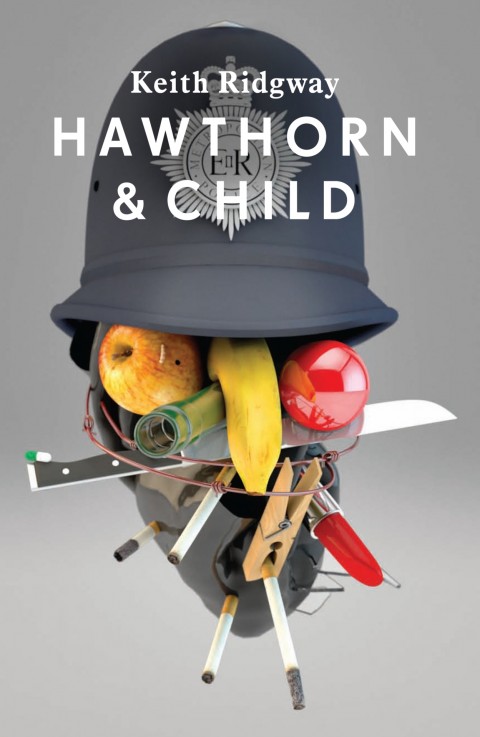
I picked up Keith Ridgway’s new book Hawthorn & Child almost entirely on the basis of John’s recommendation (I also read Colony by Hugo Wilcken, one of my favourite books of recent years, as a result of John’s review). The astonishing cover (pictured above) is by Tom Darracott by the way.

(Semi) Colonoscopy — Mary Norris on how to use the semicolon, at The New Yorker:

So the semicolon is exactly what it looks like: a subtle hybrid of colon and comma. Actually, in ancient Greek, the same symbol was used to indicate a question.

And it still seems to have a vestigial interrogative quality to it, a cue to the reader that the writer is not finished yet; she is holding her breath.

And finally…

Imaginary Buildings — Jimmy Stamp on the locations of 221B Baker Street, for The Smithsonian:

The mystery of 221B Baker Street is not one of secret passages or hidden symbols. Rather, it could be described as a sort of existential spatial riddle: how can a space that is not a space be where it is not? According to Arthur Conan Doyle’s stories, Sherlock Holmes and John Watson lived at 221B Baker Street from 1881 to 1904. But 221B Baker street did not exist in 1881, nor did it exist in 1887 when A Study in Scarlet was published and Baker Street house numbers only extended into the 100s. It was a purely fictional address – emphasis on was. Time marches on, Baker Streets are renumbered, and 221Bs are revealed…

Comments closed

Something for the Weekend

Isolation — Martin Amis on J.G. Ballard’s novel The Drowned Worldat The Guardian:

Ballard gives The Drowned World the trappings of a conventional novel (hero, heroine, authority figure, villain), and equips it with a plot (jeopardy, climax, resolution, coda); but all this feels dutiful and perfunctory, as if conventionality simply bores him. Thus the novel’s backdrop is boldly futuristic while its mechanics seem antique (with something of the boys’-own innocence we find in John Buchan and CS Forester). In addition, Ballard’s strikingly “square” dialogue remains a serious lacuna. Here as elsewhere, his dramatis personae – supposedly so gaunt and ghostly – talk like a troupe of British schoolteachers hoisted out of the 1930s: “Damn’ shame about old Bodkin”, “Capital!”, “Touché, Alan”. (Cf DeLillo, whose dialogue is always fluidly otherworldly.) We conclude that Ballard is quite unstimulated by human interaction – unless it takes the form of something inherently weird, like mob atavism or mass hysteria. What excites him is human isolation.

(The jacket for the 50th anniversary edition, pictured above, was designed by Darren Haggar)

Avatars of Reaction — New York Times film critics A. O. Scott and Manohla Dargis discuss comic book movies:

A critic who voices skepticism about a comic book movie — or any other expensive, large-scale, boy-targeted entertainment — is likely to be called out for snobbery or priggishness, to be accused of clinging to snobbish, irrelevant standards and trying to spoil everyone else’s fun.

What the defensive fans fail or refuse to grasp is that they have won the argument. Far from being an underdog genre defended by a scrappy band of cultural renegades, the superhero spectacle represents a staggering concentration of commercial, corporate power. The ideology supporting this power is a familiar kind of disingenuous populism. The studios are just giving the people what they want! Foolproof evidence can be found in the box office returns: a billion dollars! Who can argue with that? Nobody really does.

Hmm… Isolation and misery… Really must try harder with this blogging lark…. Have a good weekend.

Comments closed

Required Summer Reading by Grant Snider

Funny…

Comments closed

Something for the Weekend

Short and sweet today…

“All they do is show you’ve been to college” — Ben Dolnick on his love of the semicolon, at the New York Times:

And so, far from being pretentious, semicolons can be positively democratic. To use a semicolon properly can be an act of faith. It’s a way of saying to the reader, who is already holding one bag of groceries, here, I know it’s a lot, but can you take another? And then (in the case of William James) another? And another? And one more? Which sounds, of course, dreadful, and like just the sort of discourtesy a writer ought strenuously to avoid. But the truth is that there can be something wonderful in being festooned in carefully balanced bags; there’s a kind of exquisite tension, a feeling of delicious responsibility, in being so loaded up that you seem to have half a grocery store suspended from your body.

(You’ve surely read this by now, but…) Also in the NYT Tim Kreider on the ‘Busy’ trap:

Busyness serves as a kind of existential reassurance, a hedge against emptiness; obviously your life cannot possibly be silly or trivial or meaningless if you are so busy, completely booked, in demand every hour of the day… More and more people in this country no longer make or do anything tangible; if your job wasn’t performed by a cat or a boa constrictor in a Richard Scarry book I’m not sure I believe it’s necessary. I can’t help but wonder whether all this histrionic exhaustion isn’t a way of covering up the fact that most of what we do doesn’t matter.

And finally…

Busted — Leah Price, author of How to Do Things with Books in Victorian Britain, on the history of reading at The Browser:

Ernest Hemingway had this to say about James Joyce: “I like him very much as a friend and think no one can write better, technically. I learned much from him.” But if you look at Hemingway’s copy of Ulysses, which is kept today in a library in Boston, you see that the first and last pages are the only ones that have been cut. So you can’t always trust people to tell the truth about their own reading. What makes it fascinating and also frustrating to study is that reading is one of the most private things we do.

1 Comment

Something for the Weekend

Commercial Indifference — Geoff Dyer’s Zona reviewed at the LA Review of Books:

[Dyer] followed a book of eccentric travel writing with a book on photography, and then in 2009 served up a couple of loosely-linked novellas under the, let’s face it, terrible title of Jeff In Venice, Death in Varanasi. Add in Dyer’s pre-2000 offerings on jazz, D.H. Lawrence, and World War I, along with several novels, and you have an oeuvre that resembles a messy and ever-expanding Venn diagram of the author’s obsessions. Even so, a 200-page book about a Russian film from 1979 takes commercial indifference to heroic lengths.

(And much as I love you and your recent redesign LARB, could we get simple RSS feed please?)

The Great Unwashed — Julia Kingsford, writing at The Bookseller, on the cultural snobbery and clichés surrounding Fifty Shades of Grey  (h/t Don Linn):

Surely they can’t be ‘real’ readers whose papery passions have traditionally been our bread and butter and who shop in ‘real’ bookshops? No, these must be a different sort of reader, new and not as good, ‘silly’ and to be only temporarily humoured and nervously served before we gladly see them off as they return to whatever form of entertainment they normally enjoy. Far from intellectual snobbery about readers being the preserve of the book trade, it runs rife through everyday media and culture, constantly perpetuating the view that books are for the few.

Medium-Rare — Author Lev Grossman (The Magician King) on almost being a rare book collector, at Time:

My specialty as a collector is books that almost have value. When I love a book, I don’t buy the first edition, because those have become incredibly expensive. But I might buy a beat-up copy of the second edition, third printing, which looks almost exactly the same as the first edition except that a couple of typos have been fixed. (In the rare book trade the little details that definitively identify a first edition are called “points.” My books are not strong on points.) It’s not glamorous, but it’s still satisfying, and it’s a hell of a lot cheaper.

And finally…

“New” — An archive interview with art director and pioneer of modern advertising Helmut Krone. There is so much good stuff in this… (via Coudal, naturally):

“New” is when you’ve never seen before what you’ve just put on a piece of paper. You haven’t seen it before and nobody else in the world has ever seen that thing that you’ve just put down on a piece of paper. And when a thing is new all you know about it is that it is brand new. It’s not related to anything that you’ve seen before in your life. And it’s very hard to judge the value of it. You distrust it, and everybody distrusts it. And very often it’s somebody else who has to tell you that that thing has merit, because you have no frame of reference, and you can’t relate it to anything that you or anybody else has ever done before.

(The going rate for Helmut Krone: The Book appears to be upwards of $80 on Abebooks. Time for a reprint?)

Comments closed

Midweek Miscellany

I really enjoyed Naïve: Modernism and Folklore in Contemporary Graphic Design, so I really think I have to pick up  Echoes of the Future: Rational Graphic Design and Illustration, also published by Gestalten. A “compilation of recent graphic design and illustration that is inspired by our collective visual memory”,  the book includes work by Gianmarco Magnani, AKA Silence Television, who (calling all enterprising art directors) ought to be doing book covers (if he isn’t already):

But moving on…

“The only thing left on the high street that doesn’t want either your soul or your wallet” — Zadie Smith on libraries at the NYRB:

What kind of a problem is a library? It’s clear that for many people it is not a problem at all, only a kind of obsolescence. At the extreme pole of this view is the technocrat’s total faith: with every book in the world online, what need could there be for the physical reality? This kind of argument thinks of the library as a function rather than a plurality of individual spaces. But each library is a different kind of problem and “the Internet” is no more a solution for all of them than it is their universal death knell.

And on a sort of related note…

The Disease-Carrying Book — John Sutherland reviews How To Do Things With Books in Victorian Britain by Leah Price for the Literary Review:

The public library, introduced in Manchester with much municipal self-congratulation in the early 1850s, was ‘free’, unlike ‘leviathan’ circulating libraries such as Mudie’s and W H Smith’s that catered to the middle classes. The lower classes lick their index fingers to turn the page. A quaint ‘fumigator’ in which Victorian public libraries could decontaminate their stock is illustrated in Leah Price’s discussion of the disease-carrying book. Victorians were wedded to the ‘miasmic’ theory of disease. Yet it wasn’t air but spittle that was the vector of the dreaded consumption.

Reality is Elsewhere — Steve Wasserman on Amazon at The Nation:

For many of us, the notion that bricks-and-mortar bookstores might one day disappear was unthinkable. Jason Epstein put it best in Book Business, his incisive 2001 book on publishing’s past, present and future, when he offered what now looks to be, given his characteristic unsentimental sobriety, an atypical dollop of unwarranted optimism: “A civilization without retail bookstores is unimaginable. Like shrines and other sacred meeting places, bookstores are essential artifacts of human nature. The feel of a book taken from the shelf and held in the hand is a magical experience, linking writer to reader.” That sentiment is likely to strike today’s younger readers as nostalgia bordering on fetish. Reality is elsewhere.

Also at The Nation Michael Naumann on Germany’s bookstores and literary culture:

Since the late 1840s in Germany, the ambiguous character of books—simultaneously a commodity and a cultural work—has defined internal discussions in the publishing business. Putting aside the implicit hubris of German nationalism, the country’s self-aggrandizement as a veritable Kulturnation, the fact remains that in Germany the cultural definition of the “book” as a major source of intellectual, scientific, economic and aesthetic self-improvement has carried the day over the capitalist notion that a book is a commodity and therefore deserving of no special considerations. The book as such is sacred. One does not throw books away.

And finally…

The Graphic Modern: USA, Italy and Switzerland 1934–66 exhibition curated by Patricia Belen and Greg D’Onofrio of Kind Co. is on display at Fordham University at Lincoln Center, should you happen to be in New York between now and July 26th.

Comments closed