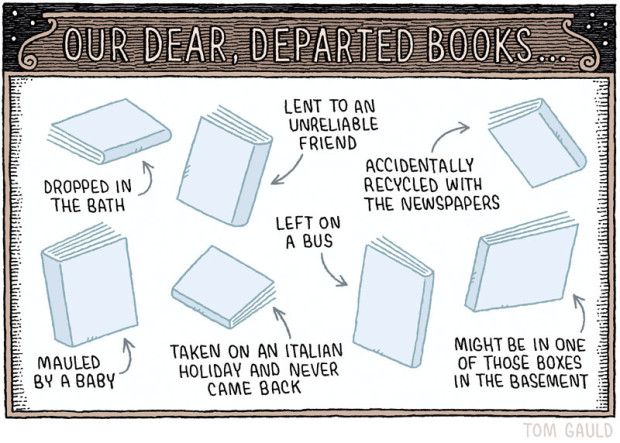
This is one of the attractions of wear and tear. Objects that feel lived in give us a comforting feeling of having come a long way, of having been through the years (or months, as it might be). There is also the sense of having done some work. Even reading a book can be denoted by the physical mark you leave on it – the cracking of a spine, its progressive warping as you work your way to the end. Occasionally when reading a secondhand paperback, a bookmark or a dog-eared page shows you where the last owner gave up – you feel momentarily like Amundsen discovering Scott’s encampment.
Over at Design Observer, writer Timothy Younggives 10 reasons why the book is still important. Number seven is that it is an object fixed in time:
“A book can tell us about its status in history. If we look through first editions of Moby Dick or Leaves of Grass, we find that they give away information not only about when they were created, but also about the worlds in which they were created, by way of advertisements, bindings, the quality of their paper, and watermarks on that paper. Such components are often not captured by scanning or are flattened out to make them of negligible use. In Nicholson Baker’s Double Fold—his saga about how libraries microfilmed runs of newspapers in the 1950s and 1960s and then discarded them—one of his chief complaints was that the filmers skipped advertising supplements and cartoons: things that had been deemed unimportant.”
Here’s the full list:
It is a piece of technology that lasts
It needs very little, if any, extra technology to be accessed
The book retains evidence
Books are true to form
Each copy of a book is potentially unique
Printed items are consumable goods
A book is an object fixed in time
A book can be an object of beauty and human craftsmanship
When you are reading a book in a public place, other people can see what you are reading
In November’s Vanity Fair, Bruce Handy profiles George Whitman, the late owner of Shakespeare & Company — “the most famous independent bookstore in the world” — and his daughter Sylvia, the current owner of the shop:
It is not true, as the store’s workers have sometimes overheard passing tour guides proclaim, that James Joyce lies buried in the cellar. (If only. He was laid to rest at a conventional, non-bookselling cemetery in Zurich.) But the store’s roots do indeed reach back to the Shakespeare and Company that Sylvia Beach, an American expatriate, owned in Paris in the 1920s and 30s. As every English major knows, her bookshop and lending library became a hangout for Lost Generation writers such as Ernest Hemingway, F. Scott Fitzgerald, Ezra Pound, and Joyce, whose Ulysses was first published in its complete form by Beach because authorities in Britain and America deemed it obscene. She closed up shop during the Nazi occupation and never reopened. But her mantle was taken up by another American, George Whitman, who opened the present-day store in 1951, just as Beat Generation writers were finding their way to the Left Bank. (The so-called Beat Hotel, which would become a Parisian equivalent to New York’s Chelsea Hotel as a flophouse for writers, artists, and musicians, was only a few blocks away.) Writers who logged time at the current Shakespeare and Company, sometimes even sleeping there—Whitman was possibly keener on extending hospitality to authors, lauded or not, than on selling their books—include Allen Ginsberg, Henry Miller, Richard Wright, Langston Hughes, Lawrence Durrell, Anaïs Nin, James Jones, William Styron, Ray Bradbury, Julio Cortázar, James Baldwin, and Gregory Corso. Another early visitor, Lawrence Ferlinghetti, co-founded his City Lights Bookstore, in San Francisco, as a sister institution two years after Shakespeare’s opened. William S. Burroughs pored over Whitman’s collection of medical textbooks to research portions of Naked Lunch; he also gave what may have been the first public reading from his novel-in-progress at the store. (“Nobody was quite sure what to make of it, whether to laugh or be sick,” Whitman later said.)
Anyone who has written about Geoff Dyer will have been tempted to emulate his style, particularly his tendency to digress: “I planned to write about Geoff Dyer but instead I got distracted/stoned/fell asleep.” (Of those who resist this urge, most feel obliged to describe this temptation.) However, the point of works like ‘Out of Sheer Rage’and ‘Zona’is not just that Dyer chronicles his experiences; it is that, for all of the tangents, we still at the end find ourselves closer to Lawrence, closer to Tarkovsky. Personal reminiscence alone did not necessarily make us closer to Dyer — but it was still welcome in shaping the tone. Amid the ’ism’s and ’otic’s of traditional academic papers, humanity can often be lacking — yet Dyer’s work is all flesh and bone, united by a persona that is profoundly, playfully human.
And on a related note, Philip Maughan also spoke to Dyer about the conference for the New Statesman:
“I’m one of the people who seem to have licensed the ‘I’m meant to write about this book but I’m just going to write how I got stoned instead’ essay – but it only works for certain subjects. It has to lead you into a deeper appreciation of the subject than could have been attained in a more direct way. It’s like those legal highs,” he said. “Some of them can get you pretty messed up. Really they ought to be proscribed.”
On the blog of designer and art director Henry Sene Yee there is a fake poll question: “Who is your favourite book cover designer?” Three of poll’s four possible answers are “Chip Kidd.” The fourth is “none of the above.” The joke is, of course, that Kidd is the only book cover designer most people can name (if they can name one at all).
After this week, however, Henry might have to add a second designer to his list — Chip Kidd’s colleague at Knopf, Peter Mendelsund.
Already a well-known figure in book design circles, the publication of Peter’s two new books this week—Cover and What We See When Read—has apparently made everyone else sit up and take notice. Already interviewed by Alexandra Alter for the New York Times last week, Peter is suddenly everywhere.
At the New Republic, he discusses his work with Amy Weiss-Meyer:
I think the most import thing about being a cover designer is being a decent reader. If you haven’t read a book well, [and] you just throw an image on it, chances are you’re going to fail at representing it. On the other hand, if you do use imagery that’s broad enough, then you want something that’ll serve as a universal emblem to the book rather than one particular reading of it.
The truth is when you go to school to learn something, you’re on a dedicated trajectory. So that puts a certain kind of burden on you to succeed in that particular trajectory. One of the wonderful things about having sidestepped into design is that there was never any pressure for me to succeed. … It’s not something I spent money to learn how to do. So I still kind of feel like I’m dabbling, and I think what’s great about that is you can maintain a certain kind of beginner’s mind when you’re working, which obviously, I think, makes for better work. You’re just fresher because you don’t have the anxiety of influence. There’s nothing really at stake.
And at The New Yorker, Peter talks to his friend Peter Terzian about his work and the genesis of What We See When We Read:
Reading with a mind to designing a jacket is very different from just reading. When I’m reading for work, I’m looking for something described in the book that will be reproducible visually and that will serve as an emblem for the entire book—a character, or an object, or a scene, or a setting. That’s not the way one reads when one is simply immersed in a book.
Let’s say I’m reading something and I come across a scene that I think is particularly pregnant with significance and that could really work as that emblematic something to go on the jacket. It’s not like I picture it completely and then render it on the screen. I have the idea that this scene and its structural components could work well as a jacket, and then I start making things. And when something is made, I compare it back to the reading experience and ask, Is this dissonant with the way I’m reading this, or consonant with it? Does it in fact represent the author’s project? But it’s not like I’m rendering something that I saw. When I start to make it, that’s when I start to look at it for the first time—that’s when it develops visual coherence. That moment is very satisfying, professionally, but also disappointing as a reader.
Dwight Garner reviewed What We See When We Read for the New York Times. While at the Washington Post, visual editor David Griffin reviews both Peter’s new books (one less favourably than the other).
And if that weren’t enough, Pablo Delcán and Brian Rea have also made this trailer, apparently the first in a series, for What We See When We Read:
And this is surely just the beginning. Congratulations Peter, it’s well-deserved.