Skip to content

Tag: Reading

Obama and Books

The New York Times has published a transcript of Michiko Kakutani’s recent conversation with US President Barak Obama about books:

Some of the craft of writing a good speech is identical to any other good writing: Is that word necessary? Is it the right word? Is there a rhythm to it that feels good? How does it sound aloud?

I actually think that one of the useful things about speechwriting is reminding yourself that the original words are spoken, and that there is a sound, a feel to words that, even if you’re reading silently, transmits itself.

So in that sense, I think there will be some consistency.

But this is part of why it was important to pick up the occasional novel during the presidency, because most of my reading every day was briefing books and memos and proposals. And so working that very analytical side of the brain all the time sometimes meant you lost track of not just the poetry of fiction, but also the depth of fiction.

Fiction was useful as a reminder of the truths under the surface of what we argue about every day and was a way of seeing and hearing the voices, the multitudes of this country.

You can read the article that resulted from this conversation here.

Surely there are few other politicians — let alone world leaders — who could speak so intelligently and at such length about contemporary literature. 

And, on a somewhat related note, I just wanted to mention the Women’s March on Washington on January 21. The official logo for march — reminiscent (in a good way) of Saul Bass’s 1978 logo for the Girl Scouts of America (revamped in 2010 by Original Champions of Design) — was designed by Nicole LaRue. There are sister marches around the world — find your local event here — and you can download typographic posters for occasion from Counter Type.


Resist.


Comments closed
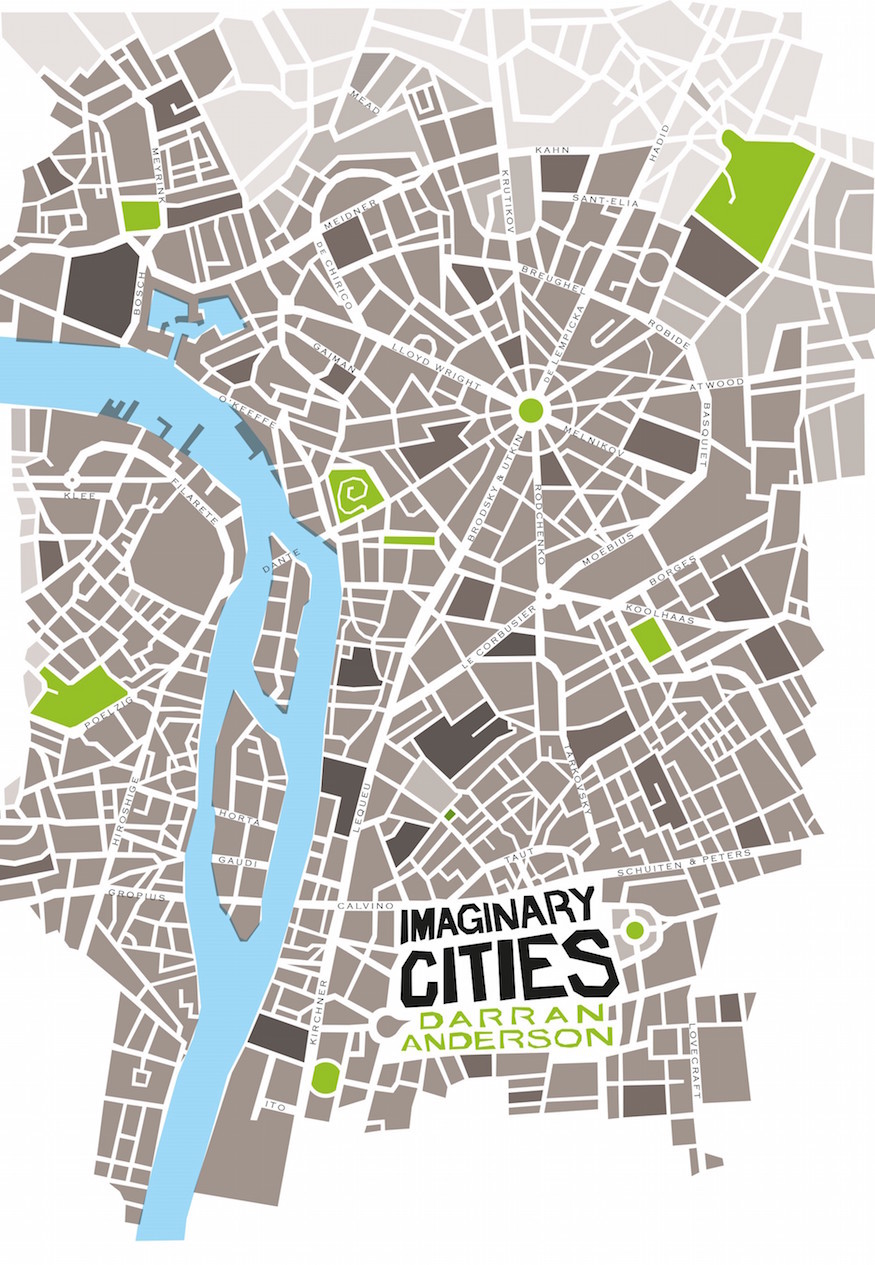
Darran Anderson on Imaginary Cities and Books as Maps

COV_cities_noMarks

Author Darran Anderson discusses his book Imaginary Cities with Rhys Tranter:

[M]y intention was to write something that isn’t self-contained; a book that somehow spills out of its pages and into the world… I wanted to send people out looking for Sant’Elia or Chernikhov or whoever. It would be as much a map as a book…

…We have a tendency to think of books as ends in themselves, which has always seemed somewhat ludicrous, even a bit arrogant to me; the assumption because you’ve read Isherwood’s Berlin novels, you’ve got the Weimar Republic sussed (I don’t mean that detrimentally to Isherwood, whose work I love, incidentally). It’s like that bucket list approach to experience, when you hear someone say they’ve ‘done’ Europe or Thailand. However great a book is, however ‘definitive’ it is on a subject, it strikes me as only a point of beginning or as temporarily conclusive, as time and perspectives are constantly changing. I’ve always had enough self-doubt to be resistant to definitive narratives so I wanted Imaginary Cities to be full of points of departure, contradictions and questions. That’s one of the things I loved about Calvino’s Invisible Cities, which the title is also a nod to. The sense of poetic incompleteness to it. The feeling that the story is continuing on somewhere beyond its pages.

Imaginary Cities, which is already available in the UK, will be published in the US by University of Chicago Press in April 2017.

1 Comment

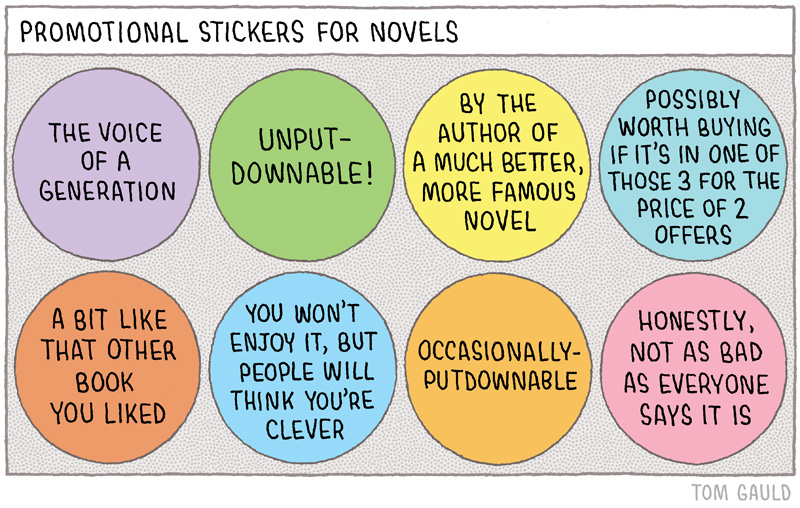
Promotional Stickers for Novels

promotional-stickers-for-novels-tom-gauld

Tom Gauld‘s latest cartoon for The Guardian. It seems kind of appropriate for the day this year’s Man Booker Prize shortlist is announced…

Comments closed

All the Books

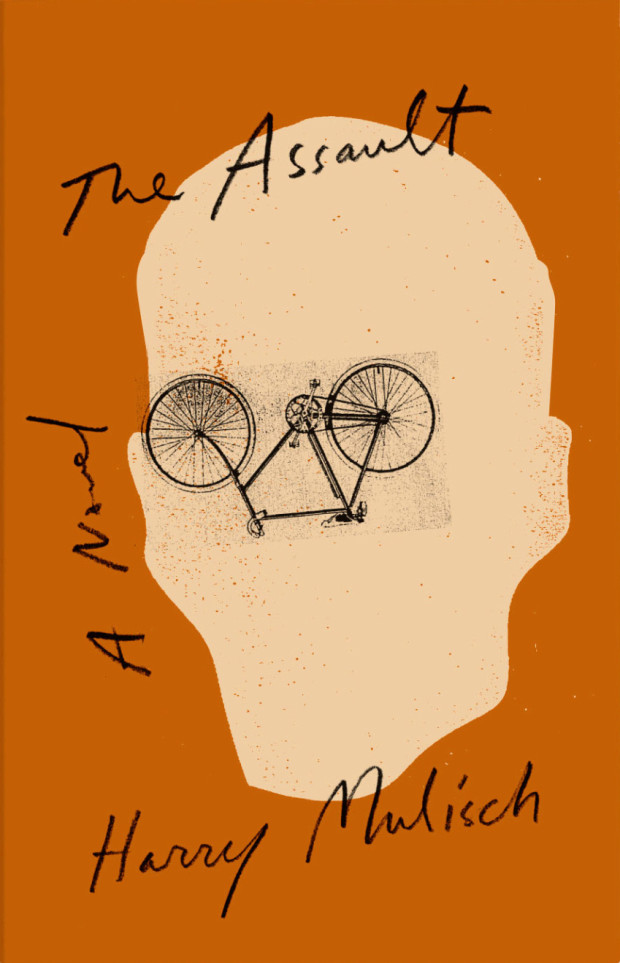
Assault design Oliver Munday

At Literary Hub, Designer Oliver Munday discusses his design process and reading the whole text:

As designers, we are forced to read quickly, and incisively, mining for the clues to the coveted iconic cover. It can feel careless at times, leading me to believe that my reading skills are being dulled. I think of the author in this process, and in some ways the guilt that I may feel about a less-than-ideal reading of their text is exceeded by the potential of presenting their book with the best possible jacket, one that their audience of ideal readers will appreciate. A cover that feels simultaneously unexpected and inevitable.

I used to aspire to a process that created an expanse for reading each text, one that merged the ideal-designer and ideal-reader into one, but found the boundaries of distinction too severely marked. It would be amazing to have the time, space, and inclination to read an entire text when designing its cover, but I have realized that is not essential. There may be times when my two selves are reconciled, but in the event that they exist separately, a reading designer, divided against himself, will remain standing.

Comments closed

Find Your Stories in the Dirt

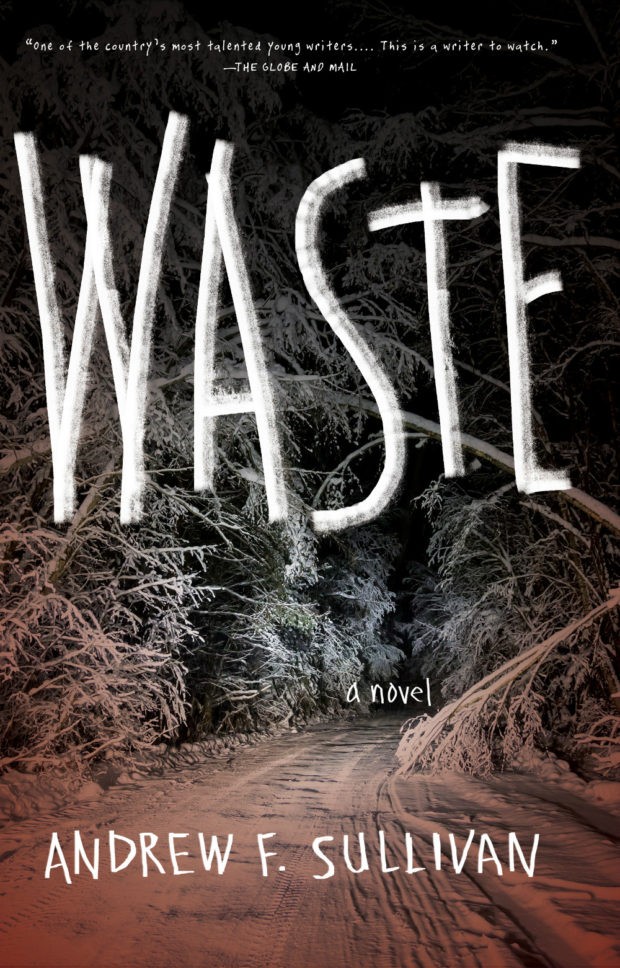
cover design by Steven Seighman

I mentioned Andrew F. Sullivan’s piece on High-Rise last week, and I recently spoke to the author about his own novel WASTE, and about influence of David Lynch on his writing in a Q & A for Publishers Group Canada:

Initially, I think I was very resistant to Lynch. I think I thought a lot of it was just nonsense for the sake of nonsense. It was Blue Velvet that won me over, that showed me you could implicate and confront your audience, you could tell a sad, vicious truth and people would want to hear it/see it. Lynch opened up so many opportunities to leave the explanation out, to make the work immersive and unsettling while still dancing around the established conventions for storytelling. What he was doing seemed very singular, but also invested in the everyday, in waking up, going to work, putting in the hours. He created a world, especially in Twin Peaks, that began as just slightly askew, plausible even. He lured you into the nightmare and then told you it was real. And everyone questions the theories their friends have, there is no code to break. His work exposes the peculiarities of each audience member in their own response—their passions, fears and obsessions. How can they make this story make sense? What demons does it awaken?

Lynch is still doing that. He is always doing that.

Comments closed

The Custodian of Forgotten Books

In a lovely piece for The New YorkerDaniel A. Gross talks to blogger Brad Bigelow, the man behind the Neglected Books, about rediscovering forgotten literature:

Most novels are forgotten. Glance at the names of writers who were famous in the nineteenth century, or who won the Nobel Prize at the beginning of the twentieth, or who were on best-seller lists just a few decades ago, and chances are that most of them won’t even ring a bell. When “The Moonflower Vine” resurfaced and ricocheted around the publishing world, it became an unlikely exception.

What’s strange about the journey of that book—and about our moment in the history of publishing—is that its rediscovery was made possible by an independent blogger, named Brad Bigelow. Bigelow, fifty-eight, is not a professional publisher, author, or critic. He’s a self-appointed custodian of obscurity. For much of his career, he worked as an I.T. adviser for the United States Air Force. At his home, in Brussels, Belgium, he spends nights and weekends scouring old books and magazines for writers worthy of resurrection.

“It can just be a series of almost random things that can make the difference between something being remembered or something being forgotten,” Bigelow told me recently. On his blog, Neglected Books, he has written posts about roughly seven hundred books—impressive numbers for a hobbyist, though they’re modest next to the thousands of books we forget each year. “It’s one little step against entropy,” he said. “Against the breakdown of everything into chaos.”

Comments closed

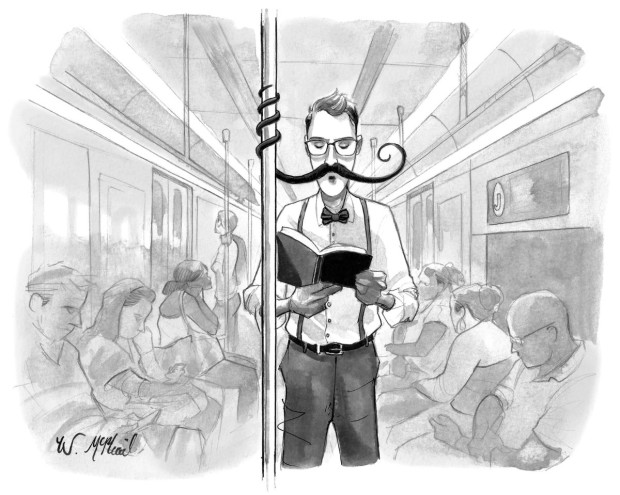
Moustache

new yorker subway reading

Will McPhail for The New Yorker.

Comments closed

James Gleick on What Libraries Can (Still) Do

James Gleick (The Information, Faster) on libraries, and James Palfrey’s book BiblioTech: Why Libraries Matter More Than Ever in the Age of Google, at the NYRB Blog:

In the midst of an information explosion, librarians are still the most versatile information specialists we have. And the purest. In his new book, BiblioTech, a wise and passionate manifesto, John Palfrey reminds us that the library is the last free space for the gathering and sharing of knowledge: “Our attention cannot be bought and sold in a library.” As a tradition barely a century and a half old in the United States, it gives physical form to the principle that public access to knowledge is the foundation of democracy.

The problem of libraries now—and it is a problem—involves some paradoxes, which need to be sorted out. For one thing, as Palfrey says, librarians will need to cherish their special talent as “stewards” while letting go of the instinct to be “collectors.” Knowledge in physical form needs to be handled carefully, preserved, and curated. But with digital information pouring into iPhones and Kindles in petabytes—via Twitter and Instagram and YouTube, not to mention Amazon’s self-publishing factories—libraries need to rethink old habits. They cannot collect everything, or even a small fraction of everything. “That model is already too hard to keep up,” Palfrey says. “A network of stewards can accomplish vastly more than a disconnected (even sometimes competitive) group of collectors ever can.”

Comments closed

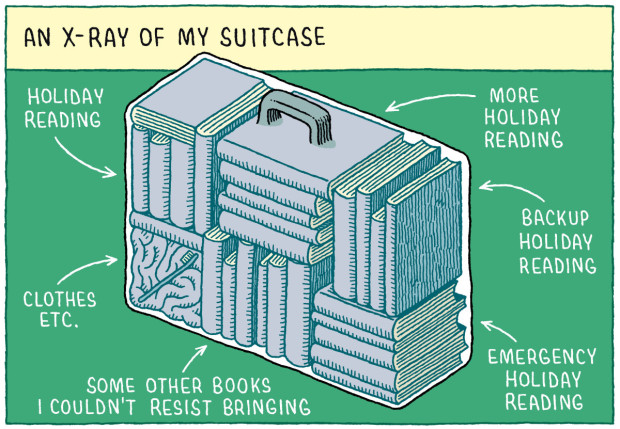
Tom Gauld’s Suitcase

Gauld-Suitcase

Tom Gauld for The New Yorker.1

Comments closed

Available Only in Bookshops

To mark Independent Bookshop Week in the UK, author Helen Dunmore celebrates browsing the shelves:

Readers go their own way, and this is what frustrates governments and tantalises publishers. You can drag the reader to the water with the most brilliant advertising and marketing campaigns, but you cannot make him or her drink deep of shallow words.

No one can define the quality in a book that makes it command passionate loyalty from readers, and while some bestsellers are predictable, others have leapfrogged every idea about what readers should love. This is where physical bookshops and libraries are so important to readers, in spite of the convenience and ease of making an online purchase. We need to be able to see all the books that we don’t know about yet. Bookshops encourage browsing, dawdling and discovery. They open byways that become high roads to new fields of understanding. They don’t nag; they suggest. To be a reader in search of a book is more than to be a shopper who already knows what he or she wants to buy. Bookshops and libraries are places where books and readers come out of the private world, and make their claim on the public space. They say, visibly, how important books are to us.

Comments closed

The Book Thieves of London

At The Dabbler, gentleman bookseller Steerforth recalls his run-ins with book thieves over the years:

After a while I became quite good at spotting the biblioklepts. Sometimes they gave themselves away through their body language, other times it was their appearance. One thief was dressed as a respectable businessman but his shoes were shabby and when I scrutinised him further I could see that he was wearing a charity shop suit. Our eyes met and he realised that he’d been rumbled. Later I mentioned this incident to someone in another bookshop and they said ‘Ah yes, the Businessman.’ He was well-known.

The most successful thieves were, of course, the ones we never saw. Someone used to steal entire shelves of books during Thursday lunchtimes – one week it was Nabokov, another Terry Pratchett – presumably in order to furnish another bookshop. Although we became obsessive about checking everyone who entered the shop, we never caught them.

We had regular thieves at both bookshops I worked in too. I don’t think any of them were quite as colourful as ‘the Businessman’ sadly.

Comments closed

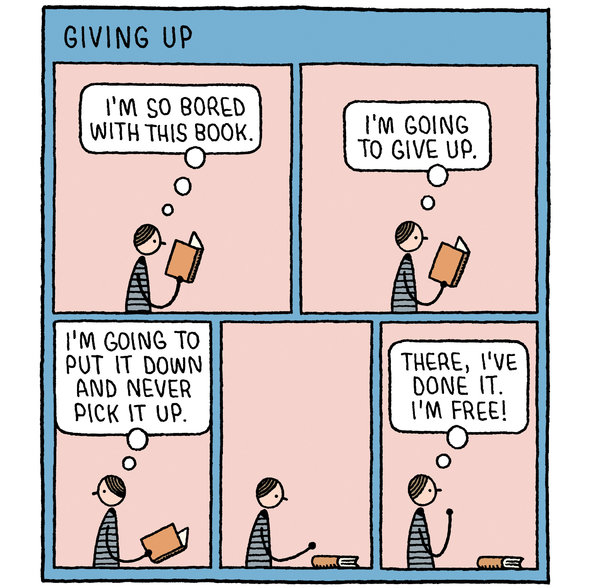
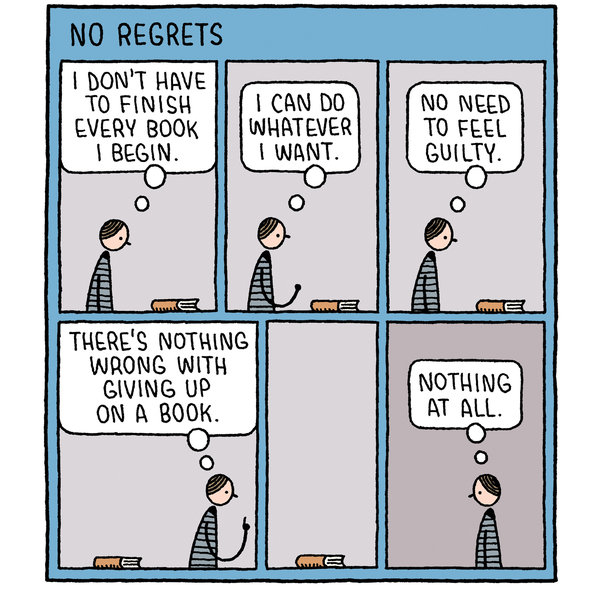
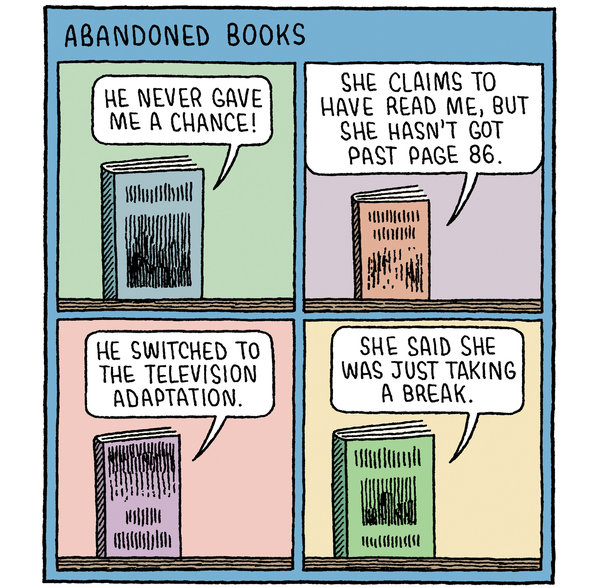
Giving Up

giving-up-tom-gauld-1
giving-up-tom-gauld-2
giving-up-tom-gauld-3
giving-up-tom-gauld-4

Tom Gauld for the New York Times.

Comments closed