Skip to content

Tag: Reading

I Love Autumn

Tom Gauld for The Guardian. (I feel… attacked?)1

Comments closed

Darkseid Is…

Mister Miracle by Tom King and Mitch Gerads was unexpectedly one of my favourite comics this year. I hadn’t previously read any books set in the ‘Fourth World’ despite it’s massive influence on comics and films. I’ve always found Jack Kirby’s grandiose, dialed up to 11, vision of the New Gods to be a little too much, even for Jack Kirby.1 But the constant overwhelming ridiculousness of it all is one of the themes of Mister Miracle. How do you stay sane, let alone have a normal life with a family, when you are constantly ground down by the world you find yourself in, and confronted daily with situations that are tragic, absurd, and just so much bigger than you?

At the Daily Beast, Entertainment Editor Melissa Leon talks to author Tom King about how his experiences as a CIA counterintelligence officer and his personal struggles with stress and anxiety shaped the book.

“The book started when I had one of those first-episode-of-the-Sopranos panic attacks and I ended up in the hospital,” he says. “It was one of those things where you ask the doctor, ‘Am I dying or am I crazy?’ And they tell you you’re crazy and you’re like, woo-hoo! Oh, wait a second.” He laughs. “I thought I was a pretty tough guy. I’d been to war twice, I’d had three kids. In my own little nerdy corner of the world I was pretty successful. But there was something brittle inside of me.”

Mister Miracle was his chance to write about those brittle parts—and about the creeping suspicion in the age of Trump that reality is fundamentally, metaphysically even, coming undone… Unremarkable events [unfold] in heightened, surreal circumstances; sometimes touching, funny, or grim. The juxtapositions are essential to King, who likens the scenes to the memory of debriefing a source in Iraq in 120-degree weather. “We were both sweating and talking about a guy getting his head chopped off. It was horrible,” he remembers. “But it was my wife’s birthday.” He recalls shuffling into a corner, calling his wife, and singing “Happy Birthday” in half-hushed tones. “That’s what life is, right? The mundane lives right next to the crazy.” …

It sounds all very grim, but somehow it isn’t. At least not completely. There is a lot of humour and affection in it too, which is why I think it works. Somehow King finds a way to be (just about) life-affirming in the end.

Gerads layered artwork is also extraordinary and, at times, beautiful. Laid out on the page in a metronomic 9 panel grid, the glitches, blurs, and repetition add to the sense of dislocation and detachment from reality, like life is being filtered and replayed through a screen.

Part of Mister Miracle’s ambition is to capture a feeling many know intimately, but which can be hard to put into words. King and Gerads articulate that dread succinctly, often with a single phrase: “Darkseid Is.” Panels black out without warning, flashing the phrase in typewriter lettering. It interrupts moments of loneliness or disassociation. But it can also be a punchline, or a shrug: When Big Barda says it, for example, she could just as well say “shit happens.”

2 Comments

Reader’s Block

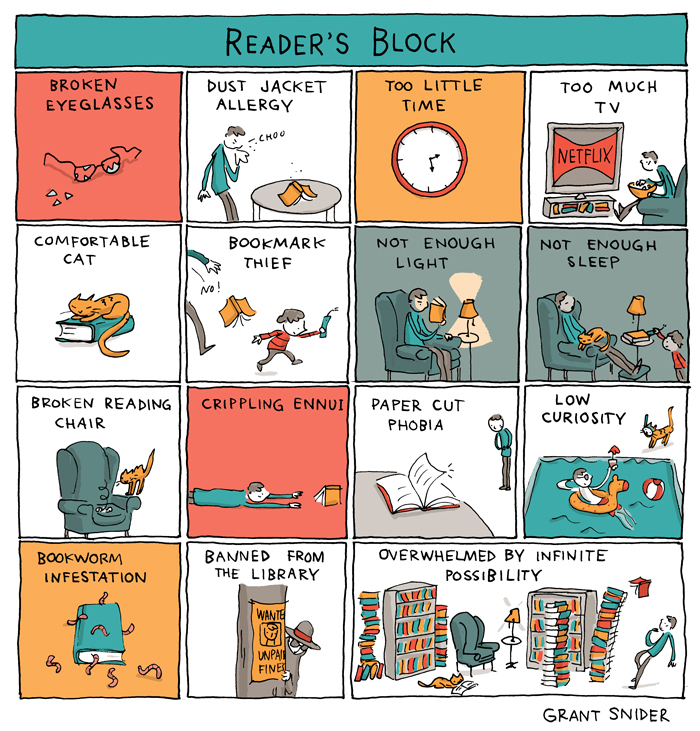
I’ve been in a bit of reading slump of late so I can relate to this recent cartoon by Grant Snider for the New York Times Books Review (although, thankfully, I’ve not been banned from the library!).

Grant has a couple of new books coming out that are available for pre-order. What Color is Night? will be published by Chronicle Kids in November, and I Will Judge You by Your Bookshelf will be published by Abrams in April 2020.

Comments closed

The ‘Future Book’ is Here

I haven’t posted anything about books and technology here for a while, but I thought this recent Wired piece by Craig Mod on the “Future Book” was quite interesting: 

Physical books today look like physical books of last century. And digital books of today look, feel, and function almost identically to digital books of 10 years ago, when the Kindle launched… Yet here’s the surprise: We were looking for the Future Book in the wrong place. It’s not the form, necessarily, that needed to evolve—I think we can agree that, in an age of infinite distraction, one of the strongest assets of a “book” as a book is its singular, sustained, distraction-free, blissfully immutable voice. Instead, technology changed everything that enables a book, fomenting a quiet revolution. Funding, printing, fulfillment, community-building—everything leading up to and supporting a book has shifted meaningfully, even if the containers haven’t. Perhaps the form and interactivity of what we consider a “standard book” will change in the future, as screens become as cheap and durable as paper. But the books made today, held in our hands, digital or print, are Future Books, unfuturistic and inert may they seem.

Comments closed

Noir in the Age of #MeToo

With the release of an annotated edition of The Big Sleep this month, author Megan Abbott reflects on noir and the work of Raymond Chandler:

What fascinates and compels me most about Chandler in this #MeToo moment are the ways his novels speak to our current climate. Because if you want to understand toxic white masculinity, you could learn a lot by looking at noir.

Loosely defined, noir describes the flood of dark, fatalistic books and films that emerged before, during, and especially after World War II. As scholars like Janey Place have pointed out, this was an era when many white American men felt embattled. Their livelihoods had been taken away—first by the Depression, then by the war, and then by the women who replaced them while they were off fighting. Into this climate noir flowered: Tales of white, straight men—the detective, the cop, the sap—who feel toppled from their rightful seat of power and who feel deeply threatened by women, so threatened that they render them all-powerful and blame them for all the bad things these straight white men do. Kill a guy, rob a bank—the femme fatale made me do it. These novels simmer with resentment over perceived encroachment and a desire to contain female power.

In an earlier essay for the LA Times, Abbott looks at why women are interested in true crime stories:

[In] the last few years, and especially in recent months as the Harvey Weinstein and associated scandals have dominated headlines, I’ve come to think of true crime books as performing much the same function as crime novels (also dominated by female readers): serving as the place women can go to read about the dark, messy stuff of their lives that they’re not supposed to talk about — domestic abuse, serial predation, sexual assault, troubled family lives, conflicted feelings about motherhood, the weight of trauma, partner violence and the myriad ways the justice system can fail, and silence, women.

While these weighty issues aren’t generally resolved in true crime… these books provide a common site to work through crises, to exorcise demons. I’ve come to believe that what draws women to true crime tales is an instinctual understanding that this is the world they live in.

And at Vulture Abbot talks to Ruth Franklin about her new novel, Give Me Your Hand:

The seductive female criminal, a.k.a. femme fatale, has always been a noir staple: Mary Astor in ‘The Maltese Falcon’, Ava Gardner in ‘The Killers’But Abbott argues that these characters aren’t psychologically authentic. They’re “a projection of male anxiety,” she says, vampy caricatures whose primary purpose is to use their irresistible charms to lure the detective-hero into a setup. As Abbott sees it, classic noir “always comes back to the idea of femininity as a kind of dark continent.” Male writers “really don’t want to look in there,” she says. They want to believe female violence “is always an aberration … What if those stories had been told from the femme fatale’s point of view? Think how different they would look.”

On a semi-related note, film critic David Thomson recently wrote a long piece for the London Review of Books on Alfred Hitchcock’s film noir Vertigo in light of the revelations about Harvey Weinstein. It’s interesting as a dissection of a classic movie, but it is not, ultimately, the take I wanted. Thomson’s claim that a medium that has historically been dominated by the male gaze is somehow essentially so, is surely something that only a male critic would say. Women need to be given the space to address these issues, and, frankly it is a female critic’s reassessment of Hitchcock that I want to read. 

Both the Abbott and Thompson pieces on noir reminded of Claire Dederer’s 2017 essay, ‘What Do We Do with the Art of Monstrous Men?‘, on Woody Allen and whether genius and monstrosity go hand in hand. It’s worth reading if you haven’t already. In the essay, Dederer talks briefly about Roman Polanski. I would love to read a contemporary reassessment of Chinatown. 1        

Comments closed

Women and Critics: Roxane Gay and Michelle Dean

Michelle Dean talks about her new book, Sharp:The Women Who Made an Art of Having an Opinion, and the nature of criticism with Roxane Gay for The Cut

I tend to judge a piece of criticism by how smart I find the argument… I don’t mean, how much I agree with it, exactly, but more: how much does this open up the subject at hand? Does it show me things about it I didn’t already know? I like debate and argument, so I’m usually all right with disagreement, and I’m even all right if the critic doesn’t come to a clear thumbs up or thumbs down. But I need the disagreement to have some kind of line I can follow on the map. I like following an interesting mind along it.

Bad criticism recites rote arguments. The shame of rote arguments isn’t just that they’re clichés, though they are, but that they tend to hide from us why a critic is actually thinking what they’re thinking. In which case there’s no point in reading the review at all. I don’t care about the bare fact that anyone liked or didn’t like a book or movie; they can only interest me in that bare fact by writing an intelligent review.

Comments closed

Olivia Laing on Daphne du Maurier’s Rebecca

I am about a month late to this, but Oliver Laing (author of books you should read), wrote about Daphne Du Maurier, and the strangeness of her bestselling novel Rebecca, for The Guardian:  

Rebecca has a disturbingly circular structure, a closed loop like James Joyce’s Finnegans Wake. It ends with Manderley in flames, but the first two chapters are also the conclusion. Husband and wife have been condemned to the hell of expatriation, in a hot, shadowless, unnamed country, staying like criminals in an anonymous hotel. It is apparent that they are revenants in a kind of afterlife, their only pleasure articles from old English magazines about fly fishing and cricket. The narrator attests to their hard-won happiness and freedom, while knowing it resides in a place accessible only by the uncertain routes of dream and memory, expelled from the Eden they never quite possessed.

Du Maurier was under no illusions as to the bleakness of what she had written. “It’s a bit on the gloomy side,” she told her publisher, Victor Gollancz, adding nervously “the ending is a bit brief and a bit grim”. But her predictions of poor sales were inaccurate. Rebecca was a bestseller; 80 years on it still shifts around 4,000 copies a month.

Virago have published a special hardcover edition of Rebecca to celebrate the novel’s 80th anniversary. The cover designed was by Hannah Wood whose artwork was embroidered by specialists Hand & Lock. You can read about the process here.  

Comments closed

The Archaeology of the Book Tower

Well, this is a little close to home isn’t it?

Tom Gauld for The Guardian

On a related note, Tom’s musical cover for April 16 edition of The New Yorker is lovely.  

Comments closed

Grown Men Reading Nancy

Writing for the New York Review Books, Dash Shaw reviews How To Read Nancy: The Elements of Comics in Three Easy Panels by Paul Karasik and Mark Newgarden: 

Today, comics are studied in colleges and reviewed in prominent magazines, but they are often discussed either as vessels for urgent, personal stories or as objects filled with beautiful, unusual graphics. They are rarely discussed or reviewed for their “cartooning,” the particular panel-to-panel magic, the arrangement of elements that mysteriously combines reading and looking, and distinguishes why a comic like Nancy is masterful and others are not. Beautiful cartooning affects a comic the way a well-chosen word, arriving at the right time in a sentence, makes for good writing, or the way a room composed with the right combination of things in the exact right places is good interior design.

I don’t think it’s any secret that I love Ernie Bushmiller’s Nancy. It is, as the review points out, a beautifully constructed comic strip. But it is more than that. It’s also genuinely warm, funny, and relatable. I see a bit of my kids in Nancy and Sluggo, I see a bit of myself too.

I that think Steven Heller kind of gets to it in this interview with co-author Paul Karasik: 

Nancy reminded me of someone close to me. In fact, she reminded me of me in a deeply existential way that cannot be explained properly in this brief column… In any case, whenever a collection of strips emerged, I’d scarf them up. They were gags but poignant. They were comic but deep. And Sluggo. How can you not love Sluggo? This was the world of comics where kids were the wise ones, the keepers of wisdom and truth. 

If you haven’t read any of the Nancy comic strips don’t start with How to Read Nancy (with all due respect to Karasik and Newgarden!), start with Nancy is Happy, the first volume of daily strips republished by Fantagraphics.  

1 Comment

Books Will Always Matter

“Even though we think of reading as something that we do alone in our rooms by ourselves, we talk about books, and we take the ideas that we learn from books and the stories that we have heard about books, the characters that we have fallen in love with in books, and we bring them to our conversations.

They make us more empathetic. They connect us to one another. They make people who are not like us more human.”

Lisa Lucas, executive director of the National Book Foundation, explains why books will always matter on PBS Newshour

Comments closed

At Least She’s Reading

Another back to school appropriate comic, this time by J.A.K. (AKA Jason Adam Katzenstein) for The New Yorker

Comments closed

Bibliomania

At The Guardian, Lorraine Berry looks into the curious history of compulsive book buying:

In the 19th century, book collecting became common among gentlemen, mostly in Britain, and grew into an obsession that one of its participants called “bibliomania”. Thomas Frognall Dibdin, an English cleric and bibliographer, wrote Bibliomania, or Book Madness: A Bibliographical Romance, which was a gentle satire of those he saw as afflicted with this “neurosis”. Dibdin medicalised the condition, going so far as to provide a list of symptoms manifested in the particular types of books that they obsessively sought: “First editions, true editions, black letter-printed books, large paper copies; uncut books with edges that are not sheared by binder’s tools; illustrated copies; unique copies with morocco binding or silk lining; and copies printed on vellum.”

But Dibdin himself was obsessed with the physical aspects of books, and in his descriptions paid an intense attention to the details of their bindings and printings (rather than the content) that betrayed his own love. In a letter published in an 1815 journal, he beseeched subscribers to bulk up their subscriptions to help complete a set of volumes called The Bibliographical Decameron – more beautiful than they could imagine. “I should be loth to promise what is not likely to be performed, or to incur the censure of vanity or presumption in asserting that the materials already collected, in this department of the work, are more numerous, more beautiful, and more faithful, than any which, to my knowledge, have come under the eye of the publick.”

Comments closed