Skip to content

Tag: Publishing

1/3 Alligator: The Book Cover Archive Q & A

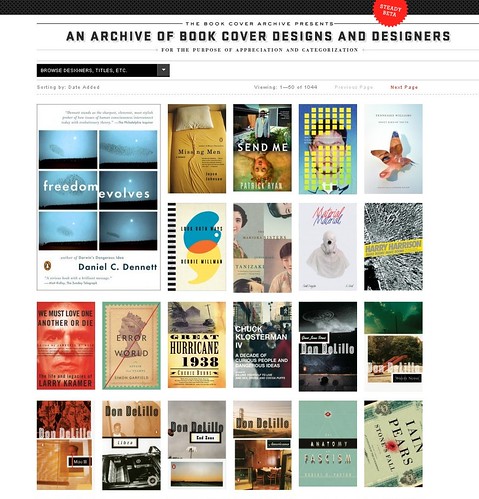
Lauded and linked to by everyone from The Guardian newspaper to the New Yorker blog (not to mention the really important folks like Drawn!Kottke, We Made This,  and Veer)  the dazzling The Book Cover Archive is — as the name suggests — a hand-picked archive of book cover designs and designers, collected “for the purpose of appreciation and categorization.”

Edited and maintained by frequent collaborators Ben Pieratt of General Projects and Eric Jacobsen of Whisky Van Gogh Go, it’s an indexed database of credited book covers sortable and searchable by title, author, designer, art director, photographer, illustrator, genre, publication date, publisher, and even typeface.

Earlier this month, I emailed Ben and Eric with a series of questions about the project.

What was the impetus behind BCA?

Ben: In all honesty, the Book Cover Archive is meant to serve as a passive teaching tool for people like me who suck at book cover design but want to get better.

Do you see BCA as expansion on Covers, the book cover design project you created for Fwis?

Ben: The two sites provide different services. The Fwis Covers blog serves as a platform from which to comment and critique. You can’t post a cover on Covers without commenting on it. Whereas the Archive is passive in its function and editorial voice. The only curatorial decision is the binary It’s In Or It’s Not.

R. Mutt ReadyMech

You’re getting quite well known—notorious even—for online not-for-profit ventures like Covers, ReadyMech, Schtock, and now BCA. How do you get started on these projects?

Ben: For every launched project there’s 10 failed ones that never got off the ground. It’s really just a matter of having ideas for projects that you know no one is ever going to pay you for and then running with it anyway because its fun as hell.

How did you become interested in book cover design?

Ben: Senior year of college I was struggling with my thesis project. I think I had been doing a study of “bad taste” and was just having a hell of a time with it. At around the same time my former business partner, Chris, told me to read Ender’s Game, a Sci Fi classic. I hadn’t read any sci-fi growing up because my dad kept feeding me non-fiction stuff. I loved the book but was embarrassed to carry it around because the cover was so incredibly bad. So I changed my thesis project to redesigning the book covers of science fiction classics. I’ve been mildly obsessed with both sci-fi and book covers ever since.

How do you select which covers to include in the archive?

Ben: I’m picky as hell.

Are there particular designers you look out for?

Ben: I’d like to think that I judge each cover on its merits alone, but there’s no question that I’m super biased. If its American and it’s coming out of New York then I’m probably going to love it.

Eternal Light by Paul J. McAuley, designed by Sanda Zahirovic

Do you have any recent favourites?

Eric: I’m very excited about the new promotional work that Gollancz/Orion has been putting out, the Future Classics and Totally Space Opera series. Besides being surprisingly conceptual and classy takes on genre fiction, I think they point at a trend toward collectible and fetishable books as a revenue stream for authors and publishers. I hope we’ll be seeing more of these kinds of editions soon. More on this in a below.

You’re actually designer yourself. How do you go about designing a new book cover?

Ben: I don’t think I’ve designed anything decent enough to merit being asked this question, honestly. I have no tricks beyond embracing the power of utter panic.

What do think makes a good cover design?

Ben: one-half concept, one-quarter contextual appropriateness, one-half design, one-half je nais se quois, one-third alligator.

And, I have to ask, what makes for a bad one?

Ben: I’m starting to come to realize that the biggest difference between a good design and a mediocre one is the typography. Most covers have a decent, if not passable, concept. Everyone has concepts. It’s really the typography that sets the best apart from the rest. That’s my current thought anyway, subject to change.

Which book would you like to redesign?

Ben: I really dislike the covers of Malcolm Gladwell’s books. They’re completely decent, but they rub me the wrong way. They take a visual from his books and find a piece of related stock art and slap it together. I think he’s earned better. I’d also love to standardize Stephen Hawking’s catalog into some kind of glorious uber-nerd package with a lo-fi sci-fi aesthetic.

Have you ever seen a cover and thought “I wish I’d thought of that”?

Ben: Jamie Keenan’s design for Faster makes me want to give up on life. Jon Gray’s cover for Steinbeck’s Murder makes me feel inadequate in any number of ways. Rodrigo Corral’s design for Invisible Monsters makes me question my sense of self. Most recently Helen Yentus’ cover for The Way Through Doors leaves me questioning if I should pack it all up and become a plumber.

Have you ever bought a book just for the cover design?

Eric: Lots, particularly from McSweeneys. I also re-buy a lot of books I already own when newer, nicer editions come out.

The Americanization of Benjamin Franklin by Gordon Wood, designed by Evan Gaffney

Ben: I was looking for a good book on Ben Franklin recently and bought the Evan Gaffney-designed The Americanization of Benjamin Franklin specifically because I hated all the other covers. Great book, by the way.

With the growing popularity of e-books, are you concerned that book cover design may soon be a lost art (hence the need to archive it)?

Eric: Nope. See next question.

Ben: The only thing I’m worried about is animated covers. You know that shit is coming.

Are we finally seeing “The End of Print”? What’s next for books?

Ben: I have no idea. I don’t think I’m qualified to have an opinion on the issue. I certainly don’t think so. The tactility of the technology is going to have to improve significantly before people are willing and ready to abandoned their hard[cover]ware for hardware (sorry, I had to). As far as books are concerned, I assume the industry will go through the same pains as the music industry. The number of independent publishers and self-publishers will increase dramatically as technology allows them to bypass the major booksellers altogether.

Eric: I think that due to the nature of reading and readers, adoption of e-books will be much slower than that of digital music (a similar paradigm shift), so even if e-books herald an ‘End of Print,’ it’s at least a decade off.

Will it even happen at all? I think so. I hope so. When I read about objections to e-books, it’s usually a lot of hemming and hawing about tactility and comfort and even the smell of pages; these complaints rarely touch on such trivialities as book availability and overall readership, which e-books would certainly expand.

E-book detractors have of a strange idea of what most books are. Those beautiful dusty old encyclopedias, that rare first-edition of Ulysses, even your fancy new Vintage paperback? That is not most books. The Grisham and Grafton paperbacks at the airport, Chicken Soup for the Spirit, college textbooks — that’s most books. Does anyone really care if the next Janet Evanovich thriller has no corporeal form? Wouldn’t that be an improvement?

Those who fear e-books should have a discussion with audiophiles. While CD sales have been steadily declining all decade, vinyl — the choice of music lovers everywhere — has gone up. iTunes downloads didn’t destroy the serious album market; it got more people listening to more artists, at the expense of bulk CDs (which “real” music fans sneered at to begin with) by one-hit-wonders. Listen to audiophiles talk about the “warmth of sound,” fidelity and tactility of vinyl, and compare their words to those of bibliophiles talking about the scent of pages; these are kindred spirits.

Here’s a possible future scenario: e-books become wildly successful, at the expense of  “airport paperbacks” and the bestseller list. Big Box bookstores go the way of Virgin Records. Readership and literacy grows (this is already happening), leading to more bibliophiles and Serious Book Lovers. As the market of crappy, badly designed books diminishes, the demand for beautifully crafted, fetishable books grows (sparking an unexpected return of the Independent Bookstore). There will ultimately be fewer books “in print,” but more awesome, well-designed books than ever.

Thanks Ben and Eric!

Link.

5 Comments
6 Projects Video

6 Projects That Could Change Publishing For the Better — Video of Michael Tamblyn’s talk at BNC Technology Forum 2009:

1 Comment

Experiments

One of the recurring themes of the Book Net Tech Forum was that publishers need to learn through frequent experimentation, or as BNC CEO Michael Tamblyn put it: “place lots of little bets quickly.”

Mark Bertils has just posted this great interview with  O’Reilly Media’s Andrew Savikas recorded at the BNC Tech Forum last week on exactly this topic (and Andrew — sorry about making fun of your PowerPoint slides on Twitter):

And, all this ties in quite nicely with Clay Shirky’s recent — must read — essay on Newspapers and Thinking the Unthinkable :

“You’re gonna miss us when we’re gone!” has never been much of a business model. So who covers all that news if some significant fraction of the currently employed newspaper people lose their jobs?

I don’t know. Nobody knows… it’s easier to see what’s broken than what will replace it… We just got here. Even the revolutionaries can’t predict what will happen…

“If the old model is broken, what will work in its place?” The answer is: Nothing will work, but everything might. Now is the time for experiments, lots and lots of experiments…

Comments closed

BookNet Tech Forum

Yesterday I was at Book Net Canada’s Technology Forum at the Radisson Hotel on Queens Quay West in Toronto.

The theme of the event was Evolution or Revolution: “How does the publishing community best prepare for the next generation of reading (and readers)?”

With a wide-range of speakers from publishing and beyond, there were lots of ideas zipping around.

For basic details, the day’s schedule,  brief summaries, and slide-show presentations are available from the BNC website, and  immediate, off-the-cuff comments (including my own not terribly clever insights) can be found on Twitter with the tag #bnc09.

The Quillblog has just posted a scholarly summary of the day, but here are some of my slightly random notes on the good, the indifferent, and the ugly of Tech Forum 24 hours later…

The Good

BookNet. Along side SalesData and the forthcoming BiblioShare (which will facilitate access to bibliographic data),  Tech Forum demonstrated that BookNet is fast becoming the honest broker for publisher collaboration in Canada.  Whilst dropping heavy hints about future BNC projects (notably electronic cataloging) CEO Michael Tamblyn delivered a genuinely brilliant presentation, and slipped in the line of the day:

Plastic Logic is like Jesus: It’ll save the world, but only 12 people have seen it, and no one knows when it is coming.”

(With quips like that I can almost forgive him for: “What do you want your revolution to be?” Er… Something that doesn’t involve vacuous bullshit hyperbole?*)

Harlequin Enterprises. Discussing the evolution of their ebook program, it was hard not to be impressed with Harlequin’s willingness to experiment in  a potentially conservative market.  I’m yet to be convinced that everything they do could be done as effectively by a general trade publisher, but Harlequin’s initiatives  demonstrate  that publishers should innovate and innovate often. And involving authors and readers will only improve that process.

Neelan Choksi, COO of Lexcycle who managed to talk about technology without condescending to his audience or hard selling Stanza. He also dealt with  speed-presenting  the app’s new features as the video demo malfunctioned behind him with self-deprecating good humour.

Hugh McGuire (LibriVox, BookOven) shaking off scurilous internet rumours that he is the angry man of publishing, and talking about love. A lot. Hugh’s advice: Focus on readers and enable book lovers to talk about your books. Do not underestimate the power of passionate people!

And, it should also be said, Tech Forum was  a great opportunity to meet new people in the industry and catch up with familiar faces.

The Indifferent:

Too little discussion of quality and how to make better books; too much blather about marketing and window-dressing.

Asking a room full of Canadians “how many of you have Kindles?” is an easy mistake for an American to make, but it was indicative. The US and Canada are very similar — in lots and lots of ways — but there was very little recognition that there are also very real differences between the markets. The absence of any Canadian sales figures and stats (or even cultural references) made several presentations markedly less compelling.

Assuming that your specific experience can be generalized; the current model is valueless and irreparably broken (even though it provides the vast majority of our business and fuels yours);  that publishers are fiddling while Rome burns; you know something (anything) about the music industry and can make a convincing argument with sloppy comparisons;  all content is of equal value; social media will save the world; the screen is inherently better than print; DRM is the biggest thing we have to worry about…etc. etc.  =  big *meh*. Platitudinous  digital orthodoxy is . not. interesting.

The surprisingly low number of people online at the forum. Mark Birtels’ unofficial count had a dozen laptops in use in the room of around 200 people (all Apples except mine!), which is pretty close to the number of  people who live-tweeted the event… It’s hard to convince people we know our arse from our technological elbow with those kind of numbers…

The Ugly

The really good news is that there was surprising little to complain about. BNC Marketing Manager Morgan Cowie and the rest of the BNC staff did a great job of corralling everyone and ran a great event. BUT, just for the record,  if there’s one thing worse than PowerPoint presentations, it’s BAD PowerPoint presentations: Never. Use. Comic. Sans. In. Anything. Ever.


And if you were at Tech Forum yesterday, I would love to know what you thought about it. Send me an email send at danielwagstaff [at] gmail.com, DM me on Twitter, or leave a comment below…

*As its overall glibness atests, this post was written in haste  to be timely, ‘hyperbole’ better fits my intended meaning better than ‘bullshit’.

3 Comments

Monday Miscellany, March 2nd, 2009

Apologies for a delayed entry in the Monday Miscellany category, but here we go (better late than never)…

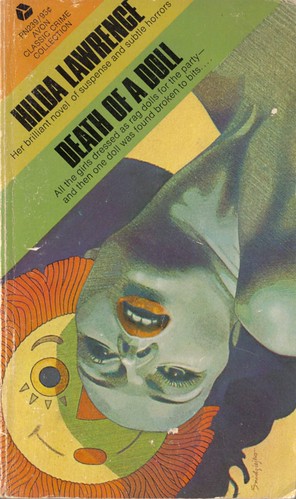
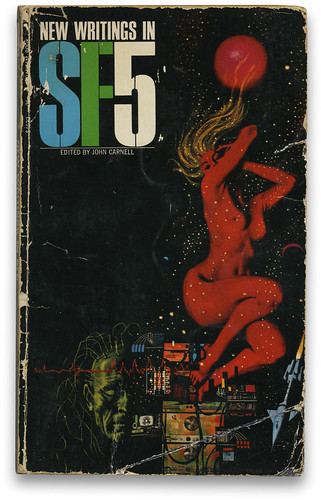
Eric Carl‘s Flickr photostream has some nice classic sci-fi and fantasy book covers (the rather fine looking Death of a Doll and New Writings in SF 5 pictured above). (via but does it float)

Re-envisioning the American small press — Fiona McCrae, director and publisher of Minneapolis independent Graywolf Press, profiled in PW (via @sarahw):

McCrae believes the publishing business is changing in favor of smaller presses, which can have close contact with their audiences and realistically support the smaller sales that typify many literary books: “I think that’s been true for a long time, and it’s just getting truer and truer and truer. There’s still obviously a layer in which we don’t compete, and it’s not our job to”

Rearrange, Rewrite, Redefine and ReimagineChicago-based indie Featherproof Books would like you to “remix” parts of their forthcoming titles, starting with Tour of the Drowned Neighborhood a short story taken from Blake Butler’s Scorch Atlas (via @R_Nash).

Overdue! The Central Library in Atlanta, the last building by “Modernist master” Marcel Breuer, is under threat according to Jonathan Lerner in Metropolis Magazine (pictured above).

A fair share — In the final installment of a 3-part series for the Globe and Mail on the publishing industry in Canada, James Adams looks at the thorny issue of digital rights.

Wild Hair, Wilder Ideas —  The Guardian profiles Alan Moore (and — on a related note — novelist Lydia Millet’s somewhat ill-considered assessment of Watchmen for the WSJ)

From Caveman to Spray Can: A Graphic Journey — Mike Dempsey’s gently meandering history of graphic design which not only features one or two books, but also the lovely Gill Sans typeface (picture above) which was used on the early Penguin paperbacks (via Noisy Decent Graphics).

Comments closed

Unproduct

More Ideas, Less Stuff — London-based graphic designer Ben Terrett of the Really Interesting Group and Noisy Decent Graphics is in The Guardian today talking about Things Our Friends Have Written On The Internet 2008, a limited-edition newspaper that collected together interesting stuff from the internet, and the idea of  ‘unproduct’, or creating more value but producing less stuff:

Originally coined by the designer Matt Jones and built upon by the strategist Russell Davies, among others, unproduct is basically maximum idea, minimum stuff… More than anything, unproduct is a new way of thinking about things. A new model. So is making something and giving it away. So are joint ventures. We’ve got people building stuff quickly, trying out new ideas, often for free. We have clients and agencies taking risks and more importantly sharing those risks. We’re creating maximum ideas and minimum stuff.

When people start talking to me about e-books, I have to confess there’s a small part of my brain that begins to shut down because I just don’t find them intrinsically interesting (inevitable and utilitarian yes, fun and interesting, no). But I love the idea of applying unproduct-type principles to publishing.

Sadly I don’t own a copy of Things Are Friends Have Written on the Internet 2008, but I gather that on the last page Russell Davies and Ben Terrett say: “2009 feels like a year for printing and making real stuff in the real world. Its going to be exciting”.

I hope so. I think this is fantastic.

Link

4 Comments

Why don’t you take the comfortable chair?

Colin Robinson, former editor at Scribner (a division of  Simon & Schuster) and previously at The New Press and Verso,  has written an excellent diary piece for the London Review of Books on Publishing’s Demise.

It’s always interesting to read an experienced insider’s take on the state of the industry, and although it covers some very familiar ground, Robinson’s article is particularly  comprehensive and thoughtful (and, given he was fired by Scribner in December 2008, dignified).

It is also interesting that Robinson notes — as Allan Kornblum of Coffee House Press did in his recent interview with Scott Esposito at Conversational Reading (mentioned yesterday)  —  that electronic communication has made  “life easier for writers and harder for readers.”   As more and more stuff is published fewer of us are actually reading. We’re  becoming more concerned with being  heard than with listening, with being read rather than reading:

Books have become detached from meaningful readerships. Writing itself is the victim in this shift. If anyone can publish, and the number of critical readers is diminishing, is it any wonder that non-writers – pop stars, chefs, sports personalities – are increasingly dominating the bestseller lists?

And yet, Robinson doesn’t think the book is doomed. Publishers just have to change the way they do business:

A system that requires the trucking of vast quantities of paper to bookshops and then back to publishers’ warehouses for pulping is environmentally and commercially unsustainable. An industry that spends all its money on bookseller discounts and very little on finding an audience is getting things the wrong way round.

According to Robinson, the opportunity is in curating the mass of material that is out there and finding niche audiences:

The roles of editor and publicist, people who can guide the potential reader through the cacophony of background noise to words they’ll want to read, will become ever more important.

Sounds about right.

Link (via @sarahw)

Comments closed

Something for the Weekend Jan. 9th, 2009

Curation, Appeciation, Organization: The Book Cover Archive goes live with “cross-indexed meta data” (and blog)! LOVE this. Nice work fellas. (via SwissMiss)

Skinny tight jeans and mild panic: The Scotsman profiles Canongate’s Jamie Byng.

Almost half of Canadians can’t name a single Canadian author according to the hand-wringing National Post… Or to put it another way, over half of Canadians CAN actually name a Canadian author? It could be worse (really)…

Canadian booksellers manage a “late holiday rally” in December reports PW:

Retailers large and small were unanimous in their opinion that books proved to be an excellent recession gift, with the value proposition of books being improved in part by fact that the actual price of books have fallen relative to U.S. prices.

A .38 shell for independent bookshops: The Guardian‘s Stuart Evers considers consumer apathy and the imminent closure of the Murder One bookshop on Charing Cross Road in London:

These kinds of shops are facing a long, bloody battle – and one which, without significant reinforcements, they are likely to lose. As we hear of the travesty of another brilliant independent going down, we’ll mourn the loss, wring our hands and damn Amazon and the supermarkets and Waterstone’s. Yet perhaps the most important detail we’ll probably keep under wraps: the last time we actually spent any money there.

Hapless Houghton Mifflin Harcourt reinstate editor Drenka Willen after Noble prize-winner Günter Grass intervenes.

Nostalgic book covers a hit for Penguin in Australia— 50 titles released with covers in the original orange-and-cream designs are selling strongly:

“They are instantly recognisable and have an emotional pull… Most people or their parents have got second-hand or old Penguins at home that have the same livery. But it’s not only pulling on that nostalgic lever, it’s also got that retro coolness. We’ve found that younger readers have been really drawn to them.”

“To say his work was inspirational is an understatement”: The New York Times profiles the late Barney Bubbles  whose iconic album cover designs (for the likes of Elvis Costello, Ian Dury, and The Damned) are celebrated in Paul Gorman’s new book “Reasons to Be Cheerful: The Life and Work of Barney Bubbles” published by Adelita (pictured).

Comments closed

Double-or-Nothing

Having already called “bullshit” on the Long Tail, Professor Anita Elberse argues that recent acquisitions by Hachette’s Grand Central and Little, Brown & Co. show publishers will continue to make “outrageous” bids for new books despite the recession in (a much linked to) article for the WSJ:

Blockbuster strategies are certainly not free of risk, but, in the long run, they beat the alternative of more balanced investment strategies. That explains why, even when the book industry struggles with the effects of the economic downturn, publishing houses won’t steer away from big bets. Publishers may be even more determined to land such projects in tough times… Are there breakout hits that no one sees coming? Sure. And do media companies sometimes pick the wrong titles to focus their attention on? Absolutely — no one in the industry has a perfect record, and the process of picking winners remains “an informed crapshoot,” as one executive put it. But given their recent performance, it is hard to argue against the approaches taken by publishing houses like Grand Central and Little Brown.

I’m not sure I completely agree with her reasoning–and it’s certainly a lot less warm-and-fuzzy than either the Long Tail or Tipping Point models–but it’s still an interesting argument and I think there’s some truth to her suggestion that consumers prefer blockbusters because, in the end, they “find value in reading the same books and watching the same movies that others do.”

GalleyCat has some thoughtful criticisms of Elberse’s article here and here,  but the shriller, teeth-gnashing responses  make me think she might be on to something…

Link

1 Comment

Cautious Optimism

Books a better buy in Canada? After all the problems caused by the high Canadian dollar in 2007, Canadian publishers and booksellers are “cautiously optimistic” at the start of this year’s holidays according to Vit Wagner in the Toronto Star:

“The climate is much better this year,” says [Nancy] Frater, proprietor of the Orangeville store BookLore. “My reason for optimism is that in challenging economic times, people do turn to books. As gifts, books have long-lasting value and they’re reasonably priced.”

It’s all relative though:

“I can’t look into the future and say everything’s going to be sanguine,” says Random House of Canada’s [Brad] Martin. “We’re doing a lot of cost cutting, but it’s more discretionary, like cutting the number of sales conferences from two to one. But we believe that the organization that we have now is what we need to successfully publish books in this country at the level that we have been publishing them.

“What I can’t tell you is what is going to happen to the market over the first six months of next year. It’s concerning for all of us. But certainly right now we seem to be performing better in a difficult market than the two other major English-language markets.”

And I’m not sure how this all sits with the recently reported “belt-tightening” in Canadian publishing — including staff changes at KidsCan Press and Thomas Allen postponing most of  their spring 2009 list — and all the grim news coming out of the US.

Is there worse to come? Any Thoughts?

1 Comment

Monday Miscellany

“I have always enjoyed photographing loners” — A lovely BBC audio slideshow of “Writers’ Rooms” narrated by award winning photographer Eamonn McCabe. The project, appearing weekly in The Guardian and currently on show Madison Contemporary Art in London, captures the working environments of novelists, biographers and poets.

Book Industry Enters Shaky Chapter: NPR’s Lynn Neary looks at last week’s horrorshow.

The 10 Best Books of 2008 according to The New York Times Book Review. Interesting that they’ve also created a mini-site which has promotional material for the top 10 books, including shelf talkers, bookmarks, and posters for bookstores to download . There are also web banners and a video with author Toni Morrison. This is has to be a good idea.

“The news is still big. It’s the newspapers that got small”: A spectacular Roger Ebert rant about the death of criticism :

The celebrity culture is infantilizing us. We are being trained not to think. It is not about the disappearance of film critics. We are the canaries. It is about the death of an intelligent and curious, readership, interested in significant things and able to think critically. It is about the failure of our educational system. It is not about dumbing-down. It is about snuffing out.

Spot. On.  I actually met Roger Ebert a few years back in Pages bookstore. The Toronto International Film Festival must have been on. I had no idea who he was at the time (a colleague told me later), but he was very nice about it.

“The Most Dangerous Man in Publishing”:  A profile of publisher Barney Rosset in Newsweek:

Before Rosset challenged federal and state obscenity laws, censorship (and self-censorship) was an accepted feature of publishing. His victories in high courts helped to change that. Rosset believed that it was impossible to represent life in the streets and in the dark recesses of the heart and mind honestly without using language that in the mid-20th century was considered “obscene”—and therefore illegal to sell or mail. To a significant extent, the books he published convinced others that this was true.

The Well-Tended Bookshelf— Laura Miller on culling one’s book collection:

There are two general schools of thought on which books to keep, as I learned once I began swapping stories with friends and acquaintances. The first views the bookshelf as a self-portrait, a reflection of the owner’s intellect, imagination, taste and accomplishments… The other approach views a book collection less as a testimony to the past than as a repository for the future; it’s where you put the books you intend to read.

Which leads me rather nicely to…

Books At Home: A blog about bookshelves. It is possible that this just too nerdy. Even for me.

Relevance: Brian at daxle.net interviews author Tim Manners , editor and publisher of The Hub and Reveries.com. It’s a fascinating discussion that covers innovation, brands, and the consequences of overabundant advertising (amongst other things).

3 Comments

Whiskey Tango Foxtrot?*

There has been relentless torrent of grim publishing news coming out of New York the last few days.

It has, at times, been hard to keep up with it all, and I don’t know the people involved well enough or understand the machinations sufficiently to offer much in the way of trenchant analysis. I hope that a summary of ‘Black Wednesday’ and the rest of this week’s events — with appropriate links — will, at least, offer some kind of context.

The details are sketchy, but Houghton Mifflin Harcourt acknowledged that there would be further changes at the company, including job-cuts. According to Publishers Weekly, at least eight people have been let go including executive editor Ann Patty, senior editor Anjali Singh and legendary editor Drenka Willen. GalleyCat has spokesman Josef Blumenfeld’s full statement about the changes.

Personally I’m stunned that the recipient of the 2007 Maxwell E. Perkins Award Drenka Willen, the US editor of Günter Grass, José Saramago and Umberto Eco, has been let go by HMH. PW profiled Willen in 2002, and, after pointing out that she has edited four Nobel Prize winners, MobyLives asked, pertinently, “do the proprietors of Houghton Mifflin Harcourt really know what they’re doing?”

I think my favourite quote, however, came from an unnamed ‘publishing veteran’ who told GalleyCat:

“Those fuckers have destroyed two venerable publishing houses in less than a fucking year.”

Elsewhere things are not much better.

Earlier in the week, Christian publisher Thomas Nelson announced it would be laying off 54 employees, or about 10% of its workforce. CEO Michael Hyatt said in a statement on his corporate blog From Where I Sit :

This was the second round of reductions this year. Unfortunately, this one was no less painful. We did the first round after significantly cutting our SKU count. However, this second round was purely a result of the slowdown in the economy.

According to GalleyCat , Hyatt apparently first made the announcement by Twitter. Stay classy Michael, stay classy…

After Doubleday cut 16 jobs in October, the “long anticipated” restructuring of Random House was announced on Wednesday. Maud Newton offered some bleak analysis and reprinted the full memo from Random House CEO Markus Dohle. Sarah Weinman has questions. Kassia Krozser at BookSquare thinks it’s all irrelevant:

“Who really cares if Crown or Knopf or Ballantine or Bantam Dell survives? I’m serious. Who. Cares… Focusing on imprints is focusing on the wrong problem.

The hyperbole-prone New York Observer called it “The End of an Era”.

In addition to the upheaval at Random House, Simon & Schuster announced it was eliminating 35 positions on Wednesday. Publishers Weekly reported that the Rick Richter, the president of the company’s children’s book division, and Rubin Pfeffer, senior v-p and publisher of the children’s group, would also be leaving.

On Thursday, Penguin Group chairman and CEO John Makinson announced the company will not give pay raises to anyone earning more than $50,000 in the new year. PW quoted Makinson as saying: “I cannot of course guarantee that there will be no job losses in Penguin in 2009. In this financial climate that would be plain foolhardy.”

And, according to a recent wire story from the AP on this week’s events in publishing, pay raises at HarperCollins have been delayed until next July. Spokeswoman Erin Crum says that “no decisions had been made” on job cuts, whatever that means…

All in all, it’s been quite a week. Thursday’s New York Times had a thorough summary and postmortem, and Andrew Wheeler has been keeping a running tab of the changes on his blog if you want more details.

Do I see a silver lining? Well, my hope is that all the talented, smart people who got unceremously dumped this week will stay in publishing (but who could blame them if they don’t?) and take their brilliance and vast experience to smaller more flexible companies and deliver a resurgence of creativity in New York. That would be nice wouldn’t it?

UPDATE:

Ron Hogan has posted some that trenchant analysis that I was talking about over at GalleyCat.

Also, what are the implications of all this, if any, for Canadian publishers? Anyone…?

*Thanks to Pete for the best blog post title ever.

Comments closed