Skip to content

Tag: Publishing

Q & A with Nate Salciccioli

Thanks to blogging and Twitter I’ve been lucky enough to connect with a group of people in the book trade that I probably wouldn’t have met otherwise. Their enthusiasm and willingness to share their experiences is in stark contrast to the traditional reluctance of people in the industry to talk meaningfully (or positively) about what they do (without being three sheets to the wind).

Book designers in particular have an amazing online dialogue about their work and so over the next couple of months I’m planning a series of interviews with some of the designers whose projects have recently caught my eye.

First up on the docket is Nate Salciccioli. Nate is a graphic designer at The DesignWorks Group — purveyors of fine book covers since 1996 — and the chap behind the excellent Paradox of Awesome (it’s a long story and you probably had to be there…).

Even though he is only 23 (according to his website), Nate’s work has already been recognized by Print, Graphis, CMYK Magazine and elsewhere.

What attracted you to a career in book design?

Like many things, my career in book design was accidental. I’ll admit that, while in design school, I had neither considered nor seen many book covers. It certainly hadn’t entered my school-addled brain that I would (or could) pursue it exclusively. That all changed when I landed an internship with The DesignWorks Group, which I deem one of the most providential events of my life thus far. Everyone here is such a blast to work with, and I think falling in love with what they do here led to my love of book cover design.

Briefly, could you tell me a little about The DesignWorks Group?

Surely. Our little studio has been in the industry going on 14 years. We work almost exclusively in book cover design, with a few identities, websites, and movie posters thrown in for good measure. All told, there are 6 designers who call DWG home, and some amazing production and management people. From what I’ve gathered in talking with friends, the atmosphere at DWG is pretty unique; we love to collaborate, love to have fun, and LOVE the Shat (for those of you who are uninitiated, that’s William Shatner).

Something interesting is that none of our clientele is local. We work with publishers in NYC, Chicago, Nashville, San Francisco, Colorado Springs, Boston, and lots of other equally spaced out locations. This creates an interesting disconnect, which I think actually has helped our studio reach out through the internet with platforms like FaceOut Books, design:related, and Twitter.

How long have you worked there?

I’ve been working here since July 1, 2007. Has it really been over two years? I’m still waiting for two 30 inch monitors, if anyone is reading this…

Is there a ‘house’ style?

Thankfully, no. Our range of clients is so diverse that I think we’d be doing ourselves a disservice to aim towards anything as unified as a ‘house style.’ All the designers working here are deathly afraid of repeating themselves (in a good way). I do have to make a concerted effort to expose myself to lots of different kinds of design aesthetics to avoid getting a NATE look. Which reminds me, I need to stop using Futura…

Is there much collaboration between designers at DWG?

We’re always talking to each other. Many times a day I’m showing different people what I’m working on, and in turn taking a look at their screen. I can’t tell you how valuable this is in keeping my brain from fizzling. As a team, we’ll have brainstorming sessions when someone wants help in coming up with concepts. These concept generation sessions (CGSs??) always enrich the thinking on any given project.

Could you describe your design process?

Ah. You had to ask. Can I plead the fifth? Does ‘Plead the Fifth’ even make sense in Canada?

To be honest, my process varies from project to project. Sometimes I’ll read the book, do some sketches, find something I like, find a great image, create some brilliant typography, and get an ecstatic response from the client. SOMETIMES. More often, I’ll read and reread the given material from the client, roll some ideas around in my head for a while, and struggle for about an hour in Photoshop until I gain some momentum. If that doesn’t work, I run to the local convenience store for an ice cold Coca-Cola. I can’t stress enough the role of caffeine in graphic design.

What are your favourite projects to work on?

I love digging my teeth into a good fiction title. To me, fiction affords the most open-ended challenge: design something unique that gives an insight into the story. It’s more than problem solving. The art director I’m working with at the publisher plays a huge role in setting the tone for the project: Are we going for something brilliant, or for something palatable by Danielle Steele fanatics?

Some of my favorite projects lately have been a book about zombies, a reference series for Barnes and Noble, and several university press projects. I can’t get enough projects for university presses, by the way. Always a fun challenge.

What are the most challenging?

The biggest challenge is trying to continue innovating after several rounds with a project. When your ideas keep getting shut down, you have to find the place in your head that refuses to give up. On the flipside, it can be very rewarding to emerge from a bout like this with a cover that makes everyone happy (including me); it happens like that, sometimes.

What do you think makes a good cover design?

I’ve discovered that a good cover is more than just “oh wow, look at that neato type” or “shee whiz, no title on the cover!” It’s about communication in the end. I’ve admittedly produced designs that I thought looked great, but didn’t speak to the audience at all. If a cover can effectively introduce the book to its intended audience while still looking like a million bucks, it’s a good cover.

Where do you look for inspiration?

I have a morning routine that runs me through the gamut of book cover design sites (of which, happily, there are PLENTY), design inspiration sites, and blogs. I also have a running folder of lovely bits of design I find in different places. FFFFound is a great resource for visual stimuli, as are sites like NOTCOT.org and The Book Cover Archive. Just walking into a Barnes and Noble is a wonderful way to build enthusiasm for book design, as you can actually TOUCH them.

Who else is doing interesting work right now?

Some of my favorites to watch right now are Brian Chojnowski, Jason Heuer, Megan Wilson, Ben Wiseman, Christopher Brand, Jacob Covey, Helen Yentus, and Adam Johnson. There are so many talented designers working in book design, it boggles my mind.

As a young designer, what do you think the future holds for book cover design?

Some older and MUCH smarter people have told me there will always be a market for book cover design. I guess I’ll have to take their word for it. For me, the skills I develop working in books could translate easily to many other graphic design facets, which brings some comfort. I don’t expect to be holding a cardboard sign that says “Have Mouse, will Kern for Food” any time soon.

Thanks Nate!

You can find more of Nate’s work at his website and design:related portfolio.

6 Comments
Knots

I usually avoid discussions of digital rights management (DRM) as much as possible. It’s a Gordian Knot. We can spend a lot of time and energy painstakingly untangling it, never to find a form of DRM that keeps everyone happy. Or we can  end DRM altogether with one bold stroke (“mission accomplished!”) only to discover that cutting the knot takes longer than we expected and is more complicated than we first thought. Either way, my sense is that we will continue to have some kind of hybrid situation — with some e-books ‘protected’ by DRM and some not — as we both cut and untangle all the issues…

And for all that I’m often left wandering if DRM really matters as much as we tend to think it does. Do people outside of our strange intersection of media and technology really care about it as much as we do? Are there other pressing issues that we should direct energy towards?  I have this nagging sense that as we agonise over the do-we-don’t-we of DRM, most people just want to read good books.

Nevertheless, the great DRM debate has come to the fore again as a result of Michael Bhaskar’s seemingly mild assertion that DRM Is Not Evil on Pan Macmillan’s The Digitalist blog, which resulted in the (predictable) slew of comments.  Michael has now posted a response which has garnered another slew of comments.  It’s all worth reading if you can summon the energy and want some insight into the issue (although I don’t think anyone mentions foreign rights, but perhaps some one will get to that yet…)

3 Comments

Something for the Weekend, July 10th, 2009

Shute — JRSM, the Caustic Cover Critic, has a great post on the work of book designer and illustrator Mick Wiggins, whose evocative illustrations (which look a bit like dark interpretations of vintage Tube posters) adorn the Penguin Classics US editions of John Steinbeck and the new Vintage Classics editions of Nevil Shute.  JRSM will have an interview with Mick Wiggins soon. Can’t wait…

The Revenge of PrintEric Obenauf, publisher at Two-Dollar Radio on the state of print and publishing for The Brooklyn Rail:

The goal for book publishers, most simply put, should not be to undertake a virtual arms race of developing technology with both the Internet and media, or to try to compete on a bloated scale with music and film, or even to translate a work to conform to an undetermined potential future model. The mission for book publishers and print media at large should be to create a product that is irreplaceable and indispensable.

And I will just add for the umpteenth time that it’s not about e-books, DRM, pricing, or devices — it’s about making better books.

Big BluePhilip Hoare, author of Leviathan or, The Whale winner of this year’s Samuel Johnson Prize (and one the books I’m currently reading), chooses his Top 10 Whale Tales in The Guardian. You can also hear Claire Armitstead’s interview with Philip for The Guardian here and read PD Smith‘s TLS review here. And, for the record, Philip is a Southampton boy like myself…

Top 10 Comic Book Cities as chosen by Architects Journal. Gotham is only number 6 (via Book Oven on Twitter).

And lastly…

Up We Go! Up We Go! — The wonderful BibliOdyssey has posted a number of E. H. Shepard’s lovely illustrations for The Wind in the Willows.

Have a great weekend.

1 Comment

Monday Miscellany, June 29th, 2009

Gestalten’s Naïve: Modernism and Folklore in Contemporary Graphic Design, edited by Robert Klanten and Hendrik Hellige,  reviewed at The Designer’s Review of Books.

Served — Jeremy Ettinghausen, Penguin UK’s Digital Publisher, explains the rationale for their new (v. cool sounding) project for kids We Make Stories:

[A]s the debate about the value and price of digital content rages on, I’m testing out a new mantra on my suspicious colleagues; services not content. The idea, ill-formed as it is in my head, is that while we might continue find it a challenge to get consumers to pay for digital content, we might be able to use our skills, expertise and experience to create services that people will pay for. Services are what we do for writers, so perhaps there might be services we can create for readers.

Proof I think — were it still needed — that not all the most interesting book stuff is being generated in Seattle.

Friction — Laura J. Murray’s excellent critique of Brett Gaylor’s documentary RiP: A Remix Manifesto for Culture Machine (PDF). Murray’s comments about a copyright  ‘war’ and choosing ‘sides’ certainly resonated with me:

I’m not on any side, because I’m not in a war. Such language is a) a kneejerk echo of the Hollywood/recording industry message, b) offensive to anyone who has ever experienced a blood and guts war, and c) a joke to those who are not already convinced of the importance of remix. But most importantly, it is, d), an unproductive way of framing our current copyright challenges, because it suggests that the debate won’t end until one side has achieved total victory.

Amen.

The State of the Union — A big sprawling spaghetti post from the the chaps at Three Guys and One Book (loosely) about the state of publishing from the perspective of readers (mostly). I don’t agree with all of it by any means, but some of it sticks…

Less, But Better — A profile and brief interview of design hero Dieter Rams at BBH Labs. Just FYI — If I ever write a publishing manifesto (ha!), it will be called Less, But Better: A Publishing Manifesto. And just for the hell of it, here are Dieter Rams 10 principles of good design:

  1. Good design is innovative
  2. Good design makes a product useful
  3. Good design is aesthetic
  4. Good design helps us to understand a product
  5. Good design is unobtrusive
  6. Good design is honest
  7. Good design is durable
  8. Good design is thorough to the last detail
  9. Good design is concerned with the environment
  10. Good design is as little design as possible

Most, if not all, of these principles could be applied to publishing. Who (or where?) is publishing’s Dietar Rams?

And finally…

Big Gold Dream — Michael Fusco’s great redesigns for the Pegasus Classic Crime reissues of Chester Himes seen (of course) at FaceOut Books. Michael Fusco has some more great cover designs on his website.

(And a quick side note to publishers and designers — it was impossible to find decent hi-res image of these covers. If you want people share your brilliant work, you need to work on this. Ideally I want images that are at least 400px x 600px)

1 Comment

Something for the Weekend, June 26th, 2009

2009 Penguin Design Award — Peter Adlington’s abstract design for The Secret History by Donna Tart (pictured above) took 1st place. More on the Penguin Blog.

The Good Design Book — Christopher Simmons, graphic designer and principle at the San Francisco-based design firm MINE, records the progress and process of writing and designing his new book on design (via Unbeige). The whole concept reminded me that I should also mention the crowdsourced Smashing Magazine Book.

OK, Go — Kassia Krozser, Kirk Biglione, and Kat Meyer (and an unnamed “veteran of the book industry”), put their money where their collective mouth is, and launch digital publisher Quartet Press (and they’re accepting submissions).

The Debrief — Organizer Hugh McGuire pens his personal thoughts on BookCamp Toronto for Book Oven.

One of the most powerful things about BookCamp, compared with other events I’ve been to, is that this was not just a grassroots group. There was high-level engagement from the publishing industry, with publishers, editors, senior VPs, production managers, marketers, and interns, and everything in between. It was great to see the honest debate and conversation being lead by these insiders, who are truly grappling with the future of their business and their passion.

And VANTAP‘s Sean “Crazy Horse” Cranbury  adds his 2 cents on #bcto09 at the Books on The Radio blog, and teases BookCamp Vancouver.

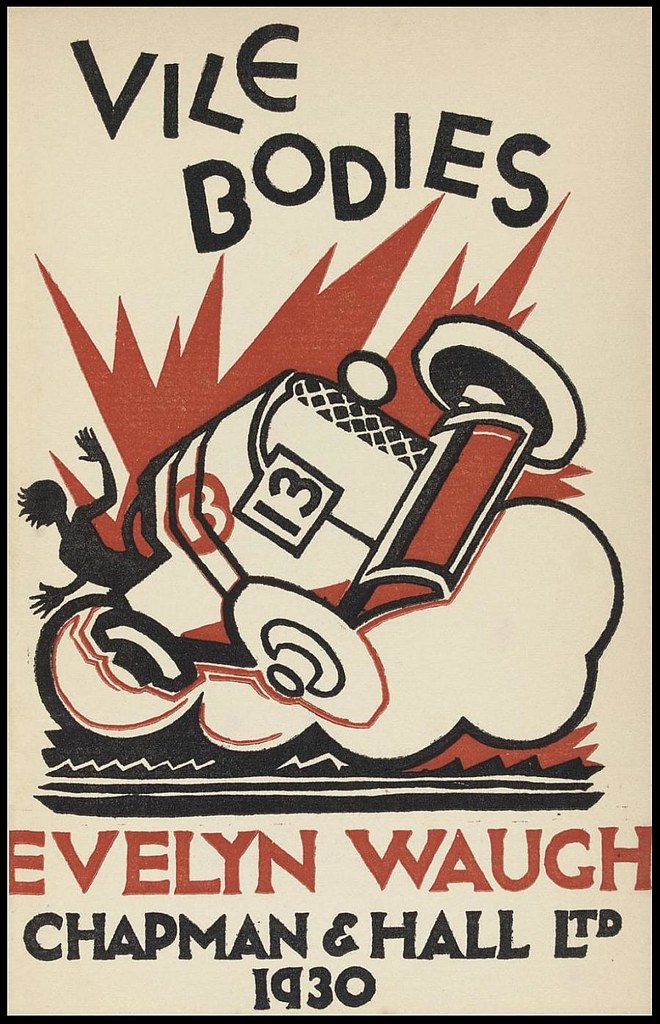
Vile Bodies — The 1930 first edition cover of Evelyn Waugh’s second novel seen at BibliOdyssey.

And last, but not least…

Apples and Oranges — The article about the evolution of Amazon by Adam L. Penenberg, author of the forthcoming Viral Loop: How Social Networks Unleash Revolutionary Business Growth, that launched a great Twitter chat with @FastCompany and yesterday’s ’26 Things…’ list (which could have easily been twice as long). 

Comments closed

26 Things Not Related To Amazon

Oh dear. I’m really not an Amazon-hater. But this morning I inadvisedly took Fast Company magazine to task on Twitter for only writing book industry stories about Amazon and the Kindle.

In their response, Fast Company rightly pointed out that the Fast Talk section of the April edition of the magazine  featured technology — aside from the Kindle —  that is changing book publishing. It included  (short) interviews with Josh Hug, CEO and co-founder of Shelfari (which is in fact owned by Amazon), Julia Cheiffetz, Senior Editor at HarperStudio, the team behind Scholastic’s 39 Clues, Steve Haber developer of the Sony e-reader, and Eileen Gittins, CEO of Blurb.

Funnily enough, I had actually bought April issue of Fast Company and completely forgotten about this (admittedly somewhat forgettable) feature. Suitably chastened, I apologised for my sweeping generalization.

I am grateful (and slightly amazed) that Fast Company took the time to reply to my glib missive and put me straight. However, I do think there is a tendency — not just isolated to Fast Company — to use Amazon as the only frame of reference in stories about the book trade.

With this in mind,  I challenged myself to pull together a quick list of current book-related things that I think are exciting that don’t (as far as know) have anything to do with Amazon (yet).

So here is a completely personal, off-the-cuff list of 26 book companies, ideas, projects, blogs, websites and trends that I think are inspiring, interesting, exciting, or worth watching (and are unconnected to Amazon):

(And yes, I realise there is a certain irony in writing a list that’s not about Amazon just to prove not everything has to do with Amazon)

  1. The Afterword
  2. Authonomy
  3. BookArmy
  4. BookCamp
  5. The Book Cover Archive
  6. The Book Depository
  7. Bookkake
  8. BookNet Canada
  9. Cell phone novels
  10. Drawn & Quarterly*
  11. Faber Finds
  12. FaceOut Books
  13. Gollancz’s collaboration with the D&AD Global Student Awards
  14. Google Books
  15. Gutenberg Rally beta
  16. Harlequin
  17. iPhones
  18. McNally Robinson
  19. Shortcovers
  20. Unbooks
  21. Twelve
  22. Twitter
  23. VANTAP
  24. Vromans
  25. We Tell Stories
  26. WW Norton’s Book Design Archive

Who or what would be on your list?

*Full disclosure: D+Q are distributed in Canada by Raincoast Books.

3 Comments

Something for the Weekend, June 19th, 2009

50/50 — AIGA announce their 50 Books/50 Covers of 2008. Included in the fifty is the cover of Kenneth Hayes’ Milk and Melancholy designed by Toronto’s Underline Studio (pictured above).

Gxuu! — Linguist Arika Okrent, author of In the Land of Invented Languages, chooses her 10 favourite words from invented languages for The University of Chicago Magazine. Having been kind of fascinated with Volapük after reading William Gibson‘s  Spook Country, I was happy to see the inclusion of ‘pük’ (via the incomparable Kottke of course):

In Volapük, pük means “language.” It comes from the English word “speak” but it’s hard to tell (vol, means “world”, so Volapük is “world language.”) Unfortunately, it looks a lot like a different English word. And even more unfortunately, it shows up in various other words related to the concept of language: püked – “sentence” and pükön – “to speak.”

Nice Work — Mark Thwaite interviews novelist, critic and Emeritus Professor of English Literature, David Lodge about his new book Deaf Sentence for The Book Depository blog:

One’s ideal reader is intelligent, alert, open-minded but demanding, and equipped with what Hemingway called “a built-in shit-detector.” He/she does not actually exist. In a way you try to be that reader when you read and re-read your own work in progress, and not to kid yourself if something isn’t quite right. That’s a rather different matter from one’s “readership” which in my case, I’m aware, is probably well-educated, well-read, maybe Catholic, and getting more and more senior in years, like myself.

A Special Specimen — A lovely post by James Phillips Williams at amassblog about Paul Rand, Jan Tschichold and a very special type specimen book.

And speaking of Paul Rand, be sure to visit Daniel Lewandowski’s tribute site to the great man (via grain edit).

Comments closed

Monday Miscellany, June 1st, 2009

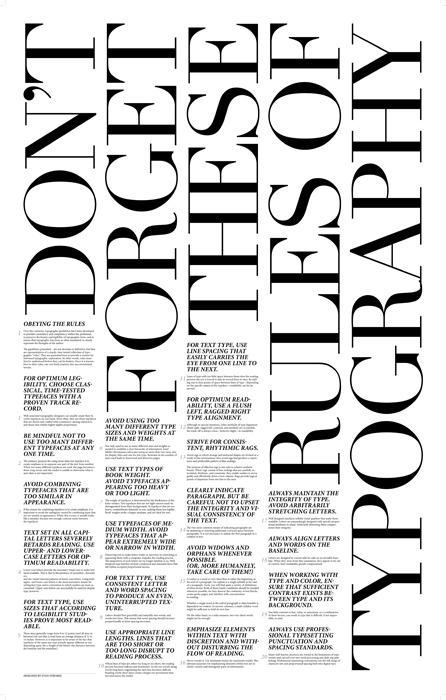
Don’t Forget the Rules of Typography — Nice work by graphic designer Evan Stremke (above). Also available as a handy PDF (via ffffinds). (Update: Evan appears to have redesigned his Rules of Typography. The image above shows the original version which personally I prefer. The new version is here)

The UnconferenceThe National Post reports on BookCamp TO, which takes place Saturday June 6th at the University of Toronto:

“I really think I’m going to get in trouble for saying this, but book publishing needs to stop being so insular. We need to stop just looking at our own industry for inspiration,” says Deanna McFadden, marketing manager, online content and strategy for HarperCollins. “The people who are doing BookCamp in Toronto are all smart people who understand where the industry is and where we need to go, and are really looking at innovative ways for us to keep book publishing alive and healthy.”

I’m going to be at BookCamp on Saturday, so please say hello if you’re there. And I’m still looking for feedback on the role of publishers in the digital age (see my post here). Please leave a comment if you have thoughts.

The London Review of Books now has a blog.

But Thank God I Ain’t Old — In a teaser for forthcoming  Heavy Rotation: Twenty Writers on the Albums That Changed Their Lives edited by Peter Terzian, literary critic James Wood waxes lyrical about The Who album Quadrophenia in The Guardian:

Quadrophenia is itself a nostalgic album – it wants to be there, back on those beaches and in those Soho clubs of the early 60s. So when I listen to the album now, nostalgia is doubled, since I am looking back at my own youth, and also back at the Who’s youth, at an era when I was not even born. I become nostalgic for a rebellion I never experienced and for an England I never knew.

Txt Island — A short film made with a few hundred spare pegboard letters by Chris Gavin at TANDEM Films (via I Like):

Comments closed

Something for Weekend, May 29th, 2009

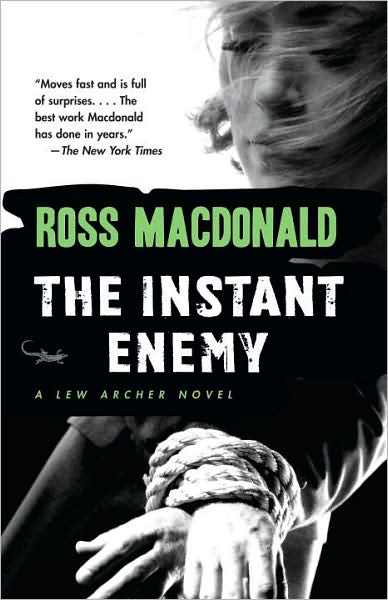
Hard-boiled — New designs for Ross MacDonald’s Lew Archer books by Joe Montgomery seen at FaceOut Books. I know I link to FaceOut just about every other week, but it’s an awesome site and the juxaposition of images in this series are great (as are some of the unused comps).

The Concierge and the BouncerPublishers Weekly report on Richard Nash (formerly of Soft Skull) and Dedi Felmen (formerly of Simon & Schuster) and their plans to “push back against the outmoded idea of publisher as cultural gatekeeper” with their new venture Round Table (announced at BEA this week):

The key is a shift from a caretaker mentality to a service mentality, from a linear supply-chain model to the idea of a free-floating, non-hierarchical “ecosystem” of readers, writers and authors… Nash and Felman’s idea of Publishing 2.0 could make a semi-professional reader, writer, editor and critic out of anyone with the desire.

Reading in a Digital World — A killer line in an otherwise blah article for Wired by Clive Thompson:

“We need to stop thinking about the future of publishing and think instead about the future of reading.”

Book Distribution in Canada — A Canadian Heritage study on book distribution in English Language Canada produced by Turner-Riggs dropped this week.

Can Editors Change Their Spots — David Hepworth’s thoughts on Robert G. Picard’s CS Monitor article ‘why journalists deserve low pay’,  and what “the new dispensation” means for  editors:

Magazine editors spend most of their time deciding what they’re *not* going to do and trying to arrive at a mix that the majority of people will like. They then find that whatever they’ve arrived at is too much for some people and not enough for others. This is made more difficult by the fact that their readers, being the most engaged in their particular area, are the people most likely to tap into other sources themselves. The people who value your mix most are also the people who would feel most qualified to mix it themselves.

The italics are mine.

Cover to Cover —  Steven Heller reviews newly released  ‘visual books’ in the New York Times with a nice accompanying  slide-show. (See image above, but hey NYT, when are you going to let people embed your slide-shows? When?).

Comments closed

What’s Next For Publishers?

An unforeseen consequence of the “New Think for Old Publishers” debacle at SXSW in earlier this year is that I will be a participant in a session on the role of the publishers in the digital age at Book Camp Toronto on June 6th.

140 Character Assassination

The now infamous SXSW panel was supposed to discuss “what’s going right and what’s going wrong in publishing, assess success of recent forays into marketing digitally, digital publishing, and what books and blogs have to gain from one another.”

As has been well documented elsewhere, things did not go according to plan.

Despite the presence of heavyweight panelists (including the venerable Clay Shirky), new ideas were in short supply. Audience frustration overflowed on to Twitter and an array of 140 character bullets (identified by a #sxswbp hashtag) ripped into the panel, with what was perhaps the kill-shot fired by a writer in the audience:

“If, as an author, I can design it myself, write it myself, publish it myself, why would I bother going to a publisher at all? What purpose do you serve?”*

Existential Crisis

The old answer to this question was that publishers offered technical expertise and mass distribution.

But, nowadays, digital technology has made it easy for writers to publish, distribute and market their own books independently. And whilst professional editing, design, production, distribution, and marketing may still be valuable and sought-after services, it’s become very apparent that the perceived gap between self-publishing and traditional publishing is narrowing.

The battering that the SXSW panel took inadvertently revealed what we have long-suspected — publishers need to change the way they think about themselves, the decisions they make, and the services they offer, or cease to exist.

Fine Filtering

One idea that gained some currency in the aftermath of SXSW was that publishers are — or could be — ‘cultural curators’, a role made only more important by the explosion of content created and distributed by digital technology.

In a world where it is impossible to read everything that is emailed, texted, tweeted, posted, uploaded, or printed, there is an opportunity for publishers to become trusted advisers who sift through the vast digital slush-pile and present only the best, most interesting work. Or so the argument goes.

Unfortunately, the truth of the matter is that publishers haven’t proved to be very effective at curating in the past, and it’s precisely this kind of pretension that gets them in trouble at events like SXSW.

A rap sheet of opportunistic publishing, self-indulgence, costly blunders, and generally too much poor product means that publishers (not to mention the mainstream media) have squandered any cultural authority they may once have had, and have been superseded by an informal network of curators connected online.

Furthermore, curation doesn’t really explain what publishers actually do for authors. If it’s just filtering (by set a of cultural criteria I may or may not agree with), why bother going to a publisher at all?

Strengthening the Signal

Not long after after SXSW I sat down in Toronto with Book Camp TO organizer Hugh McGuire to discuss these crumbling cultural hierarchies and the implications for publishers.

Expressing my dissatisfaction with the idea of publishers as curators  — and trying to take into account Hugh’s reader-centric approach — I suggested that perhaps we’d stand ourselves in better stead if we thought of ourselves more as ‘advocates’.

More proactive than curation, advocacy takes into account that publishers do more than find completed works of art and present them to the public. And it goes at least part way towards explaining what publishers do for authors, whilst offering a model for how they can interact meaningfully (and honestly) with readers.

Perhaps, just as crucially, it also means being able to effectively publish and promote books that we believe in, without making any of the claims of cultural authority or superiority that are attached to curating — the framework of advocacy works whether you are publishing literary fiction or genre, poetry or humour.

Admittedly, there are probably minimal and maximal versions of what ‘publisher as advocate’ means. On the minimal side, publishers promote (and defend if necessary) their books in the public forum. A more maximal version — which is probably where my thinking lies — would not simply limit advocacy to marketing a finished product. It would begin with the commissioning editor championing the work in-house, and continue through the production of the book to the publicist who is pitching it to reviewers, and beyond. It would also mean publishing less and publishing better.

So…

These ideas are not definitive. In fact they’re a rather hurried formation (at the prompting of Sean Cranbury) of a jumble of ideas that I’ve had kicking around my head that need more time, but also more air and more discussion.

The Book Camp Toronto session about the role of publishers is on Saturday June 6th at the University of Toronto’s iSchool. Please come along and share your ideas. If you can’t make it, please feel free to leave your feedback, ideas, and links in the comments section or send me an email or a DM.

Over and Out.

* For the record, this quotation is from panelist Peter Miller‘s account of #sxswbp

1 Comment

Why Not? Or How We Live-Tweeted Fall 09

Why Not?

One the things that really stuck with me from Michael Tamblyn’s 6 Projects That Could Change Publishing For Ever presentation at the BookNet Tech Forum in March was the idea that publishers have to “place lots of little bets quickly.”

It tied into another idea that’s been kicking around recently about reframing ‘Why?’ questions into ‘Why Not?’ questions. That is to say, whenever we — publishers, book distributors et al — ask “why would we do this?” we should flip the question on it head and ask “why wouldn’t we?”.

This doesn’t mean we should pursue every idea that someone puts forward. Sometimes there will be good reasons not to try something — “it costs too much” and “it’s illegal and/or evil” are perfectly valid reasons that spring to mind to nix something (and no doubt there are  plenty more). But, in my experience, reframing the ‘why?’ question encourages people (me included) to think creatively and be more positive about ideas/projects we might otherwise dismiss out of hand.

#rainfall09

This is all a roundabout way of explaining how I ended up twittering from the  Raincoast Books Fall 09 Sales Conference last week.

Before we got under way on the first morning, a few of the early birds were laughing about using Raincoast’s Twitter account to micro-blog the presentations as they happened. Although it started as a joke, the near-inevitable “why would we?” and “who cares?” questions came up, and that raised the stakes. I turned the questions around and couldn’t actually think of any good reasons why we shouldn’t ‘live tweet’ the conference. I had my laptop, wireless access and a power source, so it seemed easy enough to do. And I figured people would tell me pretty quickly if they were bored and I should stop.

Decision made.

We quickly adopted #rainfall09 (an identifying reference tag for twitter posts or ‘tweets’ which was accidentally shortened to #rainfall on more than one occasion) and,  with some help from my colleague Siobhan, I covered all 3 days of the conference in a series of posts of 140 characters or less.

To people who live their lives online and are accustomed to social media rather than the slightly conservative book publishing world, the response to all this is probably a very sarcastic “big whup”. But sales conferences are not usually open and inclusive, and, needless to say, there was a degree of skepticism and resistance to overcome. Certainly it was experiment for us, if not, admittedly, a very large one. And  we were, as far as I’m aware (and someone please correct me if I am wrong), the first publisher/book distributor to Twitter their entire conference.

20/20

With the benefit of hindsight, the drawbacks were predictable. It was very intensive and time-consuming and I found it was difficult — at least initially —  to interact with the people actually in the room and tweet. I’m sure I missed a lot of nuance and I passed on more than few book samples with the barest of glances. We probably over-tweeted and lost a few followers as a consequence.

That all said, the positive outcomes vastly outweighed the problems. The feedback was overwhelmingly positive. We learnt as we went along — becoming better organized and tweeting less — and we gained far, far more followers than we lost over the 3-day period. Our posts were re-tweeted. Followers asked questions and made requests. We raised awareness of Raincoast, the publishers we work with, and the books we distribute. And we were able to connect with reviewers and bloggers we weren’t previously aware of.

I would do some things differently next time for sure. But, ultimately, it was definitely worth doing.

If you are thinking about live-tweeting your conference, here are my 5 Tips:

  1. Be Prepared — Whilst Twitter is great for spontaneity,  making sure you can set-up  your laptop with internet access, and a power source is essential (our conference days were 10 hours straight). And knowing the books (at least a little) in advance, definitely helps — I was often scrambling to find additional information on particular titles and bookmarking a few pages in my browser in advance would have been a plus.
  2. Be selective — Raincoast Books is primarily a distributor. We have something like a thousand titles a season from a variety of publishers. It is impossible to tweet about all of them, and it became quickly apparent it isn’t desirable to try. Our followers just wanted the highlights.
  3. Link — Readers also wanted links to more details if a title caught their eye. I had publisher websites and google open in separate tabs at all times. Even so, linking wasn’t always possible. Put your marketing materials online early and encourage your authors to update their sites (and join Twitter!).
  4. Be creative — If you can’t get your marketing material for your key titles online before conference, or something comes out of left-field, use the resources you do have to find an interesting work-around. When we had some very immediate reader interest in a book called The Quotable Douchebag and there was no information available online, the publisher Quirk Books quickly threw up a blog post with details.
  5. Tool-Up — Twitter management tools like TweetDeck and HootSuite are always useful for professional Twittering, but being able to quickly monitor replies, retweets, and references, not to mention conveniently shorten URLs was essential during conference.

Did you follow @RaincoastBooks or #rainfall09 last week? If so, how did you think it went? What could we do better next time? Leave a comment below or email me.

Note: This is my personal blog, and this post is my personal opinion. Neither reflect the opinion or official policy of Raincoast Books.

Illustrations from the Inspired Magazine Social Bird Icon Set (From the top: Chimero’s Birdie by Frank Chimero, Burdy by Tad Carpenter, and Jacque by Jessica Gonacha).

2 Comments

Q & A with Ellen Lupton

“Ellen Lupton makes this industry smarter. If graphic design has a sense of its own history, an understanding of the theory that drives it and a voice for its continuing discourse, it’s largely because Lupton wrote it, thought it or spoke it.” — Katherine Feo, AIGA

Dedicated to raising design awareness, Ellen Lupton is the Director of the Graphic Design MFA program at Maryland Institute College of Art (MICA) and curator of contemporary design at the Cooper-Hewitt National Design Museum.

A regular columnist  for ReadyMade Magazine, she has contributed to Print, Eye, I.D., and Metropolis, and writes regularly about design at both Design-Your-Life and her own website Design Writing Research.

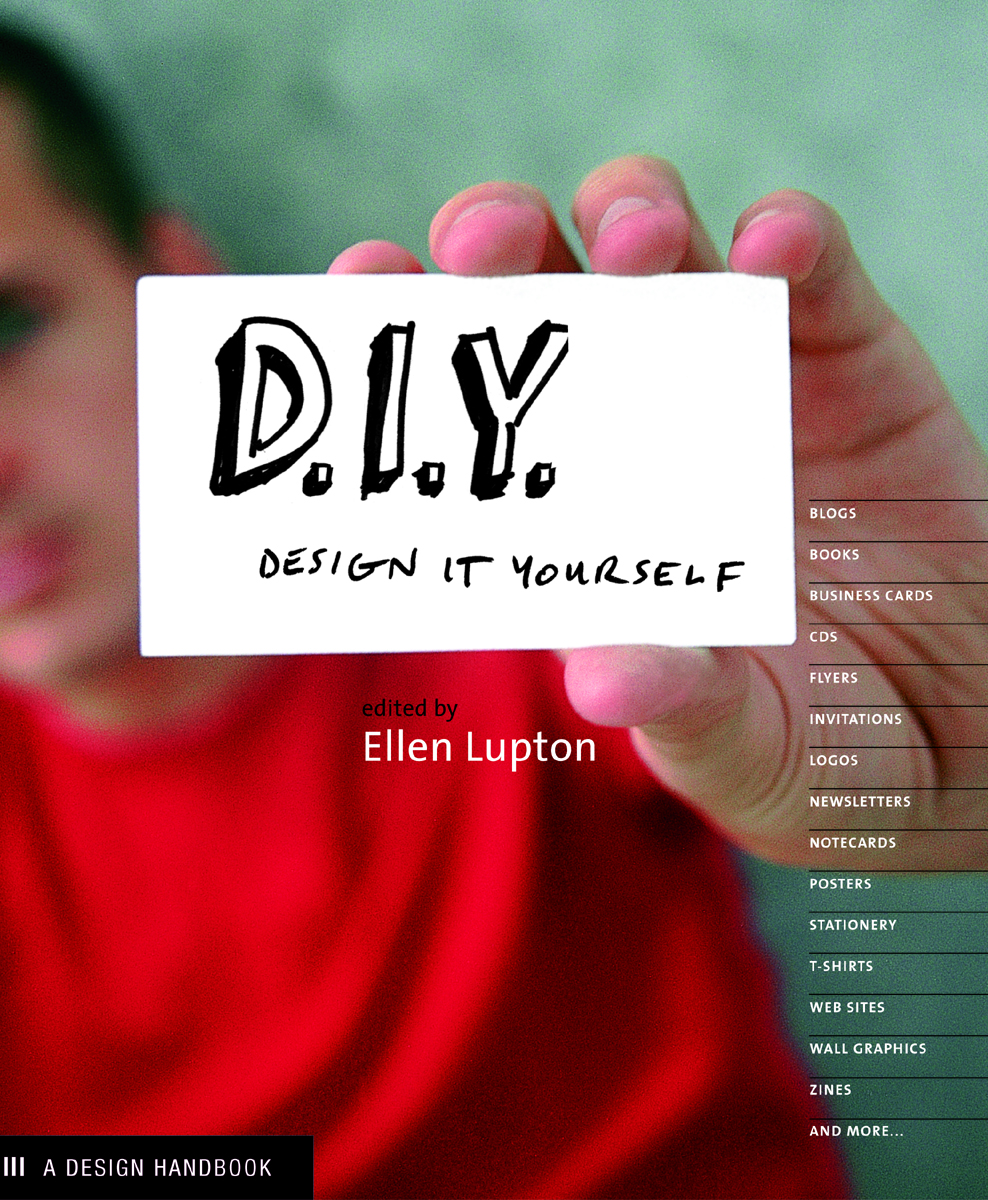
Her books include the indispensable introduction to typography Thinking with Type, DIY: Design It Yourself, D.I.Y. Kids,  co-authored with her identical twin sister Julia Lupton, and Graphic Design: The New Basics, co-authored with Jennifer Cole Phillips.

Design Your Life: The Pleasures and Perils of Everyday Things , another collaboration with her sister Julia, will be published by St. Martin’s Press later this year.

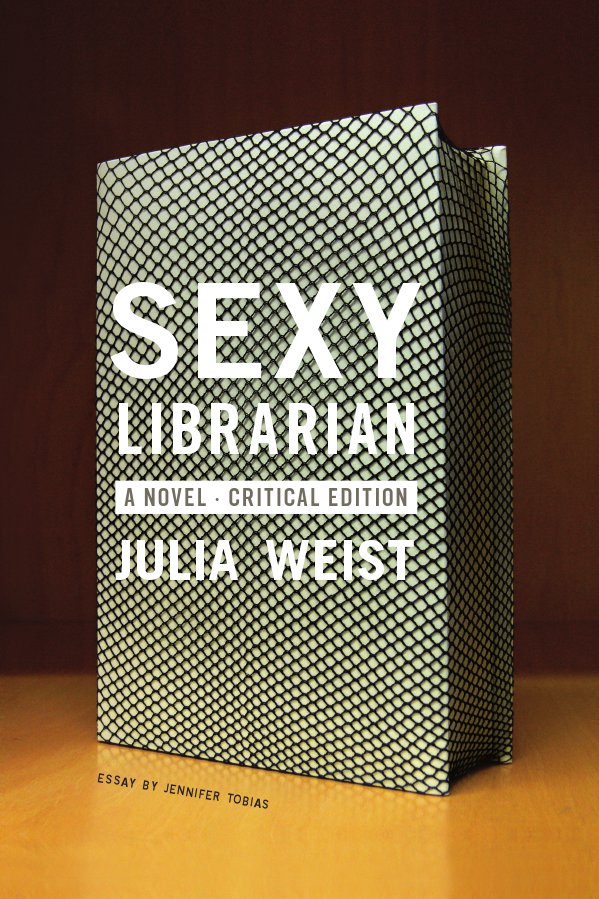
But, not content with being an  author, curator, designer, and educator, Ellen recently became a publisher, founding  Slush Editions to independently publish the novel Sexy Librarian by artist Julia Weist.

Sexy Librarian also features as a case study in Ellen’s latest book  Indie Publishing— a guide for independent authors written, researched, and designed in collaboration with graduate students at MICA — published in December 2008 by Princeton Architectural Press.

Ellen kindly replied to my questions about design and indie publishing by email.

And for the sake of full disclosure, I should make absolutely clear that several of Ellen’s books are published by New York’s Princeton Architectural Press who are distributed by Raincoast Books in Canada. But, for the record, that only explains why I have her email in my address book, not why I chose to interview her.

I have also interviewed Ellen previously for the Pages bookstore in Toronto.

How would you define ‘indie publishing’?
Indie publishing is author-driven. The traditional publishing industry is controlled by publishing professionals — editors, marketing people, promotional staff, and the publishers in charge. These are all skilled people. In our book, we use the term broadly, to encompass everything from handmade zines to print-on-demand books to offset publications distributed by the authors to small imprints created by design firms who wanted to get into the content business.

How is it different from the traditional publishing industry?
Because it’s author-initiated, indie publishing side-steps the traditional barriers of the publishing industry. It gets beyond the gatekeepers. Now, those gatekeepers act as guardians of quality to some degree, but they also contribute to a homogeneous and profit-driven publishing industry that many authors find hostile and hard to penetrate. Indie publishing often serves niche or local markets that can’t be addressed by mainstream publishing.

What are the benefits of publishing yourself?
If you have had difficulty breaking into the mainstream publishing world, going independent is liberating. If you end up producing a successful book, the profits can be substantial, but this shouldn’t be the main motive to get into publishing. Few authors make substantial bucks on their books — regardless of who publishes them. For most of us, writing and producing books is a labor of love.

What are the risks?
Most forms of indie publishing cost money, and that’s a risk. When you work with a commercial publisher, they foot the printing bill. Publishers also provide essential services like editing, proofreading, design, distribution, and marketing. The indie publisher has to take on all these tasks alone (or find friends to help out). It’s not easy, especially the distribution part. Self-published books are still viewed as less legitimate than commercially published books, although this is starting to change.

Do you see indie publishing as part of a wider D.I.Y. movement?
We are seeing more independent production in all creative fields — music, art, theater, design, etc. Younger creative people are interested in creating new institutions and networks outside the official art world or music/literature establishments. They are comfortable using technology to disseminate their ideas.

How has the internet affected the development of indie publishing?
The internet allows indie publishers to reach potential readers outside the bookstore system. Today, anyone can set up an Amazon Marketplace account or sell publications directly from their web sites. Print-on-demand publishers like Lulu and Blurb produce books when someone buys them, sending the finished book directly to the customer. These technologies are creating new possibilities for authors, especially those whose work is directed at narrower, smaller audiences.

What advice would you give someone publishing their first book?
Love your book. Get advice from lots of people in order to have the best possible content. Consider the different avenues that exist for publishing your work, including mainstream publishing as well as independent ventures.

Think about your audience and the best way to reach them. And think about your own primary goals for publishing a book. For example, an artist having a gallery exhibition might use a print-on-demand book as a tool for building his or her career via grant applications, networking with galleries and curators, securing lecturing and teaching opportunities, and more. A well-designed, carefully authored book has many functions. Selling copies to lots of people is just one of them. You might use a book as professional portfolio for landing a job or attracting clients — maybe all you need is a few copies.

What are some of the common mistakes people make designing books?
It’s important to use good software. The industry standard today is Adobe InDesign, which is available for both Mac and PC and can be easily learned via software manuals or technical workshops. Programs like Microsoft Word or Publisher are extremely cumbersome and will ultimately be frustrating to a person trying to design a refined and elegant book. Choosing a good typeface is also important. Avoid Times Roman, which was originally designed for newspapers and is so widely used as to be banal. Beautiful, high-quality typefaces such as  Garamond often come bundled with layout software and computer operating systems. Keeping your design simple and consistent from page to page is a rule of thumb for any book design. You also need to “unlearn” some habits from high school, such as leaving two spaces between sentences — this is not done in formal typesetting, and it will make your book look amateurish.

What do you look for in good book design?
Beautiful type, elegant margins, consistent pages.

Have you ever bought a book just for its cover?
Of course! Cover design is extremely important. A cover is not only a billboard advertising your book on a shelf, it’s also an online logo for your book that needs to look great at 100 pixels high. Getting help from a good graphic designer on your book cover is a worthwhile investment.

What will be the impact of e-books on publishing?
I believe that e-books are going to be very, very good for authors. By lowering the cost of publishing, e-books will make it easier for more authors to get their work published and to reach specific audiences who want their content. What I’m less sure about is how e-books will affect graphic designers!

Are we finally seeing the ‘End of Print’?
I do believe there is a sea change going on. After decades of unsuccessful attempts at creating electronic book readers, suddenly the time seems right. I don’t think print will disappear, but I think we will see less of it. It remains a tactile, permanent, stable medium that users can feel a personal attachment to.

What role do you think print-on-demand will play in the future?
Print-on-demand is where digital media and print meet. I think we will see a lot more of this as prices go down in the future. Ultimately, it is a more sustainable way to publish and involves less financial risk, but right now, it is too expensive for large-scale endeavors.

How will e-books and print co-exist?
E-books are great for disposable reading — magazines, casual fiction, newspapers. Perhaps every physical book in the future will come with an e-book supplement. I often want to quickly reference a book I read, and e-books would be great for that. Personally, I collect books, but I don’t need to keep the latest Richard Price book on my shelf forever.

As a designer, do you feel an attachment to print?
I am very attached to print. I don’t want to see it disappear in my own lifetime, that’s for sure. I love the tactility, permanence, and scale. But I do find myself reading more and more online.

Thanks very much Ellen!

4 Comments