‘A Cocoon Over There!’ is a lovely cartoon about going back to school by Argentinian cartoonist Liniers for the New York Times Book Review:

Liniers has a new kids book out this fall from Toon Books called Goodnight, Planet.

Books, Design and Culture
‘A Cocoon Over There!’ is a lovely cartoon about going back to school by Argentinian cartoonist Liniers for the New York Times Book Review:
Liniers has a new kids book out this fall from Toon Books called Goodnight, Planet.

Tom Gauld takes a look at editing process for The Guardian.
Tom’s recent comic ‘Editor’s Letter’ for the New York Times Magazine‘s ‘New York Stories‘ comic strip issue is also great:

Tom illustrated a story by Andy Newman called View Finder, and provided other incidental illustrations and lettering for the magazine, but the cover was illustrated by Bill Bragg who also, you may remember, illustrated the cover of Welcome to Lagos by Chibundu Onuzo, published by Faber earlier this year.

You can read more about the issue at Creative Review and It’s Nice That.
Comments closed
The New York Review of Books has an essay by cartoonist Chris Ware on George Herriman the creator Krazy Kat, one of the most beautiful, poetic and inventive comic strips ever created:
Krazy Kat has been described as a parable of love, a metaphor for democracy, a “surrealistic” poem, unfolding over years and years. It is all of these, but so much more: it is a portrait of America, a self-portrait of Herriman, and, I believe, the first attempt to paint the full range of human consciousness in the language of the comic strip. Like the America it portrays, Herriman’s identity has been poised for a revision for many decades now. Michael Tisserand’s new biography Krazy does just that, clearing the shifting sands and shadows of Herriman’s ancestry, the discovery in the early 1970s of a birth certificate which described Herriman as “colored” sending up a flag among comics researchers and aficionados. Tisserand confirms what for years was hiding in plain sight in the tangled brush of Coconino County, Arizona, where Krazy Kat is supposedly set: Herriman, of mixed African-American ancestry, spent his entire adult life passing as white. He had been born in the African-American neighborhood of racially mixed, culturally polyglot 1880s New Orleans, but within a decade Herriman’s parents moved George and his three siblings to the small but growing town of Los Angeles to escape the increasing bigotry and racial animosity of postbellum Louisiana. The Herrimans melted into California life, and it was there that George, with brief professional spates in New York, would remain for the rest of his life.
But imagine knowing something about yourself that’s considered so damning, so dire, so disgusting, that you must, at all cost, never tell anyone. Imagine leaving behind a life to which you cannot claim allegiance or affection. Imagine suddenly gaining advantages and opportunity while you see others like you, who have not followed in the footsteps of your deception, suffering. Herriman, once he was considered white, didn’t even have a way of voicing this identity. Until he started drawing Krazy Kat.

Krazy, the new biography of Herriman by Michael Tisserand that Chris Ware mentions, was also recently reviewed for New York Times Book Review by Nelson George:
Though Herriman’s “Krazy Kat” comic strip was admired in his lifetime, it wasn’t until years after his death in 1944 that his vast influence received widespread critical respect. Herriman’s depiction of the tangled relationships among the black cat Krazy, his white mouse tormentor and sometime love interest Ignatz and the bulldog Officer Pupp, set against a desert backdrop in fictional Coconino County (taken from a real area of Arizona), inspired several generations of cartoonists. Charles M. Schulz’s “Peanuts,” Ralph Bakshi’s “Fritz the Cat” and Art Spiegelman’s “Maus” all owe a debt to Herriman’s draftsmanship and poetic sense.
Schulz got turned on to “Krazy Kat” right after World War II, he said, and it “did much to inspire me to create a feature that went beyond the mere actions of ordinary children.” Theodor Geisel (Dr. Seuss), whose animal characters strongly resemble Herriman’s, told a biographer, “At its best, the comic strip is an art form of such terrific wumpf! that I’d much rather spend any evening of any week rereading the beautifully insane sanities of George Herriman’s Krazy Kat than to sit myself down in some opera house to hear some smiling Irish tenor murdering Pagliacci.” The iconoclastic Robert Crumb called Herriman the “Leonardo da Vinci of comics,” while the ambitious Spiegelman argued that “Krazy Kat” “crossed all kinds of boundaries, between high and low, between vulgar and genteel.” All this alone would have made Herriman worth serious study.
But then in the early 1970s, a quarter-century after his death, a birth certificate was found stating that Herriman was born “colored” to Creole parents in that 19th-century hotbed of miscegenation, New Orleans. Clearly his work had to be re-examined. Not to question its genius, but to see how much of it dealt with hiding a huge part of himself in plain sight.
If you haven’t read any Krazy Kat, seek it out. The strange language, the small, inky art, and the repetitiousness of the strips — collected together into numerous, beautifully designed, paperbacks by Fantagraphics — can seem a little intimidating at first, but it really pays off if you stick with it.


The New York Times visits Dutch designer and bookmaker Irma Boom‘s new library of experimental books:
Comments closedIrma Boom pays careful attention to word choice. The Dutch designer, one of the world’s pre-eminent bookmakers, is loath to say “client” and refers to her projects as “commissions.” She also doesn’t call herself an artist.
Never mind that Ms. Boom, 56, was once in a group exhibition at the Pompidou Center, or that many of her books are in the Museum of Modern Art’s collection. Her belief that she is not an artist could be a matter of culture — a product of her “Dutch rigor,” as the architect Rem Koolhaas, a close friend and collaborator, said.
But there are many who would at least consider Ms. Boom’s books works of art. Among them were the jurors of the Johannes Vermeer Award, the Dutch state prize for the arts, which she won in 2014. “Her books transcend the level of mere information carriers,” the jury’s report stated. “They are small or larger objects to admire, tempting us to read them with close attention.” She received 100,000 euros to put toward a “special project,” as the prize stipulates. “I cannot simply go and shop at Prada,” Ms. Boom said.
So Ms. Boom has used the prize for the quixotic, endless undertaking of creating a library of what she called “only the books that are experimental.” Above her studio here, the recently opened library is made up almost entirely of books from the 1600s and 1700s, and the 1960s and ’70s.
Those eras are when bookmaking wasn’t held back by conventions, Ms. Boom said, and when books “breathed freedom” in content and form. (Many of today’s e-books, by contrast, represent a “provisional low point” in the art of bookmaking, writes Mr. Koolhaas in the catalog “Irma Boom: The Architecture of the Book.”) Her library includes poetry collections, as well as exhibition catalogs that experimented with form — a book bound with bolts, for example, or contained within what seems like a three-ring binder.
When it comes to choosing the year’s best book covers, it seems that everyone is at it these days…


“These covers are challenging without being impenetrable and playful without being precious — none of which is an easy task for a designer. If good design might lure us into an experience that makes us smarter, then we’ve hit the jackpot when the book allows us to spend time within the head space of a stranger.”
I always look forward to Matt Dorfmann’s selections for the New York Times Book Review. Matt is the NYTBR‘s art director and a cover designer in his own right so he knows what he’s talking about, and his choices are always interesting. If I am honest, I think this is the list the designers (American designers at least) really pay attention to. And it’s worth noting that half of Matt’s choices this year were designed by women.


Slate’s list of Best Book Jackets of 2016 includes notes from the designers about each cover.


Vyki Hendy and Eric Wilder have chosen — with input from designers Erin Fitzsimmons and Stuart Bache — 25 of the year’s covers for SPINE Magazine.


Jarry Lee chose 32 “of the most beautiful book covers of 2016” for BuzzFeed.


And last but not least, Paste’s selections includes “a few novelette and short story covers.“
Comments closed
Augusten Burroughs’ strange and sad profile of photographer William Eggleston for T, the New York Times Style Magazine:
WE LEAVE THE OFFICES of the Eggleston Trust and go to his apartment. The first thing one sees upon entering is a bright red plastic sign with a yellow border, printed with capitalized white sans-serif text. It warns, “THE OCCUPANT OF THIS APARTMENT WAS RECENTLY HOSPITALIZED FOR COMPLICATIONS DUE TO ALCOHOL. HE IS ON A MEDICALLY PRESCRIBED DAILY PORTION OF ALCOHOL. IF YOU BRING ADDITIONAL ALCOHOL INTO THIS APARTMENT YOU ARE PLACING HIM IN MORTAL DANGER. YOUR ENTRY AND EXIT INTO THIS APARTMENT IS BEING RECORDED. WE WILL PROSECUTE SHOULD THIS NOTICE BE IGNORED. THE EGGLESTON FAMILY.” It is a devastating thing to see. Heartbreaking. I was also an alcoholic for decades, the kind who had shakes and saw spiders. I’m not even through the hallway and my mind is racing from “I want that sign” to “What kind of doctor prescribes alcohol for an alcoholic? Where was he when I was drinking?”
I ask if his drinking ever got in the way of his photography. “I’ve never been able to take a picture after a drink,” he says. “It just doesn’t work. Maybe — I don’t know what it is. It’s not like I’m too drunk to take a picture. I just — the whole idea of it just goes away after one or two drinks.” Eggleston perches atop the bench in front of his Bösendorfer concert grand piano. An active ashtray and a sweating tumbler of icy bourbon on a burn-marked coaster sit inside the piano directly on the frame. He reaches for the glass and takes several small, noisy sips and his body visibly relaxes. I know his relief, exactly. “I’m gonna get this drink down,” he tells me. And as soon as he does he wants another. He suggests that I pour one for myself and join him but I tell him that I don’t drink anymore, that once I start I can’t ever stop. He replies, “Well, I can stop, but I’ll admit I want another one.”
The profile is accompanied by a short film by Wolfgang Tillmans:
Comments closed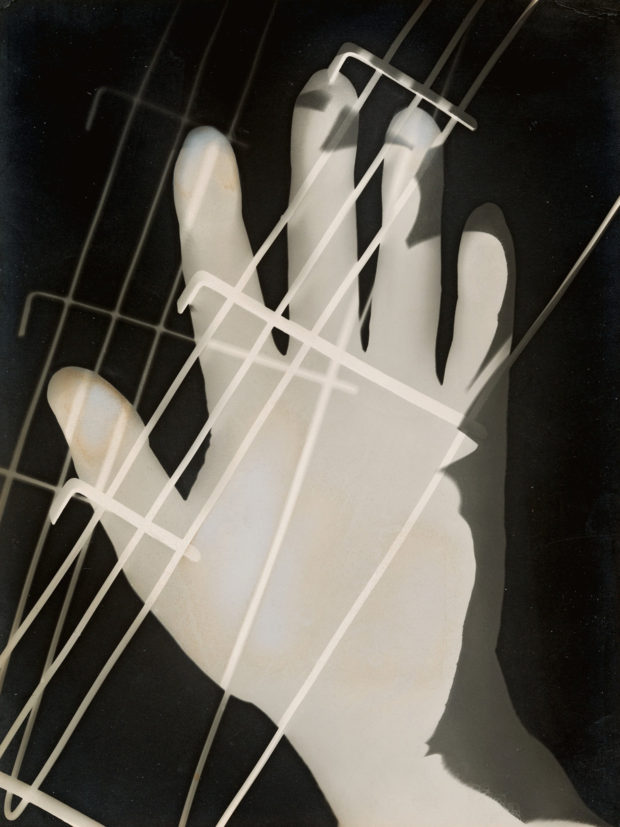
The New York Times on a new exhibition of work by Hungarian artist and designer Laszlo Moholy-Nagy at the Guggenheim in New York:
The first large Moholy-Nagy exhibition in this country in over 50 years may also be, its organizers say, the largest anywhere. It packs around 300 works into Frank Lloyd Wright’s great spiral — perhaps a record itself. They represent some dozen mediums including painting and sculpture, film and projection, works on paper as well as graphic, set and exhibition design and several forms of photography.
The show provides a bracing picture of both the extent and the unity of Moholy-Nagy’s art as it moves up the ramp, superbly styled for the occasion by Kelly Cullinan, the museum’s senior exhibition designer. Her scheme separates Moholy-Nagy’s achievement into separate strands and then braids them together fluidly. The abstract paintings and sculptures dominate the museum’s signature bays; most films are displayed in small alcoves between the ramps. Moholy-Nagy’s extensive writings and graphic design are displayed on each level in vitrines, whose bright rectangular lids manage to evoke the colorful trapezoids in his paintings. And his complex involvement with photography is played out on free-standing partitions, enabling close study of the interplay of documentary, photomontage and camera-less photograms — a term he invented — sometimes made using his own sculpture. Certain forms and motifs reappear in different mediums, and the give and take between photography and painting is one of the show’s driving forces.
It sounds like a must-see.
Moholy-Nagy: Future Present is at the Guggenheim until September 7. The exhibition is also travelling to Chicago and Los Angeles.
Comments closed
Robert Newman interviews mighty Matt Dorfman, illustrator, book cover designer and art director for The New York Times Book Review, for American Illustration:
I’m a big disciple of using abstraction to highlight emotional conditions. To that end, I love the kitchen sink perversion of psych artists like Victor Moscoso, Martin Sharp, Tadanori Yokoo and Keiichi Tanaami. As a teen I swiped a copy of I Seem To Be A Verb by R. Buckminster Fuller and Quentin Fiore from one of my dad’s shelves (and I still have it) and I credit that book with revealing to me—loudly—how vital books can be if they’re conceived with passion and energy. And I probably owe the Johns Heartfield and Baldessari some money.
At least once a month, a circumstance will arise either in work or in life in which I reflexively ask myself, without premeditation: “What would Ian MacKaye do?” This has been happening since I was 15. There’s probably something to it.


(Matt is one of the many, many people I would love to interview for the blog… )
Comments closed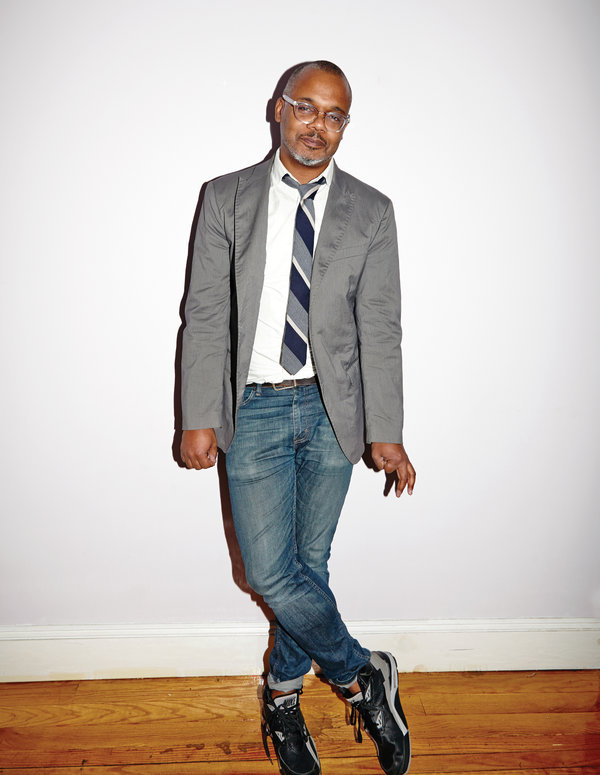
New York Times Vinson Cunningham profiles Chris Jackson, executive editor at Spiegel & Grau and editor of award-winning author Ta-Nehisi Coates:
Comments closedJackson’s role… is to perform nothing less than a kind of magic. He stands between the largely white culture-making machinery and artists writing from the margins of society, as well as between the work of those writers and the largely white critical apparatus that dictates their success, in both cases saying: This, believe it or not, is something you need to hear.
The book that perhaps best encapsulates that ethos is one of Jackson’s first, ‘‘Step Into a World: A Global Anthology of the New Black Literature,’’ published in 2000. The collection, which he and the ‘‘Real World’’ star turned hip-hop journalist Kevin Powell compiled, brought together a cohort of writers — Junot Díaz, Edwidge Danticat, Paul Beatty, Hilton Als, Claudia Rankine and others — who have today come to form a loosely generational, unabashedly multicultural alternate literary establishment. ‘‘Step Into a World’’ marked a turning point for Jackson, who had until then been publishing reference works that were the stock in trade of John Wiley & Sons, where he worked at the time.
‘‘I’ll never forget a reading we did for that book,’’ he told me. ‘‘It was at the Schomburg’’ — the Harlem library that is a repository of black literature and history — ‘‘and there were so many people there, not just publishing people, as we usually think of them, but people from the neighborhood, and they were picking up this book.’’ He paused here, after uttering the word book, and his abiding wonder at the power of the object was almost tangible. ‘‘This book, containing all these ideas that were so important to me. They were picking it up and leaving with it, and it was such a wonderful literalization of the transmission of ideas.’’