
Artist Patti Smith, author of Just Kids, in conversation with Jonathan Lethem, author of Chronic City, earlier this year:
(via MobyLives)
Comments closedBooks, Design and Culture
Artist Patti Smith, author of Just Kids, in conversation with Jonathan Lethem, author of Chronic City, earlier this year:
(via MobyLives)
Comments closed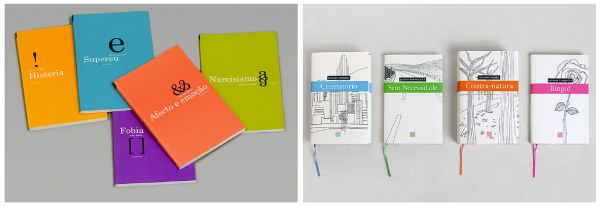 The stunningly beautiful book design work of FBA, a graphic design consultancy based in Coimbra, Portugal, seen at Cosa Visuales.
The Cosa Visuales post also introduced me to Spined, the design blog of Spanish graphic designer Álex Durana. Worth a look.
Wall of Sound — Alex Ross, music critic for The New Yorker and author of The Rest is Noise and Listen to This, talks about his workspace at From The Desks Of…
My study is stereotypically overstuffed with books and CDs. On the desk I keep well-thumbed reference works—the Chicago Manual of Style, Strunk’s Source Readings in Music History, and Paul Griffiths’s Penguin Companion to Classical Music—together with two books that my spirits when sagging: the Wallace Stevens collection Palm at the End of the Mind and William James’s The Varieties of Religious Experience. I leaf through Stevens in search of a fresh word or rhythm I can apply somewhere on the page: for me, he’s the supreme magician of the modern English language. I look to James for philosophical guidance—he shows the way out of ideological traps and abysses.
Also of interest: Designer Jarrod Taylor, shares an annotated photo of his desk in the art department of HarperCollins, New York.
But speaking of The New Yorker… James Surowiecki on what we can learn from procrastination:
The idea of the divided self, though discomfiting to some, can be liberating in practical terms, because it encourages you to stop thinking about procrastination as something you can beat by just trying harder. Instead, we should rely on what Joseph Heath and Joel Anderson, in their essay in “The Thief of Time,” call “the extended will”—external tools and techniques to help the parts of our selves that want to work. A classic illustration of the extended will at work is Ulysses’ decision to have his men bind him to the mast of his ship. Ulysses knows that when he hears the Sirens he will be too weak to resist steering the ship onto the rocks in pursuit of them, so he has his men bind him, thereby forcing him to adhere to his long-term aims. Similarly, Thomas Schelling once said that he would be willing to pay extra in advance for a hotel room without a television in it.
And finally…
Jackasses and pirate-loving Monkeys — Author and illustrator Lane Smith talks (apparently to himself) about the charming It’s a Book (via The Second Pass):
Comments closedI like arranging and rearranging books on my bookshelves. In other words, I am a nerd.
Not to say that I’m not excited by the new technologies and reading devices introduced (it seems) nearly every month, I am. But I’m sure on some level I’ll always be a traditional book guy. Then again I’m the kind of guy who still watches silent movies and listens to vinyl.
Unlike Grandpa (me), today’s kids are whip smart and tech savvy. I know eventually everything will be digital and kids won’t even know from a regular old book book and that’s fine. Truthfully? The reason I made the book? Certainly not to “throw down the gauntlet” as one critic has stated. Naw, I just thought digital vs. traditional made for a funny premise.
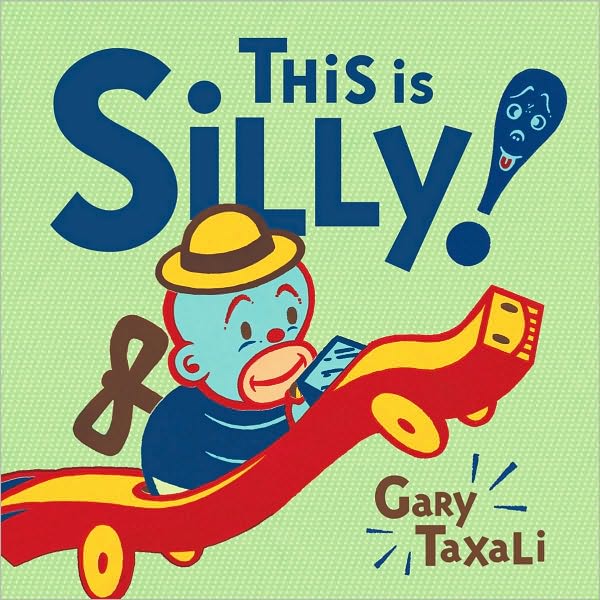 Sadly I missed the book launch earlier this week, but Toronto-based artist and illustrator Gary Taxali talked to the Torontoist and The National Post about his new kids book This is Silly!. You can see more of Taxali’s amazing book covers here.
Artifacts — Maximus Clarke has a fascinating conversation with William Gibson about his new novel Zero History :
I reach instinctively for something without knowing why, and place it in the narrative, and if it strikes a resonant chord with me, I’ll leave it there… But I myself have wondered why I do that — why I depict a universe of man-made objects, with people walking among them (laughs). My best answer is that it’s the way I perceive things. And I also suspect that the narratives of objects are more available to us when the objects themselves have become slightly decrepit. So I think my interest in old things, and worn things, isn’t about nostalgia in any conventional sense; it’s about the revelation of the narrative of how that object came to be in the world, and what it once might have meant to someone.
And on a somewhat related note, an interview with J.G. Ballard from the Winter 1984(!) issue of The Paris Review:
I would say that I quite consciously rely on my obsessions in all my work, that I deliberately set up an obsessional frame of mind. In a paradoxical way, this leaves one free of the subject of the obsession. It’s like picking up an ashtray and staring so hard at it that one becomes obsessed by its contours, angles, texture, et cetera, and forgets that it is an ashtray—a glass dish for stubbing out cigarettes.
The Black Arts — Book cover designers discuss their devious techniques for winning a clients approval with Peter Mendelsund and Peter Terzian:
Yes, a good design should speak for itself—but what if the client isn’t listening? Well, that’s when designers employ methods that are not taught in design school. Psychological methods. Machiavellian methods. Used-car-dealer methods. Manipulation. Intimidation. Seduction.
The PDF is here.
And Peter T has clearly been busy. The editor of Heavy Rotation: Twenty Writers on the Albums That Changed Their Lives has an article on books about album cover art at BookForum.
And finally (and on the subject of music)…
Finding Our Way — Radiohead bassist Colin Greenwood reflects on the digital “pay what you think it’s worth” release of their album In Rainbows in 2007 and the band’s distribution options for their new songs:
I buy hardly any CDs now and get my music from many different sources: Spotify, iTunes, blog playlists, podcasts, online streaming – reviewing this makes me realise that my appetite for music now is just as strong as when I was 13, and how dependent I am upon digital delivery. At the same time, I find a lot of the technology very frustrating and counter-intuitive. I spend a lot of time using music production software, but iTunes feels clunky. I wish it was as simple and elegant as Apple’s hardware. I understand that we have become our own broadcasters and distributors, but I miss the editorialisation of music, the curatorial influences of people like John Peel or a good record label. I liked being on a record label that had us on it, along with Blur, the Beastie Boys and the Beatles.
(via Subtraction)
Comments closedThe official video for The Wave Pictures EP Sweetheart, directed by Ben Reed and made entirely out of second hand books:
2 CommentsA student project for a class at New York’s School of Visual Arts, Jackie Lay’s neat typographic video is set to Tom Waits’ Eggs and Sausage:
In a recent interview with Jeffrey Hyatt at DesignCrave, Lay said:
“I didn’t want to be too literal with the imagery… but I did follow the loose narrative arc in the song of a man going to a late-night diner, ordering his meal off the menu and then lamenting over his unrequited love on napkins, finished off with the waitress bringing the check.”
The video was awarded a Certificate of Typographic Excellence by the Type Directors Club.
Comments closedThe Trouble With Amazon — Colin Robinson, co-publisher at OR Books (so perhaps not entirely neutral), on the internet retailer for The Nation:
The accumulated effect of Amazon’s pricing policy, its massive volume and its metric-based recommendations system is, in fact, to diminish real choice for the consumer. Though the overall number of titles published each year has risen sharply, the under-resourcing of mid-list books is producing a pattern that joins an enormously attenuated tail (a tiny number of customers buying from a huge range of titles) to a Brobdingnagian head (an increasing number of purchasers buying the same few lead titles), with less and less in between.
And, on a not unrelated note…
What’s Wrong With Music Business — A fascinating interview with Tom Silverman, founder of Tommy Boy Records, at Wired. I’m usually really skeptical about comparisons between the music industry and book publishing, but there’s lots of good stuff here for book folks:
[T]he premise of technology being the great democratizer and allowing more artists to break through than before — actually, we’ve seen the opposite effect. Fewer artists are breaking than ever before, and fewer artists who are doing it themselves are breaking through than ever before. Back in the early ’80s, when the cellphone was first invented, there were more artists breaking on their own, with no technology, than they are now, with technology. Why is that the case? And what can change to open the gates again, to allow artists to break through, whether on their own or with help?… [S]ocial networks have been a really big disappointment in terms of moving the needle in either exposure or sales in any meaningful way. There are a lot of myths in technology that everybody wants to believe, because everybody wants things to get better.
The Little Coincidence That Haunt Your Life — An interview with Alan Moore, author of From Hell, V for Vendetta, Watchmen et al, at The Quietus:
One of the academics at this conference was saying that he was working on a book which was about Watchmen as a post-9/11 text. I can see what he means to a degree. One of my friends over there… said he’d been talking to some people on Ground Zero on September 12, 2001 and he was asking them if they were alright and what it had been like. Two of them, independently of each other, said that they were just waiting for the authorities to find a giant alien sticking half way out of a wall…
…There was that atmosphere of a cataclysmic event happening in New York, which I don’t think had been depicted previously… even in science fiction terms it was perhaps unimaginable! Yes, you do find that a lot of odd, little coincidences like that haunt your life.
Double Take — Tom McCarthy, author of Remainder, Tintin and the Secret of Literature, and C, discusses Hitchcock, his preoccupation with doubles and the exact meaning of “MacGuffin”, with BBC Radio 4’s The Film Programme (via Lee Rourke).
And finally…
Blogs are dying says The Economist. Oh no they’re not, says Cory Doctorow in The Guardian.
The real question, however, is whether Publishers Weekly starting their own blog, PWxyz, is evidence for the prosecution or the defense… (Sorry, that’s a little mean-spirited. It’s great PW have started a blog even if it feels a somewhat belated)…
Have a great weekend.
2 Comments
Tom Gauld‘s cover illustration for Death at Intervals by José Saramago, who died last week, aged 87. From The New York Times obituary:
[T]he critic James Wood wrote: “José Saramago was both an avant-gardist and a traditionalist. His long blocks of unbroken prose, lacking conventional markers like paragraph breaks and quotation marks, could look forbidding and modernist; but his frequent habit of handing over the narration in his novels to a kind of ‘village chorus’ and what seem like peasant simplicities allowed Saramago great flexibility.”
On the one hand, Mr. Wood wrote, it allowed the writer to “revel in sheer storytelling,” and on the other to “undermine, ironically, the very ‘truths’ and simplicities his apparently unsophisticated narrators traded in.”
Also: Maya Jaggi on Saramago in The Guardian.
On the Record — Jamie Byng has signed a deal to create a “living archive” of Canongate Book’s records at Dundee University:
For Byng, the attraction of the project is that it will be rooted in the present as much as the past. While Canongate promises to respect the privacy of those with whom it is in contact, the overall dream is to create an archive “that will show the company as a living, organic thing. I hope it won’t just give people insights into one publishing house but publishing in general. Or even how – because I want to give access to all the financial stuff – how an independent business can grow. This business is constantly evolving, never sitting still: every day there’s a huge amount going on not just within Canongate but with all the writers we’re dealing with.”
Alphabet Soup — Author Susan Orlean‘s editorial A to Z in The New Yorker:
I could go on, about how I left Publishing House X for Publishing House Y because I was still scared of Editor F, and how at Publishing House Y I managed to get three books written there working with Editor G—who assured me that he would never leave, and this was almost true, except for a brief period when he did, in fact, leave, but then he came back—and then the head of Publisher Y got fired, and eventually I left and then Editor F left, and then I was working with Publisher Z, and then the head of Publisher Z left, and then I left Publisher Z to go back to Publisher W, because the person now running it was an old friend from the magazine world, who I knew would never leave, but you might think I was exaggerating. But I’m not.
[Mimes being on the Internet] — James Murphy of LCD Soundsystem interviewed at Pitchfork. This gives me hope (via The Awl):
I just think it takes a couple decades to kind of clear your brain now. So it makes more sense to me that I could find my footing when I was 30 instead of when I was 19. It seems a little more clear. You know, novelists are older now. Things are happening later in people’s lives. They’re kind of living lives and then creating things about the lives they’ve lived. Rather than being an artiste at an early age and coming out with a ball of fire. That energy has been co-opted because you haven’t immunized yourself yet against media. It’s easier to get swept up things then take a couple of years to get over your, like, indie rock hangover.

Drawing inspiration from the iconic Blue Note LP covers from the 1950’s and 60’s designed by American modernist designer Reid Miles, Hi-Fi is an amazing music video directed by Bante for last year’s concert season at the Bellavista Social Pub, in Sienna, Italy (how great does that sound?).
It’s beautifully done. In fact, the whole video just made me smile…
(Discovered via the excellent The Font Feed who also point to this great article The Jazzy Blue Notes of Reid Miles)
3 CommentsA true miscellany here: letterpress to Gil Scott-Heron with a lot of meat sandwiched in between… This is quite possibly why I blog…
Ditoria — An amazing video about showing the letterpress printing process by Roberto Bolado.
The Cost of Creating — Harvard Law Professor Lawrence Lessig, author of Free Culture (and others), discussing the Google Book Settlement on NPR’s On The Media last month (via INDEX//mb):
[W]e need to once again think about what the balance should be between free access to culture and metered access to culture, because both extremes are mistakes, either the extreme that says everything is free because then lots of people won’t create because they can’t cover their cost of creating, or the regime that says everything needs to be licensed, because in that world there’s a whole range of creativity… that can’t begin to happen because the cost of negotiating and clearing those rights is just so extreme.
Stopping Saying “Innovation” — Scott Berkun, author of The Myths of Innovation, in The Economist (via Frank Chimero):
Worry more about being good because you probably aren’t. If your organization struggles to make half-decent products, has the morale of a prison, and nothing ever changes much less improves, why are you obsessing about innovation? You need to learn the basics of how to make something good, that solves real problems, works reliably, is affordable, and is built by a happy, passionate well rewarded staff that believes good ideas have a chance. If you can make the changes necessary for these basic but all too rare attributes to be true, then innovation, in all its forms, will be much easier to achieve, and it might just happen all on its own.
New Type York — A (beautifully designed) photoblog by graphic designer James Patrick Gibson recording the typographic artifacts of New York City.
And thinking of New York… The NY Times is planning to spin off its Book Review as a separate e-reader product.

A Wry Return — Sean O’Hagan profiles musician Gil Scott-Heron in The Observer, revealing an somewhat unexpected connection to Jamie Byng, director of Canongate Books. I say “somewhat” unexpected because having lived in Edinburgh just before Byng wrapped up his funk and soul club Chocolate City, it seems entirely reasonable to me now I stop and think about it:
The story of how Gil Scott-Heron’s new album came to be made is a long and convoluted one. It is, among other things, a testament to the abiding power of great music outside the mainstream to spread like a virus across cultures, across decades. It begins back in 1987 in a rented house in Edinburgh when a young student is mesmerised by his friend’s collection of soul and funk music from the halcyon days of the early 70s… “I was just taken aback by the voice, the words, the poetry,” remembers Jamie Byng who, 22 years on, is the director of Canongate Books and still a fervent soul fan… “Discovering those songs was an epiphanic moment for me…” So taken was Byng by those songs that, having bought and rebranded Canongate, he tracked down his hero and, in 1996, republished his two long-out-of-print novels, The Vulture and The Nigger Factory.
And here’s Gil Scott-Heron’s painfully appropriate cover version of Robert Johnson’s Me and the Devil:
Gil Scott-Heron’s books The Vulture and The Nigger Factory were recently reissued by Canongate.
3 Comments

Kitsune Noir Poster Club — Artists Frank Chimero, Mark Weaver, Jez Burrows, Cody Hoyt and Garrett Vander Leun reinterpret their favourite books as prints for Kitsune Noir . (Frank Chimero’s Slaughterhouse Five is pictured above).
And on the subject of posters…

Penguin US have made the jacket art from Graphic Classic Editions of Moby Dick and White Noise, designed by Tony Millionaire and Michael Cho respectively, available as posters.
From Trolls to Truth — Author Ursula K Le Guin reviews Tove Jansson’s The True Deceivers (available in the US from NYRB Books) for The Guardian:
On the patronising assumption that books for children are nice, ie morally bland and stylistically infantile, critics, reviewers and prize juries often dismiss those who write them as incapable of writing seriously for adults… Anyone familiar with Jansson knows it would be unwise to dismiss her or patronise her work on any grounds. Her books for children are complex, subtle, psychologically tricky, funny and unnerving; their morality, though never compromised, is never simple. Thus her transition to adult fiction involved no great change. Her everyday Swedes are quite as strange as trolls…
 Quote/Unquote Bookends designed by Eric Janssen (via SwissMiss).
And lastly…
In my total blogging tardiness, Bookslut (inevitably) beat to the punch on this, but Simon Reynolds column on the music of the decade for The Guardian has so much resonance for books and the book industry:
“The fragmentation of rock/pop has been going on as long as I can remember, but it seemed to cross a threshold this decade. There was just so much music to be into and check out. No genres faded away, they all just carried on, pumping out product, proliferating offshoot sounds. Nor did musicians, seemingly, cease and desist as they grew older; those that didn’t die kept churning stuff out, jostling alongside younger artists thrusting forward to the light. It’s tempting to compare noughties music to a garden choked with weeds. Except it’s more like a flower bed choked with too many flowers, because so much of the output was good. The problem wasn’t just quantity, it was quantity x quality. Then there was the past too, available like never before, competing for our attention and affection. The cheapness of home studio and digital audio workstation recording, combined with the wealth of history that musicians can draw on and recombine, fuelled a mushrooming of quality music-making. But the result of all this overproduction was that “we” were spread thin across a vast terrain of sound.”
(Update: links to Tove Jansson’s The True Deceiver added)
Comments closed

Covers for The Invincible Iron Man No. 20 and 21 by Salvador Larroca and Frank D’Armata, with design by Rian Hughes (seen at the website of the author Matt Fraction). Is it just me, or do these have a whiff of Marber’s Penguin Crime series about them? Or is it more like Olly Moss?

Grey Overcoat Music — 3:AM Magazine‘s Lee Rourke talks to photographer Kevin Cummins about his new book Manchester: Looking for the Light through the Pouring Rain (published by Faber & Faber), which documents 30 years of the Manchester’s music scene.
The Guardian also has a slide show of photographs by Cummins (above: Ian Curtis, 1979).
And if you’re interested in Factory Records and the Manchester music scene you might also be interested in The Haçienda: How Not to Run a Club by New Order bassist Peter Hook (published by Simon & Schuster) also reviewed in The Guardian.
The Lost Pleasure of Browsing — Charles Rosen for the New York Review Blog:
I realize that mail order shopping has been going on for a long time, but have always thought that this destroys one of the pleasures of civilized life. I do not understand how one can buy clothes without trying them on, and as for books, the individual book should seduce and inspire you to buy it.
Spelling “Theatre” the British Way — Andy Ross talks to New Yorker page OK’er Mary Norris about copy editing “America’s most prestigious literary magazine” at The Red Room:
The main thing here is to respect the writer. The writers don’t have to do everything we want them to—we make suggestions. The ideal would be to give an editor a proof and have all your suggestions meet with approval. Sometimes you notice that your suggestions have not been taken, so if something bothers you, you try again. Sometimes you wear them down, sometimes you cave.
I have been on both sides of the process, as a writer and as a query proofreader. Being edited sometimes felt like having my bones reset on a torture rack. I don’t ever want to do that to a writer, but I probably have from time to time.
And bless The New Yorker for using double consonants before suffixes — “traveled” is barbaric.
And finally…


Illusive: Contemporary Illustration Part 3 published by Gestalten looks rather fine.