Skip to content

Tag: Miscellany

Something for the Weekend

The Betamax of Printing — A lovely post on medieval block books posted at The Catologuer’s Desk:

Block books were a sideline in the world of early printing, appearing concurrently with Gutenberg’s invention in the 1450s and 60s. Movable type and the printing press had their origins in metalworking and wine pressing. Block books, on the other hand, developed from the use of wood engravings to cheaply and quickly print fabrics, devotional items, and playing cards. Each block book was composed of individual prints that were produced by rubbing a wood engraving against paper, and they were often hand-coloured. What little text was included was usually incorporated directly into the engraving, a delicate and time-consuming process, but worthwhile because the prints could be mass produced without the capital outlay required for type.

(Is that actually a relevant, non-spurious mention of Gutenberg in a post about books and publishing? That must be a first!)

Drowning in an Ocean of Slush — Laura Miller on reading when everyone can publish for Salon:

What’s most striking… about the many, many conversations I’ve had about e-books, innovations in self-publishing and the emergence of publicity venues like social networking is how difficult it is to stayed focused on what all of this means for readers. No matter how hard you try, within five minutes the talk turns inexorably back to how agents, editors and publishers will suffer in the coming cataclysmic change — and, above all, how gloriously liberating it will be for authors… How readers feel about all this usually gets lost in the fanfare and the hand-wringing… Readers themselves rarely complain that there isn’t enough of a selection on Amazon or in their local superstore; they’re more likely to ask for help in narrowing down their choices. So for anyone who has, however briefly, played that reviled gatekeeper role, a darker question arises: What happens once the self-publishing revolution really gets going…?

You and Sonny Mehta — Another reminder from Clay Shirky, author of Here Comes Everybody and Cognitive Surplus (and who is sounding terribly pleased with himself these days), that we are all fucked:

The interesting clash to me is between you and say, Sonny Mehta… You’re both in the same industry, but from his point of view if he can just hold it together 10 more years, he’s fine. He can retire. But you know that if you stay in the book industry 30 more years, there’s no way that things will be anything like today. Sonny Mehta’s incentive is to postpone—even if it makes things worse—the moment of shock to right after he retires. But you don’t have that option. I’m interested in young writers and editors entering a system that is plainly structured around the vestiges of a world fast draining away.

Meanwhile, from the other end of the spectrum…

…Distracted — An interview with Nicholas Carr, who has followed up his essay ‘Is Google Making Us Stupid?’ with The Shallows: What the Internet is Doing to Our Brains, at Open Culture:

The Web is now about 20 years old. Up until recently, we’ve been dazzled by its riches and conveniences – for good reason. Now, though, I think we’re becoming more aware of the costs that go along with the benefits, of what we lose when we spend so much time staring into screens. I sense that people, or at least some people, are beginning to sense the limits of online life. They’re craving to be more in control of their attention and their time.

Nicholas Carr also discusses his new book with Norah Young on this week’s Spark on CBC Radio.

And finally (just in case you’re wondering)…
Here’s the latest from cartoonist James Sturm on life without the internet at Slate:

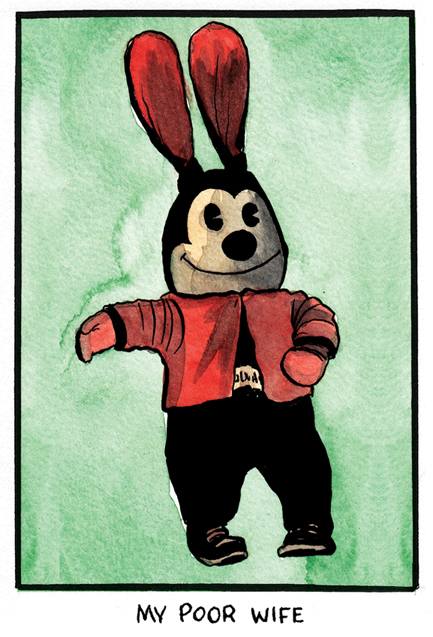
In the two months since I’ve been unplugged, I have been experiencing more and more moments of synchronicity—coincidental events that seem to be meaningfully related. Today, after finishing the first phase of a graphic-novel project that is based on the life of a fictional member of the Weather Underground, I received in the mail an unsolicited copy of a graphic novel about teaching written by William Ayers. Earlier in the week, at the exact moment I started working on a drawing of a monkey (see above), Michael Chabon started talking about Planet of the Apes… I know this type of magical thinking is easily dismissed, but I keep having moments like this. So how do I explain it? Are meaningful connections easier to recognize when the fog of the Internet is lifted? Does it have to do with the difference between searching and waiting? Searching (which is what you do a lot of online) seems like an act of individual will. When things come to you while you’re waiting it feels more like fate. Instant gratification feels unearned. That random song, perfectly attuned to your mood, seems more profound when heard on a car radio than if you had called up the same tune via YouTube.

http://www.bookdepository.co.uk/book/9780393072228/?a_aid=optimist
Comments closed

Midweek Miscellany

Tom Gauld‘s cover illustration for Death at Intervals by José Saramago, who died last week, aged 87. From The New York Times obituary:

[T]he critic James Wood wrote: “José Saramago was both an avant-gardist and a traditionalist. His long blocks of unbroken prose, lacking conventional markers like paragraph breaks and quotation marks, could look forbidding and modernist; but his frequent habit of handing over the narration in his novels to a kind of ‘village chorus’ and what seem like peasant simplicities allowed Saramago great flexibility.”

On the one hand, Mr. Wood wrote, it allowed the writer to “revel in sheer storytelling,” and on the other to “undermine, ironically, the very ‘truths’ and simplicities his apparently unsophisticated narrators traded in.”

Also: Maya Jaggi on Saramago in The Guardian.

On the Record — Jamie Byng has signed a deal to create a “living archive” of Canongate Book’s records at Dundee University:

For Byng, the attraction of the project is that it will be rooted in the present as much as the past. While Canongate promises to respect the privacy of those with whom it is in contact, the overall dream is to create an archive “that will show the company as a living, organic thing. I hope it won’t just give people insights into one publishing house but publishing in general. Or even how – because I want to give access to all the financial stuff – how an independent business can grow. This business is constantly evolving, never sitting still: every day there’s a huge amount going on not just within Canongate but with all the writers we’re dealing with.”

Alphabet Soup — Author Susan Orlean‘s editorial A to Z  in The New Yorker:

I could go on, about how I left Publishing House X for Publishing House Y because I was still scared of Editor F, and how at Publishing House Y I managed to get three books written there working with Editor G—who assured me that he would never leave, and this was almost true, except for a brief period when he did, in fact, leave, but then he came back—and then the head of Publisher Y got fired, and eventually I left and then Editor F left, and then I was working with Publisher Z, and then the head of Publisher Z left, and then I left Publisher Z to go back to Publisher W, because the person now running it was an old friend from the magazine world, who I knew would never leave, but you might think I was exaggerating. But I’m not.

[Mimes being on the Internet] — James Murphy of LCD Soundsystem interviewed at Pitchfork. This gives me hope (via The Awl):

I just think it takes a couple decades to kind of clear your brain now. So it makes more sense to me that I could find my footing when I was 30 instead of when I was 19. It seems a little more clear. You know, novelists are older now. Things are happening later in people’s lives. They’re kind of living lives and then creating things about the lives they’ve lived. Rather than being an artiste at an early age and coming out with a ball of fire. That energy has been co-opted because you haven’t immunized yourself yet against media. It’s easier to get swept up things then take a couple of years to get over your, like, indie rock hangover.
And finally (because I can)…
http://www.guardian.co.uk/books/booksblog/2010/jun/21/jose-saramago
Comments closed

Something for the Weekend

An Ethics of Interrogation — Another stunning cover design by Isaac Tobin (via This Isn’t Happiness). My Q & A with Isaac here, if you missed it.

Isaac also has at least two covers in AIGA’s 2009 selections for 50 Books/50 Covers.

Reader Despair Syndrome — An unintentionally Onion-esque post about RSS anxiety (something we can all relate to I’m sure) by Leon Neyfakh for the New York Observer (via Sarah Weinman):

Legions of jittery, media-conscious New Yorkers are eating themselves alive signing up for feeds they never end up reading  in hopes of becoming better people—more knowledgeable, more fun to talk to, more in control of their Internet consumption. They subscribe to dozens, sometimes hundreds of news sources, each of them added to the list with the best of intentions…

Hark! — Dave Howard interviews artist Kate Beaton about her comic Hark! A Vagrant for The Torontoist:

It’s very calculated, it takes me a long time to write a strip, but when you read it, part of the delivery is that timing, that kind of bouncyness of flow, getting a punch-line in without being obvious about it. Or getting the slip on someone, to make them laugh.To make somebody laugh is a difficult thing, it takes a lot of precise steps.

And speaking of comic strips…More Chris Ware posters seen at OMG Posters!

And finally…

The Superhero/Villain Name Generator

Comments closed

Midweek Miscellany

Jimmy Corrigan Japanese Edition Poster from PRESSPOP (via Flog!).

Zingers — Film critic and blogger Roger Ebert, who has lost the ability to speak unaided, on Twitter:

Twitter for me performs the function of a running conversation. For someone who cannot speak, it allows a way to unload my zingers and one-liners… This has become addictive. I tweet too often. I actually go looking for stuff to tweet. I have good friends who suggest things… I was doing this daily, but have scaled back because it was keeping me up too late.

I’ve made a change recently. After writing my blog, “The quest for frisson” and reading two recent articles about internet addiction, I have looked hard at my own behavior. For some days now I have physically left the room with the computer in it, and settled down somewhere to read. All the old joy came back, and I realized the internet was stealing the reading of books away from me. Reading is calming, absorbing, and refreshing for the mind after hectic surfing… I like the internet, but I don’t want to become its love slave.

Landscapes from a Dream — James Pardey (The Art of Penguin Science Fiction) on JG Ballard’s early novels and the Penguin cover art of David Pelham at The Ballardian:

Pelham’s covers featured a crepuscular sky above a barren expanse of water, sand or sunbaked earth as the backdrop for an artefact of twentieth-century industrial or military technology. According to the September 1974 issue of Science Fiction Monthly, these machines depict ‘the debris of our society’. Pelham, the article explained, ‘finds romance in seeing the future as if it were already the past – in visualizing ruins created from the artifacts we are manufacturing now’. But the paradox of Pelham’s artifacts is that they are not in ruins. His are pristine machines at odds with their apocalyptic settings. Half buried or submerged, they stand as tombstones to ostentation and brutality. They are icons, but only of man’s arrogance.

JG Ballard’s archive was recently acquired by the British Library. The Guardian has an fascinating slide show of the archive, including pictures of Ballard’s annotated manuscript pages.

And finally…

4CP | Four Color Process — A blog of comic panels enlarged Lichtenstein-like to reveal the CMYK halftone dots.

2 Comments

Some Football Literature for the Weekend

Somehow I managed to miss most of the hype leading up to the World Cup, but now that things are about to kick off I’m actually genuinely excited (not least by England vs. The U.S. on Saturday) and have spent the last couple of days catching up. Here are a few literary, typographical, and just plain interesting things that I’ve stumbled across…

Soccer Aid — A typographic poster for the World Cup designed by Treble Seven | 777 in aid of UNICEF.

Simon Kuper, author of Soccernomics, on CBC Radio’s The Current discussing the World Cup.

The very same Simon Kuper reviews four books about the World Cup and African football for The Financial Times:

Great claims are often made for football’s significance. In fact it’s almost always a mirror rather than a gun: it reflects society, rather than changing it. Usually the sport has just one significant effect on real life: it makes people happier. At least, it usually does.

Nation’s Only Soccer Fan Becoming InsufferableThe Onion of course:

According to sources only peripherally aware of the World Cup, Janovich’s infuriating behavior first became apparent during a Super Bowl viewing party last February when he repeatedly used the phrase “American football” to describe the action on the field. In recent weeks, Janovich has also begun referring to the supposed suspense involved in choosing the players for the U.S. “side,” and has struck up several extended but one-sided conversations concerning figures such as “Kaka” and “Ronaldinho,” generally mystifying and alienating everyone he has come into contact with.

Typographic World Cup T-Shirts. Sadly Drogba is already out for the Ivory Coast, but otherwise these are great (via Kottke).

How Did Football Get So Big? — Tim de Lisle at Intelligent Life:

If the hype is extraordinary, so is the ambient presence. The last World Cup was all around us, on billboards, drink cans and cereal packets, on garage forecourts and millions of flag-bearing cars, in the windows of Boots the chemist and McDonald’s the burger joint (“Want tickets? Win tickets! Buy any large meal to play”). The cup-winning captain from 1966, Bobby Moore, was on every KitKat wrapper, despite having died 13 years earlier; his team-mate Geoff Hurst, now Sir Geoff, was appointed director of football for McDonald’s and had columns in two newspapers. The boys of 1966 were bigger in 2006 than they were in 1966.

Footballers as Film Stars — In a related item at the Intelligent Life blog looks at the Nike’s slick World Cup commercial created by Oscar-winning director Alejandro González Iñárritu (Babel):

And finally… A few literary football lists:

And, not to be outdone, here’s a list of 10 football books worth your time (in no particular order) compiled at great haste for The Casual Optimist by my good friend and recovering sportswriter Nick Clifford who is a great source of useless facts about the beautiful game:

  1. Football Against The Enemy by Simon Kuper
  2. Brilliant Orange: The Neurotic Genius of Dutch Football by David Winner
  3. Full Time: The Secret Life of Tony Cascarino by Paul Kimmage
  4. Futebol: The Brazilian Way of Life by Alex Bellos
  5. The Hand of God: The Life of Diego Maradona by Jimmy Burns
  6. Morbo: The Story of Spanish Football by Philip Ball
  7. Calcio: A History of Italian Football by John Foot
  8. Soccer in the Sun and Shadow by Eduardo Galeano
  9. Among the Thugs by Bill Buford
  10. The Ball is Round: A Global History of Soccer by David Goldblatt

(full disclosure: this list has a couple of late additions from me, so if you disagree, it will probably be with my selections — Nick has impeccable taste).

Update: Flavorwire also has a list of 6 books to read during the World Cup.

2 Comments

Midweek Miscellany

Chris Ware’s cover for the latest issue of The New Yorker (via The Ephemerist).

Pop Will Eat Itself — Author Lev Grossman (The Magicians) on automated recommendations:

[Recommendation engines] introduce us to new things, which is good, but those new things tend to be a lot like the old things, and they tend to be drawn from the shallow pool of things other people have already liked. As a result, they create a blockbuster culture in which the same few runaway hits get recommended over and over again. It’s the backlash against the “long tail,” the idea that shopping online is all about near infinite selection and cultural diversity. It has a bad habit of eating its own tail and leaving you back where you started.

The Dark Underside of American LifeThe Observer‘s film critic Philip French on the late Jim Thompson and Michael Winterbottom‘s film adaptation of The Killer Inside Me:

Thompson was a man of the left, a lifelong alcoholic and became closely acquainted with the dark underside of American life, the lonely crowd where petty criminals, low-level cops, conmen and prostitutes rub shoulders… One of Thompson’s critics has called him without disparagement “a dime novel Dostoevsky”…

And finally… Popville, a super stylish pop-up book by Anouck Boisrobert and Louis Rigaud, published by Macmillan (thanks Sio!):

5 Comments

Something for the Weekend

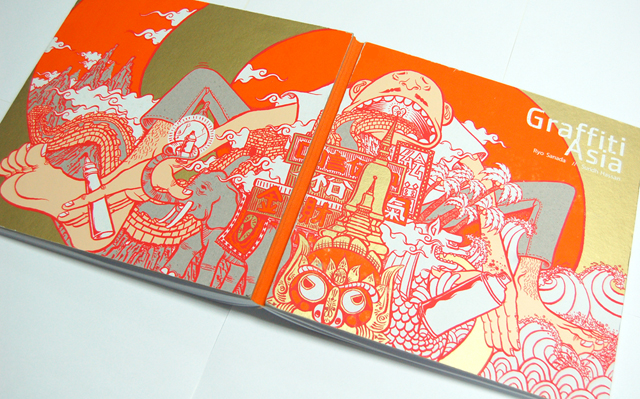
The stunning cover of Graffiti Asia by The SRK‘s Ryo Sanada and Suridh Hassan.  The image doesn’t entirely do it justice as the ‘brown’ is actually spot metallic gold (I think it’s ink, but correct me if I am wrong):

(FULL DISCLOSURE: Graffiti Asia is published by Laurence King, who are distributed in Canada by my employer Raincoast Books).

The Best Film Books chosen by 51 critics for Sight & Sound magazine. The somewhat esoteric Top 5 is here.

The Death and Life of the Book Review — Despite being a well-ploughed furrow (and the predictable nostalgia for print reviews/skepticism about the web) this essay by John Paletta in The Nation is an interesting read, not least because he recognises that the culture of newspapers has downgraded book review sections:

The book beat has been gutted primarily by cultural forces, not economic ones, and the most implacable of those forces lies within rather than outside the newsroom. It is not iPads or the Internet but the anti-intellectual ethos of newspapers themselves… In a news context, “anti-intellectual” does not necessarily mean an antipathy to ideas, though it can be that too. I use the word “anti-intellectual” to describe a suspicion of ideas not gleaned from reporting and a lack of interest in ideas that are not utterly topical.

The Host — KCRW’s Bookworm Michael Silverblatt interviewed in The Believer:

I’ve read all of the work, or in some cases as much of the work as is humanly possible. We all have time and deadlines, accidents, emergencies, but I read as much of it as I can. I’m very against interviewers who do not have time to read the work, who accept jobs knowing that they don’t have time to do the preparation. And that is almost everyone who has a daily interview program. How could you read, or see, or watch, or hear as much as you need to? So, you wing it. And it’s not going to stop. Winging it is going to be the American way.

And speaking of Bookworm, Michael talks to David Shields (Reality Hunger: A Manifesto) and Anders Monson (Vanishing Point: Not a Memoir) about the “New Prose” on this week’s show (NB: I am posting this mostly because Anders Monson references my favourite scene from the TV show Futurama in the first five minutes of the interview):

The Death and Life of the Book Review

Comments closed

Midweek Miscellany

A nice post about the US cover for The Girl With Dragon Tattoo — designed by Peter Mendelsund — and why it is so different from all international versions at the Knopf website:

[Peter] decided to shift away from the more traditional murder-mystery vibe of the foreign editions, instead providing a neon yellow in-your-face punch, a jolt of energy comparable to what Salander brings to the narrative… Knopf’s twist was achieved with the subtle interaction of the Trade Gothic type and a great piece of art in yellow and orange Day-Glo inks. Add a dash of cyan (shades of colors in the blue/green spectrum) to create the green dragon lurking in the background and a tablespoon of black for the title, flap copy, and Stieg’s photo, and voilà!

HP Sauce — Anis Shivani interviews Calvert Morgan, vice president and editorial director of Harper Perennial, for the Huffington Post:

[T]here’s an intensity of dialogue about writing online–and about fiction in particular–that was not happening ten years ago. A lot of the writers I work with are finding like-minded peers and readers, having a forum for discussion now that simply wasn’t available when the only venues you had to get published were little magazines that were distributed to a handful of shops across the country in physical form. We’re passionate proponents of the physical book and we don’t think it’s ever going to go away, but we also know that these online forums… are promoting the interest that these writers have in each other and in fiction generally in a way that can only be good for contemporary writing.

The 11th Plague — In an extract from his new book, My Experimental Life, author A.J. Jacobs gives up multitasking for a month:

Multitasking makes us feel efficient, but it actually slows down our thinking. Our brains can’t handle more than one higher cognitive function at a time. We may think we’re multitasking, but in fact we’re switchtasking, toggling between one task and another. The phone, the email, the phone, back to the email. And each time you switch, there’s a few milliseconds of start-up cost. The neurons need time to rev up.Apparently, multitasking costs the US economy $650bn a year. I’m starting to think this isn’t a problem along the lines of love handles or bad mobile phone service. This is the 11th Plague.

My first day without multitasking… My brain is not cooperating. What the hell is going on? it whines. Where’s my damned stimulation? I sit at my desk and read the newspaper. That’s all. Without checking my emails or eating breakfast at the same time.

This is awful. I feel as if my brain has entered a school zone and has to slow down to 25mph. My plan is to leave my BlackBerry off until noon. I break down at 11.30am.

See also: James Sturm quits the internet.

And finally…

Last Generation of Typewriter Repairmen — Wired visits 3 typewriter repair shops in the Bay area:

Typewriter repair may be a dying art, but it is not a dying business. All three of the shops…  seemed to generate a comfortable living for their respective owners, supported by an eclectic clientele of collectors, design enthusiasts, prison inmates and tweenage girls.

In every case, however, the technicians in charge say that there won’t be a next generation to take their places. If they are right, as time goes on fewer and fewer of the old manual machines will remain in working order. That said, crops of amateur enthusiasts have sprung up to save other obsolete technologies from disappearing entirely…

For many people, the limitations of early writing machines, with their mono-font and unforgiving keyboards, are part of their charm. That bodes well for the future of typewriters, even after the last professional repairman hangs up his apron.

3 Comments

Something for the Weekend

The charming illustrated cover for John Waters’ new memoir Role-Models by Eric Hanson, who also happens to be the author of A Book of Ages. Art direction on Role-Models by Susan Mitchell at FSG I believe.

And while we’re on the subject of nice book covers…

Isaac Tobin, senior designer at University of Chicago Press, talks to FaceOut Books about his witty cover for Adrian John’s Piracy. You can read my interview with Isaac here.

On the Dohle — PW takes a (slightly fluffy) look at Marcus Dohle’s first two years at the helm of Random House.

Allen Lane to Amazon — A nice audio slide-show history of British publishing in the 20th century at The Guardian.

And speaking of Allen Lane…

Puffin by Design: 70 Years of Imagination (1940 – 2010) seen at The Penguin Blog.

And Simon Houpt on Penguin’s 75th anniversary and their iconic brand in today’s The Globe & Mail:

Until a couple of days ago, Keir Hardie had no idea how many Penguin books he owned. For years he’d been collecting them informally, picking up a few at a time at second-hand shops. “Like a lot of fans, I grew up in a house with Penguin Books on the shelves,” he wrote in an e-mail this week, from his home in Inverness, Scotland. It was the books’ iconic design, he explained, that first grabbed his eye. “There was never much of a pattern to anything else, but the uniformity of the Penguins made them stand out.”

Indeed.

Comments closed

Midweek Miscellany

Caustic Soda — James Morrison AKA Caustic Cover Critic talks about five great covers (and a few terrible ones) at Flavorwire. The great ones include Charlotte Strick‘s design for 2666 by Roberto Bolaño. Charlotte talked about this cover and boxed set with FaceOut Books a while back.

The Case of Abundance — The formidable Clay Shirky interviewed at Publishing Perspectives:

We are already in a world where most books are incomprehensible to most people –- whether that be content comprehension or the question “why would anyone publish that?” — but we don’t notice that anymore.

What has happened with the web is that there is so much content that we have broken all the old filters. And for now, we are experiencing it as the completely overburdened and chaotic environment that it is. But that doesn’t mean people should stop publishing online. It just means that we need better filters. Because in fact, the over-publishing of content has been a normal problem since the invention of the printing press. It’s just that we had ways of ignoring things we didn’t care about. The problem isn’t getting people to shut up, the problem is creating filters to help people find their way to things they want.

And finally…

I’m probably the last person on the interwebs to discover Erik Heywood’s blog on books, bookshelves, bookstores, and libraries (etc.), but it really is quite lovely (via The Silver Lining).

Comments closed

Midweek Miscellany

90 Covers — David McCandless talks about the protracted cover design process for his new book Information is Beautiful (via This Isn’t Happiness):

Engage — Online literary magazine and short fiction hub Joyland — founded by authors Brian Joseph Davis and Emily Schultz — is launching an e-book imprint.

Graphic Novels for Booksellers — A core list compiled by Graphic Novel Reporter.

And if that’s not nerdcore enough for you, take a look at The Periodic Table Of Super-Powers.  “Orphan” is atomic number 1.

Absurdity and Tragedy — Author Jonathan Lethem on Philip K. Dick and his own novel Chronic City at 21C Magazine (via Maud Newton):

I’ve always agreed with the view that – with science fiction – its predictive powers were the least important or least relevant aspect of its public profile. I always loved stuff like Orwell’s 1984, where he explicitly said “It’s 1948, reversed.” I liked writers that were doing allegorical, satirical, fantastical versions of everyday life.

That suggests that Dick’s work is dated to the ’60s and ’70s. And I thought of him very much in this framework, and not as an extrapolative writer… But I think that Dick saw the makings of the contemporary reality we experience so profoundly.

As I’ve mentioned previously, I wanted to like Chronic City more than I did. Dan Green has a comprehensive critique of the book (and Lethem’s post-modernism) at his blog The Reading Experience. Dan is, perhaps, less forgiving than I would be, but definitely smarter…

[W]hile Lethem’s work is consistent with much postmodern fiction in that it is essentially comic, the comedy of a novel like Chronic City is indeed much too gentle, too shy of the more corrosive humor of much postmodern comedy. It isn’t so much that the novel is short on “satiric bite” as that ultimately it is merely satire, a relatively mild critique of post-9/11 New York under Bloomberg, which has become inhospitable to its misfits and nonconformists.

Lethem reads from Chronic City and discusses the book in this video interview with The Guardian.

2 Comments

Something for the Weekend

David Drummond’s Parker Series for University of Chicago Press.

“a little bit Warhol, a little bit Factory Records” —  Christian Schwartz explains why he started type foundry Commercial Type at I Love Typography:

It’s much easier to be an “armchair quarterback,” second-guessing everyone else’s seemingly questionable decisions regarding everything… than it is to deal with the actual reality of budgets, technology, and timelines. Theorizing about how and why things work is all well and good, but putting our ideas into practice is of course the real test…

Typography and JudaicaSteven Heller interviews book designer and typographer Scott-Martin Kosofsky. Fascinating stuff:

It’s the best of times and the worst of times, but I have a feeling that people have always said that… In regard to print, I think we’re at a great moment, with access to mature technology and aesthetics… There’s no excuse for anything looking less than great. But books (and print in general) have lost their pride of place. Book publishers, a group nearly always behind the curve, have failed to grasp that their online counterparts spend a lot of time and money concentrating on User Experience, while they remain unfamiliar with the concept. It wasn’t always that way, but when the professionalism and discipline that was demanded by metal type fell away, things got worse and worse, especially typographically.

Punk — An interview with Jaime Hernandez about Love and Rockets and the recently published The Art of Jaime Hernandez at NYC Graphic:

“That’s how Love and Rockets started: we were just cocky and didn’t know we could fail. We went ahead and published the first one ourselves and didn’t care what the outcome would be, we just wanted to be printed. Hopefully we could sell it and make money, but there was no one to tell us not to. That was the punk part of it. The more we got good response, the more we kept doing it.”

And finally…

The Pollak Coffee Table Book seen at UnderConsideration’s FPO. Breathtakingly beautiful.

Comments closed